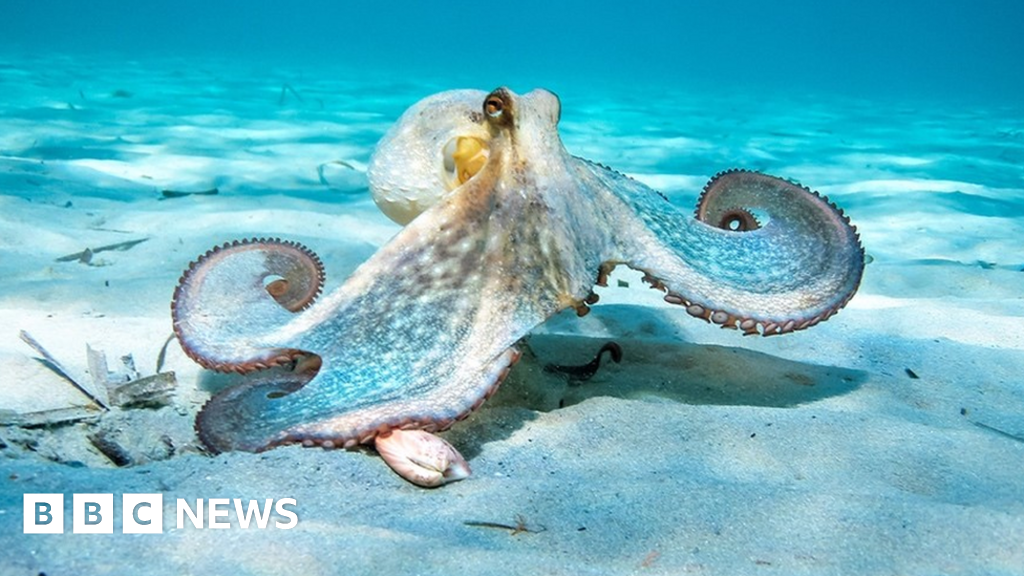
Octopuses feel pain and need legal protection, say MPs
A report by a group of MPs says invertebrates are intelligent and should be added to welfare bill.
bbc.com
152 points · by vanilla-almond · 5y ago · 213 comments
This is all disgraceful, and if we can't at least respect the animals we eat, we probably don't deserve to eat them.
Animals in the wild don't give a s** about the pain they cause to other species when they eat themselves alive, and eating a prey alive is the normal standard in nature.
This being said, I'm all for minimizing suffering of anything involved in the food chain as much as possible. I consider that avoiding wasting food is just as important as reducing the pain we cause to animals.
It seems you forget that not only humans are capable of feelings and empathy.
Why would the monkey do such thing?
Well, you see, the monkey was saving the fish from drowning. What an empathetic creature!
There is a tendency, in animal welfare discussions, to ratchet. As the conversation tips forward and back, meanings are interpreted a little more strictly each time.
Backyard chickens is a respectful way to have eggs and meat. Battery raising is disrespectful. Wasting meat is also disrespectful.
This I can completely agree with. Wasting food is completely disrespectful in so many ways and is mostly avoidable.
Yet, just last year we saw supply chain breakdowns that caused farmers to dump so many potatoes and so much milk among everything else while people were in queues for free food.
Towards chicken? Maybe. But chicken isn't the only variable in the equation. I agree it'd be much less wasteful to grow meat in bioreactor without even wasting energy on growing feathers, organs and whatnot. But we're not there yet, and we might have a hard time feeding people without chicken factories.
Animals will catch what they eat, and catch no more than necessary. Humans will over-fish and dump shit all over the place killing marine life and filling oceans with oil.
I could go on and on. But you know, we’re all fucked from this behavior. In the name of money we will all perish at the hands of our fellow cheek-turners.
I don't think that's true. Have seen many a cat catch mice to "play" with until they're dead and not eat even a nibble.
Bears love salmon brains. In boom years, bears will pull salmon after salmon out of the water, bite the head, and discard the rest. They're basically nature's dynamite fishers. Stray dogs will eat anything they can -- and they can and do kill themselves by overeating.
Nope:
> Surplus killing, also known as excessive killing, henhouse syndrome,[1][2] or overkill,[3] is a common behavior exhibited by predators, in which they kill more prey than they can immediately eat and then they either cache or abandon the remainder. The term was invented by Dutch biologist Hans Kruuk after studying spotted hyenas in Africa[4] and red foxes in England.[5][6] Some of the other animals which have been observed engaging in surplus killing include orcas, zooplankton, humans, damselfly naiads, predaceous mites, martens, weasels, honey badgers, jaguar, leopards, lions, spiders, brown bears,[7] american black bears, polar bears, coyotes, lynxes, minks, raccoons and dogs.[citation needed]
That says a lot about how much you have observed animals so far. Predators have an instinct to kill more than they have a will to eat.
Are you kidding? How do you suppose one can feel pain without a nervous system? Magic?
Er... why not? They seem fairly reasonable to me.
https://www.theessayexperiencefall2013.qwriting.qc.cuny.edu/...
We can say that insects don't have the brain capacity to be conscious. I'm pretty sure we might say the same about many fish species.
I guess it also applies at some level to animals and insects - we can assume they feel some of the basic things as us, but their "understanding" of it might be quite different.
In times or places where this abundance is not as shockingly unnatural, the feeling of the food we consume takes less importance. And, as others said, it's not just animal. Killing a plant, often in way more atrocious manners, is just as bad.
We'll probably have to murder and massacre our food for a bit longer. Live with it and work on synthetic food, this will resolve the problem you have with life-sourced food. Well except we'll probably still have to kill millions of animal and plants for population control. Heh.
You know we also kill, without asking their opinion or respecting them much, other more exotic life-forms, like virii or bacterias, that are as innocent as the rabbit you had in your last civet. All they did was follow their instincts, and they didn't have a choice contaminating you; but you had a choice killing them.
Is that just guesswork?
The truth is humans are wired to gauge the level of environmental danger by looking for personably relatable aggression events. And there is a practical limit how low we should go. Also with living more dense, humans are gotten way better at handling various aggressive stimuli, like noise, air pollution, constant close interaction. We have stopped treating them as aggression, but it still is for the rest of life on this rock.
The difference is like us touching a hot stove and pulling away as an automatic response, versus the various forms of torture we've invented.
That doesn't mean it's right, just that there is a difference and we'll all draw a line somewhere. A bit like how people see eating cats and dogs as somehow different from chickens and cows.
We could also really use a framework for recognizing and categorizing consciousness in other lifeforms. And translate that into a law that automatically applies tiered protection to all other lifeforms. We probably need to figure out consciousness in ourselves first, though.
We really don't need the amounts of meat (if at all), averagely consumed in the US, EU or many other places nowadays. Not by far.
And if you insist: there are plant based products today, that are often tastier and offer better nutrients than large swaths of the meat products they replace.
There certainly is no lab-grown alternative for a tasty slab of expensive beef (I presume, I haven't looked for it), but there certainly is a tastier and healthier plant-based alternative for that €2,99 bucket of fried chicken things. Or for 6 of the 10 cheap burgers at your supermarket.
Point: we really don't have to wait for lab grown meat. Not if you are a meat lover, nor if you are a habitual meat eater.
Define need.
I don't live to be a drone guided by some moral principles of other human who has the same rights as I do.
If I want meat - I will eat it regardless of whether I need it or not.
> And if you insist: there are plant based products today, that are often tastier and offer better nutrients than large swaths of the meat products they replace.
I hear the same mantra for last 10 years.
> There certainly is no lab-grown alternative for a tasty slab of expensive beef (I presume, I haven't looked for it), but there certainly is a tastier and healthier plant-based alternative for that €2,99 bucket of fried chicken things. Or for 6 of the 10 cheap burgers at your supermarket.
You forgot psychological factor. While the bucket of fried chicken is rarely as pretty before cooking as they display it, but in the end it is 100% meat. If we're talking about some plant surrogate, most people would probably puke at the thought of eating this. I certainly wouldn't enjoy it.
Plant-based meat substitutes are ridiculous. Americans, North and South, eat way too much meat (Europeans eat much less). To cut down on the extravagant amounts of meat consumed in the Americas is a great idea, but why do those need to be replaced with meat substitutes? Teach people to cook good food with plants, otherwise you're just keeping them dependent on the food industry that just wants to sell them cheap overprocessed shit that makes them sick and sad.
Why not attack that from all angles? Convince people to eat less meat and more vegetables…sure. But you will still have holdouts saying that they prefer the taste of meat. Hence plant based meat alternatives and lab grown meat.
There can be multiple solutions to a given problem.
Step off the concrete sometime… the solutions to the worlds problems and injustices are often far more complex and nuanced than what is proposed by the modern left.
If language evolution followed strict deterministic rules, then it probably would be "octopodes", but that's not the case - language changes and grows in all sorts of different ways and words become valid despite their "pedigree".
As your link says, "sources differ on which plurals are acceptable"; there's no single correct option and basically all of the suggested ones are in reasonably-common usage.
Elimination of pain and suffering as a primary value, changes everything. A superintelligent overlord given that objective would simply eliminate all life on earth. If preservation of life was a value, it would sterilize everything and put all existing life in a coma. If the objective was happiness, it would drug us during the coma.
But it would not be so dumb as to choose those things. I don’t know what it would choose exactly, but, I think it would have something to do with the purpose of life itself in this universe, which can be seen as a fundamental force to fight entropy at the mesoscale between electromagnetism and gravity.
Some, mostly modernist, occasionally platonist philosophers try to do this... but thats a philosophical exercise.
The way societies actually work is that we have values, because people have values. We rationalise, abstract, deconstruct, cross reference, expand, contract, torture, abandon, repurpose, revise and revisit those values in a never ending process. That is, in fact, what society is.
What you are describing is asimov computer code.
It's clear that humans over-consume and as an "intelligent species" who can make decisions based on morality and ethics, we still collectively seem unable to logically reason this overconsumption will eventually effect us all.
Why should individuals that live for themselves and don't share the same values as you do suffer because of your decisions?
This is an argument against eating octopuses. Why should they suffer because of your decisions?
We could live in a more ethical and sustainable way, we just choose not to
There's a line between exploiting others and caring for yourself. I consider myself example of second. I couldn't care less about rest of people.
> We could live in a more ethical and sustainable way, we just choose not to
I could live without shower and toilet paper, I could live without washing machine or meat. Doesn't mean that I want to.
If you want to live in more ethical and sustainable way — all the power to you. But don't force your moral onto me.
E: morale -> moral
I mean, I'm probably just as capable as you of making "decisions based on morality and ethics" as you are, but I don't think it's immoral to eat meat. So clearly there are different interpretations of "morality" (duh). But your comment seems to assume that no, there's just one morality: eating meat is immoral. Why?
Eating meat is not wrong, overconsumption is wrong, wasting resources is wrong. The question of morality is, is it right to over consume the planet to the point we extinguish other species, or even our own? Are we comfortable that future generations look back on us as selfish and greedy for what we did, or didn't do?
I am not vegetarian, pardon the pun but that's maybe what your beef is about
Again, I''m confused by the very, very strange replies.
So now I'm very confused. Why did you decide never to eat calamari again? What does your decision have to do with a film about an octopus? What does any of that have to do with over-consumption?
You made your comment very confusing so I was confused. Thanks for clarifying, but it's still very confusing so don't go accusing me of having any "beef" with anyone. Just make sure your comments are easier to understand.
The really big issue staring us in the face though is that our treatment of animals is accelerating the pace of pandemics.
Every tightly confined animal farm in the world is another lab doing serial passage gain of function experiments with zero BSL protections by the lab workers.
Why is "artificial meat production" the norm in "the distant future"? Couldn't humans just as well re-organise their societies in small agrarian groups that produce their food without torturing animals?
We are very close to having synthetic intelligences. That doesn’t mean we should care about shutting them off or damaging them, as long as they cannot suffer.
But for synthetic intelligences, I think we need to be extra careful because the suffering can be there without any means to notify humans, if those means were never programmed in. If an AI has self awareness and self preservation goals comparable to humans, but no comparable e.g. English language subroutines, being shut off at random times would probably cause it to suffer psychological distress in silence.
This is all to say that for the sake of both AI and animals, we need to learn how to directly detect brain activity corresponding to pain, in different types of brains.
The vegetarian farming isn't more ethical either. Its usually mono-cropping at large scale. see also: corn.
Well, you don't have to welcome it. That's the current world. Ask the lady who cleans your office toilets how often she eats organic, or even just fruit, other than tomatoes.
That's a bit of a strawman there. Improving food tech does not need to be a zero sum game. Can it not be that food quality will in general improve? Much like how access to clean water (at least in the Western world) has improved a lot compared to past centuries.
Right. Most animals feel pain...
> When you think of an octopus or lobster, what comes to mind? Seafood or intelligent marine life?
Many animals we eat in industrial quantities are intelligent life...
Honestly, WTF is wrong with this article. The level of argument is as if they've just found out to their shock that meat doesn't grow on trees.
Eating one crab is considered better than one octopus. What about 100 crabs vs 1 octopus? Where do we draw the line? Or if we consider something not smart enough based on our arbitrary criteria, it's open season to eat as much as we can of it.
We're mixing here categories that completely don't go together. Whether we hunt and eat an animal shouldn't be based on its intelligence. But rather on considerations of sustainability and ecosystem disruption.
This entire article seems extremely far off from making a coherent argument whatsoever that our actions should be based on.
Not at the same level as an octopus.
If this "discovery" is how they try to convince people to support the cause then they're out of touch with reality.
Is it wrong to boil lobsters alive? https://www.theguardian.com/world/2018/feb/11/is-it-wrong-to...
Some key points from The Guardian article:
- Boiling alive lobsters is illegal in New Zealand and Switzerland
- Robert Elwood, a professor at Queen's University Belfast, is a leading researcher in this field. He believes lobsters should be killed before boiling.
- Accepted wisdom about crustacean behaviour to painful stimuli is that it is a reflex, not a reaction to pain.
- No experiment can answer questions about pain in crustaceans definitively, but Elwood's research makes him see "as much evidence for pain in crustaceans as there is in many vertebrates".
- The argument against crustacean pain is that their brain structure is so different to ours. We know where pain occurs in the human brain, but those equivalent brain regions do not exist in crustaceans.
- Robert Steneck, professor of marine sciences at the University of Maine, has been studying lobsters since 1983: "I'm not convinced they feel pain...The problem has more to do with how we anthropomorphise various critters"
- Maisie Tomlinson, a campaigner for a charity called Crustacean Compassion, says "It’s estimated that an edible crab that is boiled alive may take up to three minutes to lose consciousness. That’s something that would be unconscionable in a vertebrate animal, where they talk about milliseconds to lose consciousness [in a slaughterhouse]"
- Is there a best way to kill a lobster? For a restaurant, professor Robert Elwood says "I would have [a device] that gave them electrical stunning, which completely destroys the central nervous system in a microsecond".
Cooks have told me to either run a knife through their brain or throw them in a freezer for half an hour to shut them down.
Incidentally, I used to do the latter as a kid when catching bugs outside to feed a green anole I caught and was taking care of for a Boy Scout merit badge...
I have heard this too (e.g. https://www.sciencefocus.com/nature/why-are-lobsters-cooked-...). I assume using a 'stun machine' will deliver a electric jolt to the lobster and it would be boiled immediately after.
>> plants add caffeine to their nectar to enhance their pollinators memory and cognition >> plants synthesize almost all known neurotransmitters
[0]: https://www.semanticscholar.org/paper/Balu%C5%A1ka-Commentar...
It's of course not an excuse to be needlessly cruel. But it is a valid reason to re-consider how nature works. Leaving animals alone does not mean they get to die in their sleep surrounded by their loving families and mourned by their loved ones like we all hope for. Worse, a lot of the animals we kill in order to eat them exist solely because we eat them. Ceasing to eat them adds up to genocide.
We have entire sub species of all sorts of animals that would not exist or continue to exist if it weren't for the fact that we breed them in order to eat them. Cows, pigs, and chickens are good examples of animals that have no place in nature and would likely die out quickly because of the very same properties that caused us to breed them in that direction.
Many billions of animals would not exist if it weren't for the fact that we plan to eat them. Equating veganism to genocide is clearly a bit of a stretch. But just ask yourself if it is better for the animal and its species to not have existed at all or is eating meat under some circumstances perhaps not that unethical? It's what the rest of nature does after all.
[1] https://bills.parliament.uk/bills/2867 [2] https://www.bbc.co.uk/news/uk-politics-57072922
This sentence itself is political and presents a cynical worldview.
Anything can be use as a political tool.
However, no psychologist would doubt than compassion is a fundamental trait of a healthy human mind.