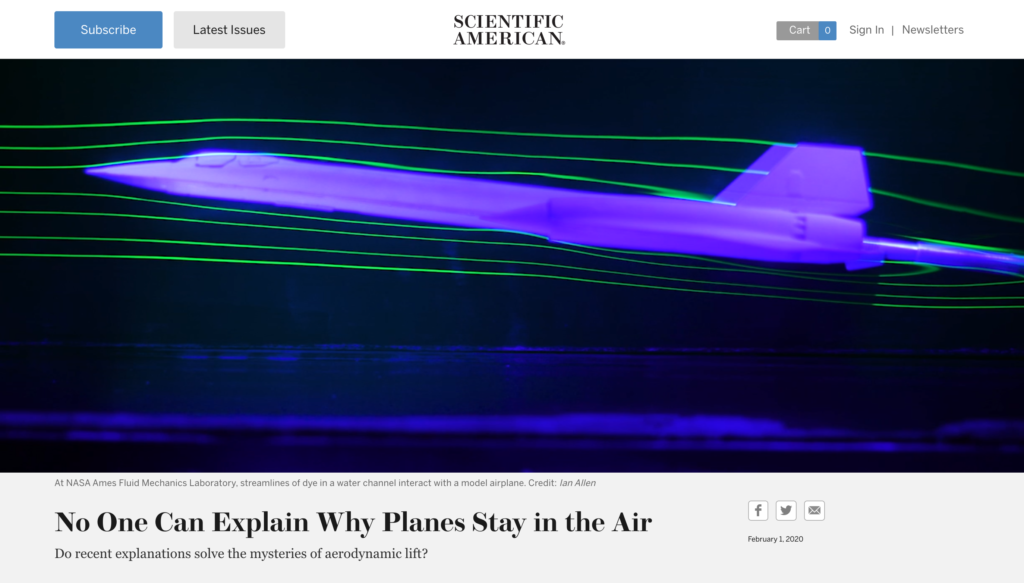
Here's why we don't understand heavier-than-air flight
If you've been reading popular science websites or magazines lately, then you may have heard the news: we don't understand how airplanes work. For example:…
Ribbonfarm
133 points · by sillybilly · 5y ago · 172 comments
Although the common explanations are often BS.
I learned it multiple times. In middle school, in high school, in university, on youtube explained by a quantum physicist.
Everytime I understood less of it.
There are some old controversies that are largely settled. The Microsoft Flight Simulator manual in 1980 "teached the controversy" but it was really settled decades before that. People still remember the controversy from back then and keep repeating it and probably will still do it when people are living in space colonies.
The Bernoulli effect explanation is bogus.
An alternate (correct) explanation is that if you just took a piece of cardboard, held it sideways, and moved it laterally it would push the air down and thus the cardboard would be pushed up.
If you like vector fields you can show that there is a topological defect (vortex ring) that is threaded through the wings and comes around to the other side. If you do an integral around the ring you can show the vortex holds the plane up.
It seems nobody really knows:
"No One Can Explain Why Planes Stay in the Air"
https://www.scientificamerican.com/article/no-one-can-explai...
Edit: Added brief from article above:
------------------------------------------------------------
- On a strictly mathematical level, engineers know how to design planes that will stay aloft. But equations don't explain why aerodynamic lift occurs.
- There are two competing theories that illuminate the forces and factors of lift. Both are incomplete explanations.
- Aerodynamicists have recently tried to close the gaps in understanding. Still, no consensus exists.
------------------------------------------------------------
It's not because there's a magic force that requires air particles parted be the leading edge to rejoin thier partner at the trailing edge.
The air particles on the upper surface reach the trailing edge much sooner than the ones under the wing.
If you try to move a flat object through water, it creates pressure at the front and suction at the back. If you tilt it diagonally (and move it right to left), you get pressure in the bottom right and suction in the top right.
It's much simpler than that anyway. The wing forces the air downward, so the plane must be forced up.
Though I think it's more valid to think of the wing as imparting a downward momentum on the air flowing over it. Meaning it's really a reaction engine.
As engineers we had been taught that lift was due to air above the wing traveling faster than air below the wing and thus creating lift by way of a pressure differential. The more accurate answer as seen in the article is that the effect is better explained through Newton’s laws as a re-vectoring of horizontal thrust in a downward direction. Literally the engine pushes horizontally accelerated air downward and the action-reaction mechanic causes an equal but opposite upward force lifting the plane.
Amazing how so many experts could be so wrong in their understanding while the planes continue to fly.
It reminds me of how hummingbirds don’t know that they violate the known laws of physics when they fly.
The Bernoulli effect explains that lift is due to the design of the wing such that the path above the wing is longer than the path below the wing.
This coupled with the fact that due to the Bernoulli effect an air particle just above the wing would reach the back of the wing at the same time as an air particle just below, and that since the upper particle would therefore have to travel faster than the lower particle the pressure differential would cause lift.
The problem is the theory doesn’t hold up under testing because it isn’t true.
That said with my historic experience with single piston RCs if you didn’t compensate for the upside down flight with your ailerons you would nose dive.
EDIT: trying to think what you might mean by "effectively changing the shape". Do you just mean that an upside-down aerofoil is a reflection of the aerofoil the right way up? Because that's the entire point of the argument you seem to be trying to rebut.
And those upside down events do not happen at 10 feet above ground. There is plenty of fluid (air) above and below the aircraft and power (fighters jet engines are the most powerful ones on aircrafts) to be able to correct any up-downward force with flaps (basically walls to air)
Except that there obviously is. Unless you ignore gravity.
The problem with this theory is that there is no physical reason why both streamlines must arrive at the back of the wing at the same time - and per experimental verification, in fact they don’t.
That's not how the Bernoulli effect explains the pressure differential. The bernoulli explanation is that air builds up in front of the airfoil, creating a high pressure region, while there is a low pressure region created in the wake of the wing. This pressure differential forces accelerates air over the wing. For an asymmetric airfoil, more of this flow is over the top than the bottom, so the airflow over the top is faster, and thus lower pressure, than the airflow under the wing.
The "equal time" thing is a pop-science misunderstanding.
You mean the wing, not the engine.
But even then that doesn't answer the question. It's just another way of looking at the effect, but it doesn't explain the cause. The question is then why/how does the wing pushes that air downward?
Yes, clarifying I meant the wing not the engine.
> The question is then why/how does the wing pushes that air downward?
Fair point. I honestly didn’t expect this quality of analysis on the topic.
I believe that another phenomenon is required to complete the explanation in addition to Newton. Couette flow explains why streamlines closest to the wing tend to follow the shape of the wing. Hence the vectoring effect. I’m sure a better article exists but Wikipedia is a bit lacking unfortunately.
[1]Couette Flow - https://en.m.wikipedia.org/wiki/Couette_flow
Whenever people argue about which interpretation of lift is correct I think back to this (https://xkcd.com/895/) comic about teaching how gravity works in general relativity. Only in the case of lift the explanations are actually _correct_, albeit somewhat circular. ("So the air above the wing sticks to the surface, which redirect it downwards. But _why_ does the air stick to the wing?!")
Also in no way do hummingbirds violate any known laws of physics, although they do have a pretty impressive way of harnessing them.[2]
[1] https://www.grc.nasa.gov/www/k-12/airplane/bernnew.html
[2] https://phys.org/news/2005-06-hummingbird-flight-evolutionar...
So saying that air on top of the wing moves faster, creating a pressure differential and thus lift, is absolutely correct. The problem begins when some people try to come up with an intuitive explanation for _why_ the air would need to speed up. "Because this is the lowest energy state that conserves energy, momentum, and mass" isn't a very satisfying answer; neither is "because this system of PDEs say so"; so they came up with the "equal transit time" explanation, which is simple, intuitive, and completely wrong.
Hopefully aeronautical engineers at P&W didn't actually believe that last bit?
That statement, that the upper airstream flows faster because it has to meet up with the lower airstream, is wrong and easy to disprove experimentally.
So, putting aside that specific statement, re-read the post you're replying to.
The airstream above the aerofoil does travel faster, and there is a lower pressure region there (commensurate with the effect described by Bernoulli), and it turns out that this is a valid way to model the forces involved just as it is valid to model them as a redirection of the airstream.
Speaking of sailing, the angle and shape of the sails are both important to maintaining velocity. Racing boats adjust (trim) the shape of the sails all the time.
Merely deflecting the wind obeys conservation of momentum, but conservation of energy in an unpowered sailboat (overcoming losses due to friction) also means extracting energy from the airflow.
You can also see the same thing with a helicopter flying over water: the water is affected in a circular region fairly close to the rotor itself, indicating that there is a large downward force being exerted on the air and a corresponding upward force being exerted on the rotor.
So an 45degree angled blade absolutely will give you lift but a tapered aerofoil will do the same with less energy spent pushing the air in unwanted directions (specifically fewer swirling vortexes immediately behind the wing causing drag).
So yes push air down to stay up. Don't push air sideways or in circles. The aerofoil shape and the equations that simplify the 'don't push air the wrong way' into a simple term of drag are all about doing this.
If you're in the sky and you want to stay there, you have to counteract gravity. Heavier-than-air flight does this by pushing down on air. Want to stay in the sky? Push down on enough air, fast enough, and you will stay in the sky.
Since air is a fluid, pushing down on air is equivalent to pushing air down. The lift a plane or helicopter generates is directly proportional to the amount of air it pushes down (and to a varying degree how much engine exhaust it pushes down). That is, we need something to divert air downwards and something to push us through that air. The better we can redirect air downwards, and push ourselves through the air, the easier it is to fly.
We have found many shapes that are very good at passively redirecting air when pushed through the air, we have developed engines that are good at pushing us through the air, and we have developed structures that are able to hold everything together while being light. That is why heavier-than-air flight is possible, and it's very well understood.
If anything, our understanding of why certain shapes redirect air so well is lacking, but even then not really. Experiments and modelling are really good at finding the conditions under which air stops being redirected efficiently. If we try to parameterise this airflow, and reduce it to simple equations, well maybe then the effect is not well explained. Statements like "the air moves faster on the top than on the bottom, so there is a pressure differential and hence a lifting force" may be true even if misleading, and statements like "the air moves faster on top because it is longer than the bottom side" are definitely misleading and incorrect, but just because these statements exist and some people believe them does not mean we don't understand heavier-than-air flight! Such flight is possible because we are able to push down on air with enough force to keep us flying, and so much of how that works is well understood.
[edit]
To try and say something directed more at the point the article seems to be making: confusion or misunderstanding about the technical details, or modelling, of something is very different to not understanding how that thing works.
We understand heavier-than-air flight in the exact same way we understand sailing - redirect airflow to generate a force for your own purpose - but you don't see articles about how we don't understand how sailing works.
The point about "not understanding" flight is that, if we truly understood it, we could design the optimal aircraft from first principles before it ever entered a wind tunnel. Instead, we work based on incrementally improving tribal knowledge of what has worked in the past and try to make something similar to fit our desired flight envelope.
Compared to something like rocket science where the entire craft can be built on a computer and we'll know exactly how much cargo we can get to the moon without even turning a single screw, we don't understand flight.
This is getting less and less true with each generation of supercomputers though.
EDIT: There is perhaps a better way of explaining it for this crowd though. To use numerical modeling to predict performance is to take a physical problem and turn it into a computational problem. And while engineers understand physical systems pretty damn well, us computer scientists have largely failed at the objective of making software systems with hard reliability guarantees. You can write a fluid dynamics simulation to test your new wing design, but how do you know that the simulation does what you think it does? Even if the code has been tested before, how do you know you're not now hitting some sort of edge case?
At the end of the day, you have to build the damn thing to test it. Numerical simulation are used more and more these days as the codes are refined, computers get more powerful, and engineers have more trust in their capabilities. But traditionally, and still a lot of the time, they build prototypes and test in wind tunnels because reality never fails to model physics accurately.
Similarly devilishly complicated is the injector design. Obviously you want to mix the oxidizer and fuel in the optimal ratio for the highest efficiency. That’s the easy part. But then you also want to offset from this optimum near the edges to produce a colder flow near the nozzle wall to protect it from melting. Of course nowadays people do a lot of computer simulations to save on testing time, but it is still not uncommon to discover combustion instabilities or hot-spots in the engine tests.
So no, nobody can, let alone did, design a rocket entirely in a computer and then send it to the moon without many many tests, and incrementally improved tribal knowledge.
I also can’t think of a technology sector where the naive/new/low level/clueless don’t also assume this is not true.
Even manufacturing. ASICs. Software. Everything.
Rocket engineering uses an immense amount of both modelling and physical testing. No-one says "Well I've got the Tsiolkovsky rocket equation, so let's go to the moon!"
I'm not even sure what the bar of 'understanding' is here - the fact that we have iterated and improved on powered flight as much as we have necessarily means that we understand it on a deep level, let alone the fact that we can create excellent models that predict what will happen to a wing in different situations.
At what point would you say we do understand flight?
So I would say, nobody really understands software, but many people have experience and total experience is growing. Via new languages, algorithms, patterns, etc.
The rapid experience advancement suggests there is a lot unknown and not understood.
I’ve worked with thousands who don’t and maybe two dozen who do.
Planes obviously don't require that to fly. So, they're different type of beast. They somehow squeeze more from less, exploiting some nonlinearity in forces that air exhibit on wings. I can understand that too, but the nature of that phenomenon is not explained anywhere (other than in words: this is the formula. It is correct, trust us)
If a plane isn't producing more lift than weight it will fall, just like a helicopter. Planes work by pushing a wing through the air, helicopters by spinning it. In both cases the wing has to push down enough air to keep the aircraft in flight.
I am even more confused now.
For helicopters in a static hover, the downward "thrust" is actually the lift produced by the spinning blades. The engines produce almost no forward thrust. Whereas, for an aircraft in flight, the engine thrust pushes the plane forward and the wings generate the lift that keeps it in the air.
That title doesn't get quite as many clicks unfortunately.
The fact that the second "we" doesn't really know aerodynamics, and is going to waste man-days chasing its own half-understandings round in circles in the comments, doesn't contradict that fact that the first "we" does understand aerodynamics. Planes aren't staying in the sky by accident, nor even just by the survivorship of trial-and-error engineering.
But the explanation I can come up with is: lift is a force due to low-pressure regions caused by laminar flow over a surface. It is essentially "form drag" (caused not by the profile facing air directly but by the aft part) but the tricky part is that it is not directly parallel to the flow of air, but also depends on the orientation of the wing.
That's the observation. Clearly my rigid arm/hand was accelerating some air downward. Like a gun accelerating a bullet, there's a recoil (but a continuous one). That's Newton: conserving momentum. Maybe not a complete explanation, but it's the bulk of one.
Here's how NASA puts it:
1) wings increase the surface area pushing down (gravity) on the air below, which pushes back (air pressure), and
2) as wings are falling toward ground (gravity), they create vortices above the wing, which lowers the pressure, increasing the push up effect of the air below, and
at a certain speed, the vortices are stabilized into low pressure regions above the wings, and in a certain "envelope" region, of speed, plane shape, air pressure, all of these forces are equalized to give you level flight, so long as the dial you turn to get into the envelope region, "speed", keeps up.
That's how I understand it. Happy to hear a physicist / aerospace engineer guide me in how to think about this clearly.
https://www.wolframalpha.com/input/?i=NACA+6409+airfoil&assu...
- The real answer is so hard to compute that there is a million dollar prize attached to it.
- Today, we design planes using approximations and trial-and-error. It works well because we are very experienced in designing planes, sometimes at the cost of many lives, but it is not exactly a "first principles" approach.
I think what people usually mean when they say that we don't understand flight is that there are no simple equations. A lot of physical problems have elegant solutions (eg. the shape of a hanging chain is roughly the cosh function). But there are no elegant equations that describe the profile of a wing, so it's a bit unsatisfying.
You can have lift with laminar flow. In fact, the article includes an explanation of the usage of the Reynolds number to characterize laminar and turbulent flow and how the flow around plane wings is clearly laminar (called "smooth" in the article).
I do think you’re dead wrong!
That's not true for rockets. Rockets can fly in air, and a rocket's fins only work in air, but rockets don't have to use fins and rockets work fine in the vacuum of space. Because air is mostly irrelevant to rockets -- and rockets [in space at least] fly by principles that have nothing to do with aerodynamics -- rockets are not typically included in discussions of how "heavier-than-air flight" works.
Star Wars ships come out of space backwards and I don’t get it...
It sounds like a great eli5, and it gets repeated in serious educational contexts again and again but it’s just absolutely completely wrong.