Lumber Price FAQ
Why wood has gotten so dang expensive
constructionphysics.substack.com
281 points · by Whitespace · 5y ago · 143 comments
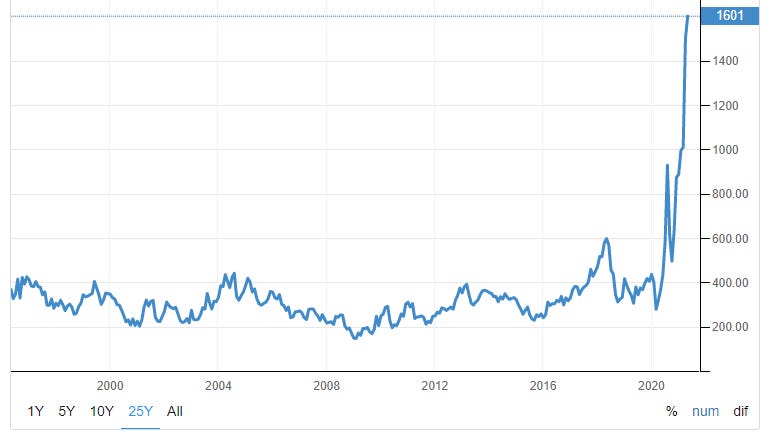
This chart of lumber futures gives an idea of the recent past (zoom out 1-5 years for perspective):
<https://www.tradingview.com/chart/?symbol=CME%3ALBS1!>
In a nutshell: a huge advance and now what appears to be a crash (~ -50%) is currently in progress.
The bigger picture is how indicative this compressed boom-bust story is of the future of the surge in US inflation. Lumber is showing us how easy it is for the market to reject ridiculous prices. What's unclear is how low lumber, and other goods/commoditiies that have seen similar booms, can go.
Edit: this links seems to work better
If the latter... what do the future markets currently say about expectations of when prices will be back down to what they were or lower?
Ie... when should I plan on building my deck?
There's "we bought a sawmill!" ads here in the rural lands now for fresh sawn green pine and oak; which isn't "lumber" yet in any useful sense. I've seen porches being built that won't last the summer.
https://markets.businessinsider.com/commodities/lumber-price
Down 8% two days ago. Down over 50% from the peak. No doubt prices will remain above trend for a while, but 4X is just another case of speculative nonsense over-amplifying the realities.
All that is to say I don't see compelling evidence here that speculation is the cause of the problem. I can as easily see more benign explanations.
I think you may get your wish. It's old info, but there are big players who don't see this as sustainable.
I'm not terribly interested in lumber but if you want a good price, with that chart it seems like now may be a great time to buy given the current low. It may also be the last time at that price level for a while. (No promises, just what I'd speculate based on the chart)
Edit: To clarify, this comment is mostly registering my surprise. I see no cabal speculation activity, just a big invite for your neighbor to buy some for their active retirement fund at these levels. Think about that as another variable.
> There's "we bought a sawmill!" ads here in the rural lands now for fresh sawn green pine and oak; which isn't "lumber" yet in any useful sense. I've seen porches being built that won't last the summer.
The allegedly "kiln dried lumber" home depot has been selling has been criminally wet throughout the last year too. Not only have people been paying through the nose for the stuff, it's been nowhere near ready to use. I had to let boards I bought for building gambrel rafters sit for a month on my covered deck before attempting to cut them to the pattern. And even after that, a bunch of them shrunk another 1/4" from the pattern in the subsequent month of waiting for me to install. Infuriating to pay so much for stuff that isn't even top quality and ready to go. I also had to throw a few away from splitting and twisting during the drying process...
TBH, the lumber yard I worked at you to flood. We would have bundled stacks of lumber float all across the yard. We can pretty much take them the next day and ship them to a construction site. KD-HT lumber is pretty good like that.
Now, most of our large customers just have a reasonable expectation of the product. It's wood. It's gonna warp. It's gonna split. It's like most things like fresh fruits, or meat, or leather. There is a lot of variability.
That is not a recent thing. Home Depot wood has been dripping wet for many years. It's routine to put a screw into it and have water running past the head as you tighten it. I typically buy 50-100% more than I expect to use on the assumption that a good chunk of it will warp as it dries and become useless.
I'm not sure if I should feel better or worse about the situation knowing home depot has been doing this long before the pandemic.
HD sells pressure treated wood that's then kiln dried (KDAT), if you would like to open up a large line of credit with them.
Now that I think of it, it kinda makes sense: it's not the timber that's gotten more expensive, but the service of milling it. For products from relatively more expensive hardwood timber, milling costs constitute smaller fraction of the final cost, so even if milling costs triple, the final product might only go by 50%.
Eh it’s always been that way. Warped and with plenty of knots too. It was considered poor quality back when a 2x4 cost $2.50.
I don't know how to calculate if more sawmills are needed (permanent backlog) or if it's a temporary backlog. I figure that speculation is for the commodity traders and maybe some stock / sawmill speculators.
In practice, guess and check may scale better? But I've also been to towns where the sawmill shut down and destroyed the local economy, so guess and check may be immoral (even if it's somewhat profitable)
If the inflation-dudes are right, then at least part of the price increase is permanent. That's why the calculations are necessary: because many people are making many different arguments about the future of this current economy.
The one who can predict the future will make money of course.
Build something, and the whole structure can bend and curl.
That said, it seems like the huge spike in building materials did a very good thing by making many people postpone renovations until prices come down, which should help smooth out the peak-to-trough chart of building construction.
I'm curious why this is. Is it the drying stage, or something else?
https://en.m.wikipedia.org/wiki/Green_woodworking
Its a shame more of that craft isn't going around. Granted, I'm not sure how a greenwood porch would work.
Wood for construction needs to reach an equilibrium moisture point with the outdoor air after its cut.
If its dried outside, it takes months to years to dry, depending on the humidity level and temperature.
The wood is dried because it makes it lighter, and the shrinkage and swelling has already played out during the drying process... instead of when its in place!
https://www.google.com/amp/s/www.businessinsider.com/lumber-...
Germany currently has a surplus of wood, yet the prices aren't low. Sawmills are the main benefactors of the current situation, they're processing wood like never before, also because last year a lot of trees were affected by beetles, fungi, storms and the like. So this lower quality wood (which is perfectly fine to use) has been mainly exported. 40% of the processed wood is exported.
Sawmills are buying the trees for cheap due to the surplus that the forest owners (around 96% of the owners own less than 20 ha) are saying that they're now considering to stop selling wood and wait for the fall or next year if they can handle it.
Then again, if they stop selling the wood, the state- or community-owned forest owners (around half of the German forests are privately owned, the other half by the state or communities) might not be able to to pay for the machinery and workers which usually work the entire year around. Also private owners have got together and share machinery and personell which needs to get payed during the entire year. So to some degree they are forced to continue cutting down trees to sell them.
[1] https://www.deutschlandfunk.de/probleme-der-baubranche-warum...
Wow, I'm surprised there weren't back-up generators if power failure means machine destruction.
I also wonder if those backups didn’t anticipate having to run the machines as well as keeping ambient temperature up.
https://m.dw.com/en/demand-for-lumber-soars-in-germany-and-s...
That being said, as the article mentions, most lumber in North America is from Canada, not the US.
[1] https://www.margulesgroome.com/publications/russias-proposed...
- PIR insulation
- Membranes (DPM, Roof membranes, Vapor check)
- External Cladding (red cedar, siberian larch)
- Concrete
I've had all range of excuses; Covid19, Brexit, Suez Canal and Americans are stealing lumber from Europe.
There are some lumber mills in the Highlands of Scotland that are shipping CLS and other framing timber straight to USA.
I'm picturing Carmen Sandiego putting a freighter full of lumber in her pocket...
I used to pay about $3 for an 8 foot 2x4 at the local big-box / lumber store. I looked this week -- $9 for the same lumber!
I'm going to wait for this to blow over before I build anything, I think.
I'm surprised it's not cost effective to have backup generators to power critical equipment long enough for a graceful shutdown if an ungraceful shutdown can keep a plant offline for a month or longer.
What about the spaces people used to occupy before covid moved them home? Does it drive demand for demolition?
What’s clear is that many of us with two people who will work from home a lot the coming years have at least one room too few and are building extensions. My builder bought a $25k load of materials and left it on my lawn before summer for an extension they’ll build in August, because their supplier advertised that prices would increase 50% in July.
If we're permanently in a more work-from-home world then yes, we'll eventually see demand for remodelling and demolition of downtown offices, though only once the economy and population have picked up enough that there's demand to use the space for something - blighted buildings from the last recession sitting idle for years is a thing that happens. The suburban business parks I can imagine just decaying forever, like low-end out-of-town malls were doing pre-pandemic - there's no other use for them and the land just isn't valuable enough.
If it is a required/needed good, that causes people to raise the amount they are willing to spend to get what they need. Inflationary spirals happen when this ‘infects’ enough markets. Everyone is spending all their money chasing an ever harder to get/more expensive set of essentials, and are willing to spend more and more as time goes on as they get more desperate.
Lumber is probably negotiable/non-essential enough it’s not likely to kick off an inflationary spiral. Food, rent, transportation, though tend to be key.
IMHO inflation is real and it's going to bite us hard
https://www.invasivespeciesinfo.gov/terrestrial/plants/princ...
It doesn't appear to be fundamentally weaker for many applications. If it's yields are 3-4x times what "SPF" is, then maybe use slightly larger boards in support roles?
I'm not associated with worldtree.eco, and obviously they are advertising a product, but I can't really find any more discussion on the pro/cons of empress tree wood production.
The invasiveness problem I heard was specific to a particular species of empress, there are empress species that don't spread so aggressively.
This habit if speaking as if one is the center of the universe is a bit tiring