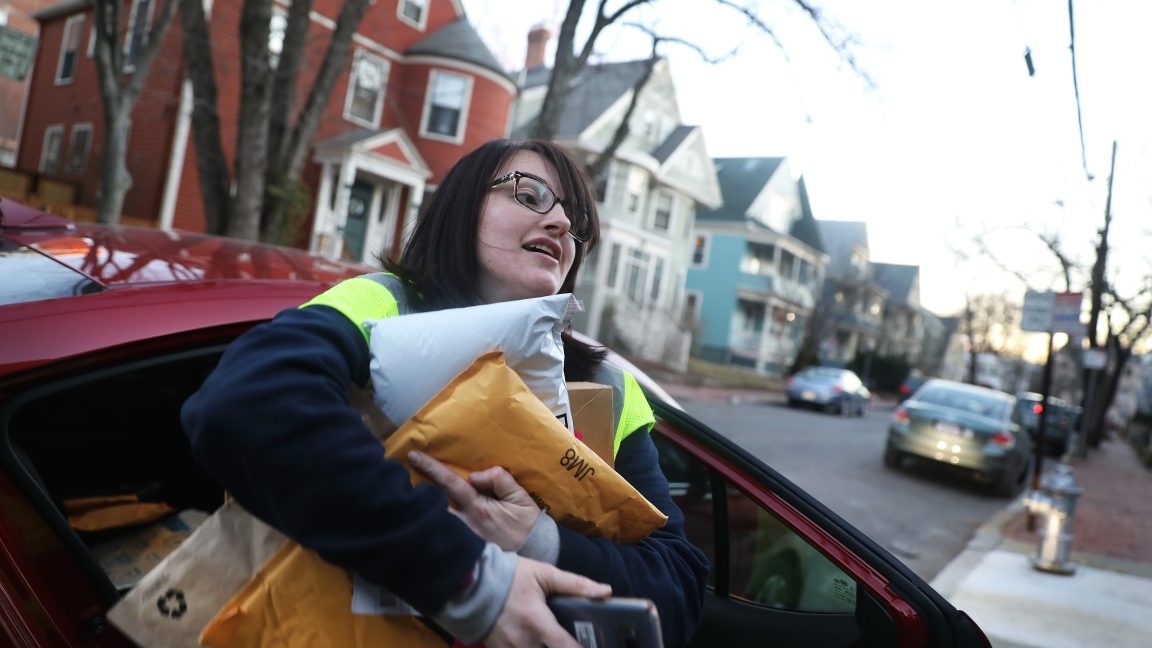
Amazon is using algorithms with little human intervention to fire Flex workers
Retailer lets bots manage many HR decisions for its Flex delivery program.
Ars Technica
222 points · by carride · 5y ago · 232 comments
Almost everyone has been groomed to defend these corporate behemots' rights to stomp on our lives like if they were defending the right of a small mom and pop shop to kick out a rowdy drunkard.
When a company has a bigger revenue than most contries' gdp they shouldn't play by the same rules, they need to be held to a different set of standards.
This is the part where it stops making sense to me. I don't see why it's morally more just for a mom and pop shop to abuse workers than it is for a big corporation. If it's wrong to treat workers poorly, it should be wrong for everyone to treat workers poorly. This logic implies that the amount you're "allowed" to abuse your workers is on a sliding scale with income. Big corporations should be nice to workers, small businesses are allowed to not be nice to workers, so are businesses in poor countries allowed to be outright awful to their workers? It sounds like the start of a justification for slavery in third world countries.
You can make the argument that Amazon can afford it, and mom and pop shops can't, but I don't find that a convincing argument. It bears the same issues as above. If we establish a sliding scale, we can't simply ignore the implications at the extremes.
Personally, I think we just need to raise the bar across the board. It's bad when Amazon does it, and it's bad when small businesses do it. Small businesses shouldn't get a break on labor violations.
You are of course right, and we don't want abuse at either scale. I think GP is also relying on mom and pop shops not having enough economic power to abuse workers at that level.
A local business usually can't afford burning through workers like cigarettes, it would go out of business at the 3rd contractor (and hopefully these 3 people can take legal action without a barrage of lawyers sucking their life savings).
Amazon can afford to burn through thousands without seeing any clear impact on its bottomline. That's where rules should be stricter IMO.
When I see people slaving away on a bicycle in any kind of weather, delivering groceries or boxes of food, I feel pity. I know they earn very little, have very few benefits, and literally zero chance of moving up. It's a dead end job. It's modern poverty. It's the tiny house equivalent of a job.
I've personally met those refugees, I've personally heard their slavers boasting about it. I'd estimate their proportion in Paris around 30% of all Deliveroo drivers. In smaller cities it's not as common.
These slavers will open accounts in the name of their whole family, and they keep 75% of what those poor guys will make.
technology is more ruthless in its application
If workers didn't think these jobs were better options than whatever existed before, they'd still be working jobs other than these.
People opted in to this.
Those laws and the regulators may be strongly influenced by deep-pocketed employers such as Amazon.
But what happens when there is no one to ask for forgiveness from?
"The UK GDPR gives people the right not to be subject to solely automated decisions, including profiling, which have a legal or similarly significant effect on them." I guess that would probably be buried in an employment contract at Amazon, but it might form the basis for a court case if it wasn't actually spelt out.
Just because a human has designed the algorithm doesn't make it non-automated: "A process might still be considered solely automated if a human inputs the data to be processed, and then the decision-making is carried out by an automated system. A process won’t be considered solely automated if someone weighs up and interprets the result of an automated decision before applying it to the individual."
Lawyers have a tendency to create employment for other lawyer-type professions it seems.
I don't think human vs automation is the question here. This would not look better if a human boss would evaluate you, and just say in one morning that you're fired, so don't come in. Like in the Back to the Future movie.
This is called fraud. It isn't legal.
Automation applies policy evenly. An employee can be sure that the firing wasn't due to a boss having a bad day, not liking the employee personally, not noticing worse performance of colleagues, etc.
The real problem comes when automated assessment is poorly designed. And it's a shame not only because of the heartless actions that impact real people's lives and the needless public relations damage that is bound to emerge. It's also a shame because of the lost opportunity to help workers' performance improve via feedback at a level of detail that the automated systems could provide.
Damn the secrecy. Develop an open rating system that provides continuous feedback to the worker. Build in dampers that provide ample time to learn, correct mistakes, and improve. Publish every factor, every consideration, every weight that goes into the assessment. Openly. Refine over and over until both management and the workforce see it as fair and helpful.
I would take that system over the subjective, unevenly applied, unclear criteria that's historically been used to assess performance. No surprises to the workers, and management has to own the criteria rather than hide behind unpublished automation. Objectivity should be a virtue. Without transparency, it's going to prove to be quite the vice.
What could maybe work is an automated system for the "easy 90%", paired with an appeals system well-staffed by human beings. But that isn't Amazon's plan (or Google's, etc), because that 10% will cost much more than the first 90%, so it's easier for them to just write it off as a loss. And at their scale, that margin of error translates to thousands of potentially-ruined lives.
In the US federal criminal justice system during the 1970s and early 80s judges had a ton of discretion over sentencing. Some were “hanging judges” that gave really harsh sentences. Some never gave any harsh sentences. Some gave harsh sentences to black people but not to white people, and so on.
The legal profession and Congress looked at this situation and decided it wasn’t fair. The difference between probation and ten years in prison shouldn’t be whether or not the judge had indigestion. The federal sentencing guidelines were put in place—-a very detailed system that considered the crime, mitigating and aggregating circumstances, the background of the convict, and several other relevant factors. Judges were supposed to use this system to impose uniform, fair sentences.
Judges hated the sentencing guidelines and kept on trying to depart from them “in the interest of justice”. For a while the Supreme Court said no—-it forced them to follow the system. But in the mid aughts a new majority reversed these precedents. The sentencing guidelines were declared to be advisory.
It took a while for the guidelines era habits to fade but now we are back to a situation where which judge you get is a significant factor in how harsh a sentence you get.
In theory the magic answer is guided discretion. That allows for mostly uniform treatment and a safety valve for unusual situations. But how do you enforce that on a nuts and bolts level? Everyone thinks his particular case is special. Thoughtful empathetic judges are likely to be persuaded that they are.
I don’t know what the answer is but I do know there isn’t an easy one.
I'm saying no policy could ever be defined well enough to cover all possible contingencies of a messy, human world. The conceit that it could is one of the biggest driving factors of our nascent tech-dystopia.
An open policy would of course be better than a closed policy, if only because it would lay bare all of its flaws, but even then it could never be completely fixed.
That approach hasn't worked, and complicating rules and procedures to cover all edge cases will fall short too. That's why judges are still humans. The list of edge cases, the number of factors that can go into a decision, is correlated to the number of things possible in reality. It's basically unbounded.
If I've misunderstood and you are arguing instead for a clear and minimal set of rules to flag and trigger a human review, that sounds sensible to me. In my experience though when companies find an exception they update the policy, and before you know it it becomes a tangled mess.
However, I'll just add that, having tried to design such systems in the past (for large-scale Mechanical Turk work), it is fiendishly complex. Not only is it incredibly difficult to turn our intuitions of "what's fair" into formulas, but then you've got to deal with people trying to game those rules for their own advantage once they figure them out, which ultimately means you can only ever be partially transparent at best.
In fact, I'd go so far as to say it's impossible for all pretty much practical purposes that need to be cost-effective, sadly. It's a really tough problem.
Setting up any KPI will reward those that optimize for them. Other workers need to emulate that behavior, which makes their work insufferable. You won't see medium to long term advantage from this.
Define what you need to produce and check if you meet targets. Don't surveil people, it is a waste of time.
I mean, good for them. They deserve my money for obeying the letter of my requirements. That's exactly what I want them to do. If the letter of the requirements don't accurately and precisely represent the spirit of the requirements, that's on me.
IMHO that sort of adversarial relationship is extremely helpful at developing a good formal spec for the requirements in the first place. It's TDD, but with a monetary incentive on the part of the developer to "code to make the test pass" and nothing more. You don't get to rely on the developer's charitability—the only knob you get to turn, is what test you write!
Of course, in the end, the "tests" might need to be Sufficiently Advanced for this to work, e.g. a spec that specifies something as "what a layman would understand X to be" — where actually evaluating that in an automated way would involve automating a "jury of your peers" type setup to act as the "layman."
The rules might be set up to allow 4 excuses of "building couldn't be accessed" per week before a warning, and 3 warnings in any 60-day period before firing.
If you don't know this, then you simply do your job, and report when a building can't be accessed.
If you do know this, then sometimes you're feeling lazy, want to go home a bit earlier and not do your job, and you lie and report the building can't be accessed, because you know you're under the threshold and so won't be fired.
This isn't about requirements. It's about setting thresholds to catch people who are intentionally not performing their job.
There's even a name for it: "work to rule".
Poor objective functions can be gamed; good ones align goals such that gaming and aligned goal attainment become the same.
I'd rather face the (admittedly formidable) challenge of designing such objective functions in the open than rely on undefined or secretive policy that's hidden.
Assessment requires definition, by definition.
Suppose I reverse engineer how the system works and find a way to steal, but have that loss attributed to different workers. How will that get discovered? how many honest workers will get fired with no recourse?
You can't replace trust with automation. You still need subjective critical thinking. If the algorithm can find the bad apples, it should be capable of producing metrics showing why they're underperforming to be reviewed by supervisor.
This is true with and without policy automation because policy itself has to evolve to address, as you say, a changing world, as well as the organization's changing goals and its outlook on the effectiveness of the existing policy in meeting those goals.
Laying people off is very expensive. However, constantly fire people at random and you can quickly grow and shrink your workforce for free!
Using automation for worker surveillance is the least innovative employment of tech. That workplace will never be good. The thing you are correct about is that it isn't due to the technology itself.
> It's also a shame because of the lost opportunity to help workers' performance improve via feedback at a level of detail that the automated systems could provide.
Unrealistic with the one exception that you provide the info only to the specific worker. Will never work that way if that info isn't kept private.
Source: Experience of anyone that ever worked at a company where middle management must defend its existence to higher ups.
It is just a level of controlling that isn't needed. The time sink alone is a larger waste than the performance increases you net from such measures. And it really gamifies you work, so don't use it on anyone smarter than a jellyfish.
Automation applies policy based on it's inputs/systems.
If someone went out of their way to insure/test that it applies policy evenly, there's a decent chance it will. If not, it'll apply policy based on whatever it's inputs/systems are.
A single photo is a picture. 150 thousand photos is a movie.
The only way I see capitalism surviving long-term is if we can embrace data collection in all aspects of life and make it work for us to internalize negative externalitites on an ongoing basis.
While it had been mentioned in the past, it was the delivery on a Sunday that really helped drive the point home, somehow.
(My money is it's other reasons, and thus the idea of "we must pressure our political leaders! is just a feel good thing we tell ourselves because the truth is very unpleasant to acknowledge)
While I don’t morally agree with Amazon policies, we must understand that companies will always optimize to win the capitalism’s game whatever the human cost.
However, as a society, our role is not to ask Amazon (or whatever misbehaving company) to stop being bad guys, but to change the rules of the game so that immoral behavior ceases to be a competitive advantage.
If these algorithms work better with lighter-skinned people (as has happened in the past), could they have a discrimination issue on their hands?
Image recognition works great, as long as you have enough reserves that its failures don't hurt you.
Regarding Amazon, Uber and other "instant employment" type companies - it's a weird world, where you can basically get automatically hired and fired by an algorithm. It creates, in theory, full employment (although not very good employment, at least right now) and gives workers more leverage if they want to quit another job, but also more instability if the rules for the new job aren't made clear or are applied arbitrarily. It also feels like we're in a very nascent stage for this. Maybe this could be done better - it seems like an area that is ripe for disruption.
For real though. We need some labor protections in this country. Remember when we robo-signed ourselves into fraudulent foreclosures?
I, as a developer, would not choose to work at Amazon because of how those who are affected are treated. That is because I have options.
I do not blame anyone who has to take a position there due to their economic position. That is not the general position of people talking here, though.
I think I may watch the movie Brazil again.....
You'll find them on Twitter falling over themselves to tell everyone how morally upstanding they are
It's no more natural or inevitable than rows of 12 year old sewing clothes or dead mine workers.
A business relationship like employment is by mutual consent. Either party can opt out at any time.
I'm not sure this is something that needs fixing. You seem to feel differently. What am I missing?
It's really only the US that allows employers to unilaterally terminate their employees, and there's ample evidence that companies use it as plausible cover for all sorts of actions that would be illegal (discrimination against protected groups). That, in my book, is indeed something that needs fixing.
But even beyond plausible discrimination: mutual consent is least ambiguous when there's mutual and equal power. No such balance exists in the employer-employed relationship: employees are de facto dependent on their employers for their ability to feed, clothe, and shelter themselves.
What if I want to quit?
If I can't be fired, then the complement to that would be I cannot quit.
There needs to be a balance where I can quit the company and the company can quit me but where companies don't abuse the system (ex Amazon in this example). I don't think there is a great solution, other than a command economy (but there you are not quite free to change "companies" either).
How does this work elsewhere in the world? From a legal point of view at-will employment seems like the default when it comes to buying a service (ie. labor). If you rent a server from amazon you can stop the rental anytime you want, and they can kick you off anytime you want.
The low hanging fruit analogies are slavery, limited suffrage, and laws against homosexual civil unions, all of which were global norms at one point.
This is false. This presumes that all employees are incapable of saving money or seeking alternate employment quickly.
Neither is true.
There are tons of places hiring right now; Amazon isn't the only game in town for labor.
If you have a policy you require of your employees("You must take a picture of yourself"), and you terminate the employee for not doing it, that is not a without-cause termination. That is a termination for-cause - the cause being the violation of the policy.
Termination without cause would basically be "we are downsizing, you are no longer needed".
The rules about "without-cause" are pretty consistent state to state. However, the rules on "with cause" vary state to state. In a lot of states, you can't terminate someone for violating a policy if they didn't violate it. These policies are a form of "implied contract".
In other states, the employer can act completely and totally arbitrarily, as long as it is not acting illegally.
This is actually the minority of states.
As are my customers.
It's a person's responsibility to plan for job loss.
Contract law requires good faith execution of the contract. It is not good faith to terminate contracts using a known bad system.
For starters, the unequal status of corporations and their employees?
This is a childish fantasy.
On what basis? Aren't they contractors? Do contractors get protections against arbitrary "firings"?
Note that getting a computer to do something doesn't make it unbiased. People can, and often do, write bias into programs.
Question is, according to whom. For example, Uber got hit with a pretty big fine in Italy because in the view of the court, the people working for Uber should be viewed as employees.
But I know nothing about pre-Uber Italian taxi regulations.
How is this considered acceptable?
Many years ago, I had a friend who was questioning a lawyer about a general indemnity clause in a contract. The lawyer said, "Don't worry about it too much. The courts don't like it when someone tries to take away your ability to seek legal satisfaction." I guess that has changed.
This is at least super immoral and fucking gross.
In the sense that 50/50 is “most”, yes.
"Examples of bad faith terminations include an employer firing an older employee to avoid paying retirement benefits or terminating a salesman just before a large commission on a completed sale is payable. There have been relatively few cases in which employers were found liable under an implied covenant of good faith and fair dealing theory."
Being fired by an opaque, capricious algorithm is not bad faith. It's likely more legally sound for Amazon than firing someone the "old fashioned way"—There's no potential for personal biases to get in the way, and I'm sure the software squirrels away all the necessary documentation should a wrongful termination suit arise.
I’ve also been buying less on Amazon, but their easy returns if something arrives truly broken or mismatched from the description are a lot more peace of mind than one typically gets with random small businesses. I’ve had to file a chargeback before after a small biz refused to let me cancel an order after informing me after charging me that one thing I ordered was no longer available in the configuration I ordered it (auto parts so it literally wouldn’t have worked). It was a huge hassle and a few hours of wasted time, plus I still had to find the hard-to-source part somewhere else. On Amazon I’ve been refunded immediately, no questions asked, when I’ve been sent the wrong thing. I’m sure that people who return stuff at a higher rate are super annoying for merchants with how Amazon puts seemingly all of the burden on them, but for consumers who mostly buy stuff in good faith (e.g. not buying a tool to use it then return it when done), it’s a great experience. I’m sure they have metrics on customers around how much they return and what that “free shipping” really costs.
30 days? Did you order from aliexpress rather than amazon?
Yes, they highlight transparency issues which is the problem. When using a tech like this objectives must be clear, workers should know the system and know the expectations and productivity criteria
The algorithm could be biased at first place.
    if(employee.isnt_somehow_white()){ employement_service_provider.fire_quicker(employee)}
    if(employee.is_pregnant()){employement_service_provider.fire_the_quickest(employee))
The question is, how do you detect such a bias, and how do you prevent it in the first place? We have some ideas when it comes to humans, but for code it's much more challenging.
https://www.reuters.com/article/us-amazon-com-jobs-automatio...
The subject of AI and ethics is, in my opinion, something that is not considered enough by the actors of the field, including developers.
https://www.propublica.org/article/machine-bias-risk-assessm...
https://www.boredpanda.com/google-translate-sexist/
https://openai.com/blog/multimodal-neurons/#biasandovergener...
https://www.theverge.com/2018/1/12/16882408/google-racist-go...
One can speculate about possible (and/or highly personal) correlations while not realizing that the outcome is completely fair.
That's irrelevant. My point is that no bias is eliminated at first place, since the algorithm is still man made. You could argue that since there is no human intervention the same input would lead to the same output, but again, neither you or I have read the code to claim that it is somehow "bias free" or even completely deterministic, especially if the input relies on computer vision.