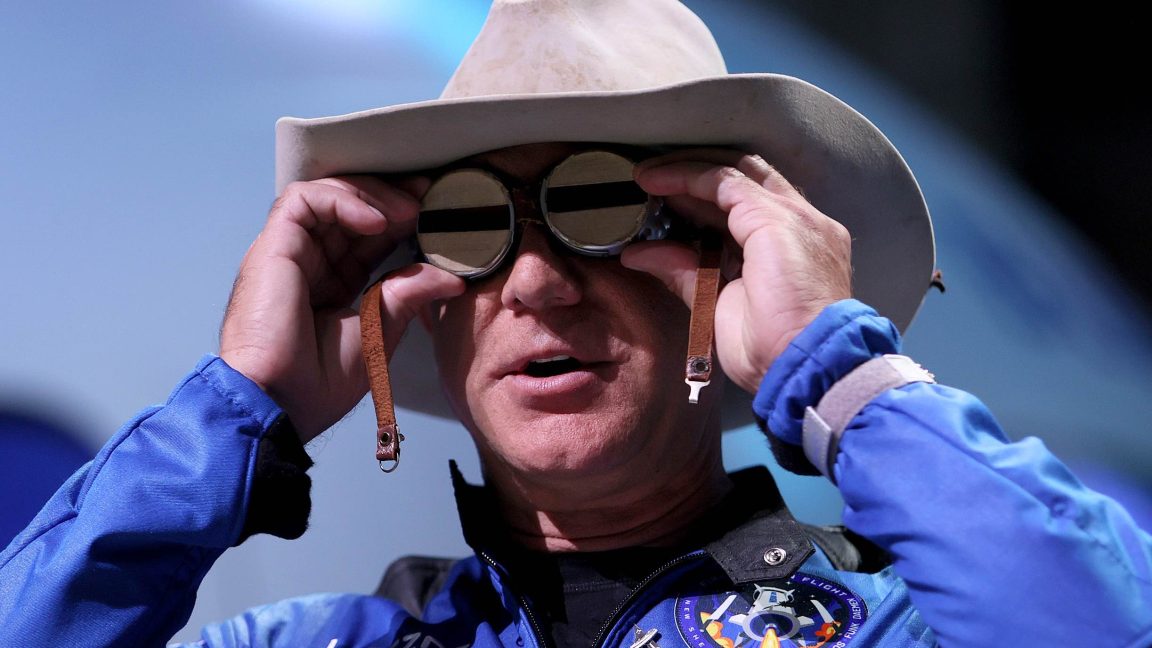
Jeff Bezos loses attempt to block the Moon-landing contract NASA gave to SpaceX
Bezos' Blue Origin protested SpaceX deal, but GAO said NASA didn't break any laws.
Ars Technica
245 points · by _Microft · 5y ago · 236 comments
Where is the BE-4 engine? Delayed, again and again. New Glenn, the rocket that could actually go into orbit? Same. So far their only functioning hardware (New Shephard) is, in effect, a glorified amusement park ride.
Considering that SpaceX has actually made it to orbit multiple times, any rational actor would clearly choose SpaceX over BO.
You're not optimizing for the same outcomes as Congress. NASA is a jobs agency.
Robert Siegel: "As NPR's Peter Overby reports, Capitol Hill has always been deeply involved in NASA's activities, and sometimes seem to regard NASA as a jobs program, as well as a space program."
Overby: "This year [2011], according to federal contract data, NASA will buy goods and services in 396 of the 435 congressional districts."
https://www.npr.org/2011/07/20/138555781/congressional-suppo...
From 2019:
"NASA will often highlight the fact that its SLS rocket and Orion spacecraft support aerospace suppliers. For example, this agency website details the number of suppliers in every US state and says, 'Men and women in all 50 states are hard at work building NASA's Deep Space Exploration Systems to support missions to the Moon, Mars, and beyond.' There are 106 suppliers in Alabama, alone, according to NASA's site."
https://arstechnica.com/science/2019/03/an-alabama-represent...
I don't think SpaceX would be as strong if not that early NASA funding. "SpaceX contracted with the US government for a portion of the development funding for the Falcon 9 launch vehicle, which uses a modified version of the Merlin rocket engine." https://en.wikipedia.org/wiki/History_of_SpaceX
So by your thinking, they could have only invested in old-school-reliable-expensive rocket companies, because less risk is involved...
So funding a space company that doesn't yet have required capability but can be helped to get there - is not dumb.
BO said historically NASA gives contracts to multiple companies, and BO wanted funding too (in addition to SpaceX.
BO “argued that the agency was required to make multiple awards" because it had previously stated a preference for multiple awards”
They also got court injunctions preventing SpaceX from starting it's program, kinda deflating your whole 'just wanted to play along' narrative
But they are, apparently, firmly in development hell, with no public indication of trying to change that.
Edit: lol forgot it was 2021 not 2022, still seems unreasonable to me though.
The BE-4 fits into that.
At this point Bezos might be better off starting over with a new team.
BE-4 has been delayed, true, but if it were looking like a failure, ULA would have dropped them a long time ago.
I think 2022 will clear up lots of things for everyone. SLS, BE-4, New Glenn, etc... Till then there is no sense of dooming anything.
"While at Princeton, Bezos attended O’Neill’s seminars and ran the campus chapter of “Students for the Exploration and Development of Space.” Through Blue Origin, which he has called his “most important work,” Bezos is developing detailed plans to realize O’Neill’s vision." - [0]
[0] https://www.princeton.edu/news/2021/04/16/documentary-featur...
Elon was probably more invested earlier and was paying more attention to what was going on is for sure though. Im not convinced Bezos personal attention is going to do much to help his space company though. Nothing about him seems like it would help other than his wealth. And he hasnt shown a willingness to throw a significant part of his fortune into his space venture. Nothing about this strikes me as anything more than what is a hobby that one of the richest persons in the world is passionate about
SpaceX is really, really fast.
Soviets were once in the lead very clearly, Roskosmos lost that edge a long time ago.
Not if it's a 100m or 200m sprint. Try that and you'll finish dead last.
If SpaceX had gone with slow and steady, it would have merely given their monopolistic competition - competition particularly well connected in DC - that much more time to try to wipe them out using their preferred approach of avoiding competition via government protection.
Blue Origin may yet make something of itself via slow and steady pacing (which Bezos can afford), however it's not winning the race.
https://www.discovermagazine.com/the-sciences/a-telescope-on...
I appreciate SpaceX's focus and god bless em for what they're doing in that sector, but there are other things to space than just delivery driving.
> Amazon did not say when the first launch will occur, but the company said it had contracted with United Launch Alliance for nine launches to begin building out its constellation of 3,236 satellites in low Earth orbit.
[1]https://www.cnbc.com/2021/04/27/fcc-approves-spacex-starlink...
[2]https://arstechnica.com/science/2021/04/amazons-first-intern...
Technically going hydrogen way Bezos cornered himself - the turbine would be extremely expensive and reliability is an issue, and by not doing it so far they are very limited by expander and tap-off.
You don't consider being the first to successfully launch and land a VTOL booster noteworthy [1]?
[1] https://www.theatlantic.com/technology/archive/2015/11/the-f...
They were not the first the launch and land a VTOL booster. According to the article it was the first VTOL booster to fly above the Karman line and then land safely. But SpaceX had a flying VTOL booster in 2012-2013. [1]
Actually it's amazing because Blue Origin made that flight in 2015, and five years later they made basically the same flight but with people in it. Meanwhile SpaceX nailed orbital landing, is reusing orbital boosters like crazy, released the Falcon Heavy, and has made remarkable progress on the Mars Rocket. And BO still hasn't made orbit.
It’s “what have you done lately?”
This should be a wake up call to established space players: the days of cost-plus contracts, multiple bid winners, and endless cost and time overruns - are over. There’s no purpose to those anymore.
For the past fifty years this all made sense: going to space was hard, and the financial risks were astronomical. This decision highlights how much progress we’ve made toward establishing a “space economy”. Space has been de-risked enough that the corporations can take on the (previously fatal) risk of a fixed-price contract. De-risked enough that the government is reasonably certain of achieving a strategic objective with a single provider.
BO, ULA, et. al - the game just changed. Adapt, or die.
But this wasn't always true. For Commercial Lunar resupply they went with SpaceX only as well.
The traditional was one supplier with cost plus.
Maybe that’s just the kind of attitude it takes to be the richest person alive, but it definitely rubs me the wrong way.
Not like he cares who it rubs or in which way, of course.
The industry needs a 2nd new generation provider. I don't harbour any fuzzy feelings for Bezos but I do hope BO will get somewhere, or that another company will. Perhaps RocketLab or Relativity Space?
You know the meme about devs going to Google to rest and vest? That's the reputation Blue Origin has in the space industry according to Stone.
But the way the new world works, that approach loses out against SpaceX.
And unlike the real Old Space companies BlueOrigin doesn't have lots of military contract or a airplane business to actually make money.
While this is great for individuals, it also attracts a lot of people looking to coast. And of course the highly motivated, intelligent people who are willing to put in more time to make cool shit happen aren't going to settle for a distant runner up.
I suppose the real question is, will the SpaceX hare or the Blue Origin tortoise win the race in the long run. SpaceX might make amazing strides quickly, but if they burn out their workforce and fail to keep talent long term, they might suffer in coming years and decades.
The idea NASA would plunk down money for imaginary spaceships is silly. They have their own one of those already.
They should do this even without grievances from losing bidders.
The first is obviously Blue Origin. Some important points:
- SpaceX was founded in 2002. Blue Origin in 2000;
- Blue Origin may have achieved a vertical landing first but it was for a rocket that basically went straight up and came straight down as opposed to going near-orbital speeds (Mach 30), which is unquestionably much more technically challenging;
- While SpaceX had delays in shipping (eg Falcon Heavy, Crew Dragon) the track record of the Falcon 9 at this point is undeniable;
- Bezos made an extremely odd (to me) choice for leader of Blue Origin: the former CEO of Honeywell (to the point that I've read insiders call the company "Blue Honeywell"). The result seems to be that things are done incredibly slowly and the delays keep piling up. I wonder if the company is now so risk-averse they'd rather do nothing than risk doing something that will fail. Now compare that to SpaceX's Starship prototypes.
Whatever magic touch Bezos has hasn't rubbed off on Blue Origin and I honestly think they're at risk of sliding into irrelevance.
So the second example is of course (Activision) Blizzard. We actually have a good data point in how another company, Square Enix, handles Final Fantasy XIV (vs Blizzard and World of Warcraft). Some interesting points:
- Blizzard doesn't engage with the WoW community. Compare this to Square Enix explaining the issues and timelines for bringing new servers online to alleviate queues;
- It seems like Square Enix is still player-focused whereas all of Activision is clearly financially-focused at this point;
- The horrific allegations against Blizzard fit into a narrative that Blizzard leadership and employees disdain their audience and almost certainly don't even play their own game;
I could go on.
So the reason I bring this up in the context of Blue Origin is because to me there's some striking similarities here. Blizzard is run by non-gamers. Blue Origin is run by Wall Street financial types not rocket men (or even engineers). Boeing is another data point in how horribly that can go wrong.
A fish rots from the head they say. If leaders want to claim credit and get the rewards for good performance (eg Bobby Kotick's $150m bonus) then the buck stops with them with regards to the culture they've created or allowed to fester on their watch.
But just virtue signaling to the market by replacing the head of the company isn't enough at this point (in either case). The fish doesn't reverse the rot when the head is cut off. It's going to take cleaning house to save Blue Origin (or Blizzard).
It's not like they don't already have all the money they'd ever need or could use, and wouldn't the world be better off if they worked together than against each other?
Pointless as in I, an old man and an uncoordinated complete failure at athletics, can ride my bike faster than any of them can run.
From a layman's perspective, an idea like that would make superficial sense; they are all programming languages, after all. From a programmer's perspective, that would be a nightmare.
I think the companies are so far apart that extensive technical cooperation would slow them both down. Maybe they could share a weather service or even a drone ship fleet for landings, but not the core products and their parts.
Yes!
They need different runtimes, but there's a lot of infractructure they could have been reusing. It's a shame we have a couple dozen language silos that have to reinvent everything.
Rarely does a new language build everything from scratch, and the parts they build new are often progress.
I can only recommend Eric Berger's excellent book "Liftoff" to gain insights into SpaceX' way of working to get the Falcon 1 rocket off the ground and eventually into orbit. I cannot imagine Blue Origin having operated in a similar way at any point in their history.
Another problem when multiple independent orgs pool resources and work together is you either end up with design-by-committee (which leads to overengineering and extra expense, both of which are anti-goals for SpaceX and BO), or deadlock when the parties can't agree. And you'd better believe personalities like Musk and Bezos would clash a lot if they ever did a joint venture on something.
That's all these companies exist for.
Basically every successful company has a massive amount of ego behind it but the question is if they actually achieve anything tangible and, eventually, profitable.
This might actually lead to a greatly increased risk of creating an impenetrable field of space junk if the thousands more satellites that SpaceX launches collide in to one another.
If that happens expect SpaceX supporters to start singing a different tune.
With the weight of Amazon on their side, I wouldn't rule that path out.
EDIT: Probably India as well
If SpaceX were Russian, Indian, or Chinese, the US would shit its pants.
You know what space nerd love? SpaceX. You know what they don’t love? Blue Origin.
If there is an "on topic" discussion, the back-and-forth can actually be very engaging and worthwhile. Some of these exchanges are really golden and is why I keep coming back to HN. However, these high value interactions tend to be rare.
Unfortunately, many discussions here tend to be fairly low value. Especially those topics that are prone to draw emotional responses from people that are arguably no more qualified to comment other than they feel strongly about the topic (and, yes, guilty as charged). In these cases, back and forth between the already committed serves little purpose and just adds stress to life. I think by simply stating your position and maybe why you think it, anyone really interested will know by that single expression that 1) there are contrary points of view, and 2) it might inspire the undecided to look into matters and draw their own conclusions... and do so with better information than is available from comments here.
Some viewpoints expressed on HN feel like social media fed hatred, people often forget that there is a massive army of brilliant people doing stuff that most engineers would dream of. There are Facebook/Google engineers working on advertisement tech and we generally don't scorn at them. Adtech is far more "uncool" than space exploration.
I say kudos to Blue Origin to lift a building sized socket up to space with humans in it.
I think it's genuinely interesting to compare two well-funded, privately-led space companies and their results. What is it that has allowed one to make such substantially better progress than the other?
It's clear that SpaceX is a tough place to work, and Musk has very high expectations that go well beyond a hard-worked 9-5 5 days a week. That said, Amazon is not an easy place to work either ... so is Blue Origin a driven workplace culture?
Perhaps it's just that BO got distracted by the sub-orbital hop goal, and should have ditched that (like SpaceX and the Falcon 1 and Falcon 5) and just gone straight into New Glenn? There's something to be said for aiming high.
Perhaps it's just bad luck? BE3 seems ok, but BE4 appears to have some issues. Maybe SpaceX got lucky with Raptor? Or perhaps the difference is just the staff -- one good hire could be the difference between the fairly quick success of Raptor vs. the delays with BE4?
Ironic as it is, I will give Musk some credit for keeping his ego out of the cockpit. Not that he's short of ego, but (so far) he's resisted the urge to launch himself.