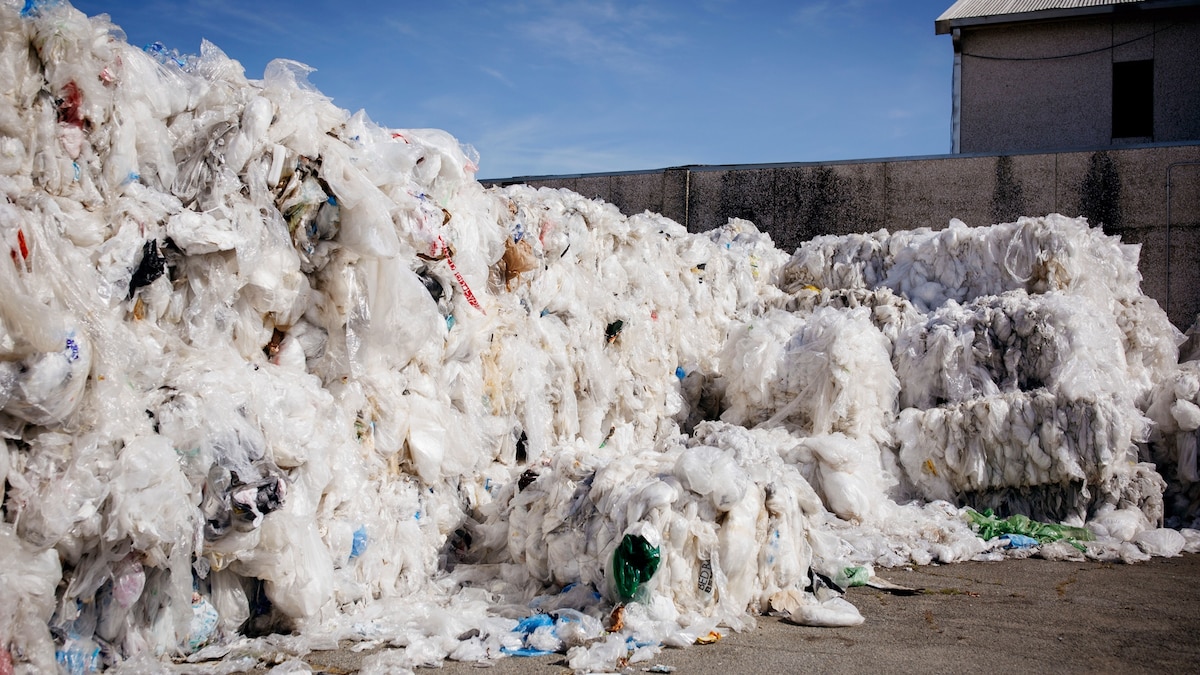
U.S. generates more plastic trash than any other nation, report finds
The plastic pollution crisis has been widely blamed on a handful of Asian countries, but new research shows just how much the U.S. contributes.
Environment
361 points · by DocFeind · 5y ago · 273 comments
And even if one company cares enough to do something, they will change their tune when they have to start charing more.
The only way this will get better is if the external costs of single use plastic are borne by the companies that make them and consumers are subsidized to absorb the extra cost.
I had a similar experience the last time I was at CES and was deep into the "South Hall" where there's kiosk after display booth after kiosk of just completely pointless crap of every shape and size. Thousands of practically identical cheap cell phone cases. Thousands of cheap bags and backpacks adorned with battery packs and/or Bluetooth speakers. Each and every booth staffed with multiple people who have to stand there and try to convince you that their big mountain of garbage is somehow special. At the same time as it's astonishingly wasteful and kind of insane when you think about it, it's also completely existentially debasing to the people involved.
If we have a global addiction to anything that seems like it needs fixing, it seems like we're addicted to producing stuff we don't need for problems we don't have just for the sake of doing something.
Everybody's got aged-out baby crap taking up space in their house, if you can get them before they get off their ass to throw it out they're usually overjoyed for it to disappear
Into the garbage it went, sadly.
Most of our baby stuff comes (and goes) that way. We rarely bought baby stuff at all except for consumables (and even those we gave away when we didn't use them all up, like diapers).
The big issue is that it requires a social circle of people also having kids that are slightly older and younger, and for a lot of people in bigger cities, it's hard for them to build those circles.
There are online forums that help (non-sarcistic Thanks Facebook!) but it's a lot easier if you have a wide social circle already.
I have another friend that would never buy a used car. He's convinced all used cars were totaled and are a scam, despite the fact it is all I've ever owned and they've been fine.
Something about being "used" really freaks some people out. It's this weird purity thing, I dunno.
However, Americans in general just don't take good care of stuff. Combined with products being designed from the cheapest possible materials, the quality of second hand goods isn't great. People avoid it if they can afford to buy new.
The hidden lede is that Germans are not as rich as some would believe, with fairly low salaries, high home prices and high taxes, and a low level of wealth compared to GDP. Much of the German wealth is held by heirs of big dinosaur companies.
Wow, the privilege wrapped up in that statement. Do you think it’s existentially fulfilling to clean public toilets? To drive a bus? To bottle alcohol?
I am old enough to remember when there was practically no plastic in food packaging. Twinkies and its ilk were more or less the exception (and fine examples they were of that exception!).
No doubt many remember glass ketchup bottles, glass mustard jars, glass peanut butter jars, glass mayonnaise jars... I swore to continue to buy only glass condiment jars but they no longer exist. I think the exception now is jams and jellies still come in glass jars. Honey too if you look for it.
Cereal? No plastic bag liner, it was wax paper or that weird paper foil stuff that Super Sugar Crisp came in.
I'd love to go back to glass, wax paper, but there just isn't any options any longer.
With plastic there is trash to deal with, but glass is heavier thus will take more energy to deal with logistically. Recycling is not energy free either, and there is plenty of loss to deal with there. Plastic is very cheap to manufacture partly because its manufacture is so easy.
And right now it seems like energy consumption is a far larger worry than trash at the ecological level.
If you have local production and re-use of glass it can be more energy efficient to use the more heavy glass. The further the transport, the worse it becomes.
But there is a second factor to it, besides energy use: microplastics are a problem and most plastics can only be used for "energetic usage" - being burned in a power plant, which causes probelmatic gases needing filtering and then disposal of those filters ... re-use of broken glass is elementary in glass production and even if not recycled less of a problem for the environment.
My family has been using the same set of glasses for canning for decades.
But I'm just guessing.
The problem is having the space in some place where neither flora nor fauna will be affected.
Landfills are "holes in the ground", I won't deny it. But a lot is happening in these holes, will all sorts of microorganisms breaking down stuff. Well managed landfills try to minimise impact to the environment with that knowledge.
In an oversimplified way, our landfills are putting oil back where it came from. Recycling and incineration are good too, but so are well managed landfills. It all depends on the situation/materials/...
The average American produces 3.5 pounds of trash per day at an average one third of a gram per cubic centimeter. Assuming that holds steady, and we use a normal landfill depth of 400 feet, and the US population doubles over the next century, we need a landfill area of 250 square miles to cover us for the next hundred years.
Compared to available land that's tiny.
Just because you can’t see it, just because it doesn’t have value to property developers, does not make it junk.
I mean, by this logic, we should just dump our trash in the “junk water” which covers much of the planet.
Is there any data that single use stuff (of any kind) creates less carbon emissions? I would expect it to be the other way around, except for some edge cases.
https://www2.mst.dk/Udgiv/publications/2018/02/978-87-93614-...
You're probably not going to do that.
Otherwise you poison the land and water that flows through the land.
I'm down for recycling or burial in landfills, but CO2 seems like something we need to minimize this century.
In any case, it'd be compounding the problem here, and rather bad economics at the same time. Plastics aren't that hard to collect/separate, especially if it's ok to be mixed with paper. They burn readily and, given high temperatures, cleanly, allowing the recuperation of a significant fraction of its energy content.
Then, there's recycling, of course. Not always possible, but not entirely impossible, either.
“In 2018, 24% of all municipal waste generated in the EU was landfilled.” That said, incineration is a similar option that drastically lowers volume of waste, but still produced ash that ends up buried and vast amounts of CO2.
Absolutely not true, glad you maybe live in a country where landfills are disappearing, but they will always exist in some form - even with burning where do you think the slag goes to? That's right, a normal landfill. Not everything can be burnt, and not everything can be recycled.
And definitely not "all" EU countries - Poland has normal landfills that take everything still, very few operational waste incenerators, and recycling is still unknown to a lot of people.
The problem is food packaging. Even if you use paper here, it often is coated with plastic anyway, any diary product for example.
Just one bite, and you had to throw it out. It was more plastic than food. Whole Foods was the same. I think it is a crime against environment and I started feeling bad about it, and stopped taking samples when there were plastic utensils.
It think behaviour like this should be legislated out. For something like a sample, just a small wooden spoon, or anything else renewable, should be enough.
The externalities of that plastic, is something that neither Trader Joe or Whole Foods pays, but we all do in some way.
F Trader Joe's fruit and veg.
That's what my Trader Joe's uses. I believe they're made out of cornstarch.
This is a distinction without a difference - all forks are biodegradable, the question is over what time-frame.
All of that exists because the system is built to encourage it, and building something more sustainable means lots of us need to start calling for major changes. I think it's reasonable to worry about that even if you didn't personally create the problem.
Which is to say that if you choose to live someplace where you can't walk or ride a bike or have mass transit access to daily needs, you made that decision. I'm not going to tell you that you are wrong, though.
If you really care, talk to your local representatives or write to Trader Joes and Whole Foods. Anything else is posturing. Not taking a sample which costs them a few cents on the dollar is not taking action.
I'm not going to stop, personally. They can give it to me in paper wrapping instead if they want to make a difference, and in fact, with their cups, they already do. Let someone invest in paper sampling spoons.
Or you can do both.
> Your refusal to not consume it isn't going to change them buying the plastic, because given the choice, people aren't going to stop sampling in the aggregate. And at that point you're just signaling to other people in a really silly way.
This is a strange viewpoint to me. Acting based on your principles in your day-to-day life isn't just about signaling to others. It's about how you live your life, and acting "in tune" with your beliefs can lead you to profound happiness. If you decide that single-use plastics are bad for the environment, and you like the environment, then you try to avoid them. It's pretty simple.
But I don't even think that signaling is silly. Some people are convinced more by actions than words. I've reduced the amount of waste I produce by bringing containers to get stuff from bulk foods sections, literally because I saw someone doing it and realized it was possible. Before that, I would've thought "oh man it sucks that you have to get granola in single-use plastic, but oh well, that's life." As strange as it sounds, I had never even considered bulk food sections, even though I know the mantra "plastic bad".
If you extend your arguments, they imply that acting based on your principles in day-to-day life is pointless (or merely "posturing") because we are all small and insignificant, and the only thing that matters is trying to change laws. But I think you have it partially backward. People acting on their strong beliefs and spreading those ideas to others is what eventually invigorates political changes in the first place.
Doesn't this seem like it's saying illegal + legal plastic waste in the US is greater than legal plastic waste in other countries? That seems like a much different claim to me.
But that doesn't mean we're innocent in the rest of the western world.
One really cool improvement here in Sweden recently, besides "banning" plastic bags at supermarkets, was one store called ICA started selling their burger pattys in cardboard packaging. So the only plastic is a top foil that you peel off to open the package, the rest is cardboard. Pretty cool! That's one area where we're all guilty, namely fresh meat and dairy packaging.
Speaking of dairy and meat I tend to buy from the butcher's section instead of the pre-packaged stuff, just because they wrap it in paper instead of plastic. It's the little things you can do.
And to store it in your fridge, don't wrap it in cellofane, use glass tubs with plastic lids instead. Yeah the lids are plastic but they're amazing at keeping stuff fresh and re-usable.
Cling film and aluminium foil are both incredibly useful at ridiculously tiny thickness/weight levels. One roll of 30m of either easily lasts a year or two in my kitchen. A glass tub probably has way more embodied energy, I'd need more of them, etc. The full life cycle analysis might not be as clear cut as we'd like.
Those "cardboard" foot containers are usually lined/sealed with stuff containing PFAS and goodness knows what else.
In days of yore, butchers (etc) would use wax paper for wrapping food. Which is ... paper ... and paraffin wax. A hydrocarbon usually derived from, you guessed it, petroleum.
This war on useful food packaging is silly and maybe even counter productive. A box of individually wrapped chocolates is pretty stupid. But a pallet full of those boxes is often wrapped with more plastic than all the other packaging combined, and then some!
For example, your Starbucks cup is covered in plastic film and is generally not recyclable. It actually contains more plastic than straws do, which are now being banned in many cities. The same is true for things like milk cartons or juice boxes.
Even your aluminum soda can has plastic in it.
Fast food paper/cardboard packaging has a layer of PFAS containing compounds to make them grease-proof. And consumption of fast food is correlated with PFAS blood concentrations so it probably contaminates the food. Hopefully the packaging you're describing isn't, but...
https://www.cnn.com/2020/08/06/health/toxic-food-wrappers-pf...
There are quite a few schemes for reusable packaging for food delivery currently getting started. It's a concept that needs a certain amount of market penetration and concentration to work, but has the potential to make a significant contribution for private sector/household trash and energy use.
And how much does it actually differ, plastic vs cardboard?
For the cardboard, the basic ingredient also has to be harvested, or won another way. Then it needs to be transformed into cardboard.
https://thecounter.org/pfas-forever-chemicals-sweetgreen-chi...
(This is assuming the problem with plastic is direct pollution and not CO2)
Yet you still eat meat. It’s fucking appalling how easy it is to placate ourselves by rearranging the deck chairs on the Titanic.
Reasonable legislation that sets the right incentives works. But it's difficult to get passed when entrenched interests are against it. The problem isn't capitalism, the problem is the industry influence on politics that prevents reasonable legislation.
By the way, Noam Chomsky uses the phrase “really existing capitalism today” to talk about the system we’ve ended up with.
Now there are vastly more of us, and we have a lot better tools to do damage with.
I don’t have any options with regard to how I get to and from work nor how I hear and cool my home.
Is that directly your fault, or am I right to place a fair chunk of the blame on the source of that denial?
Floods are prevented, or mitigated, not by single raindrops, but by chaotic systems on a much larger scale, and / or infrastructure projects raindrops have little to no ability to action.
Humans need leaders to rally behind, and what we’ve had for too long, and likely will have for longer still, is wet dishcloths masquerading as leaders.
We have glass bottles, we have compostable plastic, a company is not incentivized to lose profit by switching to more expensive alternatives until it becomes illegal to not do so and they have more lobbying power than any of us.
Have you been to less developed countries? They just simply do not package some products. It removes a lot of the allure of buying particular things, but also generates less trash.
Here's a simple example: utensils. In some countries, you just buy the utensil. In America, you buy a box with utensils in them, sometimes with a plastic shell, sometimes with paper wrapping inside of the box. But without the box, it feels like you're buying them from the dollar store no matter how nice the actual spoons and knives are, which commands less of a price mark up.
In India, we would buy produce without any packaging, you would pay by weight. Whereas in Germany, fruits, vegetables and even fresh leaves come pre packed in plastic. I know Germany has better recycling but the amount of plastic is crazy. Quite the shock for us.
In my country (Ukraine) its cheaper to go to a restaurant for 'business lunch' which is soup, potatoes+vegetables+meat, and juice, for $3.35.
As a single guy I can't cook that cheaply at home, which is not surprising when I am buying small portions with a huge amount of packaging around them.
Its really a shame that this concept is not more broadly applied in the West, and that restaurant food has sales tax attached to it whilst grocery food usually doesn't. We could reduce food and packaging waste if we taxed communal kitchens at 0% and shifted more people to eating inside them.
I’m always a little surprised that people are so quick to jump to conspiracy here. China is an authoritarian country with recent prior experience of dealing with epidemics, which took extremely aggressive measures against covid, some of which would not fly in a democratic country. You’d _expect_ it to have a low rate.
Would you also assume Australia’s lying about this? Up until a month ago it followed a pretty similar pattern to China, based on somewhat less aggressive tactics.
And again, China has taken extremely aggressive, and very disruptive and expensive, measures on covid where it has shown up, some of which people wouldn’t put up with in democratic countries. It also has a respectable though not world-beating vaccination rate (a little higher than the US and the EU average), and encountered Delta pretty late (in the last week or so). You’d expect good performance based on this.
That said, it may not last; it does look like the Delta cat is now out of the bag, and experience elsewhere has been that suppression measures that are good enough for Alpha aren’t good enough for Delta (see Australia).
I wouldn’t in general trust China’s government much, but the incentives to lie here just don’t seem like they’re there, and their approach to managing covid seems like it should work, on paper.
I can't access the paper, but can anyone verify: Do I understand correctly that this means the US might be as high as third in terms of contributing trash that ends up on the US's coastline?
The government should focus on proper disposal laws. Banning plastic bags at the grocery store is a bandaid on a blood gushing wound.
Always thought it would be a cool thing for us to try, but can’t quite figure out how practical that really is
So I don't think there's a world in which we just stop using them cold turkey. At least not a compassionate one. A lot of research and effort needs to go into finding alternatives for these things, but the structure of our society doesn't really incentivize that.
You're right, there's not single-use material that compares. However, there are plenty of reusable sterilizable materials, like steel, aluminum, rubber, and glass.
We just need to stop being so ready to throw things in the trash and actually think about the backend logistics of bringing containers back and reusing them.
This isn't a materials problem. It's a efficiency/cost problem.
Just look at the Pfand system for glass bottles in Germany. 2 basic beer bottles, different labels. Reused dozens of times. Deposit system.
We can eliminate or at least improve a lot of single use plastics outside medicine and people with special needs.
At my local farmer’s market, for example, all prepared food from food trucks and stands comes in unlined cardboard containers. When you’re done, you throw it in compost because cardboard is compostable. Works great and disadvantages nobody.
You still get plastic cutlery but it says to be made of compostable plastic. I don’t know how well compostable plastic works but I sure hope it does.
Anyways the difference between these two arguments is that people use these things to increase the odds of their survival. No one (approximately) hauls a boat for their survival.
And the really sad frustrating truth is that literally the only way to make a lot of these things that do genuinely help people survive economically worthwhile is to make them useful to everyone else too. That's why, as an oft-cited example, pre-cut veggies at your grocery store are simultaneously essential for some people and incredibly wasteful for others.
This is the faustian bargain capitalism forces us to make.
Eh, they also choose big trucks so they'll win in a crash. Remember, safety ratings/requirements for cars are based on collisions with similar cars. If you're in a Fit or Golf or Mini and the other guy's in an F-150 or Tahoe, you're in big trouble.
The solution's probably some form of graduated weight-based tax. Makes sense both on a safety-externalities basis and on a damage-to-the-road basis (which doesn't scale linearly with weight, so the first ton is way less damaging than the second ton, and so on).
Similar to cheap but non-repairable or non-reusable stuff in general. How do we get rid of it? The answers amount to making stuff more expensive, or making labor cheaper, or some combination of the two.
I think the reason this is not as public as it should be, is that males are sensitive when it comes to the "mannliness hormone", Testosterone. Thus, there's probably a high number of unreported cases.
Some symptoms are lower sex drive and libido.
Considering:
Reclamation and recycling technology will improve over time. Similarly the economics of processing recycled material are likely to make it more valuable.
and:
Supposing we can protect the surroundings, water table etc.
further:
Supposing, as other comments have pointed out, the availability of land is not really an issue.
Then:
Is it crazy to think that there is value to be found in safely storing this material until it is more feasible / valuable to process?
At least it seems like a better plan than incinerating it.
Plastic securely sequestered in a landfill isn't a medium-term concern and I'm optimistic that future recycling or sequestration technologies will help obviate that problem before it becomes acute.
I wonder if we just legislated taxes on plastics that local recycling centers can't utilize, if we could get the majority of the benefit of banning plastics with few of the downsides?
To what extent would greater standardization of plastics mitigate this issue (and make recycling more profitable)?
Considering it takes so much less fossil fuels to make plastic containers than to many alternatives, shouldn't we focus on proper disposal in poor countries and otherwise move on to much more pressing environmental concerns, like I don't know, climate change?
Some other compounds like phthlates may have negative endocrine effects but I believe this is far from resolved.
"Microplastics" to the extent they exist in meaningful concentrations are not anything like asbestos fibers (this is known) which cause mechanical damage to cell structures by their needle like shapes. Rather microplastics are akin to small sand particles. Inert dust. The very reason that plastics do not decompose makes most of them safe to life unless absurdly high concentrations of very small particles are present in which case sand or silt dust would be comparable.
The mass hysteria about "plastics" in just shows how easily human emotions can be manipulated.
Sure, plastic bags floating in the ocean may look like jelly fish sea turtles. This is why we shouldn't throw plastic bags in the ocean. Maybe bags should be made more dense than sea water so if they do end up in the ocean they sink.
Otherwise the solution to the plastics "problem" is really simple: burn it, recycle it or bury it in the ground.
The last option has the added benefit of potentially serving as a long term carbon sink.
I could envision a world where solar power or bioengineered plants perhaps are used to pull CO2 from the atmosphere and lock it up in something useful and stable like polyethylene, which could be used or just burried in shallow pits removing CO2 from circulation for centuries or thousands of years.
The river systems in Asia responsible for the vast majority of marine trash more so are.
To put this in perspective, if you got the Philippines to reduce the amount of plastic it sends to the ocean by just 1%, it would have a larger impact on ocean plastic than completely eliminating plastic in the U.S.
This is not true, see [1].
> As a result, the U.S. is responsible for only ~0.25% of plastic in the ocean.
This is also not true, and your link does not say that. The link is saying that the rivers in the USA are carrying 0.25% of the plastic that ends up in the ocean, the U.S. (as in, the people living in the US) are responsible for much, much more.
Recycling plastic is a mess, so instead of dealing with it, countries like the U.S. or Canada have decided to ship it across the world to countries like the Philippines to be "recycled" over there (see [2]). So now, of course, if you look at where the plastic enters the ocean, you will see that almost all of it happens in Asian countries, that's not because they use more plastic, that's just because that's where all the plastic of the world ends up.
Taking into account the origin of the platic, the U.S. is among the worst offenders:
> "the United States generated the largest amount of plastic waste of any country in the world (42.0 Mt). Between 0.14 and 0.41 Mt of this waste was illegally dumped in the United States, and 0.15 to 0.99 Mt was inadequately managed in countries that imported materials collected in the United States for recycling." [1]
[1]: https://advances.sciencemag.org/content/6/44/eabd0288
[2]:https://en.wikipedia.org/wiki/Canada%E2%80%93Philippines_was....
Also when it becomes economical to recycle parts it in the future, we don't have to go hunting around for it, we can just dig it up and process it in-place or nearby.
https://medium.com/@robertwiblin/what-you-think-about-landfi...
I think the only solution is global legislation forcing consumers and businesses to use alternatives.
Q: Do we know where the plastics in the pacific garbage patch actually come from?
[EDIT] which is not to say that the plastic was not used and discarded in an OECD state, then shipped elsewhere for "disposal" (LOL).
For example in a documentary with Simon Reeve where he tours the mediterranean he visits a conservation center for sea turtles. The staff there show him a bunch of plastic found inside the stomachs of two of their rescues and among the plastic found was a pasta wrapper.
So I think the type of plastic in the worlds oceans is completely dependent on how streams communicate into the ocean.
What's next breaking news? That China, the 2nd economy of the world, is 2nd place in plastic generating as well? Color me shocked. /s
* Some exceptions apply. See https://archive.is/zBbNG
/s