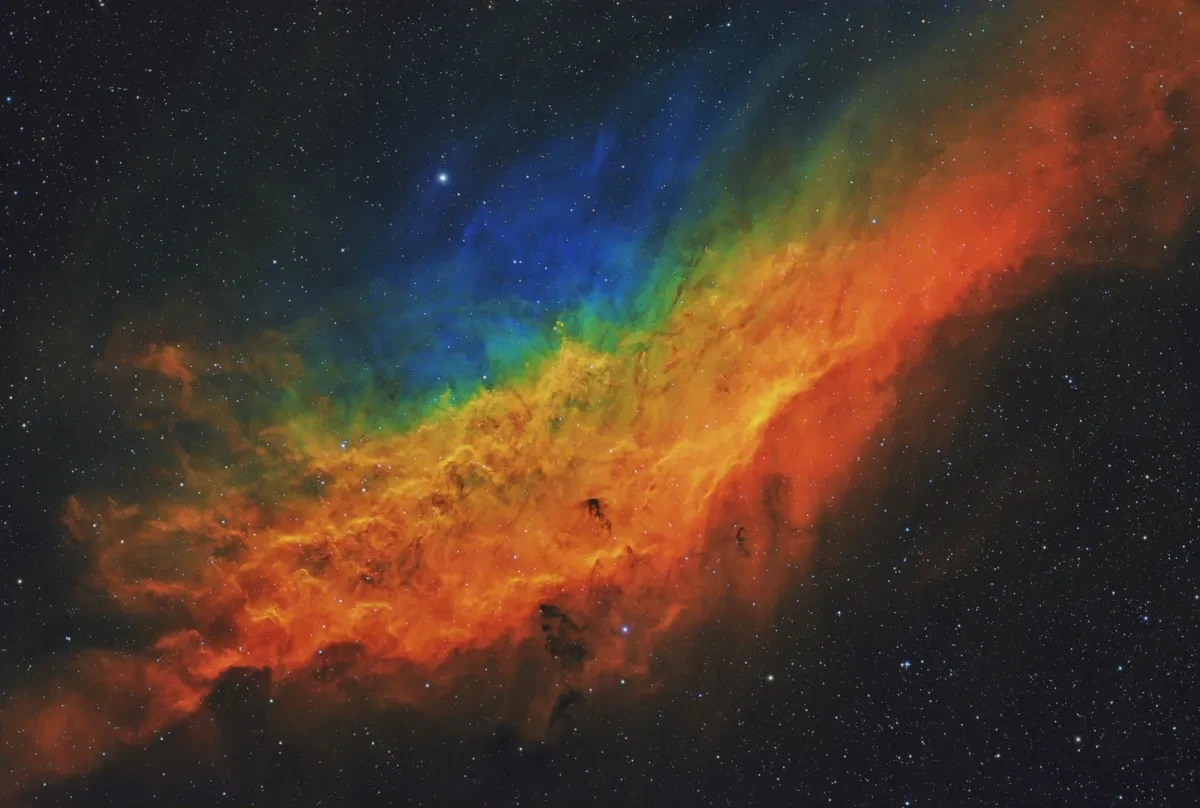
Astronomy Photographer of the Year 2021 shortlist images
See the shortlisted images from the world's greatest space photography competition
rmg.co.uk
174 points · by Tomte · 5y ago · 42 comments
To celebrate these wonders, I have recently created an artwork with astrophotography from astrobin.com (really cool amateur astrophotography community). Maybe someone in this thread will be interested https://www.astrumnft.art The collection relates to the 110 astronomic objects of the Messier Catalog.
You can get quite a lot of detail with standard camera lenses; you just need a dark sky and a star tracker that lets you expose for long enough, and a different IR filter that cuts off at ~700nm instead of 640nm, so you can get the Hydrogen alpha line to pass through (which is actually within the visible band, but consumer cameras attenuate it to almost zero).
I've got a Nikon 200-500mm lens, which while on the long side of lenses most people have, isn't especially hard to get... and its easy to get a 500mm f/8 mirror lens (which has the same field of view, along with no issues with bokeh for astrophotography). With a full frame camera, its field of view is 5°00'. The California Nebula would take half the frame. With a DX lens, that would be 3°10'.
The bigger challenge is the tracking.
Btw, given:
> I've been doing a project to capture them in context with landscapes around California.
Have you headed out to the Alabama hills? Yea... its star trail photograph rather than specific nebula - http://www.panoscapes.com/showImage.php?partNo=P250H&catNo=7... (its shot a 6x17 film camera - each frame is 6cm x 17cm - that's one shot; if you look at the full size prints you can see airplanes and satellites)
True. All you need to do is go online with a credit card. The thing is, that's a $1400 lens new that still sells for over $1000 used in decent condition. That's a pretty decent chunk of change. ;)
Yes! I have a couple of images coming, one of the Pacman nebula and one of the emissive regions of Cygnus, over the Alabama Hills. Stay tuned!
Most of the other nebulae you can't really see at all with your naked eye no matter how dark it is, human eyes just aren't that sensitive. The Orion nebula is one exception, as it's extremely bright for nebula standards, you can see the core part of that nebula with your eye easily.
These photos are more like what the night sky would look like if it was dark AND our eyes were much more sensitive. Maybe some animals actually see it that way, I don't know too much about biology.
Not only that, but you can achieve some pretty nice results with just a DSLR or mirrorless camera, a remote trigger, and a tripod. Literally just aiming the camera at something and opening the shutter for a few minutes can get you results that, while they aren't going to be on par with some of the images linked here, are definitely going to be pretty cool looking. A lot of the tricks of the trade are really post-production techniques, rather than shooting techniques.
Sky & Telescope says it better than I do, but, the TL;DR of this comment is "you don't need a lot of equipment, and it's not hard to get started."
https://skyandtelescope.org/astronomy-resources/deep-sky-wit...
But still, it's true - it's easy to get started, and all you need is a tripod, a camera, & a remote trigger. You can skip the latter if your camera has a delayed trigger. (But fair warning - if your hobbies tempt you to get new toys, this is a dangerous hobby to have. There are LOTS of toys ;)
You take your N long exposures, and then have the program map the movement of stars around you during those (if you do 20 30s exposures, you’ve spent ~10 minutes on it, so the stars will have shifted). Then the program corrects that motion and sums the images. It’s a cheaper and easier way to “simulate” a longer exposure, that would require a tracking system otherwise.
I assume that this means that anything stationary on the earth will be blurred instead, but still very cool.
For example, Andromeda is 6 times the visual size of the moon, the Rosette nebula is over twice the visual size of the moon, and so on.
The only reason you don't see them that way is that they are too dim. I've been doing a project to capture them in context of landscapes to rectify this misconception.
We would be able to see things like this if only our eyes were more sensitive. All of my images were taken with DSLR lenses, not even a telescope.
- Normal DSLR camera with the IR filter taken out and a different (~700nm cutoff) IR filter put in -- you don't need this for broadband objects like galaxies but for emission nebulae that have a lot of 656nm light, it helps a lot. For some emission nebulae I use an dual-narrowband (H-alpha and O-III lines) filter.
- Some pretty normal camera lenses. Actually mostly 30-40 year old manual focus lenses that are built much better than today's plastic crap and easier to focus properly. I highly recommend the Nikkor ED Ai-S 180/2.8 and Nikkor ED Ai-S IF 300/4.5 if you want a couple of winners.
- A sturdy tripod that won't vibrate in the wind. Heavier the better. None of that carbon fiber BS. Steel is good. Video camera tripods work well.
- Tracking mount, such as an iOptron Skyguider Pro in my case.
All of the images I take are as close to natural color as I can make them, since landscapes in false color aren't exactly good looking. Most Hubble images on the other hand are false-color, and for a good reason: The Hydrogen and Sulfur lines both fall in the red, so in order to be able to visually distinguish the chemical processes they assign S to red, H to green, O to blue. This is commonly called the "Hubble palette". In my case O spans green-blue and S/H are both in the red, and although you can't really distinguish S from H in my pictures, but that's how they would look if our eyes were more sensitive.
https://www.rmg.co.uk/national-maritime-museum/astronomy-pho...
This shot maps a little closer to the state's outline: https://www.flickr.com/photos/suborbital/49229271976