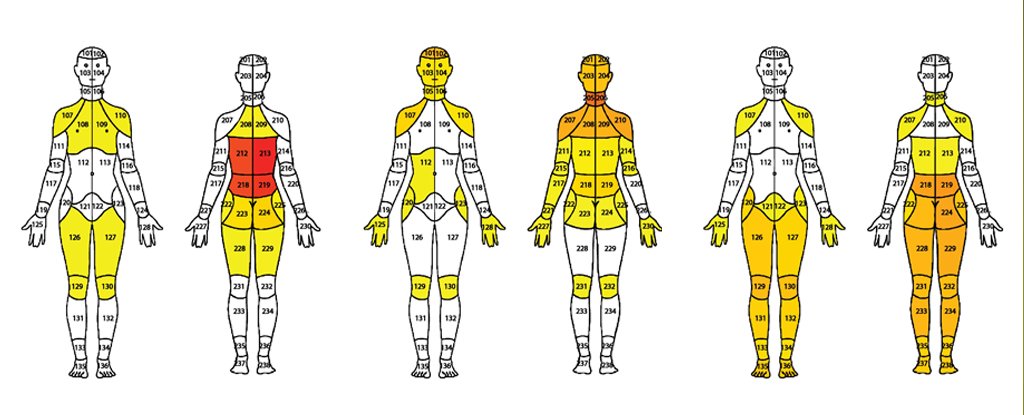
Chronic Pain Has 9 Distinct Types, According to a Large New Body Mapping Study
The relentlessness of chronic pain wears you down.
ScienceAlert
172 points · by lnyan · 5y ago · 54 comments
I happened to find a personal trainer that was educated by osteopaths and the last year with him has been shocking. In my mind, I didn’t have any pain issues, though some areas were stiff, getting things from lower cabinets was becoming a chore, and the end of the day at work the back of my head and neck would get stiff. A cocktail or beer could solve the latter.
It has been over a year of discoveries. It turns out, muscles all over my body were very tight, for whatever reason, many major movements were no longer using the major muscle, but instead the brain had recruited minor muscles for the movement - perhaps a compensation for a past injury. I’ve learned that I have psoas muscles, and how to use them (though that journey continues) and that pinching feeling in my hip no longer happens when I am sitting.
I was already aware that so many things happen in our bodies that we aren’t conscious of, but the depth of it now astounds me. First, I did have pain and problems, but I had somehow shut off awareness. Second, all of those problems were being still having the effect of making me feel tired and worn down. Third, all of these compensatory movements that the brain does all by itself were probably great for simple survival because they allow us to keep going even though the best way to move is lost. Thing is, the brain doesn’t seem to have an automatic ‘service restoration to primary’. We have to do it consciously, intentionally, and with practice.
Pain is in the mind. There can be pain where there is no physical problem, and there can be no pain where there is a serious problem, but there can also be pain because we have lost awareness of our body and so pain manifests all over the place. There is an idea that the mind and body are separate, this is wrong and the idea needs to be burned with fire. Until then, people will continue fighting with these phantoms. We can group pain together, slice it apart, but I think that in many cases there isn’t much more to learn from pain, except that in many cases it is a symptom of a body trying to communicate to a mind that stopped paying attention.
I had constant foot pain in one foot for nearly a year. Doctors told me to rest. I walk a lot, and walking less wasn't really an option. Saw an osteopath, with more than a healthy dose of skepticism. They gave me exercises which were both baffling and ridiculous, which basically taught me how to use my big toes, then graduated to strengthening those muscles. At some point during this process, the pain went away, and it hasn't come back. Why couldn't my doctor identify this apparent muscle weakness in my foot? I don't know. But I'm glad the osteopath did.
A quick Old Man(tm) rant.
Concerning healthcare, you have to be your own project manager. They're a lot better at curing things they can see (ie. surgery), GPs have crude tools for analysis and mostly serve as gatekeepers to specialists and pharmacists. Also, GPs work mostly from flow charts and you are just one of 1000 patients they see that year. Communications between hospital departments, independent contractors like specialists or ER personnel, GPs, etc. are poor. Continuously audit procedures and drug regimes. Sci-Hub is your friend but don't overestimate the value of studies.
Nobody knows their symptoms and illness better than the patient themselves. A doctor looks at them for 5 minutes, the patient lives with them so not including the patient in the diagnostic process is like working with a blindfold on.
+1 for that. 10 years ago I had misdiagnosed cancer for 3 years despite seeing lots of doctors. The symptoms were there but none of the doctors connected the dots.
Since that experience I am coming to the doctors prepared and with defined expectations. And I engage them in well defined Q&As which have defined goals.
I am taking care of my 90 years old Mom now and I do the same - I read the medial literature and suggest to the doctors what results I am expecting. To my surprise most doctors are quite keen to co-operate.
I have improved my Moms quality of life suggesting replacing sleeping pills for mild ant-anxiety pills, and getting anti-depressants that work well for osteoarthritis pain.
That said, the idea that PT may be more effective than medication or surgery is kind of new to me. People may need to be informed that PT is a possible solution for a some pain, especially those a physician may find difficult to diagnose.
If something hurts the default is, and should be, consulting a primary care physician, who should then forward your issue to a specialist. PTs are less trained and less useful than MDs, so their scope should be more limited (and should only be consulted for appropriate ailments).
Therein lies a major problem, PTs are so used to dealing with health plans capped at hundreds of dollars. People go to a PT expecting an instant solution which is impossible for complex problems. So the whole PT industry has turned into quick fixes in 2-3 sessions that have an immediate feel good result and hand out a piece of paper with a bunch of exercises no one does. It is just as well, without supervision and coaching, they are probably doing the exercise poorly resulting in minimal benefit.
If they know bones, everything is caused by bones. It's a variant of "if your only tool is a hammer, every problem looks like a nail". Each specialization has only one tool: a hammer or screwdriver, etc. and that's the only lens most have.
None know how to holistically look at things or, for example, consider that bones are connected to tendons to muscles so all three are likely to be involved in certain common pathologies.
The other issue I have with most: they are both shallow and gullible AF. It's far too easy to "suggest" an ailment and get them to only focus on that. Objectivity is not part of their methods in my experience. That does not build trust either.
So both of these combined to create a lot of "cookbook medicine" - like the old pizza commercial: "I go to the fridge and get the box!" which is everything they do.
At least in America.
I've had better experiences with doctors overseas sometimes. Not always but sometimes concierge/resort medicine does better. More time. More focus.
Worst result is the referral to a podiatrist for expensive insoles that IMHO are snake oil. Huge waste of time and money. It turned out that the primary problem they were trying to fix was an issue with glute activation, nothing to do with the foot itself.
Like many developers, I grew up thinking of my body more as a tedious, irritating burden; the whole brain-in-a-jar/live-in-the-matrix thing seemed kinda appealing. So I was proud of how long I could spend coding or reading and ignoring my body. That gave me a lot of bad habits.
Then I made a friend who's a yoga teacher. Out of curiosity I started attending some of her classes. In her yoga tradition, the root purpose of yoga is to free the mind for meditation. That really resonated for me. Instead of ignoring my body, I could work with it to do better at the things that mattered to me.
In the years since, I've come to think of my previous relationship to my body as like somebody running a large software system with poor instrumentation and observability. Somebody who ignored monitoring alerts until there was downtime. In that framing, I could see it as obviously the wrong approach. That instead I needed to pay attention, take care of maintenance, debug problems, and generally to understand and improve the system over time. Especially as I get older, it really pays off. My only regret is not starting sooner.
https://www.goodreads.com/book/show/22847203-a-guide-to-bett...
My left shoulder was mostly unusable after a subaccromial decompression surgery that was meant to make the shoulder less-unusable. Doctors told me to see PT, PT had me do the same waste-of-time banded pull aparts and subscap work. Imaging suggested there wasn't a structural problem and PT never really listened to anything I had to say. So, as do most, I stopped going.
Eventually I got tired of being immobilized and I just started doing what I wanted to do. I lifted weights and just clenched my teeth during the periods of extreme pain during various movements. Lo and behold, the issue was mostly related to lots of muscles being very weak from the changes in movement patterns to accommodate the extreme pain. None of the PTs allowed me to do any movements other than rotator cuff band work. Bench pressing for 2 weeks had me largely out of pain.
The state of doctors/phsyiotherapists/physical therapy is a joke. At this point I would consult a bullshit crossfit box owner before going to a doctor for movement deficiencies.
It is one of my favourites because shoulder pain is so annoying to reach, and all it took was a simple ball. Lots of sites on the Internet have better detail on the steps, but releasing tight muscles can work wonders.
It started with a muscle injury to my upper back. Well to heal it, unbeknownst to my conscious awareness, almost an entire half of my body tightened to allow that one area to heal. Like you said it's as if whole sections of my muscles were numb as well, and only after repeated stretching did I "activate" those dormant areas.
And it took being in a very calm and relaxed state (not trivial to do with tightness and/or pain) to "sense" these areas and being stretching them out. Turns out I had to find stretches for all the way down to my big toe to the top of my head and everything in between.
The lessons of body to mind are overflowing suffice to say.
I have a chronic neck pinch, coming from a weak lower trap (I think), that I’d love to fix. I make it worse multiple times a year from lifting and have to take at least a week off the gym.
I bet I am doing what you did with using the wrong muscle.
The part I like the most is that I have a bunch of solutions for my problems. I don't need to call him, he taught me what I need to do.
A good trainer might have this kind of outlook and training but most don’t.
I’ll see if I can find a PT who can replicate.
It's like your car.. if one part fails the system will compensate globally by absorbing the issue in every possible way but it leads to what you had. Tiny issues spread everywhere. When you restore balance your life gets so much easier.
It's under major criticism nowadays, although mostly for the wrong reasons. Because like so many once beloved and respected professions, they become the unfortunate prey of the capitalism frenzy and being used as the tool for profit.
Practitioners now use the inherent fuzziness to hide their ignorance. Putting the ineffectiveness of their treatment on some seemingly plausible "theory" that was never proclaimed by their ancient predecessor.
Even worse, the herbs used in traditional Chinese medicine are now toxicated by the industrial wastes grow into the soil. Merchants are now more than happy to adopt modern agriculture techniques to improve their quantity and cases nothing about the effectiveness.
Alas, sadness is now upon the ones who truly see and feel the greatness of the traditional Chinese medicine.
1. Pick an algorithm.
2. Get a number of clusters. Preferably below 10, because otherwise it gets too messy for publication.
3. Justify algorithm based on its first paragraph on Wikipedia.
More over, picking new categories is a great application of "big data".
Real example:
Imagine catalog for fashion retailer. Time to add color picker & filter. No agreement on color names, how many shades of gray, etc.
So one of our big data gurus figures it out. Gather dozens of palettes. Social cognition style guessing game. Slice & dice our product catalog 100s of ways to get best fit.
Result was a thing of beauty. Truly novel. The analysis worthy of a PhD.
I am by no means an expert, but I have spent time and experience enough with chronic pain to state that this rather one dimensional. Meaning their group although big was narrow in scope. For example, no chronic head pain? We have been working on a VR body mapping app(https://www.hatsumivr.com/), I'm the art lead on it. And you quickly find that there is an ocean if different experiences out there, and thats probably the biggest obstacle to helping people with chronic pain. Its is often treated (at the policy level) as one condition with a select few options for treatment. Studies with conclusion like this reinforce a reductionism in medical spaces and leave the people that don't fit into their pidgin holes out in the cold, alone, and in pain.
Discussing pain with my care providers is very suboptimal.
The 9 categories from this OC are far superior to our respective current vocabularies.
This diagnosis (only 6 months ago) got me out of a spiral of pain. Knowing it was not a disc or other soft tissue gave me the confidence to stretch and exercise appropriately and I’m now mostly pain free. I expect in another 6 months I won’t notice it at all.
If you see a chiro then ask for imaging (X-rays are typically covered by insurance after 6 visits with your doctor). This diagnosis literally changed my life, and I wish I’d had it sooner.
I find a lot of pain we have could be due to muscle overuse, misuse, underuse causing tightness. Everything seem to link and if you relief a kink in a different area, it could solve a pain in another area.
https://www.ninds.nih.gov/Disorders/Patient-Caregiver-Educat...