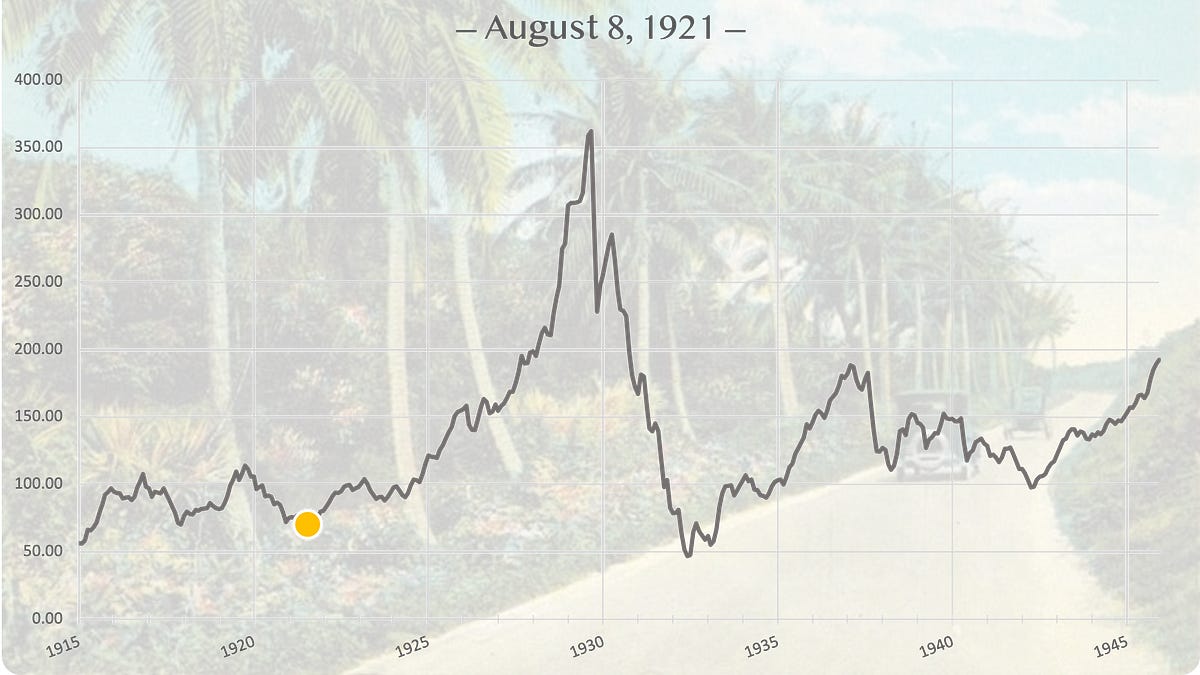
August 8-14, 1921
This week, the Dow languishes near multi-decade lows and blue-chip stocks trade below book value.
roaring20s.substack.com
323 points · by roaring20s · 5y ago · 250 comments
On the other hand, CPI has gone from 17.6 to 271.7 in the past century, so that 5000x total return is really 324x after adjusting for inflation -- also known as 6%.
Now, 6% after inflation is nothing to sneeze at; but it started at a cherry-picked low point in the market and it comes with a lot of market volatility... and it's still not dramatically better than the 4-5% which ultra-long term investors (e.g. university endowment funds) aim to receive after inflation.
Back home, I've had so many agents try to sell me inferior insurance and investment opportunities dressed up as insane deals hoping I wouldn't look too much into the details. I was really lucky to come across the folks at /r/indiainvestments who frequently warn about this. But I am sure there are many others who are not aware of these things and fall for them.
https://en.wikipedia.org/wiki/Rule_of_72
I guess doubling in 10 years corresponds to annual percentage of 7.2 percent, and 20 years, 3.6 percent. Adjusting for inflation, the rate will be lower.
BTW, you may be referring to Unit-linked insurance schemes. They are neither good as insurance, nor good as investments.
[1] Yes, yes I know. Charities are supposed to do some good. How, exactly, providing income to candy shop owner so that they can buy education for their kids is less good than your average tax avoidance charity scheme?
It is remarkable how overlooked that era is today, despite it being a highly transformational time and economically very distinct, yet it's remembered mostly just by disco and unusually gritty movies.
Perhaps because compared to the revolutionary 60's (and later rebuilding of the 80's) it's a more confusingly anarchic time with no clear narrative to grasp a hold of to make sense of it.
More like a messy organic reorganisation as both the counter-culture and traditional culture lost coherence in the face of high unemployment & high inflation, and with society's rule book torn up but no clear path to a better one.
Maybe being a time of social fragmentation and escalating ambient mayhem from crime, hijackings, bombings etc, the best way to make sense of it is actually to watch those great auteur movies unique to the era dripping with atmosphere and mood. Less of a narrative, more a vibe.
In order to get a better estimate of returns it would have to include the cost of redistribution of investments due to the changes in companies that constitute the Dow. Some of these companies that dropped out of the Dow would also have been trading near insolvency, and the losses associated with investments in them need to be accounted for.
If I rerun the calculation from the cherry-picked peak of about 360 in 1928, I get around 4.5% after inflation, without dividends.
The thing that jumps out to me as the dumbest is that it uses raw share price instead of market capitalization.
https://www.npr.org/sections/money/2012/02/07/146546183/why-...
Only reason why some people think CPI is wrong is because people psychologically tend to ignore prices on things that are going down, only mentioning those that are going up. Prices on almost all food, all clothes and most energy (surprise!) are down vs 1921 CPI-adjusted price, and prices on housing are up per unit but down per square foot.
But can we even compare food and clothes from 1920s to today? Of course prices have gone down, and the quality has diminished greatly along with the prices. None of our food is nearly as nutrient dense as it was in the 1920s. Large yields is what the large producers care about. What does this mean for most foods mass produced these days? More water added. You're paying less, because you're getting significantly less.
In 1921, you did not know DJI would have done so well over the next 100 yrs.
A very real counter example is the Japanese stock market. The Nikkei peaked at 39,000 in 1989. Thirty yrs later, it's only 28,000. Many blue chip stocks on Tokyo Stock Exch have never recovered their previous high.
This is what happens when a central bank keeps on preventing moderate recessions necessary for correcting a nation’s economic failures. The US and Europe should study the case of Japan very closely these days.
An alternative view might be that the excessive returns in the US are due to outright financial manipulation using share by backs funded by low interest rates (amongst other things) leading to an insane concentration of money in the stock market and financial sector to the detriment of large sections of US society, its basic infrastructure, and its democracy.
This is what happens when white collar crime is institutionalised.
Buying back shares is neither "financial manipulation" nor is it a "white collar crime".
When interest rates are low and you are bullish on the company, it makes perfect sense to buy back shares.
Do you know what share buybacks even are?
The subsequent 30 years look bad, but the alternative was Great-Depression-style deflation, 25%+ unemployment, and potentially societal collapse.
That 40k was a fake, not true in the sense japan was not actually 2x more productive than the US. Instead it was the product of a super massive bubble. It took over a decade for the US to "catch up". To be more honest: it was japan which needed time for reality to catch up to nominal values.
At this point in time the US is now well past Japan in GDP per capita, which frankly makes sense. The US is much more innovative, with creative destruction occurring everywhere.
By the way. QE has literally no impact on an economy by definition. It's entirely psychological. I don't know why central banks keep doing it. There isn't any private demand left over for credit at current interest rates. Central bank reserves are counted as part of the money supply but their velocity is 0 for practical purposes. You can't withdraw them and you can't use them to purchase goods. The only thing they do is let banks lend out more money which counts for nothing if interest rates are too high.
>This is what happens when a central bank keeps on preventing moderate recessions necessary for correcting a nation’s economic failures.
No such thing is necessary (enduring recessions for no reason). Also, USA is suffering from having the worlds reserve currency and Europe is suffering from having an incomplete euro.
Possibly largely unrelated solely to this, Switzerland is amazing on another thing - very strong middle class that is not dwindling, unlike most of the western world.
Yeah, expats often complain to no end that services and food are expensive compared to where they came from, but thanks to that tons of folks are not desperate, we don't have slums of poor serving the rest, and you know that even person filling the shelves in supermarket is getting decent wage.
Low criminality, high education, generally very smart general population (which allows to have frequent public votes on important things without shooting one's foot like some other places), tons of personal freedom that average US person can only envy, EU is even worse. It all ties together, and middle class is one of the pillars of this.
It does have a rather larger number of temporary workers than was historically the case.
but they do? bernanke was a scholar of japan's central bank policy.
If I remember correctly then Japan was about to take over the USA in terms of the GDP, but started to become strong in many key industries, and then Raegan, who was running under "Let's make America great again" slogan, initiated the anti-Japanese trade war.
And if I am not mistaken or am not simplifying too much then Trump was even hiring the same consultants from that "anti Japan" trade war to start the trade war with China.
> a large unemployment rate
1) Noting that the stock market was boring I think is real indicator of the mass psychology of that time. There is definitely a inverse correlation between enthusiasm for markets and future returns.
2) Noting the returns of standard Oil is a reasonable take. There was a massive expansion of combustion engine production in the preceding two decades and inferring that this would be correlated with increased demand for oil based products is not hot take. Also it doesn’t take a genius to understand a oil is better business that automobiles, recurring revenue and all.
3) Tax rates have historically influenced valuations.
4) I’m not sure how to extrapolate the the German currency situation but I think looking at the relative attractiveness global markets makes sense.
A sector can shrink from 63% of the total market to less than 1% and outperform the market over the time that happened. See the US railway sector from 1900 to 2020:
https://www.credit-suisse.com/media/assets/corporate/docs/ab...
In the 1920’s standard oil subsidiaries were still an effective monopoly for petroleum in the us market. Therefore a reasonable proxy for the future profitability of the entire industry in that market assuming that their ruthless anticompetitive behavior allowed them retain their market dominance. Additionally they were profiting off the same disruption in transportation that you are citing, which as we are both acknowledging was massive.
The book Titan is awesome context for this. Wonderful read.
Unlike the technology such as railroads, natural resource commodities and vertically integrated supply chains tend to not be disrupted as easily (very unfortunate for us).
I’m not saying that it couldn’t have gone wrong, but clearly an asymmetrical risk reward at 3-5 PE. So in general you are right, but I think if you find a company that has a great business model, is a monopoly, and is disrupting a massive market, at reasonable price, you have a recipe for outlier returns.
If we can use hindsight in our trades, I'd recommend using the numbers 60, 54, 36, 24 and 7, on last week's Powerball lottery that paid out $211mm. That's a 100,000,000x return!!
So when Apple does a 1 to 4 stock split its influence on DJI nonsensically falls by 75%.
In theory, price weighting is a poor way to index, but look at it from the other side of the coin - if you choose 30 stocks, from all sectors, how likely is it that you'll get a different return from the market even if you try? Not very.
It's only relatively recently that it became popular to never split and let stock prices grow without limit, too. If the prices are mostly in a small range, then the index is similar to an equal weighted one.
Also amusingly, DJIA is unable to include Amazon since it would obliterate the rest of the index.
Also, almost nobody thinks the S&P5 is worse than the Dow. I'm not sure how you can back that up.
(If you actually want to index, though, a total market fund makes much more sense)
Also including 500 big companies is much more reasonable than including just 30.
---
People lately criticize S&P committee for the rule that a company needs to report 4 consecutive profitable quarters in a row to be included. Thanks to this they've missed the boat on Tesla and they had to eventually include it as the 8th largest component.
Someone on this forum joked that they should amend the rule to say: A company needs to report 4 consecutive profitable quarters in a row and the CEO name must not rhyme with melon tusk.
I guess there's an element of randomness to everything and any company could go under overnight, but in general I think you can rely on hindsight in terms of performance. The higher you get up the ladder and aggregate, the more stable I feel that is.
If you're just comparing the methodology of extrapolating expected returns from hindsight I would agree with you.
I guess what I'm saying is using hindsight to pick a direction seems logical. And doing it from a broad perspective seems more stable (using hindsight to predict if a company will go up vs using hindsight to estimate if a sector ETF will go up). However, I agree that I don't think you can estimate how much it will go in that direction.
There's probably a fallacy in my logic there somewhere. But the results in the real world are good. If those returns are all just luck, well at least I had fun and made some money.
risk free bonds are yielding 5%
It is interesting to find old articles and read what people cared about at the time. Inflation was often a top concern, and politicians running their campaign on curbing it. Some old movies also refer to it (that stolen money which will melts away while you await behind bars).
Our current complacency in term of budget deficits and monetary policy will wake up that sleeping dragon.
For example, I used to assume that monetary inflation was instant and automatic. Double the money supply overnight, and everyone will double their prices and incomes overnight too, as though all that happened was a substitution of variables.
Later I understood that it's not that simple. First, the new money doesn't get distribution in proportion to how much people own, so savings get halved. Second, contracts denoted in dollars don't get adjusted, so debts and purchase orders get cheaper, accounts receivable become worth less, and so on.
And lastly, prices aren't updated automatically by some perfectly objective value calculation. They're held in place by a combination of supply and demand, competitive forces, price elasticity, psychology, and collective expectations.
So the inflation can apply instantly in some markets but it can also take years for those changes to propagate into various other markets.
And even once the money supply stops increasing, inflation can keep going all on its own accord, once expectations become fixed. This happened in Japan in the '60s and '70s where unions demanded 5% annual wage increases to keep up with the inflation caused by every industry getting 5% annual price increases caused by union wage increases...
Right now it seems like the new money is going straight into asset prices, and that will probably remain the case until either asset holders start selling their assets to consume an absurd amount of food and gasoline, or the high price of assets starts to weigh heavily on the cost of production.
The funny thing about inflation is that if it is high enough to "sting" (2-5%) then people notice the missing wealth in the real world and create it to the best of their ability.
The fact that the money isn't moving, that it isn't entering the real economy is one of the greatest mistakes made by the central bank which is prevented from doing so and the government which refuses to do it for petty ideological reasons.
As a gov contractor, I'm seeing this first-hand. Inflation has been tame my whole career in this industry - 2% or 3% / year; therefore, contracts of fixed length have built-in rate increases of similar percentages, and raises trickle down from there.
Most companies will give you raises a bit less than what they're getting each year in increased rates themselves - it's how they increase their own growth and executive bonuses. This can go on for a long time - 5-10 years before the employee will really notice they're falling behind peers who've just been hired or general market rates if they were to jump shit.
But when real inflation is running 7%-10%, the wage disparities between new hires & contracts and existing employees & contracts become evident quickly. For example, I'm discovering that new engineers with far less experience and talent are being hired on for $20K - $40K more than I make, all else equal.
Which forces me to start looking for new employment or ask management for a raise, neither of which is desirable.
/s?
Since the people who can take out new debt are wealthy, the things that the wealthy buy go up. They don't need more apples, so the demand for apples stays the same, and the prices of apples stays the same. Instead they take that debt and pour it into the market(mostly buybacks) and other savings. So we don't end up seeing consumer prices change much.
Each person is attempting to maximize their long-term utility, and so long as inflation stays in check their best option is to keep it in the market growing ever more. Money is useless if you can't eventually spend it for utility. Each billionaire/company is planning what to do with their wealth. Some will create rockets, others will fund disease research hoping to get their name into the history books. It's always and will always be about the utility.
Like the Martingale Betting System has shown, you can not remove the risk by shifting the betting sizes around. As the money supply increase more "energy" is added to the system. It becomes harder and harder to control it. As it increases, the power of each individual to effect the entire system increases. In the 1970's the richest person had $6B, now the richest person has $177B, an increase of 30 times. By 2170 the richest person could have 30x that.
If there is a reason to believe that selling their stocks will yield greater utility, then the wealthy would figure it out, and the first person who acts would win(like what happened with the banks handling Archegos), second would do worse, most would get wiped out, including all the non-wealthy. It would be like a dam collapsing all at once. Sometimes all it takes for the dam to burst is a small trickle. But all that energy was always being stored in the reservoir.
But you better believe that the Fed understands this, and is doing everything in their power to keep the system under control. The problem is though, they need for investments to be the biggest long-term utility creator, but that only increases the energy. The more they keep it going, the more unstable it becomes.
And borrowing money to spend on consumables like apples is clearly risky borrowing. How will you pay it back once you've eaten the apples? So the lender is very strict and the rates are high.
When you borrow money for an asset, it looks safe. You aren't spending money you don't have. You haven't really spent anything; you can always sell the asset to repay your debt! And in the meantime, you reap the gains as the asset goes up. So mortgages are cheap and the lender works hard to help you qualify.
But like you say the risk can only be shuffled into bigger gambles, not removed. You can't make risk-free money by borrowing money cheaply to buy growing assets forever. If the assets are increasingly bought with debt, then their price will correlate inversely with the cost of borrowing.
So right when borrowing gets expensive and you want to sell your assets to pay back your debts, the asset price also drops because everyone else is doing the same thing. It's very hard to de-risk because almost every asset ends up correlated to the same thing: the debt that people are buying those assets with.
I do believe the Fed understands this (and more relevant to me, the Bank of Canada). They know the game they're playing, and I think they're very good at it. And they know the psychology.
They believe the economy will be better off with a period of transient inflation that levels off, because it will get oversized debts down. They're hoping they can hold off on rate increases before that happens, so that rates don't go up until debts are under control. And they're hoping the lenders will go along with it.
Here in Canada we're seeing pseudo interest rate increases via the "stress test", where you have to prove you can afford a 5.8% mortgage in order to get a 2% mortgage, because the government needs to keep debt servicing costs low as they inflate them away without incentivizing everyone to load up on even more of them. That net doesn't catch everybody, but it should protect the most vulnerable. It's a very delicate balancing act. I don't know if it will work.
I think we'll find out soon.
Akhem, there are places outside America. I still have the postage stamps for 100,000 monetary units from the late 1980’s and early 1990’s Yugoslavia in my mom’s basement somewhere.
My parents’ tales of ridiculous mass inflation have been etched into my brain. I was too young to remember, but the spectre loomed large. Especially in the mid 1990’s when the rest of Yugoslavia set the world record for monthly inflation that still stands today. Luckily we were our own country with our own money by then.
At one point hyperinflation reached 2% per hour.
https://en.wikipedia.org/wiki/Hyperinflation_in_Yugoslavia
I believe many parts of South America are going through high levels of inflation right now.
Imagine if the president of the USA decided to solve the homeless problem of the black population by pointing guns at white homeowners and forcibly dragging them out of town. It's clearly unsustainable.
There might be truly disgusting capitalists like martin shkreli on this planet but they don't attack you directly, they merely deny you your fair share of the wealth you have created.
What's the difference between Marxism and "anti-colonial Marxism"?
Last year a dozen donuts at the local family run shop was $9, this year it is $12. My daughter's specialist doctor raised the cost of an office visit by 30% this year. The cost of a burrito at my favorite spot is up 25% in two years. I could go on. I care about inflation, and it is real.
Also, despite what the Fed probably wants you to think, QE is not money printing, it is a duration swap between different forms of existing money.
I wish the fed would raise interest rates.
These low rates only seem to help the wealthy, and prop up an overvalued stock market.
While the wealthy see their stocks skyrocketing, the poor and middle class just see higher living costs. I guess if you can afford a house the low interest rates are nice?
In the 90's I used to get $400 a year on my sweaty cd wad. (I can't afford to gamble with stocks.)
The other day I took out a few thousand from my cd, and was concerned about the early withdrawal which is tied to current interest accumulation. The fee was 49 cents.
Personally, I feel the reason the fed tax rate is so low is because Powell knows this stock market is truly a house of cards. Most business are way overvalued. He's scared to death it will crash on a scale that won't be as bad as '29, but the wealthy will lose most of their cash.
I have never seen a bull market go on for this long.
Almost in every other I have watched the professional stock boys wait until the last retail investor put in his last dime, and they pull all their money out.
I felt it was doing to implode a few moths ago with all the NFT's, and glamour puss celebrity SPAC's being pimped, but no.
I feel if that hastily put together, nebulous, pork filled 2700 pages, infrastructure bill, which seems like it will basically be a gift to contractors (like Ghilotti Family syndicate types). It will produce very few union blue collar jobs that will not last. If it does pass we might not see a big stock market crash for a bit longer, but it's coming.
Instead of the Infrastructure bill, I would rather see a Basic Income. Poor people who didn't work got nothing out of the pandemic money. Homeless got nothing out of the handout.
Let's do the infrastructure spending when we have a clue to where the money is going?
Ok--to those who can't afford to lose money, get your money out of those overvalued stocks.
The crash is coming.
(Sorry about the rant. I have watched the stock market decimate the little guys over the years. The wealthy slowly pull out, but the retail investor gets whacked.)
  > I wish the fed would raise interest rates
  ...
  > The crash is coming.
reason being that for the last 10 years or so, companies all over have been soaking up "cheap" capital from what is basically basically zero interest loans
these debts are what is keeping those companies floating/alive, and if rates were increased even a bit, it could be devastating by causing a quick succession of bankruptcies (supposedly this was why trump was so angry at the fed for pondering raising the rate)
anyways, im not an expert, but it seemed plausible...
Most folks are in mortgage and consumer debt and have little wealth. Higher inflation mostly impacts people with wealth.
Look at what’s happening now. Lower income folks are getting life changing payments of just a few thousand dollars in the US that is causing increase in services costs.
For example, inflation typically triggers interest rate increases. If your debt is fixed rate that's fine, but if it's not, it might get more expensive more quickly than you expected, and your wage increase might not cover it.
I had a car loan in the early 21st century, and the rate was about 6%. It didn't seem that bad at the time. I think I remember when the bank paid 4% on savings accounts in the 80s or 90s.
That's not to say inflation was very high in my lifetime, but it took a long time for people to get really complacent that it wasn't coming back, and super low (or negative) interest rates are quite recent.
It's only been about 40 years since 30-year mortgage rates were over 18%. Someone in their 40s may not remember it first hand, but they probably have a sense from the older generation that is a thing that happened.
With that cycle now concluding it's likely that inflation concerns will soon be making a major comeback, already some observable echos of the stagflationary 70's: https://www.nytimes.com/1978/06/18/archives/how-carter-can-s...
Now... doing so might totally ruin the economy and eat all GDP growth, but that's the next generations problem.
The inflation rates aren't too bad, but $10k can't get you a (very lowend) new car anymore, like it did when I graduated. Speaking of graduation, looking ahead to college prices for my kid, sticker prices are easily the price of a whole 4 year degree when I went for every year.
If we include my childhood, arcade games used to be a quarter; the last arcade I was in, even Pac-Man was 50 cents, let alone the dollar or two dollar games that were more modern.
Now that the harm is done and the money circulating, the media is slowly starting to shine some light on the topic.
Although that could push one toward conspiracy theories, as per Hanlon's razor we shall not attribute to malice that which can be adequately explained by stupidity. The media probably just got distracted as we all were.
And I suspect economists are manipulating how they calculate inflation, since I am creature of habit and mostly buy and consume same things for the past 15 years.
Prices are going up significantly. Some of it might be due to global shipping increase, but over all my total spending on consumables has increased to between 15% and 20% in the past 2 years.
Then all that nonsense about lumber earlier in the year, blaming QE for supply problems. Lumber prices now 1/3rd what they were a few months ago.
Neither of these are true anymore and inflation now will be a reflection of true scarcity of a good / service (e.g., housing) as opposed to the transaction costs associated with procuring it...
Furthermore it's also more accessible proportionally to existing wealth, which means inflation is in effect an inequality amplifier.
This is what a lot of people don't get about market bottoms. Nobody cares. It's not like they hate an asset class. They just could not care less.
This is one of the reasons that buying market bottoms is so hard. There's no story. You tell somebody what you did, and they just look at you with a blank stare.
Then you get to wait while ... nothing at all happens. Good news that should turn prices around - nobody cares. Or worse, a surprise snap lower that makes you question your "value" stance.
During the transition period from bear to bull, nobody believes it's real. The bears from the previous cycle who called the top and made the right choice to sell will not believe the bull is real and so will stay on the sidelines. As the market rises, everyone - even the bulls - will expect the inevitable return to baseline. Rinse and repeat. Maybe for years. Not many people will continue to hold on during that period.
Near market tops, of course, it's exactly the opposite. You will be congratulated from here to Timbuktu and back for your "wise" investment when buying into a market shooting higher. You'll look like a star. Somebody who knows what they're doing. There will be lots of talk about new paradigms and how this time it really is different, and why.
You should be selling, but your own brain and the brains of the people around you will make you buy, buy, buy instead.
It's so predictable as to be laughable, except for the pain and chaos that happens when an especially monstrous bull goes to the slaughterhouse.
Market timing has always been a thing. Whether it's a bottom or a top or a head and shoulders pattern. This is the whole point of technical analysis and there's enough people out there to care about every single thing the market does at any stage in it's cycle.
I'll let you in on a little secret. Technical analysis is a lot of smoke and mirrors. I was in this industry.
You can draw all the head and shoulder patterns you want, if Elon posts a Tweet about price targets of 420.69, Apple doesn't sell enough iPhones, the company you are charting causes a major oil spill, or the weather gets warmer, those patterns vanish in an instant.
Millions of global traders do not obey lines drawn on charts. The market is too complex for that.
There's absolutely zero legitimate reason for a human to look at charts and use TA.
So while the hordes are all trying to suck blood out of increasingly tapped investments in real estate (e.g. 8th tier mountain "resorts" in the middle of nowhere) or equities (me-too energy or tech pump & dumps), the next big thing is completely being ignored.
And in 10 years, everyone will say it was obvious that these would be the next big play. 20/20 hindsight.
This is bad advice.
There is always a reasonable chance that the next bear market is more than 4 years away and that equities are still cheaper now than they will be at the bottom of the next crash.
You have also explained quite well that you likely won't be able to hit that bottom of the next crash.
So just don't care about anything and invest every month, even if everything is "overvalued" and a "crash is imminent".
I knew a few people who took a gamble and bought up real estate and made out like bandits. At the time people thought they were nuts.
Humans suffer a lot from recency bias - whatever has happened for the past 5 years will continue forever.
One of the great challenges of human existence is we do not live 100 yrs to see those returns. Instead we're living, blind to the exact details, on the choices of those 100 yrs prior to create the X% returns of their choices _for our lives_ . One way to get people to make such choices is to create a love for whomever comes next. Children used to be a "skin in the game" sort of scenario where you didn't want to mess up the future cause you had a vested interest in it. Between selfish culture and few people having children, i'm not sure the solution .
While many say that ending aging / increasing life span to 100s or 1000s of years would be disastrous, I actually think it might fix a lot of issues as we'd have that timespan of a personal interest to optimize across.
So you think we might have put a few people out of business today. That its all for naught. You've been doing that everyday for almost forty years Sam. And if this is all for naught then so is everything out there.
Its just money; its made up. Pieces of paper with pictures on it so we don't have to kill each other just to get something to eat. It's not wrong.
And it's certainly no different today than its ever been. 1637, 1797, 1819, 37, 57, 84, 1901, 07, 29, 1937, 1974, 1987-Jesus, didn't that fuck up me up good-92, 97, 2000 and whatever we want to call this.
It's all just the same thing over and over; we can't help ourselves. And you and I can't control it, or stop it, or even slow it. Or even ever-so-slightly alter it. We just react.
And we make a lot money if we get it right. And we get left by the side of the side of the road if we get it wrong.
And there have always been and there always will be the same percentage of winners and losers. Happy foxes and sad sacks. Fat cats and starving dogs in this world. Yeah, there may be more of us today than there's ever been. But the percentages-they stay exactly the same.
Why even repeat that? It’s like saying “did you even read the article?”
Tangentially, it is kind of interesting that very few people in markets use this kind of historical information to learn more about markets. Russell Napier runs a library in Edinburgh that is composed solely of economic and financial history books. You can have all the technical information in the world, it won't help you avoid the impact of human psychology. I suppose this is why financial cycles happen, the old guys retire, the new guys who have only known a bull market get into it...same mistakes over and over.
To give you a concrete example, I did my thesis on US monetary policy in the 50/60s. The understanding of this period within economics is based almost entirely on the view that economists have of themselves today. If you read the minutes, you see that the Fed understood why inflation was rising in the late 60s but were unable to do anything about it. This grey area of political independence is, of course, totally forgotten today (when you have a former Fed chair as Treasury Secretary, alarm bells should be going off...but, of course, this is all long forgotten).
The reason why Burns' policies were poor was because he wasn't making policy within a context that makes sense today. From the mid-60s onwards (before inflation took off), monetary policy was formed politically. The economy used to cycle around elections for this reason. Burns really took this to its logical conclusion...and to be totally clear, a lot of the mistakes that Burns made were made in other countries. Burns was actually fairly hawkish, compared to Miller, but the problem was (partly for reasons of political expediency) people believed that wage restraint policies would be effective.
To loop back, the lesson of the 60-70s is that monetary policy should be free of political influence. Look at what is happening now. Has the lesson been "learned"? And, more importantly, can it ever be "learned"?
Lefevre, E. (2004). Reminiscences of a stock operator (Vol. 175). John Wiley & Sons.
Kramer, C. (2000). " Devil Take the Hindmost: A History of Financial Speculation" by Edward Chancellor (Book Review). Finance and Development, 37(1), 53.
Mackay, C. (2012). Extraordinary popular delusions and the madness of crowds. Simon and Schuster.
The book that I cite is identical to the OP. The author goes through newspapers from the period leading up to 1929 (and iirc, through to the late 30s).
Can you elaborate on this point? I would think a cabinet member going to the fed and not coming from the fed would be more alarming. What am I missing?
This happened in the 70s. Nixon politicized the role with Burns (who came from the CEA), then Carter appointed Miller (who went onto become Treasury Secretary). And btw, Miller was (with hindsight) one of the worst Fed chairs of all-time.
Tbf, Volcker came from Treasury, Geithner went into Treasury (after FRBNY) but, in both cases, they operated with Presidents who respected the distinction in functions. This distinction weakened significantly under Trump, and is now non-existent.
“The New York Times reported, on page one, that the Central Union of German Citizens of the Jewish Faith, a group with sixty thousand members, had issued a statement saying that the reports of atrocities by Nazis against Jews were ‘pure invention.’ It was March 25, 1933.
“Anti-Semitism existed, and it was, the society said, a matter of grave concern, but it was a domestic affair. ‘Let us take an energetic stand against everybody attempting criminally to influence the shaping of Germany’s future through foreign newspapers.’ ”
Lords of Finance: The Bankers Who Broke the World by Liaquat Ahamed. It is more interesting than the title, I think. It covers WW I, great depression, and the beginning of WW II, with a focus on monetary policy (gold standard, etc.), but also gives general political and economic background.
My main take-aways:
1. Things were slower. The Governor of the Bank of England wanted to confer with his counterpart in the US. So, he'd board a boat to the US anonymously, travel there over the course of several weeks, chat with his pal for a few weeks, and travel back for a few weeks.
2. Things are hard to predict (market collapse, inflation, fascists taking over your country). In particular, by the time it becomes clear that the threat is real, it is too late to protect yourself against it.
What I did not realize until going back in time was how these German reparations are dragging on and on.
Armistice is signed in 1918, and reparations are agreed upon in late 1919. In 1920, the payment plans are put forth. By 1921, it's clear Germany can't repay in full. For the next 3-4 years, the entire calamity will stumble in fits and starts. Until the US gets involved in the mid-1920s (Dawes and Young Plans).
Even then, war reparations aren't completely paid back until 2010.
It reminds me a lot of the Greek situation in the 2010s. Three bailouts, several different rounds of negotiations, etc.
If only 5 percent or so of those companies still exist (optimistic percent), it would mean you lost most of your money in 95 percent of your original investment if you just bought and held.
Curious if you'll reach the same conclusions from WSJ/FT on the key causes of the bubble and crash.
TIME's coverage of the 20s seemed to suggest that the bubble was caused by loose monetary policy from the Federal Reserve over the course of the decade. There were a few key turning points during the decade
1) Fed lowers rates to help Calvin Coolidge get re-elected in 1924
"Easier money was the most significant development of the past week..We have more gold, less active business in many lines, and a Presidential election ahead. No good Republican would particularly enjoy seeing the brakes applied to the money market as hard as to cause a skid downhill similar to that experienced last year. As long as the Federal Reserve Board consists of political appointees, it is somewhat beside the point to declare that politics has nothing to do with business tendencies." --February 1924
2) The Fed tries to raise rates after the election in 1925 but decides not to in order to help Britain return to the gold standard
"When the New York Reserve Bank raised its rediscount rate from 3 to 3 1/2 % (TiME, Mar. 9), financial London at once showed something nearly akin to excitement...when the Wall Street money merchants snap the whip, Lombard Street must jump." --March 1925
"The rates of the Reserve Bank of New York and the Bank of England are made cooperatively in order that the British rate may always be slightly higher and thus avoid heavy gold exports to this country. New York Reserve rate is now 3 1/2%, and a rise to 4% would consequently threaten the British gold supply and the sterling gold standard. Hence, after all these alarms and excursions, the money outlook in America is still for stable and relatively low rates. This in turn facilitates stable security prices and commercial prosperity." --October 1925
3) This attempt to keep rates low to help England leads to a schism in the Federal Reserve Board in 1927. Tight money interests in Chicago break from NY loose money proponents.
"the [Chicago] Journal of Commerce charged last week, "The little New York group that dominates the Federal Reserve System came to Chicago and tried to induce the directors here [of the Chicago Federal Reserve Bank] to cut the [re-discount] rate and afford pretext to New York. The request was flatly and somewhat indignantly refused.
Continued the Journal of Commerce: “Europe and particularly England wants, and no doubt needs, a very low money market in this country so that American bank funds in large totals may be' attracted to England; and to that end our re-discount rates are to be reduced, and probably Federal Reserve securities are to be sold, and easy credit is to be manufactured." --August 1927
4) The Chicago contingent takes control of Fed policy
[One week after forcing the Federal Reserve Bank of Chicago to lower its rediscount rate] "Daniel Richard Crissinger, governor of the Federal Reserve Board, tendered his resignation. Though bankers and lawyers were still dis- puting whether or not he had been "domineering" in forcing a reduced re-discount rate on the Chicago Federal bank (TIME, Sept. 12), Mr. Crissinger said that this dispute had nothing to do with his withdrawal" --September 26
5) Speculation runs wild in 1928 even though the Fed begins to tighten. Retail investors lead the charge.
"The Chicago Federal Reserve Bank last week increased its rediscount rate from 3½ to 4%. At once the Richmond Federal Reserve Bank did likewise. It was the first time since August, 1926 that any of the 12 Federal Reserve Banks had increased their rates." -February 1928
""[At the New York Stock Exchange] Every "record" of any shape or description was broken and rebroken. The explanation is simple. The "public" had finally come in, tardily, clumsily, "at the top," as always, with the greatest reservoir of cash of all, compared to which Wall Street's organized money force is small. It astonished nobody, because 7,000 tickers are now hypnotizing greedy eyes in 40 states, leaving scarcely a middle-sized town from Maine to California where citizens may not actually see their savings bank withdrawals dance past their giddy eyes in strange, cryptic abbreviations three minutes after passing their checks to the broker." --April 1928
6) Low interest rates lead corporations to lend excess deposit money on margin. Bankers warn that this is dangerous but only act as intermediaries.
"With $500,000 surplus cash to put aside until it is needed, a corporation usually does one of two things. It may bury the money, either in gilt-edged securities, yielding from 3 to 4%, or in its bank account, where it draws 2% as a commercial deposit. Or it may ask the bank to lend the money out on call, at interest rates ranging from 5 to 10%. As the bank asks only a small commission for this service and generally assumes all the risk, the conversion of surpluses into call loans has become a popular feature of corporation financing. In the last year, the total of such loans has risen from $906,144,000 to $1,808,645,000. To the corporations, this practice seems both obvious and admirable. But to the paternal superbankers, guarding the money market, it appears highly hazardous, deeply disturbing" --August 1928
7) In 1929 the Fed begins to actively fight speculation. The all out assault eventually bursts the bubble.
"Toward Wall Street last week the Federal Reserve Board shook a threatening finger, spoke a warning word. With loans to brokers standing at $5,669,000,000, the Board felt that too much money was being absorbed by the stockmarket, that other interests were being forced to pay too much for money they borrow, that indus-try as a whole was suffering from diversion of funds to brokers and speculators. It therefore expressed the opinion that a member of the Federal Reserve Banking System is "not within its reasonable claims for rediscount facilities" when it borrows Federal Reserve money to be used in "making or maintaining speculative loans." Further, the board threatened to "restrain the use of Federal Reserve credit facilities in aid of the growth of speculative credit." Taken at face value, this statement would mean refusal of loans for speculative purposes, plus a rise in the rediscount rate, which in turn would mean a stockmarket afflicted with scarce money and falling prices." --February 1929
"For so many months so many people had saved money and borrowed money and borrowed on their borrowings to possess themselves of the little pieces of paper by virtue of which they became partners in U. S. Industry. Now they were trying to get rid of them even more frantically than they had tried to get them. Stocks bought without reference to their earnings were being sold without reference to their dividends. At around noon there came the no-bid menace. " --November 1929
I’d love to run some NLP over that history to track sentiment over time.
The market sentiment in 1921 was very bad for stocks. In fact, a week ago in 1921, Andrew Mellon (Treasury Secretary) suggested retail investors avoid stocks. This was covered in my post last week.
Sentiment is going to flip around 1923-1924 (once we clear the 1920 top) and only strengthen into 1929.
I am working at a YC Fintech company exploring economic opportunity over time and think there are some deep relationships here around human psychology and markets.
If you can't say, no worries.
So it's 1935 in terms of war, 1928ish in the macro economy, 1858 in terms of nationalism, 1900 in terms of trusts? I console myself by thinking about my grandfather in 1935 when his family lost their farm and it was the Great Depression and he had no money and he somehow started college the next year and graduated as an engineer right into the teeth of world war II - but he made it.
What you'll notice is "plus ça change, plus c'est la même chose"... It's all self similar. The same concepts and patterns back then are the same concepts that people chase today.
The ripple effects of seemingly disconnected events thoughout history never cease to amaze me. It makes me more aware how damaging seemingly once-off things can be (act of terrorism, discriminatory or unfair policies, economic hardship) due to the spiralling effect that can happen.