The Evolution of Trust
an interactive guide to the game theory of why & how we trust each other
ncase.me
405 points · by GranularRecipe · 5y ago · 62 comments
>the fewer "repeat interactions" there are, the more distrust will spread.
Doesn't this explain quite well why big internet communities devolve into a cesspool? I'm not behaving like a jerk (or worse, a moron) if I know people around me will recognise and avoid me, but as the odds of that happening get closer to zero, it becomes more advantageous to fling shit.
A. Behaving like a know-it-all jerk?
B. Behaving like a contributing member of a curiosity community?
Depends on the community norms and how well we understand them.
Even if a similar topic comes up on FB and I've just posted a large comment here with multiple sources against a point of view, on FB at most I'd probably post "Eh, I'm not sure that's quite right, at least according to this. <link>". Almost nobody there is actually interested in having their point of view challenged or learning more about the thing they're posting, from my experience, so that's about all you can do in many situations without things just devolving or people ignoring you.
Edit: and bitter arguments.
The effects of that go beyond just the awful emotional impact. People get fired for that kind of controversy. (I hesitate to call it "cancel culture" because of the implications in that term of who's canceling who).
The other takeaway is to foster Win-win situations as opposed to zero-sum games.
I found it extremely insightful and their observations connected long standing disparate dots for me. It’s as if a big jumbled up puzzle suddenly clicked into place.
However, I’m not entirely sure that this was the intended insinuation. Yet it’s hard to read anything else into it since its about a girl trying to engage with her friends on her phone across these various platforms and being stopped by the ‘anxiety wolf’. She even gets her health dinged for sharing a news story, which to some extent could be viewed as engaging with reality.
Engaging with reality can most assuredly cause anxiety, however I don’t really view this as improper. I don’t believe that mental health should be thought of as a framing or mindset one has to the extent that it frames reality away. I.E. I may feel better if I pretend covid is not real though I am not making a healthy choice if I do.
This is a really odd reading to me. Especially if you play through the scenario multiple times, you see that the Anxiety Wolf controls Human regardless of what you do: even if you turn down the party invitations or if you never interact with the news story on Twitter at all.
It's not that engaging with social networks is bad, it's that Anxiety Wolf views every interaction and outcome as dangerous. If you eat bread, you're eating junk food. If you don't eat bread, you might have an eating disorder. If you don't share a story, you're disengaged. If you do share a story, you didn't fact check it enough. If you eat lunch alone, you're going to die alone because you can't make friends. If you try to get a date, your date's a serial killer. You can't win; there isn't a move that Anxiety Wolf will be happy with other than being in a constant state of panic all the time or curling up in a ball and crying, because Anxiety Wolf is scared of everything.
The point of the first section of the game is that Anxiety Wolf has an unhealthy relationship with risk analysis, which ultimately leads into the point of the second act of the game -- that the absence of Anxiety Wolf also causes Human to have an unhealthy relationship with risk analysis in the opposite direction, to the point where Human starts ignoring imminently dangerous situations.
> I.E. I may feel better if I pretend covid is not real though I am not making a healthy choice if I do.
Covid is actually a pretty good example here. Anxiety Wolf wants you to get vaccinated (which is a very good idea, because you should be scared of catching Delta). But Anxiety Wolf was also the voice early on in the pandemic telling people to dip their fruit in bleach in case somebody in the grocery store had touched it. It's important to figure out how to distinguish between those two suggestions.
It reminds me of the whole Colbert paradox, where he polls equally well with all sides of the political spectrum despite engaging with politics daily. No matter what you believed you felt he believed the same things as you.
This is not that I disagree with your overall view here - I don't, people should absolutely apply logic in reasoning to their rick/reward calculations rather then going on pure gut feeling - however I just do not believe this game really goes into any of this in a manner fitting to the complexity of the subject. But really, how could 6 min flash game do that?
So, moral of the story is: Reward good behaviour.
Being "nice" (copycat) is not the same as being a "sucker" (cooperator).
Suckers don't make things worse just for themselves, but for everyone around them, by encouraging bad behaviour.
Even then, people make mistakes, so don't hold grudges for too long. They won't lead you very far.
The problem I see only pops up when there are more interactions - when the player knows the other will cheat, but still decides to cooperate.
I wish. This is an oversimplification.
In many real-world scenarios bad behavior wins unless the rules of the game are changed to encourage cooperation.
E.g. by social norms or legislation or contract
The morality depends on where/who you were when the system/rules changed.
In those games, best move is to exit the room. Cause no reward/punishment system work.
Nash equilibrium is a fixed point.
i.e stuff is happening, there's a lot of predictability but no easily determinable stabilisation endpoint?
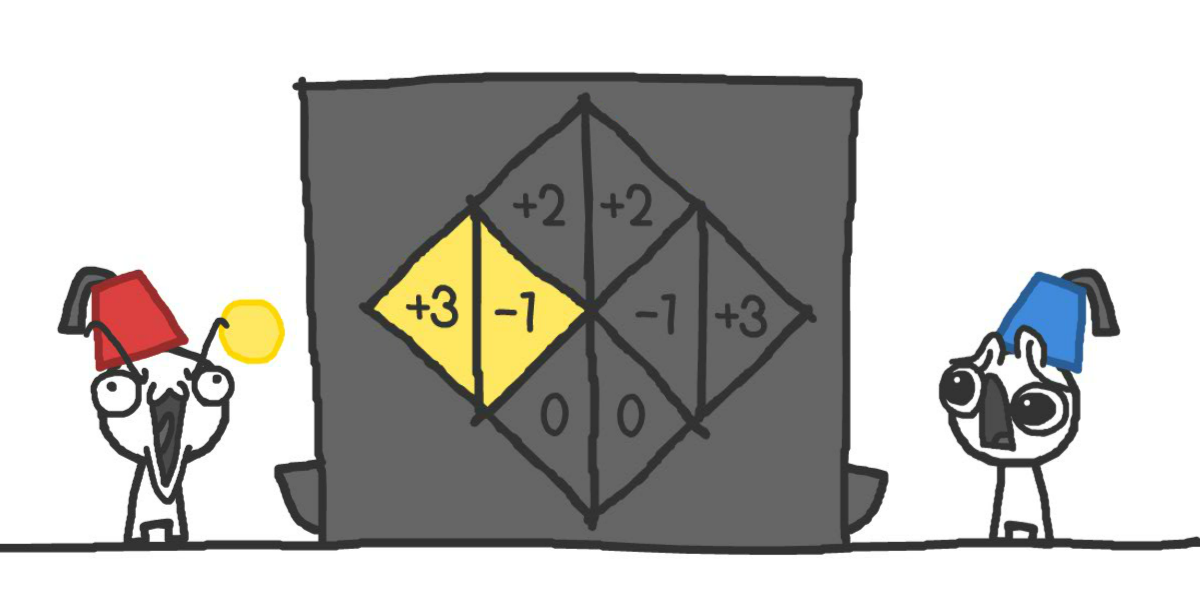
In a way, this makes sense: if the penalty when both parties cheat is harsher than the upside of swindling your partner, "trust at all costs" wins out!
But on a societal level, I suppose this means that if you want to optimize for do-gooders, you should punish failure harshly, no matter which party is responsible...
And, as chance would have it, this is where I first heard Komiku's "It's time for Adventure!" (the song that plays in the intro). It has since been what I listen to when programming when silence is not an option
https://freemusicarchive.org/music/Komiku/Its_time_for_adven...
Check out the other Volumes too, they're all great
https://hn.algolia.com/?dateRange=all&page=0&prefix=true&que...
It would be interesting to see what happens when the types „slide“ towards the next personality (copycat into copykittens into always cooperative) as they get possitive feedback (and the opposite for always cheater).
mmm. or just play nice.
co-operate first, then if the other person cheats once then cheat back always