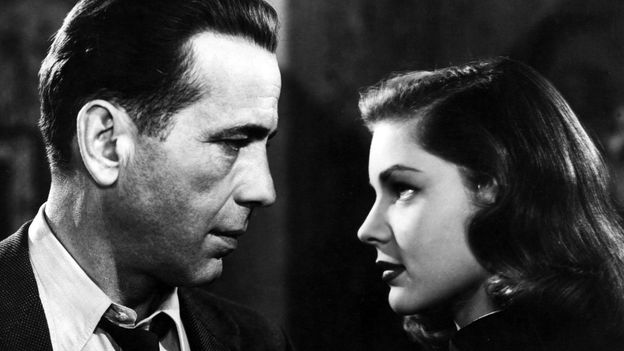
The Big Sleep: The most baffling film ever made
Film noir The Big Sleep was released 75 years ago. While its plot has been criticised as 'cryptic' and 'confusing', that can also be a virtue, argues Nicholas Barber.
bbc.com
145 points · by DrNuke · 5y ago · 154 comments
Lynch is a bit harder. Lynch is atypical in two ways that play off of one another. First and most obviously, he has been developing as a film-maker (as one would hope over the decades), but he expects that his audience would have kept up with him, introducing a kind of filmic vocabulary. I would say that Mulholland Drive is much, much more comprehensible once you have understood what Lost Highway is on about. In turn, Lost Highway is an extended riff off of the dualism you would see in Twin Peaks and Fire Walk With Me. As to the second factor, Lynch is very heavy into TM and he would like to present images, sounds, and such to the viewer, and then find out what the viewer thinks of them. Not in a "this is up to you to puzzle out," rather he is pitching rocks and skipping stones off of what he likely believes is to be a collective unconscious or a shared cultural experience, then being excited about what might pop up. It's a genuine interest, I think.
My second least favorite thing studios do is cut the trailer in a way that makes the movie seem totally different or even a totally different genre.
Aside: a friend gave me the Sixth Sense dvd as a birthday gift one year, which I had yet to see, and my idiot roommate at that time was in the room couldn't restrain himself from trying to cleverly address my friend in a way that communicated he knew the twist. Except he'd never touched on clever in his life and gave it away instantly. Nice one Paul. Nice one.
Most people, in most cultures, don't accept it as fact that life doesn't make sense.
What % of people would agree with the statement "everything happens for a reason"? Or even "because God did it".
Of those who don't think everything happens for a reason (i.e. life makes sense... to someone), the vast majority nevertheless believe we live in a universe of physical rules.
We accept we could get wiped out by an asteroid or a deadly plague, sure. That makes sense.
We don't accept we could get wiped out by a Lynchian fever dream. That doesn't make sense.
Film & literary theory starts from an understanding of this phenomenon. It's the basis of willing suspension of disbelief. We don't have to try to fill in the gaps with our imagination, when we see/hear/read the corpus of a story... Our minds tend to start playing along, automatically, when prompted.
Plenty of people have proved perfectly willing to entertain the idea of getting wiped out by asteroid or plague... But also, plenty of people have proved willing to entertain the idea that we live in a constructed artificial reality, a la "The Matrix".
Our religious beliefs are just as nutty and varied as movie premises, and that's not a coincidence, because religious beliefs basically emerge from the same mental phenomenon as literature.
I mean, it makes no sense that an invisible Sky-Father supernaturally impregnated a Jewish teenage girl, two thousand years ago, and that the resulting child could reverse thermodynamic processes at will... But nearly 1/3 of the world says they believe it like that, more or less.
[1] https://www.youtube.com/channel/UCVdYdogQM2xd29HUOED4EbQ
I was totally puzzled by Mulholland Drive, then I read an explanation in a IMDB review, watch it again, and I was amazed that everything made sense. It was encrypted and somebody gave me the keys. That's really an artistic experience.
One big thing, that I realized later (and the GP comments on this too) is that Lynch has his owns symbols and language that clue the audience about what's going on (the red velvet curtain for the subconscious/dream world, for instance). If you are not aware of that, it's easy to get lost.
On the other hand I did see Blade Runner when it had the narration the first time I saw it. Luckily I've seen it without many times since.
There's an old Steve Yegge post where he described presenting for Jeff Bezos. I'm paraphrasing, but Yegge said something like after writing the presentation (no slides), delete every fifth paragraph to keep Bezos intrigued enough to pay attention. I feel like that's what happened to either the script or the filming of 'The Big Sleep.'
EDIT: Every third paragraph, link to Yegge post: https://gist.github.com/kislayverma/6681d4cce736cd7041e6c821...
A good movie nonetheless.
[0] https://en.wikipedia.org/wiki/Talk:The_Long_Goodbye_(film)#A...
Let's face it: Bezos isn't some alien from another planet. He's privileged and lucky. He's lucky he had engineers come and help him build his company.
I've made a habit lately of "checking out" on having any opinion about anything I can't truly analyze. And this is a great example of why.
I'm surrounded in content telling me why Bezos is a monster, and they make a good argument. But for all that hatred, I've never once heard a single mention of him being smart, let alone intimidatingly smart, let alone "a first class genius" or "better regarded as hyper-intelligent aliens with a tangential interest in human affairs."
This seems like an important character detail to have been left out.
I say this not because I don't believe he doesn't have an impressive intellect, but because, well, what if someone had his intellect, but worked in an Amazon warehouse due to circumstances outside of their control?
I had a friend once who was very smart. He was always starting new projects to make money, and always quit at the first or second obstacle.
1. Yes--he built an impressive company, and a company ripe for unionization. I've never understood why he allowed so much counterfeit merch on that site? I can't imagine why he didn't stifle that one.
2. He gave away billions in a preventable divorce.
3. Because of vanity, he wore those stupid cowboy hats during that amusement ride for wealthy people. Looking back that PR stunt could have been so much better.
4. I really think his forte is diligence, and drive testosterone gives a man. He was also first to market basically, and tenacious.
Hell-- if he was truely a genius, he probally would have never started the company. I'll go farther. Being smart might be a impediment to a good businessman?
5. I don't know Bezos. I don't know any successful businessman, except one. The owner of Dentek. Oh yea, I do know the CA governor. Both are far from intelligent. They both came from wealthy families, and had sympathetic fathers financing,planning,inventing prototypes in every move in their lives. Intelligence had nothing to do with their success.
6. What makes Bezos special is it sounds like he didn't come from money, and didn't have the sterotypical wealthy father.
On articles about the beginnings of Amazon, the writing culture, or anything that is in part a biography on Bezos, I always see it mentioned how smart he is.
I think the distinction between "evil" and "evil genius" is actually kind of important for a world that often anchors its reality to Hollywood narratives. It sets up a more believable antagonist, and makes it clear that -- unlike the grinch -- their heart is not likely to change.
It also sets up the challenge: be smarter. If he was just greedy, it might be a race to the bottom (greed always wins). But in this case it's a race to the top (intelligence seems to win).
I also think the distinction between "greed wins" and "smart wins" extends with a similar lack of mention into other popular "villains" like Elon or THE ZUCK.
At least for me, knowing that the richest person in the world is also considered extremely smart by the smartest people he could pay to work with him... it makes me feel that -- unlike politics -- business is not yet a complete race to the bottom.
Ambiguity, elision, out-of-order story telling, etc. are all part of art but it's a delicate balance. There's a contract that artists set up with the audience that will allow them to use these techniques. Primer is one of those where I'm OK with my confusion because the story was interesting without all the answers, and it was setup pretty early on that this wasn't an A to B story. On the other hand, the fade-to-black ending of The Sopranos was, in my opinion, a total violation of that contract. Nowhere did they setup that kind of ambiguity. Yes, it's a series vs. a movie but my point still stands.
No Country for Old Men, again IMO, rides that line a little close. Sure the Bardem character checks his boots at the end but there were some other major gaps that I don't think were set up. It was well acted and produced but expectations were not managed so it still goes into my meh pile.
When it works the it's a lot of fun figuring things out. I'll have to give The Big Sleep a try.
Edit: At the other end of the spectrum, expository lumps are no fun either.
I respectfully disagree. One of the qualities of "The Sopranos" was exactly that things weren't always spelled out explicitely. Also, I did not really find the ending to be extremely ambigious. I mean, it is pretty clear what happened.
Michael Imperioli even pointed it out on a late show interview, that there were multiple hints in the previous episodes that spelled things out entirely clearly.
Really? This is one of my favorite movies. What did you find overly ambiguous? If anything I felt the closing dialog and monologue were sort of on the nose about the theme of the movie, but I don't mind that.
Though "Lost" was on to something with the dialog "it's a snowglobe!" They could have followed up on that, leading to a satisfying conclusion, but as with everything else, it just went nowhere.
I suspect that the writers originally had a coherent story arc, but the show was so successful they had to extend, extend, extend it, which produced the incoherence.
Is this different than the Lost series of 6 seasons and 121 episodes?
Or is this just an unusual use of the prefix “mini-”?
If you like Primer, I highly recommend Shane Carruth's other movie, Upstream Color. Very different from Primer, but similar in that both movies let viewers figure things out for themselves.
Its like the amazing difference between medieval and modern art works is the difference in how metaphor and meaning is represented rather than the actual story represented. However some might say that it's the story that counts and thats whats interesting.
To be a cultural historian today must be very frustrating.
On the other hand, we just saw The Green Knight and that one will throw you.
I think I'm going to need at least two more viewings to get from "OK, I see it saying a lot of things about several themes or ideas, and I can tell what at least some of those themes or ideas are, but I have only the vaguest idea what it's saying about them" to "ah, now I get it."
Great movie.
https://play.google.com/store/audiobooks/details/Raymond_Cha...
The plays are rarely rebroadcast on the BBC:
For anyone who's thinking of watching this weekend, the Maltese falcon is another great Bogart movie, and not quite as complex as the big sleep, and my personal favourite.
But do films (or any art) have to "make sense"? For example, I've never really worked out what the original "Solaris" is about, but it doesn't stop it from being both scary and moving.
In a lot of ways I think it depends on your role, and the role of the film in your experience. If your role is to enjoy, then I hope the film was created with your preferred perceptive style in mind.
If your role is to write a paper on a film, maybe the make-sense films make that whole assignment much easier.
Solaris is a tremendous sensory experience on its own. You can pick up on a lot of the implications by interpreting the film's sensory output as metaphor. From facial expressions to positioning, texture, and sound / music.
A lot of people find that relaxing because the metaphor-extraction process is like a background process for them and it feeds their intuitive grasp of what's unfolding in the "big picture" of the film. They tend to take in and process much of life in the same way.
At the same time, not everybody enjoys that, and it will make some people downright uncomfortable. To be comfortable with a film, maybe they need to be able to piece it together logically for example, or at least be able to create by themselves an explanation/exposition of the contents where one didn't exist before.
Incidentally, I find the sensory-experiential/metaphorical approach (my go-to) much less fulfilling while watching films created by people who are more logical and detail-driven.
For example, I was rewatching _The Spanish Prisoner_ the other day and it was painfully clear that Mamet really wanted viewers to track his labyrinth of aphoristic details.
From a sensory-metaphor perspective there wasn't much to work with, and the film didn't seem to "make sense" from that intuitive standpoint.
But it's less painful IMO, and maybe even more pleasurable, when you know the kind of gifts and preferred perspectives the director is working with, and at least you're aware that you can make a decision to change your perceptive focus, or watch something else. That aspect makes sense to me, and helps me watch films that wouldn't otherwise make sense in this way or that one.
This is probably my most despised media trend of the 21st century, and that's saying something.
"You decide how it ended"
"You decide if she lived or died"
"Their motivations for doing that are up to you"
"It means whatever you want it to mean"
It's an excuse for lazy writing and for being too cowardly to make decisions.
Highly technical people -- developers, engineers, etc -- are much more likely (at least in my experience) to react negatively to nonlinear storytelling. Further, the reaction is almost never "wow, not for me" but instead "THIS IS STUPID".
It's essentially the equivalent of walking through, say, a Mondrian exhibit and spouting "my kid can do that."
I do not know why this correlation exists. I could make guesses, tying the exacting nature of programming with an attraction to well-defined and explicit storytelling, but it is what it is.
THE BIG SLEEP is awesome. MULHOLLAND DRIVE is a tremendous (and award-winning) film. Ambiguity and vagueness are integral to art (and life!).
Years ago, I saw a play by Maria Irene Fornes called THE DANUBE. It's a bizarre, baffling, and beautiful piece, and you cannot really approach it like you would (say) a Marvel film expecting a traditional narrative. That's not what it's FOR. It's an experience. You have to let go of the desire to tick off plot points and characters like players in a football program and just experience the art on its own terms.
Creating something that includes, or even hinges on, ambiguity is challenging in the extreme. It's like when jazz musicians break the "rules" of music and melody; you can only break the rules and have it work when you have really mastered the underlying craft.
Exploring these kinds of challenging works can be incredibly rewarding. I encourage anyone reading this to do so. I long ago decided that if I only ever saw plays/read books/watched movies that I liked, I wasn't branching out enough. Find things that challenge you, and engage them on their own terms. Figure out why (for example) a host of professional movie critics loved Lynch's film when it left you cold and maybe even angry. What do they see that you don't?
Listen, it's fine if people enjoy nonlinear storytelling to make it an "experience" or a canvas with a few straight lines painted on it. But it is stupid, to follow your quote.
If you're using devices to make a story more difficult to follow, just for the sake of making it more difficult to follow for the "challenge", then that's stupid. I'm not claiming The Big Sleep is even in this category, because I haven't seen it, but plenty of films and books are.
If a canvas painted a solid color or with a few straight lines sells for millions, then that's stupid.
People enjoy "stupid" things all the time, and that's fine. There's nothing really wrong with that.
But the important part of my point is: only artists seem to think they're above it.
I don't know you, and even I know you disagree with your own statement. If not, the only thing you'd enjoy are media targeted at pre-schoolers and young children.
Anything targeting and age beyond that is made more difficult to follow, by design to make it more challenging than what a young child can grasp. That allowed the creator to explore deeper subjects.
Maybe you don't like things more challenging than your comfort zone, maybe you don't like more less linear depictions but do like them somewhat. Unless you can tell me you only consume media targeted at young children. Even you average Marvel film leaves plenty unsaid that needs to be infered, plenty unspoken to be felt. Non-linear narrative's to evoke a response in the viewe, false imagery, deception, feints and direct intuitional/emotional appeals.
Now those might be targeted at just where you like them, but thats admiring you like them and you agree with the approach and that it's not stupid. It's just when thing slave your preferred zone you begin to dislike them.
Why?
Mondrian painting are the most beautiful, calming pieces of art I know of (just look at Composition C (No. III) with Red, Yellow and Blue)
> If you're using devices to make a story more difficult to follow, just for the sake of making it more difficult to follow for the "challenge", then that's stupid.
Why?
Other things use devices to make them more challenging, and this is generally accepted as entertaining. Think harder levels in video games, rules in sports and games etc.
Why should stories be any different?
And it should be noted there are different levels to this. For example, Shakespeare tells one story on the surface, but if that is all you understand then you miss the glory of Shakespeare: his use of literary devices to tell other, hidden stories underneath what you think you are reading.
You seem to be using the word "stupid" to mean something like "non-obvious". That isn't what "stupid" means.
Difficult texts are their own reward. Not everything has to spoon-feed you the plot. And enjoying things like a Lynch film doesn't mean you don't also enjoy highly conventional narratives like the aforementioned Marvel films.
>If a canvas painted a solid color or with a few straight lines sells for millions, then that's stupid.
Thank god we have you here to explain how the experts are all just plain wrong!
> Exploring these kinds of challenging works can be incredibly rewarding. I encourage anyone reading this to do so. I long ago decided that if I only ever saw plays/read books/watched movies that I liked, I wasn't branching out enough. Find things that challenge you, and engage them on their own terms. Figure out why (for example) a host of professional movie critics loved Lynch's film when it left you cold and maybe even angry. What do they see that you don't?
I've had that experience. But I've had it in response to many phenomena, artificial and natural, not just critically respected artworks. If you approach other things on the same terms, you can find the same depth and reward - even when there's no there there.
> Creating something that includes, or even hinges on, ambiguity is challenging in the extreme. It's like when jazz musicians break the "rules" of music and melody; you can only break the rules and have it work when you have really mastered the underlying craft.
Citation needed. The effectiveness of GPT etc. suggest that poetic ambiguity may be the cheap trick that many of us have long thought it was; similarly I've seen a few cases where when a critic takes schizophrenic writings seriously and has much the same response as they do to respected artists. Has anyone actually done a double-blind trial comparing "good" and "bad" high-ambiguity works? (e.g. if you make those professional movie critics write their responses independently, without knowledge of the creators, and then compare those responses in an objective way, are they actually more correlated than chance?)
In a world where ambiguity didn't actually take a lot of artistic skill, and whether a high-ambiguity work was perceived as good or bad was more a function of art-community politics (e.g. who the creator is), what would you expect to be different?
Peak HN comment right here.
Primer on the other hand, I think all you can really do is accept that there are big unexplained gaps in the story, and no amount of debugging is going to help. I personally take that as a fun hint of a larger story you're not seeing.
Never seen The Big Sleep so not sure which it's more like.
I'm not sure if you're being sarcastic or not, but I do want to point out that there definitely ARE a lot of people who immediately ascribe snobbery to folks who enjoy complex film, or art that requires thought, or wine above two-buck-chuck, or beer other than Miller Lite, or whatever.
It's a pretty silly thing to do (and one that I'm pretty sure you're doing only in jest, let me be clear).
Heck, even David Lynch himself gave Laura Palmer an origin story in Twin Peaks: The Return! And even where he tried to preserve some mystery, the companion book by Mark Frost explained all of it.
I think Lynch, who's learned to "rule over small films than serve large corporate ones" [1], probably bent over a little bit to get The Return made, but I still left with as many, if not more, questions as I had coming in.
I am not a huge Inception fan, but I do think the cut at the end is an important part of the movie and a good example of effective ambiguity. It might scratch an itch to show the top falling of hold longer (to confirm he is in a dream), but what value comes from that resolution? Ending the film before the answer allows us to think about what we've seen earlier to try and answer it for ourselves. Even though the movie is over, the audience is left with a part to play as they leave the theater.
That doesn't mean you get to decide. Ambiguity isn't choose your own adventure. You aren't having agency assigned to you in order to be the ultimate arbiter.
Ambiguity is the opposite. You are having agency withheld and being told by the author that you don't get to know.
It's an exercise in accepting that some things are unknowable and a challenge to you to find enjoyment in the story despite that.
Maybe you fail at that challenge. That's ok. Some people demand their art be unlike life, in that everything is always fully explained. But some people enjoy the construction, the ride, and the occasional recollection and reconsideration as time goes on. Ambiguous art is for for them.
But it's not a choose your own adventure story for anyone.
I love being made to think during a movie. I despise the movie ending without an ending.
It's incredibly easy to set up a scenario that could have multiple endings, but it's hard to see what the ending actually is before it happens.
It's a lot more entertaining and satisfying to view that scenario to the end and then have the tale end in a satisfying way.
Any idiot can come up with an ending to those tales. (And they do, because you'll find them posted on the internet afterwards, even if the movie already has one!) Only good writers can come up with good endings.
Really?? The "unreliably narrator" is a classic literary device that introduces ambiguity about the basic facts of many well loved stories. See "Wuthering Heights" as an almost 200 year old example, or "The Handmaid's Tale" as an extreme example of factual ambiguity from about 40 years ago.
Pardon my EDIT: The Prisoner, from 1967-8, was when ambiguity came to American TV, and with it Art (although there were precursors). To this day people argue about the plot of that one. People were so distressed at what they perceived, at the time, to be a lack of resolution (or their inability to deal with metaphor) that McGoohan had to go into hiding for a while. Really, the problem is that most people just don’t pay attention.
Having digested so much and having 30 years to think about, I just don't think the medium lends itself to art well. The medium lends itself to cohesive pedestrian narratives. Going beyond that mostly just ends up with bad art and nonsense.
Big Sleep has nothing on Warhol's Sleep. I mean I actually rented Warhol's Sleep before...
But there are movies/stories where it adds a whole different layer upon leaving that decision to the viewer.
For me the final scene in Inception is a really good example of using the above said ambiguity.