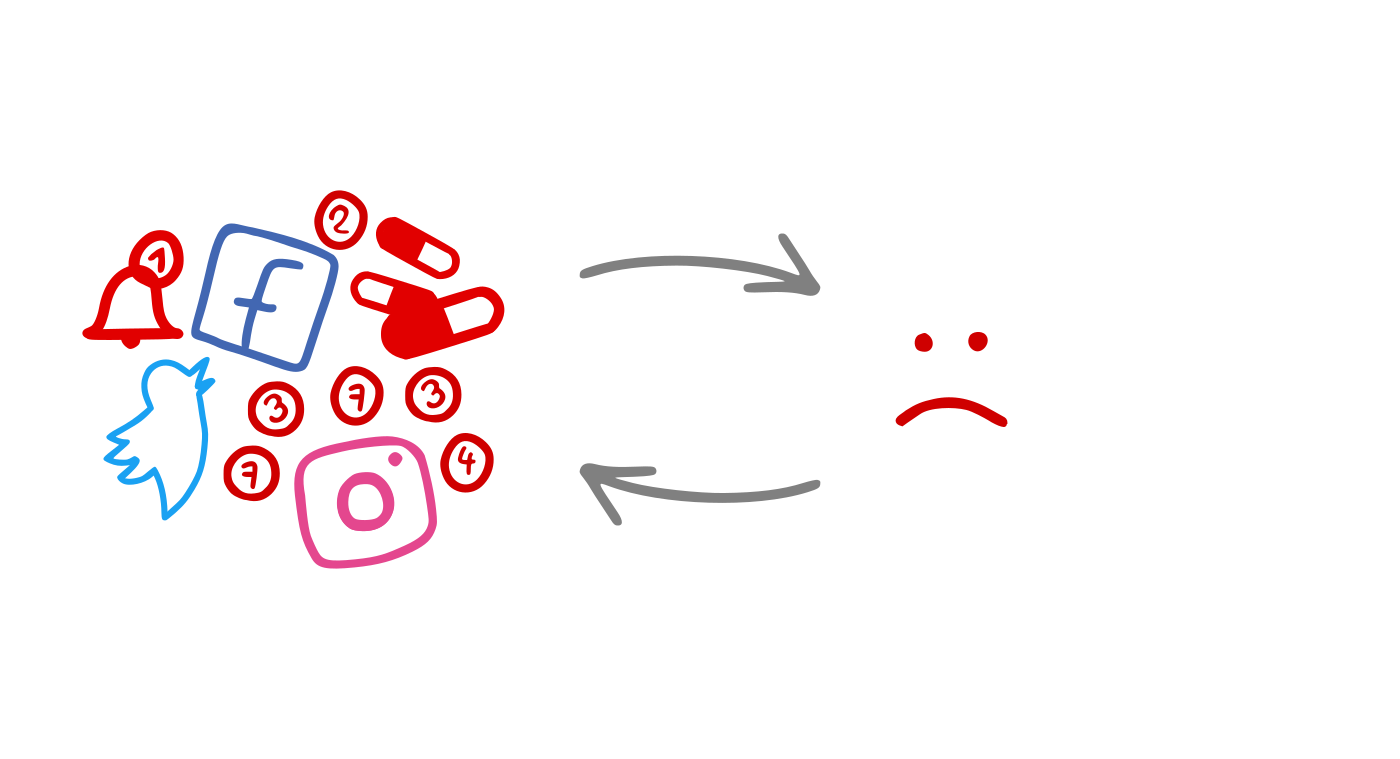
Is Internet addiction real?
Are you really addicted to your smartphone? Or is it a made-up story to scare you?
deprocrastination.co
37 points · by vitabenes · 5y ago · 72 comments
I frequently cold turkey it, or nuke my accounts in an attempt to stop this, but to no avail.
I have been addicted to other processes, I know that I can cut them by substituting with other, less unhealthy addictions, at the moment, I am trying to get myself addicted to math books. It seems to be working, I managed to get out of bed with ease.
I am currently working through MacDonald's "Linear and Geometric Algebra", and Pinter's "A book of Abstract Algebra". The next books will probably be Mendelson's "Introduction to Topology", and MacDonald's "Linear and Geometric Calculus".
By the time I wrote this reply, I have already glanced at my karma - on the upper right corner of my screen - four times, even though I am well aware that it is static and can not change until I reload the page.
It seems like technology is just exploiting instinctive ways we interact with the world and learn.
This matters because it is not an individual problem of low will power etc. We will understand that the way the internet and social media interact with people just fundamentally creates false connections and impressions and generally confuses our unconscious mind.
I’d rather be an internet addict than go back to those days.
People aren't feeling bad because of continuous scrolling on news and social media. People are looking for something to take their minds off whatever difficulty they are facing.
People should do what they think will help but I don't think the framework of addiction is the right way to approach it. You don't have withdrawal and assuming the compulsion to return is because of the content and not because you want to escape holds you back from addressing the real issues.
Doing a "dopamine fast" will also force a person to reevaluate their current situation and not escape using tech.
The outcome will be positive but I feel that term addiction should be limited to things that seriously impact your life in a negative way.
Bad habits aren't the same as addiction.
It can be both right? For instance with substance abuse, part of the "vicious cycle" is that when addicts are feeling stressed, they reach for their drug of choice rather than actually solving the problems which are making them stressed.
When I got depressed I became more obsessed than normal with social media, chats (think being constantly refreshing your messages), compulsive browsing, mild drinking, mild eating garbage food.
It's a normal phenomenon: your life is shit and you look for ways to make it less worse.
Fasting from your addiction does work remarkably well: I cut off social media and chatting for a year and then gradually allowed chatting more and more in my life once I wasn't as depressed.
Replacing with healthier alternative is also a great strategy.
At that point though, is becoming a better musician any better than learning something from YouTube or becoming very skilled at a multiplayer FPS?
You can surely get addicted to exercise and practicing music, but we don't consider it as bad as gaming or watching content online.
That said, I too don't think internet addiction is as bad as other addiction. Sure, you're wasting time, like in all other addictions, but at least you're not damaging your body (Eg. By eating too much, drinking too much, doing harmful drugs, getting cancer smoking, etc).
That’s my experience anyway, all anecdata.
People with chemical addictions face days or weeks of trembling, seizures, hallucinations, physical pain and the risk of death, when they try to withdraw. To compare that kind of experience with (say) withdrawing from Faceache is to imply that physical addiction is just a failure of willpower and self-control. It isn't so.
Physical addiction has been stigmatised as a failure of self-control more-or-less forever. It is still thought of that way - even when the addiction was caused by taking drugs prescribed by a physician, for perfectly legitimate reasons. That stigma results in inadequate funding for addiction treatment, loss of jobs, loss of homes etc.
I hear the story that "addiction" is at root an addiction to the dopamine hit. I'm sorry, but I don't buy that. The dopamine hit occurs when you do something that gives you pleasure. We all do that; and if we can, we repeat it. But we don't get the shakes when we stop doing it - we just might feel crap, is all.
When famous people like Michael Douglas claim that their personal failings are the result of "addiction" to pleasure, they are sidelining/gaslighting people who really are addicted, and making it seem that the problems those real addicts face is equivalent to the problems of a person who lacks self-control.
I think that's pretty despicable.
If you are dependent on something to a degree that it has an adverse effect on your life, it's an addiction. Full stop. The degree or the effects will differ, but it feels like you're dismissing the suffering of one group of people because another group of people has it so much worse. But if both groups of people are suffering, even severely (even if it's "just" Internet addiction), who the fuck are you to decide its not valid suffering or addiction?
This isn't a fucking competition. Both groups of people deserve to have their suffering recognized and both groups deserve to be helped in the ways that are necessary.
Your comment is despicable and inhumane.
Edit: In absolute clarity, obviously physical and psychological addictions are different. Nobody is arguing otherwise. But that doesn't mean psychological addiction isn't an addiction. It just means it has different effects and symptoms. It doesn't mean it isn't real or that the people suffering aren't actually suffering, even if it is suffering of a different kind.
So OPs comment is just needlessly critical of psychological addiction, to the point of implying it isn't "real" addiction like people hooked on cocaine.
Honestly, it's sickening that people here are so eager to invalidate the suffering of some in favor of others, but HN doesn't surprise me in its lack of empathy for other human beings.
I understand the point made by the comment you're replying to, whether I agree with it or not. Perhaps you could argue your perspective without the hostility? It may encourage a worthwhile dialogue where both you and others may come to understand your difference in opinion.
"Decimate" used to mean to kill one in ten. It now seems to be used to mean either that one sports team soundly beat another one; or that a fighting unit was completely wiped out. The word is now useless.
"Exponential" used to be a particular mathematical function; nowadays seems to mean "grows quickly".
"Addiction" used to mean "dependent on a substance to the extent that withdrawal would result in serious symptoms". If it now means the condition of liking something so much that one is unwilling to forgo it, that's a shame. Now we need a new word for the physical condition.
I don't want anyone to have to endure suffering; but not all suffering is the result of addiction.
I don't know what "gatekeeeping" means. I guess you're saying that I'm trying to control how other people describe their experience.
If that's what you're saying, then I suppose I have to put my hands up: I don't think words mean whatever you want them to mean. And when you change the meaning of a word, then forever after people will need to know which version of the word is being used whenever they encounter it.
[Version-controlled semantics? I think so. You saw it here first.]
I would argue that gambling addiction is not a simple "failure of self control" - the pathology is consistent enough that I believe that it's a special kind of stimulus, such that some people will not be able to resist it if they are predisposed to fall victim to it.
The same way a smoker will become agitated and distressed if they can't have their first cigarette in the morning, a gambling addict will feel the same if they can't log into their online poker site.
In other words, it's still a chemical addiction, it's just that the chemicals are endogenous, created by your brain as the result of a behavior rather than coming from something you put in your body.
I suppose I could be convinced that gambling is sufficiently similar to (e.g.) alcohol addiction that withdrawal can be a serious medical problem without treatment. But I haven't heard that yet.
I think nicotine addiction is a thing; but as a smoker myself, I think the addiction aspect is overblown. The agitation and distress you mention can last for months, or even years; that's what I'd call "craving". but physical withdrawal takes 72 hours (roughly), and is never very severe - it's mainly shakiness, aches, sweats, and fluctations in body temperature. That's if you've got it really bad.
Addicts, smokers and gamblers all get cravings. I suppose sex addicts do as well; perhaps there is even a set of people who have cravings for Rum Baba.
Some people apparently get their dopamine high from fighting; I don't expect anyone from the gambling-addict or sex-addict groups to jump up and say that addiction to fighting really is an addiction. I'm told that joggers feel distress when they break their ankle, and can no longer jog. Sorry, but I 'm not prepared to call that "jogging addiction".
I'm afraid I'm not at this time prepared to accept that dopamine addiction is a thing. Dopamine is released into the brain routinely, by "normal" people who neither smoke nor gamble.
Dopamine withdrawal never results in life-threatening symptoms like seizures. Ergo, withdrawal from real addictions is not the same as dopamine withdrawal.
In university, I worked in a lab studying the biological mechanisms of addiction for a couple of years. There is a fairly well understood relationship between dopaminergic release in the nucleus accumbens and the formation of behavioral patterns.
This can be induced reliably with certain drugs, like stimulants, which chemically induce the activity of dopamine receptors. It can also be reliably induced endogenously, using a stochastic reward schedule. In other words, if you put a rat in a cage and give him a lever which produces a food pellet every time he presses it, he will eat until he is full, and then he will stop. If you give him a lever which produces a pellet randomly, he will press it all day, even to the point where he eats past the point of satiety, and forgets to drink water.
This response to a stochastic reward schedule has been demonstrated in all kinds of animal models, and also in humans. It's also exactly the reason why slot machines are compelling and habit forming.
You don't have to look very hard to see how a stochastic reward schedule is applied to things like mobile games, and the design of social media user journeys.
Gambling addiction is real, and social media is designed to be addictive.
Even adrenaline addiction has been named in medical context, and that's produced by our bodies - not ingested/injected.
There really should be a specific term for the physical dependence you're talking about which can end in serious medical issue if the person just quits cold turkey though. It would make sense to differentiate this hard dependence.
Given this edvidence, I don't think there's any argument that can challenge my belief about internet addiction. Most argument I see, are semantic arguments that amount to a definition of addiction other than the one I posed above. These usually come from people who make money from this addiction and have a vested interest to muddy the waters about what addiction is. Or from people who confuse addiction with morality. Meaning, they think that if you prove something is addictive, then it means they are addict, which means they are "bad", which causes a defense mechanism that denies the whole concept of addiction. So rest assured, a certain thing can be addictive to some, but not for all. And being an addict doesn't make you morally "bad". No need to make the discussion personal.
Social media, just like a slot machine, or a mobile game which is engineered to rob whales of thousands of their hard earned dollars, is optimized to create the type of reward signal which will result in a behavioral loop which will keep users coming back. Using data collected from the usage patters over billions of sessions, they've been able to test and craft a user experience which affects human psychology in such a way that a huge majority of people will be extremely compelled by it, and many users will not be able to resist falling into this behavior pattern even if they try. Especially children who don't have a fully-developed prefrontal cortex yet.
We have a long history of regulating things like this. For instance, it used to be possible to buy cocaine over the pharmacy counter in the US. But at a certain point we realized that this substance was stronger than human will in many cases, that there was a lot of harm being created by it, so we regulated it.
The only open question about social media is the harm component. For instance coffee is extremely habit forming, but we don't regulate it because the social harm is negligible. But I would argue the negative externalities caused by social media has already been demonstrated. Social media incentivizes engagement, which is most reliably cultivated by content creating emotionally charged responses, outrage, and conflict. As a result, the rise in social media has led to a decrease in social cohesion, and the rampant spread of misinformation and conspiracy theories.
I suspect in 50 years we will look back at unregulated social media the same way we look back at selling cocaine at the pharmacy.
However Reddit, Youtube, Twitter, Medium and most VC-funded social media products are unusable without heavy modifications. Their default settings (endless feeds, notifications, suggestions) are designed to be addictive and often trigger behavior that results in countless wasted hours.
My solution is to only use these manipulative sites on my Desktop where I can change the layout etc. Mobile apps are off-limits. This works 80% of the time. Another step is to cut down on hardware - a slower phone, no tablet, less gadgets. In my experience this last step is very effective... but it's not easy because like most people here I love technology and it certainly has its advantages too.
It's like that the society does not like when people reach happiness and self satisfaction.
You use too much internet that makes you less lonely and bored? Bad.
You like to go to the beach or in nature? You are destroying natural space. Bad.
You like to travel? Bad.
You like to eat? Bad.
You like to play video games? Bad.
You like to do a specific activity all the time? And it is enough for you? Bad.
Hacker News check my comments, repliserte and upvotes
Softporn ans suggestive content on TikTok
Yeah it surely is addictive.
Summary
- there is a tendency to overuse medicalised terms. Like “I’m a bit OCD” or “I have PTSD” even when it’s clearly a gross exaggeration at best.
- Every generation had their own moral panics about addictions of the day. Examples given are “women are addicted to hobbies like bird watching”, radio addiction from the 1920s, telephone addiction from the 70s, television addiction from the 80s, Tetris addiction from the 90s. A lot of this is pathologising normal behaviour
- the major change came in 2013 with the publication of the fifth edition of DSM (Diagnostic and Statistical Manual of Mental Disorders). For the first time gambling addiction was grouped with substance addiction. This led to an explosion of research to find other addictive behaviours. Suddenly phones were addictive, internet was addictive and so on.
- the definition of addiction they propose is “In the case of addiction, where you have a particular substance or behavior that you are obsessed with, you cannot move away from, it preoccupies all your thoughts to the point that it is destroying your occupational or social life. That's a particularly strong set of behaviors, and a particularly unique outcome.”
- phone use has increased over time, but the role of phones has changed as well. They are devices used to keep in touch with friends and family. No one is going to argue that those are negative things, or that they are destroying our occupational or social lives
- the research into technology addiction was flawed. Many studies used the methodology of previous alcohol addiction studies. So for example a person who couldn’t answer how many times they had drank in the last week - that would be an indication that they’re an alcoholic. But the same thing was used on social media addiction. If you answered “not sure” to “how many times did you check HN in the last week”, you’d be classified as an addict.
- the methodology was so flawed that when applied to people’s “addiction” to friends it came back with the same result - people are hopelessly addicted to friends. They prioritise friends over their job, they lose track of time spent with friends, they can’t say how long they spent with friends in the last month, they look forward to their next “hit” of friends as soon as they’re done with one meet-up.
- gaming might addictive on it’s own, but it could be a coping strategy by people with other underlying mental health issues. Get help for those and the gaming “addiction” subsides. just like phones, gaming can fulfill basic needs we have, like social affiliation and competition for mastery.
- “ the price of living in a world with so many good things in it, is that sometimes we have to learn these new skills, these new behaviors to moderate our use. One surefire way to not do anything, is to believe you are powerless. That's what learned helplessness is all about. By medicalizing an otherwise normal behavior and telling everybody that we're all addicted, well, then what can we do about it? Nothing. Because when you have an addiction, you have a pusher, you have a dealer, you have a substance that controls you, so to speak. And so how can you possibly do something about that? You can't. And this is why you see article saying technology is hijacking your brain and why they love using the word addiction, because addiction denotes a lack of agency.”
And that’s the crux of this entire discussion. Every time someone is telling you that you’re powerless to resist Facebook or Netflix or Xbox or HN, you internalise the message and become less likely to take steps to moderate your use.
You know who can help? Thought leaders who would be willing to give a talk for modest speaking fees. Politicians who will outlaw compelling products if you’d vote for them. Detox centres who will help you if you pay them.
you all remember the history, right? It's fabled. The idea that there is "internet addiction" comes from a literal joke. Cypherpunk pioneer Ivan Goldberg, 1994, posts a list of criteria for an addiction diagnosis to a messageboard as a joke. It was not meant to evoke addiction, but was already an ironic commentary on the looseness of addiction criteria, in order to laugh about how involvement and immersion in the messageboards that literally made the internet could fall under these criteria as well. Using these criteria ironically could show how almost any random behavior can be discredited as an addiction if people are passionate enough about it.
The wider sociological point is that these are metaphorical uses of the addiction-as-disease concept (there is, after all, nothing entering the body here) that are used, socially, to heap a bit more denigration on socially disfavored activities. You don't get people blabbing on about soccer practice addiction, reading addiction, or tea addiction (on my fourth cup this morning.) Those are not disfavored activities.
Also, there is a curiously obvious defense of normalized actions and preferences baked into addiction narratives. The old argument, "they do that rather than spend time with their family!" or "they do that rather than work!" never once questions that maybe that other thing they do.. is something they prefer over spending time with their family or (gasp!) working. It's just assumed that a "healthy" person would keep to social norm, be a good petit bourgie, and love to be productive for capitalism and really enjoys being locked into this model of the nuclear family.
For sociologists, "addiction" is unthinkable without a concomitant value judgment that is anything but objective; it reproduced social desirabilities.
  - Is there such a thing as library addiction ?
  - Is there such a thing as school / university addiction ?
  - Is there such a thing as newspaper/book reading addiction ?
  - Is there such a thing as chess club addiction ?
The internet, just like your personal life, is what you make of it. Its a fabulous resource.
- Is there such a thing as food addiction?
Some people are able to enjoy these foods in moderation, and other people cannot resist the temptation and eat these to the point that it's detrimental to their health.
I think it can be argued that the internet is a lot like that.
"I only want to spend an hour browsing my phone but I end up spending 8"
Did people really interact with libraries the same way? In my experience the vast majority did not. But when it comes to phones, most people report that they use their phone more than they want to.
I am sure the vast majority of people don’t, while so many people feel completed to check something on the Internet.
Do you feel uncomfortable if you know in advance you won’t be able to use the library or the chess club for a whole day?
As someone who is not Gen-Z and remembers what life was before the internet, I can sure say that the internet beats any library I've ever spent time in.
The volume, diversity and ease of research ... all at your fingertips.
Why would anyone want to spend time trawling obscure library database systems only to find the library doesn't stock the right books or that someone has taken it on loan for an unknown period of time ?
Or worse .... microfiche. My god how that's a hellish storage medium I will not miss !
You're setting up a bit of strawman, I don't see anyone arguing the internet is inferior to the library, but that library usage (for example) doesn't trigger the dopamine release cycle in the way refreshing a frequently changing webpage does.
You’re going to say “no no, friends are different.” That it’s actually healthy compared to let’s say, grinding WoW with friends from your guild. But it’s no different really. Why is it unhealthy if I spend hours playing WoW with friends but it’s healthy if I play football instead?
The dominant narrative on HN is that of course internet is an addiction. And that it’s pushed by evil companies that seek to profit off of it. Here’s a different perspective - the idea that it’s an addiction and that you’re powerless to solve it on your own is pushed by people who want you to turn to them to solve it. And pay for that privilege. In reality it’s not an addiction like heroin. You can beat it on your own without rehab or buying their 30 day detox program.
I'd argue that it might be (though I could be wrong on this, I haven't thought through all the possibilities) because the internet is new (or at least, the latest thing), whereas books are old. New thing bad, old thing good. For example, TV is seen as bad, but nowhere near as bad as the internet, but go back a few decades, and TV addiction is the hot issue to be solved. Perhaps if you go back far enough, you will find chess addiction or books addiction to be the hot issue.
Your argument is a strawman argument. Calling something addictive, does not equate to saying that if you stop doing it, you get hurt. With this definition living /breathing/eating would be called addiction. That's not a very useful definition, and that's not the meaning of addiction.