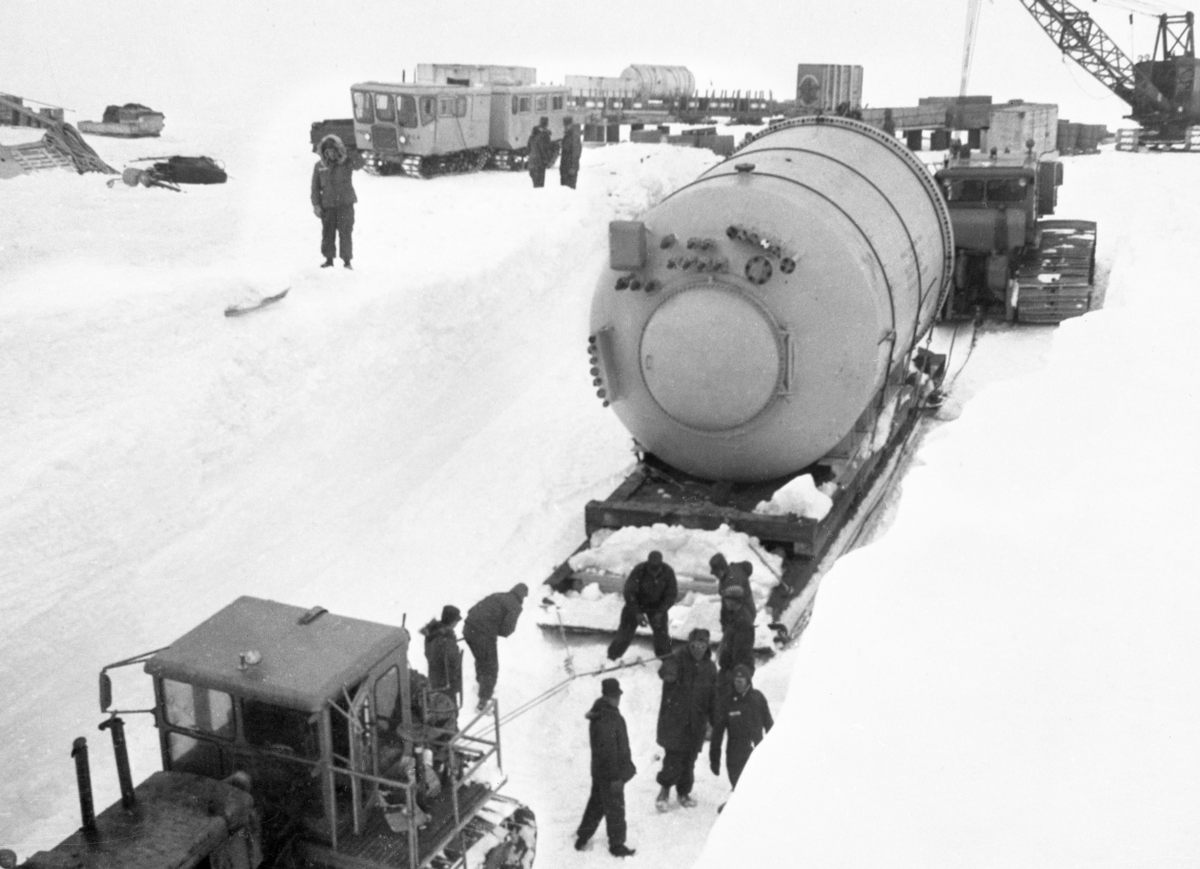
The U.S. Army Tried Portable Nuclear Power at Remote Bases 60 Years Ago
It didn't go well.
Atlas Obscura
111 points · by bcaulfield · 5y ago · 151 comments
[1] https://www.defensenews.com/smr/energy-and-environment/2021/...
[2] https://theconversation.com/the-us-army-tried-portable-nucle...
[3] https://www.civilbeat.org/2021/07/project-pele-the-military-...
[4] https://www.businessinsider.com/us-military-is-trying-to-bui...
260,000 shaft horsepower for 20 years between refueling.
I'd be curious how much oil would need to be burned instead of this (bunker fuels tend to be HIGHLY polluting).
on a separate note, NASA had a recent breakthrough after decades of "paper reactors", building and testing the safest and smallest reactor so far based on a new solid core design https://www.nasa.gov/directorates/spacetech/kilopower/
My physics teacher in high school was a retired naval nuclear engineer/tech/something. He blamed Jane Fonda (the actress) for a huge portion of the anti-nuclear activism that basically entrenched the power of oil companies and cartels. It's funny/sad how badly the save-the-forest and anti-nuke activism of the 1970s is coming back to bite us so hard now, with wildfires and global warming.
Makes me wonder which activist movements today will turn out to have been net negative in another 40-50 years.
At best operating at full capacity with moderate subsides it’s roughly competitive with coal operating 24/7, but the grid has wildly fluctuating demand and nuclear’s price per kWh is roughly 3x as expensive at 30% power output as at 100%.
France was able to export a lot of nuclear power while importing significant electricity to meet demand and they still had capacity factors fall below 70%.
The most surprising issue with nuclear is actually fuel costs. Yes, it’s cheap to mine and enrichment isn’t that expensive, but refueling ends up being quite expensive in part because it’s slow. 3+ weeks of downtime every 1.5-2 years is effectively a 1.5+% fuel cost even if everything else was free. Dropping that to 1 week on it’s own wouldn’t really change the economics much but there are many such issues.
"We'll build one near you. Oh we could build a completely safe one, but instead we're going to build the mostly safe one. We're willing to put you at risk if the commies also feel more at risk."
I don't normally sympathize with nimbys, but I think that pitch deserved some pushback.
Any news on better shielding or safer designs that might allow replacing a house or car's power plant?
> When valves leaked, more leakage was allowed — up to 20 times the original limit. When rampant cracking caused radioactive leaks from steam generator tubing, an easier test of the tubes was devised, so plants could meet standards.
https://www.nbcnews.com/id/wbna43455859
> The proposal comes as most of the nation’s nuclear power plants, which were designed and built in the 1960s or 1970s, are reaching the end of their original 40- to 50-year operating licenses. Many plant operators have sought licenses to extend the operating life of their plants past the original deadlines, even as experts have warned that aging plants come with heightened concerns about safety.
https://www.nytimes.com/2019/07/17/climate/nrc-nuclear-inspe...
> The nuclear industry is also pushing the NRC to cut down on safety inspections and rely instead on plants to police themselves. The NRC “is listening” to this advice, the Associated Press reported last month. “Annie Caputo, a former nuclear-energy lobbyist now serving as one of four board members appointed or reappointed by President Donald Trump, told an industry meeting this week that she was ‘open to self-assessments’ by nuclear plant operators, who are proposing that self-reporting by operators take the place of some NRC inspections.”
https://newrepublic.com/article/153465/its-not-just-pork-tru...
The same way the FAA allowed airplane manufacturers to decide wether their planes needed re-certifying when they changed them, and allowed them to certify themselves?
Because that's also how we got the Boeing 737 Max.
You mean the plane that was grounded for having 4 accidents per 1 million flights? Do you mean the industry with 1 fatal accident for every two million flights? An industry so safe that most people have a higher likelihood of dying on the drive to and from the airport than on their flight? If that is your nightmare scenario of safety failure, I’ll happily take the FAA model of safety.
Speaking of comparisons, how many people do coal plants kill every year with fly ash, just as a matter of course and not even as a safety failure? We aren’t comparing nuclear power risks to nothing.
You're talking about a lapse in safety relative to an industry that is 2nd only to Nuclear power in doing no harm. In absolute terms they were still reasonably safe.
I dont think I would trust one in my home, given flood risks and all, but a megawatt power plant for the neighborhood wouldn't be amiss.
No matter how many bananas you eat, your radiation exposure will stay the same as your body keeps the amount of potassium constant.
Grave nuclear accidents probably happen every few decades and more smaller reactors will make that just more likely.
Keyword there is "functioning". I believe GP's point is that the public can't be trusted to maintain household-scale nuclear reactors to the same level of safety that large-scale operators with competent staff and chains of responsibility can.
Where is my flying car I believe is the title. Earlier this year I saw a book review from the star slater codex substack. Didn't read it tho
If that is thanks to the Green Movement, then let me thank the Green Movement.
The trick is, as always, to make a sealed system and scare people into not messing with it.
Just because nuclear power has been unfairly maligned doesn't mean it would unilaterally solve our climate problems. Beware mood affiliation when posting short pithy comments.
https://www.ipcc.ch/site/assets/uploads/2018/02/ipcc_wg3_ar5... (see page 44)
The main reason why nuclear isn't a thing except in communist countries (or countries with a big centralized state power), is that scaled nuclear require central planning. You really can't expect private operators to run nuclear, because the cost of the fuel is actually 0.01% of the operating cost, and the most efficient way of running a nuclear reactor is full power.
https://en.wikipedia.org/wiki/SL-1 https://www.amazon.com/Atomic-Accidents-Meltdowns-Disasters-...
If it's known that the control rod is supposed to be between 0 and X inches out, and going past Y inches (Y > X) will likely cause a fatal failure, one would expect someone to machine a piece of metal that makes in impossible to move the rod further out than Y inches.
I read those accounts of people manipulating nuclear reactors by hand, and can't stop but think: this is dumb, even for 1950s era technology.
One day, someone dropped the brick and there was a blue flash. Lots of neutrons were released that day. People died from radiation exposure soon after.
There's also a story about a fuel rod getting jammed, so they tried to force it with a crane and ended up breaking it in half, spilling highly radioactive water all over the place, and then the fuel rod catches on fire because it's not being cooled anymore. It's comical how quickly these disasters escalate.
Read https://www.amazon.com/Atomic-Accidents-Meltdowns-Disasters-... , it's accurate and relatively fun given the subject. One of the chapters is titled "The US Government almost never lost nuclear weapons", which I find subtly amusing.
Apparently the "demon core" got its name because it was involved in more than one supercritical accident.
SL-1 feels as if it was designed and operated by Kerbals. TFA actually does mention the reactor and the accident
> SL-1, a stationary low-power nuclear reactor in Idaho, blew up during refueling, killing three men.
but that barely hints at just how eye-widening the whole saga was: https://www.youtube.com/watch?v=qOt7xDKxmCM
To be fair, it is apparently considered likely that the overextraction of the rod was a deliberate murder-suicide. But yes, it seems that there's a reason that the US Navy still has a nuclear power program and the Army doesn't ( https://www.historynet.com/going-nuclear-idaho-falls.htm seems good; I am not an expert).
It was probably a consciously-made balance of risk, with relatively "minor" accidents here and there as a result of rushed development vs. the risks associated with getting overtaken by the Soviets. Technological superiority, particularly in that field, was a major factor in the balance of power at that time.
[1] https://whatisnuclear.com/reactor_history.html#the-army-nucl...
Imagine the situation we would be in if the US military had been using nuclear power supplies at (formerly) our bases in Afghanistan.
I’m a fan of nuclear power but battlefields are the last place I want to see it.
Far less than 10,000 years ago, humans likely would've written similar messages on things of importance to deter thieves, and we just ignore them now as curses. How does one warn people of the future about genuinely hazardous, long-lasting materials without relying on language (which will certainly change on that time scale) and without the future generation dismissing it as bullshit curses?
The youth these days really isn't so different from the youth thirty years ago
[1] https://www.youtube.com/watch?v=28NYczAuXl4
There are lots of others like this.
A couple of earlier comments:
5 months ago: https://news.ycombinator.com/item?id=26854882
5 years ago: https://news.ycombinator.com/item?id=12237745
Oh, and TIL: "Alco Products, Inc.", who manufactured the nuclear reactor used at Camp Century, isn't ALCOA (as I'd suspected), but "American Locomotive Company". It was only in the nuclear power business for about 6 years, shipping its first reactors in 1957, and selling the operation in 1963.
https://www.schenectadyhistory.org/railroads/alcocovers/
I'm also pretty sure the TIME Magazine cover shown at 30:13 is is GE's Ralph Cordiner:
https://archive.org/details/1959-images/page/1/mode/1up
More on Camp Century: https://www.wired.com/story/the-top-secret-cold-war-project-...
And lastly, there were some nasty radiation incidents where ex Soviet RTGs were left unattended and random scavengers managed to open the casing, getting lethal doses of radiation in some cases. I guess this could be exasperated by the small and mobile size of RTGs.
CHANGES IN EMPHASIS AND DIRECTION OF THE ANP PROGRAM
The ANP program was characterized by frequent changes in emphasis and objectives, varying from a research and development program to an accelerated program to develop a weapon system for the Air Force.
The ANP program was carried out in competition with other programs for national defense. As a result, the importance attached to the ANP program varied greatly throughout its history. Although it was outside our scope to examine into the reasonableness of or justification for the frequent changes in program objectives, we do not believe that a research and development effort of the complexity and magnitude of the ANP program can reach its goal in an effective and efficient manner unless a certain degree of stability in objectives is accorded to the program. (See pp. 31 to 35)
LITTLE OR NO USE MADE OF CERTAIN FACILITIES BECAUSES OF PROGRAM REORIENTATIONS
During our review we noted that various major facilities had been constructed at a total cost of about $17,147,000 but were never used, or used very little, for their intended purposes because of program reorientations. The two largest facilities were the Flight Engine Test facility that was constructed at the AEC Na- tional Reactor Testing Station, Idaho, at a cost of $8,061,000...
It would be nice if it were a thorium salt based design, so you don't have to worry about disasters anywhere near as much. (Though I understand that you still have to worry about things like many, many Becquerel of Iodine being built up over time)
What other types of fuel are Armageddon proof? Certainly not coal, CNG, whale blubber, solar, etc......Fire maybe? Even then, might as well consider that the end of civilization regardless.......
Pro: smaller reactors would be faster to build, as conventional nuclear reactors are large and often use specific techs. They would be built in higher quantities than larger reactors and thus allow more nuclear power generation.
Con: economies of scale might mean it generates less electricity overall.
One of the reasons nuclear power is so unpalatable to build is that each plant is a 100% bespoke, one-off build that is insanely expensive and takes decades to pay off through profits.
If you could make one design, and create the tooling (and licensing/safety requirements), you could essentially build an endless number of them as long as you could guarantee the process is repeatable.
It's basically DevOps for nuclear reactors.
"American naval reactors starting with the S1W and iterations of designs have operated without incidents since USS Nautilus (SSN-571) launch in 1954" https://en.wikipedia.org/wiki/Nuclear_submarine
The Soviet Union had many accidents, their MO is to pretend it never happened.
Russians have even more reactor years in submarines and icebreakers, and cargo ships. They have even floating nuclear power station. They have had two major reactor accidents (we know about).
Military reactors are expensive to operate even when they are quit safe. You need highly trained people 24/7.
Seems strange to bet against ingenuity.
The safety becomes with cost and performance limit. It's hard to see how smaller nuclear reactors are significantly better than gas turbines in commercial use. The cost comes down with the size.