The
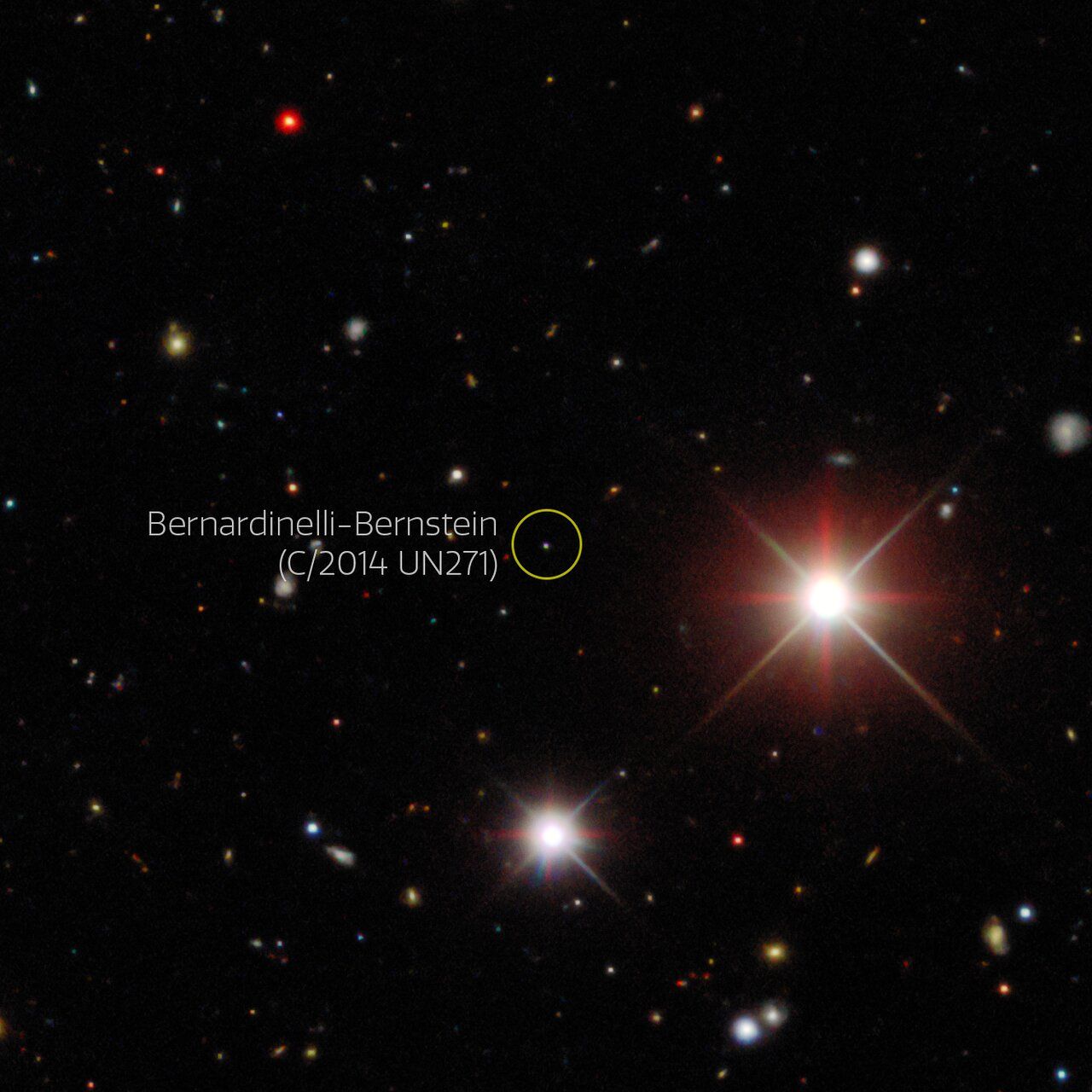
The scientists that found Comet Bernardinelli-Bernstein are an unlikely pair.
Space
334 points · by wglb · 5y ago · 68 comments
The dataset here was DES, the Dark Energy Survey. It’s a big dataset that has been around for a few years, and probably thousands of astronomers have worked with it. But its just a huge amount of data, covering a lot of the sky.
Bernardinelli’s software discovered a blip in that big pile of data. He crunched through the dataset and got a weird answer for the size of the solar system (basically - its a bit more complicated). Almost everyone, when they get something like that, tweaks the parameters of their analysis code: “I must have the threshold for object detection set too low.” The real discovery comes from trusting the software and pursuing the question.
This is a lot like software developers and their persistence. When your production service has a mysterious error in the logs, do you shrug and say “well, probably some transient network bug, it won’t matter” or do you dig in to understand what’s going on? Both approaches are reasonable, and it takes a balance of pragmatism and curiosity to be effective.
But anyway - there is an increasing demand for applying rigorous software engineering techniques to astronomical datasets. A problem that we are facing in astronomy software today is that the datasets have gotten way too large for astronomers to just pull up images in DS9 and eyeball stuff to make sure it’s right, so they need software that is much more trustworthy and bug-free than before.
—-
Edit to add: DES data is completely public access: https://www.darkenergysurvey.org/the-des-project/data-access...
> This is a lot like software developers and their persistence. When your production service has a mysterious error in the logs, do you shrug and say “well, probably some transient network bug, it won’t matter” or do you dig in to understand what’s going on? Both approaches are reasonable, and it takes a balance of pragmatism and curiosity to be effective.
I find that it really depends on how harried I am. Am I (or someone on my team) able to dedicate time to this issue, or do we have other higher priority concerns?
Every single time I can think of where we've had a "that's weird", it was a bug in the software. But it would take days to weeks for someone find the root cause (these were 1 in 100,000 race conditions), and we just can't afford to dedicate that amount of time to each.
So we have to pick our battles.
But this raises the interesting (to me) question - almost every enterprise I know operates at the "harried" level - no one is so well funded they can saunter around
But science is basically saying "we trust you to find something worthwhile. Go saunter"
Maybe it's all about trust
Not... quite.
Typically, scientist in academia are underfunded and overloaded with teaching and management duties. The way to get round to actual research is to hire phd students / postdocs. But there is no institutional funding, so you have to write a grant proposal. Since every academic is in the same boat, project calls are swamped with proposals and can only funds 10-20%. Since you want to get funding, you create a very clear project proposal with detailed timeline of expected publications. Because funders don't award mediocrity, your proposal is ambitious in this.
Now if you get the funding, you suddenly have a significant, detailed, ambitious research obligation to fulfil for the next #PhD years. You get to do research, but there's not much leeway.
No project funding? Here are stacks of committee work and teaching load. Oh, but we do expect you to keep publishing actively. Maybe make time on the evenings and weekends for research?
All in all, not really "go saunter".
...such as a 75 cent accounting discrepancy? ;)
There is plenty of opportunity to contribute to open-source —-astropy is one of the most active projects, as a starting point.
Deeper (volunteer) engagement probably requires finding a willing scientist to plug you in to a project. That can be tricky get going and to make mutually beneficial.
There are full time research software engineer positions—these will pay less than industry, of course; for some folks the subject matter and environment make that trade worthwhile.
I do remember seeing a website that attempted to connect SW engineers willing to volunteer with scientists but I think that effort died out. Not a bad idea.
> "'This is weird — what is this thing?'"
“It is said that in science the greatest changes come about when some researcher says "Hmmm. That's odd." The same can be said for relationships: "That's not my shade of lipstick . . ."—warfare: "That's an odd dust cloud . . ." Etc.”
Not making it up, this is exactly what we thought when the Oakland Hills fire of 1991 started. Our confusion was short-lived, I'm sad to say.
Humason is less than half the size of this comet and is considered abnormally large.
> It will make its closest approach to Earth around 5 April 2031 at a distance of 10.11 AU
The sad bit:
> Once at perihelion, the comet is not expected to get brighter than Pluto (mag 13–16)... Even if it reaches the magnitude of Pluto, it will require about a 200 mm telescope to be visually seen
If you're looking to see it, Orion's XT8 would be a great starting telescope with aperture enough to see the comet
Also note that the XT8 is a manual, non-motorized scope, so you'll need to find Pluto by hand, navigating from neighboring stars. This can be unexpectedly difficult. The sky is big!
And just to be really annoying, to address people who have never looked through a telescope before: an amateur telescope will give you the ability to see the comet, but it won't look like a photograph from Hubble. It'll just be a dim white dot. If you spend $500 and expect to see jaw dropping astronomical vistae, you will be disappointed.
Des is a name here (short for Desmond). Hacky alternate reality solution: Hire a guy named Des to have the comet "officially" named after.
(
It's not)Yes, cold bodies that have the properties of a comet may have lived the life of a comet at some point, or will again in the future, but currently something that shares a common center of mass with another object in a pretty stable orbit is not really going to get the full comet red carpet at the comet awards :)
Chiron is a comet.
"Wikipedia" agrees with both of those statements.
Since it cannot be both, "Wikipedia" also agrees with the statements that Chiron is not a comet and is not a planet.
tldr: we don't know, it could be either
Last I heard, DE was discovered to be, probably, a product of a pervasive miscalibration. I have not heard of any retraction or rebuttal. The recognition coincides with evaporation of galactic rotation curves as an indication of Dark Matter, also not, to my knowledge, rebutted. Cosmology is not unique in systematically ignoring evidence against the existence of its favorite phenomena -- Nessie and Bigfoot fans, either -- but its claims are the biggest.
The questions are all about what actually causes it / the mechanism behind it, and details about its workings.
https://www.wired.com/story/does-dark-energy-really-exist-co...
> It's existence is obvious because you can actively see galaxies accelerating, on average, away from each other in all kinds of datasets observing the sky.
No. Acceleration is inferred by fitting observed values of other quantities to the Friedmann equations.
https://en.wikipedia.org/wiki/Dark_energy#Evidence_of_existe...
But we keep finding the universe not to be uniform, even on a 100M parsec scale. A much larger scale would be uncomfortably close to the perceived size of the universe itself, flirting with that meaninglessness. So, it seems hard to know how the results are affected by such non-uniformity, or how much correction is needed.
...and it's been getting stronger lately as we've been finding more evidence that the visible universe is not homogeneous as we thought - which is one of the pieces of evidence for dark energy. We seem to be in a local empty area, and thus dark energy may no longer be needed to explain post-big-bang inflation.