NASA
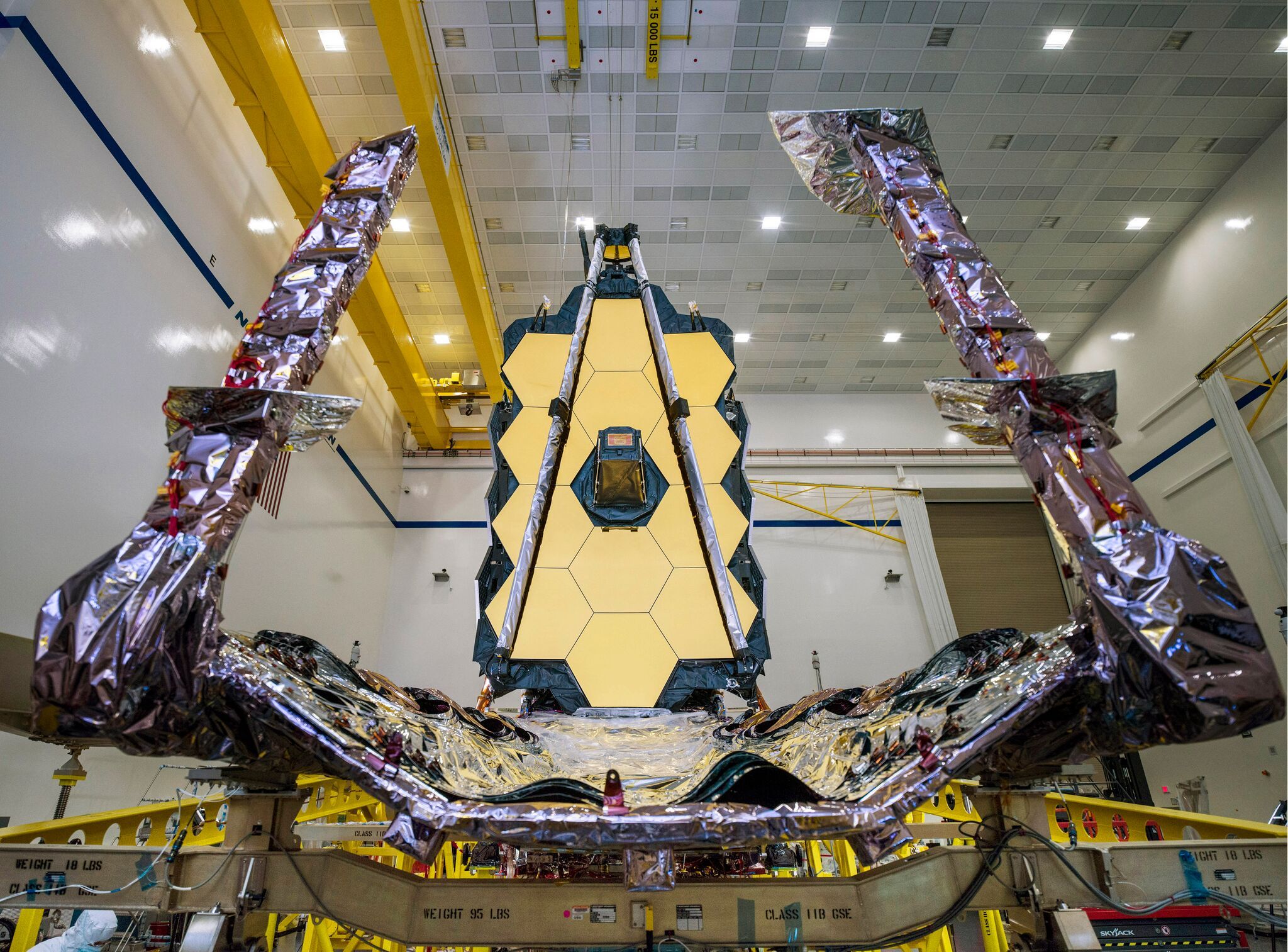
The Dec. 18 launch slip is yet another delay for the long-awaited observatory.
Space
120 points · by asmithmd1 · 5y ago · 72 comments
In 1996, it was estimated for 2007, fast forwarding a bit to 2018, it slipped one year from an estimated launch in 2020 to 2021, in 2020 it slipped from March 2021 to July, by January 2021 it slipped to October 31st, and it's been known since June, 14 weeks ago, that it wasn't likely to meet that date.
At this rate, I estimate the current date will intercept the target date in early 2022.
Not mathematically certain. If the timeline slip is a sequence like [1-1/2^k]_{k=1...} = {1/2 week, 3/4 weeks, 7/8 weeks, 15/16 weeks...}, then it's possible the project timeline could diverge forever. (This is just a restatement of Zeno's paradox).
I thought Zeno's paradox was caused by lack of understanding of infinitesimal calculus by Ancient Greeks? That is, in situations where a series converges despite an having infinite number of elements. Divergent series like yours shouldn't constitute such a paradox, since they both have an infinite number of elements AND diverge.
A crate of beer is standing in the end of a magical room; each step towards the crate is half as short as the preceding one.
A mathematician and an engineer enter the room. The engineer starts walking towards the chest, while the mathematician stands still.
M: Why are you doing this? You can't reach it in finite time anyway!
E: But in a few hundred steps I'll be close enough for all practical purposes!
An infinite number of mathematicians walk into a bar. The first one orders a pint. The second one orders half a pint. When the third orders a quarter of a pint, the bartender rolls his eyes, places two beers on the bar, and says "you all need to learn your limits!"
Question - they have a ton of shielding for solar radiation - can they not locate this thing in a shadow area somewhere?
(A technical exception is a planetary solar L2 Lagrange point [0], *if* it would occur close enough to a planet to be totally eclipsed. But that doesn't happen (AFAIK) -- they're generally far enough away that although the planet is always in front of the sun, the planet's disk is much smaller than the solar disk. Like a partial eclipse).
With cryogenic cooling, you have an even more difficult challenge: the light of a planet's infrared radiation emission is something you also have to shield. That's a major reason JWST (and similar cryogenic telescopes) go to solar L2: its sunshield doesn't only block out the sun -- it simultaneously blocks out the sun and the Earth. That's the unique advantage of the solar L2 point: the sun and Earth are always in the same direction.
https://news.ycombinator.com/item?id=10462349 ("NASA's last original Voyager engineer retires at 80")
Not if the timeline slips such that at each slip the delta between the current time and the launch time decreases by 50%.
This is the answer to Zeno's paradox. A sports reporter gives an update every time Hercules catches up to where the tortoise was the last time he gave an update. All that happens is the sports reporter eventually needs to talk faster and faster and faster, and eventually try to give infinite updates right as Hercules passes the tortoise. Then the reporter's vocal chords explode, but otherwise the race proceeds as you would expect. (That is, just because a description of an event is infinitely long, does not mean the event itself is infinitely long in any sense.)
Failures happen when delivery dates are more important than quality.
Maybe the engineer was just telling a story with a bit of flair but I believed him.
* If you're futzing with hydrazone, you want to avoid sending humans to mess with it
* Any mission to repair it risks damaging the sensors just from the reaction mass that it takes to rendezvous
* There is currently no path forward to actually doing this servicing mission, in terms of equipment and vehicles. The technology will almost definitely exist in the future, but by the time it does why not just send a new mission?
* Designing the spacecraft to make it serviceable imposes new limitations on it
Even today we don't have a proven platform that could pull off a manned mission to L2, let alone a mission that would then fix an insanely complex telescope in-situ. (There are a few that could try, but no one's done it.)
To visit L2 you basically need a a vehicle and rocket capable of performing a moon mission which hasn't been available since 1972.
I mean, technically they were available after '72. There were a couple Saturn V's and Command/Service Modules (and at least one Lunar Module) left over (and mostly repurposed).
It would be interesting to know when the last time the hardware existed in working order that would have allowed a lunar mission.
https://en.wikipedia.org/wiki/Canceled_Apollo_missions#Cance...
You don't need to land on anything - and that's a quite large delta-V saving, about 5 km/s for Apollo-style missions. So you save on mass, and you can spend savings elsewhere.
My guess is after mass is added for all the capabilities shuttle had for spacecraft servicing you probably do need a real moon rocket.
Oh, is that all?
I'm not sure why we would plan to service JWT when we have nothing to service it with.