399 points · by was_a_dev · 5y ago · 204 comments
In the sentence "With the theory physicists Gregory Breit and John Wheeler were able to prove that when two high-energy photons collide, a positron and an electron arise, i.e. matter is formed" shouldn't the word be "predict" not "prove"?
A more flagrant example of a strange word choice for a human science writer to make is "A direct conversion would require a laser that emits gamma-ray photons in a highly concentrated steel." Shouldn't the word "steel" instead be "beam"? This seems like the sort of thing an uncomprehending bot might do, conflate those two words.
Are my the nits I've picked, above, unfounded? Does the author of the original paper have any information which might suggest that an actual human wrote the "Science News" piece?
If not I would suggest that we've got a bot on the loose! Eeek!
Further, I think I'm seeing rather a lot of "content" floating around recently which smacks of machine origins.
Also, to Daniel... Great paper. Amazing stuff!
The sentence about lasers is also strange, I have no idea what is meant there. My only guess is that it might be trying to describe some laser experiment that uses lasers to "heat" a hohlraum to produce a field of photons. Then some other high energy photon beam is used to collide with the photons inside the hohlraum.
edit: Original article from DOE press release is here with a bit more info: https://www.bnl.gov/newsroom/news.php?a=119023
https://www.forschung-und-wissen.de/nachrichten/physik/mater...
You've previously asked for examples [0] of this type of fraud on HN: so this is one example! Credit to 'smurpy' in this thread, who noticed the 'bot'-like writing style.
So my guess would be that the science news "author" is rewording things to avoid stepping on another author's copyright.
And doing it badly...
https://www.forschung-und-wissen.de/nachrichten/physik/mater...
[1] https://en.wikipedia.org/wiki/Two-photon_physics#/media/File...
It's still blows my mind that a photon could do that -- turn into a particle-antiparticle pair, the pair then quickly gets annihilated and turns back into the same photon and continues in the exact same direction and form the initial photon was travelling.
But if this process is real, does it mean that high energy photons travel slower than low energy photons?
Because low energy photons could not transform into particles that have mass, while higher energy photons could and thus spend just a liiiiiiitle bit more time as massive particles that can't travel at the speed of light.
x ⊢ y
which means "x proves y".
I then kept reading things that tell me photons don't interact, which saddened me because I like the question. This now appears to not be the case, is there a specific condition under which photons can interact like this?
I am not sure about the "time" the photons collide, but the interesting thing is that the Breit-Wheeler process is what determines the opacity of the universe - since high energy photons traveling through the universe can hit low energy photons from the cosmic microwave background and convert (disappearing) into an electron positron pair.
Maxwell's equations say that light doesn't interact. Maxwell's equations are known to be wrong in that way. They're still a very good simplifying case that you can do very well with using, by all means, just like Newtonian physics in the right conditions, but they aren't the way reality works. Maxwell's equations also have no place to put a gravity term, yet gravity clearly affects light.
The one I probably see the most often is articles about black holes confidently speaking about "what goes on below the event horizon" from an Einstein relativity point of view, which is where you get all the singularities and ring singularities that lead to different universes somehow, etc, again either forgetting to point out or simply forgetting entirely that those are the specific predictions of Einstein relativity, which is known to be inadequate to describe the inside of a black hole. It is certainly fair to discuss that theory's predictions, and whatever really is happening in there, relativity will certain shine some sort of light on it, but it is a mistake to present it simply as "what happens on the inside". The model is known to be broken here.
I am working out how to phrase this in a way that makes sense to the HN crowd because this tends to ruffle feathers when I say it, but this is all what should be well-known stuff. It's not like I'm "denying science" when I say this; quite the contrary! It's "denying science" when you insist the known-by-science-to-be-broken models are in fact not broken where the science is pretty clear that they are.
The place to put the "gravity term" is in the coordinate system that Maxwell's equations take place in, and the definition of the derivative which is implicitly brought in via the curls, divergences, etc. That's general relativity, and Maxwell's equations are already fully compatible with it.
>[this tends to ruffle feathers when I say it] ... It's "denying science" when you insist the known-by-science-to-be-broken models are in fact not broken where the science is pretty clear that they are.
People are probably taking issue with your use of the words "broken" and "wrong," because you're describing a car that says 90mph on the dealership's sticker but can't go 900mph as "broken," or a one pound lump of beef as "wrong," because although the butcher said it weighed a pound, and you were charged for a pound, it'd be nice if it were two.
That's partly to do with the way that high school science is taught. If we made the context clear at all times then people would have a better grounding.
'The map is not the territory' is the phrasing I've heard: https://en.m.wikipedia.org/wiki/Map%E2%80%93territory_relati...
If you are in a room with two charges, the electrostatic field at any point is the addition of the fields from each charge. There is no extra interaction term.
Now, combine that with the superposition principle ... photons pass through one another under most circumstances because of this (unlike gliders).
If by "this effect" you mean radiation occasionally interacting to produce particles, that actually doesn't change the amount of gravity in the universe when it happens, because energy is what gravitates and it's conserved in particle interactions.
Even if in the same vicinity, and time, eg same apartment building, subway, street, driving down the road, there is often zero interaction.
Really, humans interact very rarely too. Yet, humans do interact, in meaningful ways. Thus, it is likely the same for photons.
This theory also explains why, with the rarity of human interaction, I am unmarried. In fact, it probably explains it on multiple levels.
I guess if you wanted to pose that question in a framework where a medium where the speed was less than c, and photons, could exist simultaneously, you would want an effective field theory (maybe). But you will have to get someone else who knows more than me to explain that. :-)
There is no absolute clock in the world; we can only know about what happened where and when by looking.
A way to understand this (and special relativity) is from an information-theoretic perspective, and to think of c as the “Mach number” of free space, nothing more and nothing less.
So imagine that you couldn’t see but could only know about what happened where and when by hearing. All those phenomena (foreshortening, frequency shift, apparent time dilation) would be exhibited though the speed of information travel would be much lower. You have probably experienced the equivalent of blue shift/red shift yourself by listening to a high speed vehicle.
Change the medium from ordinary air to something with a different density and all these phenomena will be detectable, even though the speed of sound will be different.
But the photons really shouldn't have rest mass.
It seems nice at first - the idea of turning raw energy into things. But the amount of energy required is just ludicrous, going through antimatter intermediary is extremely dangerous, and... there's really no point. It isn't buying you anything.
If you tried to store the amount of energy needed to replicate a kilogram of stuff in some advanced batteries, you'd quickly discover that those batteries now weigh a kilogram more. E=mc^2 works both ways - storing energy adds mass. So, unless you can literally fly through a star and suck it dry as you replicate your tea, replicators won't be reducing weight of a starship. It turns out, matter itself is the ultimate energy storage device.
And then, turning energy into matter just gives you elementary particles. You need more work to assemble that into useful stuff. This is nuclear work, and then chemical work. So why not just ditch the matter/antimatter intermediary, and start from some feedstock that already has the necessary elements, and is optimized to be easy to react into the stuff you want (and then to be recycled from that stuff)?
Think about it. If you put dirt in the replicator and you get a Rolex or a hamburger or a garment, you don't need money for anything: everyone is equal and they can go off and study or work on whatever they want. Wealth is a false proxy for social status anyway.
I think people can always invent or discover new things that are functionally finite, and their claims on these kinds of things and the way they decide to distribute it can always theoretically be quantized into something we can understand as currency or wealth. Even if it's not done explicitly, it will simply be done in something like an extremely advanced algorithm or even an opaque shadow economy of networks of favors and patronages.
Except for intellectual property, and possibly information in general. Which probably means that protecting it would become even more of a focus than it is now.
Wealth is just the current proxy. I suspect you'll never be able to fully eliminate a social hierarchy. Many animals compete physically, humans compete socially, and without money we'll find new ways to socially standout. The game just changes, it's not going to go away.
Access to healthcare remains genuinely scarce, admittedly, and Baumol's cost disease is a real problem when you need to buy someone else's time.
The implications of this in a world with both mass->energy and energy->mass conversion are left as an exercise for the reader.
Direct matter synthesis doesn't make sense in this context, but I've seen a lot of people on the Internet assume this is what happens. The way they talk about it on the show could lead you to either theory, for both replicators and transporters.
But to the extent we're discussing it as technology we could potentially have, and/or may want to make happen, I feel it's worth pointing out that transforming feedstock is a better design, doesn't require mastery of bulk antimatter processing, and is perhaps closer to possibility than one would otherwise assume.
Hell, I'd go as far as saying that there are problems with reasonable "attacks"[0] on the road to a replicator - engineering, chemical and biotech problems we could be working on right now.
-- [0] - In the Hamming sense, see https://www.cs.virginia.edu/~robins/YouAndYourResearch.html.
It would make sense that if you could "print" food from CHON then to restock during your inter-galactic travels you'd just need to find some nice asteroids with the requisite materials.
Assembling complex things - particularly biologics - from raw atoms is a painful, slow, and energy-intensive work. The growth rates of various organisms on Earth give you a ballpark of how fast you can get with this. I for one would love replicators to work faster if possible :).
I feel a better idea would be to make universal feedstock (or family of those) out of complex molecules - perhaps proteins, or protein-like nanostrutures. Molecules selected for having energy advantage in bulk reactions and precision nanowork required to assemble the most common things people replicate.
Just do E=mc^2 on the mass of your cup of tea.
Ahh... the YOLO days of nuclear physics...
An electron weighs about 10^-30 kg, or about half a megaelectronvolt, but because of cosmic balance you'll want to make a positron at the same time. So your total bill will be about 1 MeV. Visible light photons have about 1 eV of energy, if you want a photon with an MeV then you're past even hard x-rays and into gamma rays. This process is the same as matter-antimatter annihilation, except backwards.
A proper explanation would take several years.
By the way, you can use more than one photon at a time, but to my knowledge nobody has managed to fuse the million flashlight photons you'd need to do pair-production.
Could two cooperating civilizations a and b use this effect to create matter (perhaps even something self-replicating?) at a 3rd location in space?
incoming ascii art
(a)---(c)
|
|
|
(b)There are 2 problems.
First is that the energy required for generating a human-sized body is huge, several hundreds times greater than that of a nuclear bomb with the same amount of active material.
Second is that even if you would be able to do that, you would make 2 bodies, one of matter and the other of antimatter and you would not be able to dispose of the antimatter one except by causing an explosion equivalent with hundreds or thousands of nuclear bombs.
In general, for now it appears to be completely impossible to do teleportation towards an arbitrary place.
At most, it could be imagined a method that would work between 2 large installations existing at the end points, where the destination could manufacture a replica of what was sent from local materials (e.g. by placing one atom after another until an exact replica is made; extremely unlikely, but not completely impossible).
I thought this was a bit short, I'm pretty sure it's closer to:
1 gram = 90000000000000 joules
1 average us man = ~89000 grams
Google tells me 1 Hiroshima bomb = 63000000000000 joules
So the average us man should be ~127,142 Hiroshima bombs, or ~110,000 Hiroshima bombs for the average us woman.
Most nuclear bombs have just a few kilograms of active material, much less than a human.
Also the number that I have given was for ideal conversion and for a fusion bomb, which is more efficient per weight.
The fission bombs, like that from Hiroshima, are limited by the excess energy of uranium or plutonium, which is only about 0.13% of mass compared to iron.
Because we cannot actually split plutonium into iron but into nuclei with higher energy, the available energy from fission is slightly less than 0.1% of mass.
Taken into account that only a fraction of the active material is consumed, let's say 10% and that the active material of a bomb is ten times lighter than a human, then an annihilated human mass would be equivalent to 100 thousand fission bombs, so your numbers match this.
For a fusion bomb, the efficiency is much higher, about 0.5% of mass becomes energy and also the mass of active material can be much higher, so an equivalence with less than one thousand nuclear bombs is possible.
In any case I have given just the most optimistic limit, i.e. a few hundreds nuclear bombs of maximum energy, with smaller bombs, of course you need more.
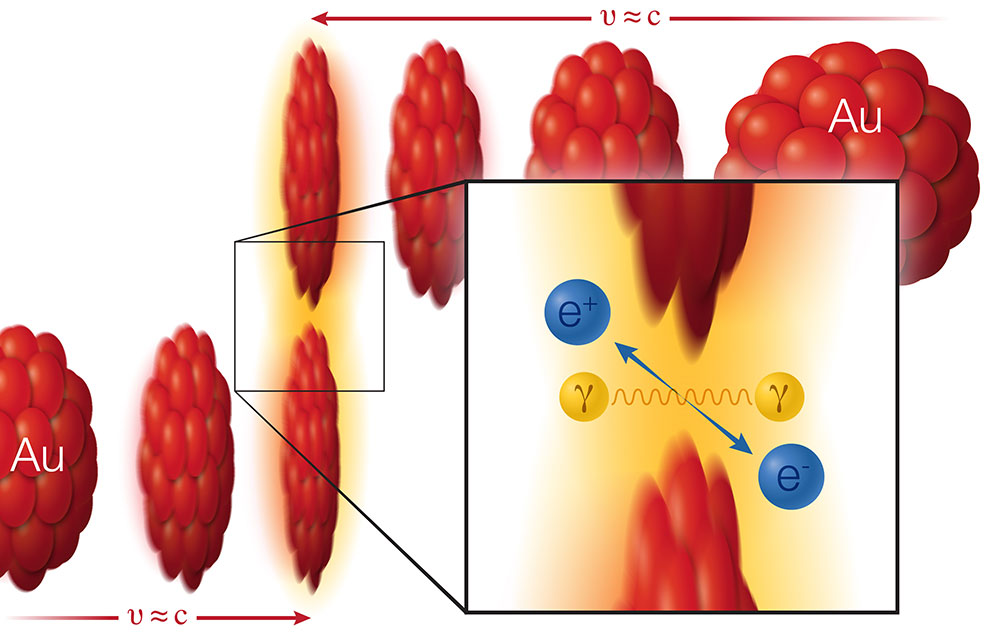
It does not apply to making a replica of a body that is composed by the same kinds of atoms linked in the same way between themselves, which can be considered as identical with the original for any practical purposes.
In a very rudimentary form, such technology exists today, it is possible to remove one atom at a time from a certain position of a body and identify it with a mass spectrometer and it is possible to grow a structure a few atoms at a time.
It is likely that the precision of such techniques could be improved well enough to be able to replicate some extremely small microscopic objects.
The most difficult limitation to overcome is the speed of the process.
To be able to make some human-sized object atom-by-atom and molecule-by-molecule in a reasonable time would require a many orders-of-magnitude higher speed than possible with the current technologies.
the question is, could we get around that by converting from mass-less forms of energy, and generating mass on-the-fly, skipping the need to accelerate tons of acceleration mass; or is there some restriction that would disallow this?
If I fire 2 photons at each other on a ship travelling at 0.5c, and this creates 2 particles e+ and e-; would the particles also be travelling at 0.5c along with the ship; would their velocity/momentum be in random directions etc?
What does "highly concentrated steel" mean here?
All my Googling is getting hits for the metal, but I feel like something else is meant here.
Here is an article from Brookhaven Lab website: https://www.bnl.gov/newsroom/news.php?a=119023
If that's true the domain should be banned. There's no point in reading things that garbled plagiarizations.
* Electrons emit photons when going from a high energy state to a low energy state (but remain electrons)
* Two photons colliding produce an electron-positron pair (always exactly one?)
List of Star Trek inventions that came true: https://qz.com/766831/star-trek-real-life-technology/
Although, from "light into electron and positron" to "Tea, Earl Grey, Hot" there is a long way to go.
How did they achieve that?
> Relativistic Heavy Ion Collider
https://en.wikipedia.org/wiki/Relativistic_Heavy_Ion_Collide...
Electrons are fermions.
I am therefore comfortable saying that electrons are matter.
I don't know why you say that electrons are "not particles" in QFT. Sure, there's an electron field, and electrons are just, like, excitations in that field. There's also a quark field. What of it? If you are saying "because everything is fields, there are therefore no particles, and therefore no matter", you are using the word "matter" in a silly way.
Also, isn't a "particle" just a representation of a compact Lie group? What's the problem?
(edit : though, I admit that I'd be a little hesitant about calling a massless fermion "matter". But, seeing as there are no known massless fermions, meh.)