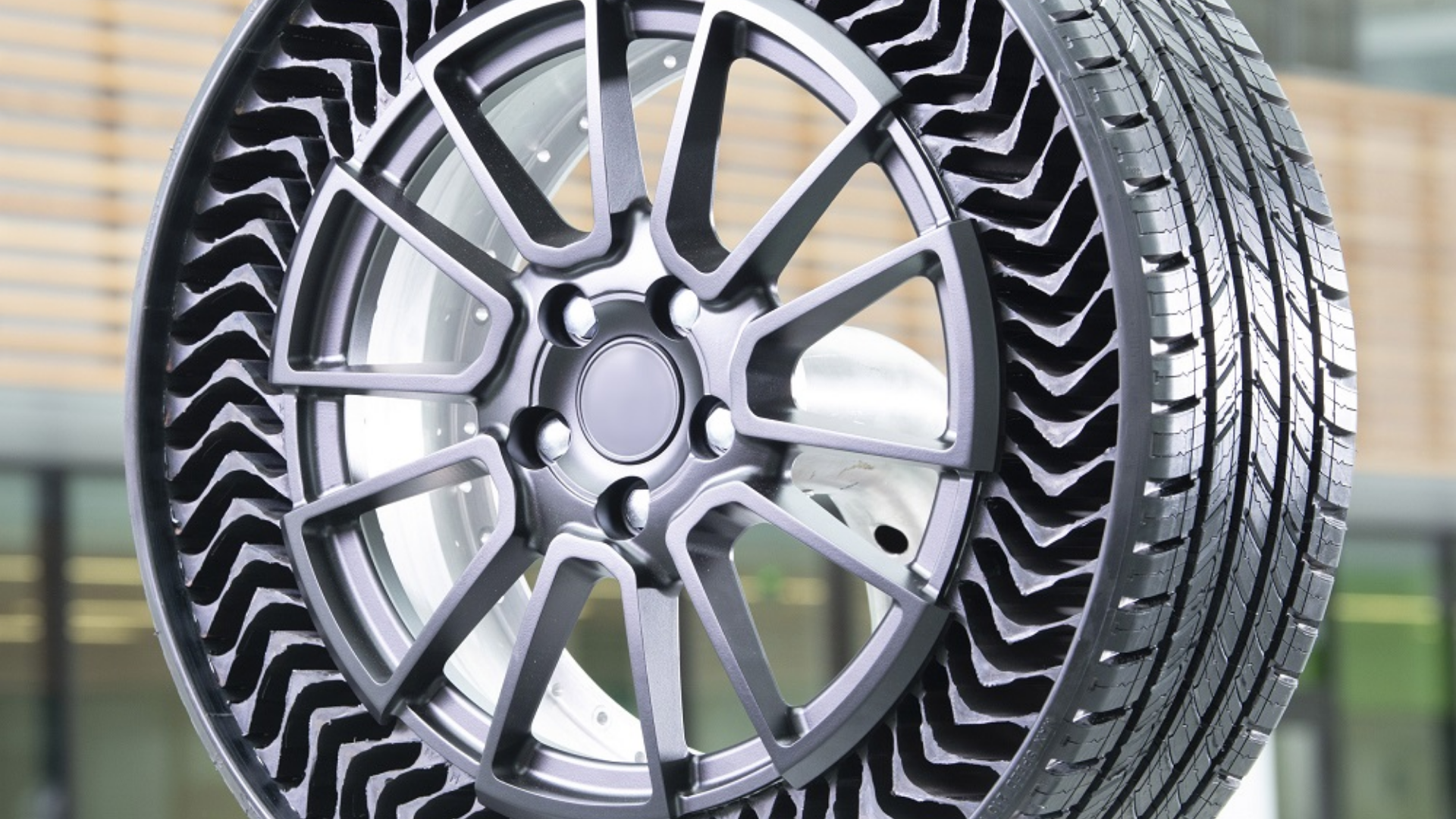
Michelin's New Airless Tires Just Hit Public Streets For the First Time
The concept is scheduled for market launch in 2024.
Interesting Engineering
230 points · by mardiyah · 5y ago · 189 comments
Of course, there, puncture resistance trumps vehicle control and ride comfort by a large margin.
If thw core patent is 31 years old then that means it's been in the public domain for 11 years. Anyone should be able to make a variation thereof at this point - steering clear of other derivative patents of coarse.
just in time for Tesla's FSD then /s
Airless tires usually depend on a finely-tuned elastic polymer of some kind with a fairly narrow temperature range.
>The company recently took the Uptis out in public for the first time and even invited a limited number of people for the test drive.
[1] https://www.theguardian.com/environment/2016/sep/11/pollutin... [2] https://www.opb.org/article/2020/12/04/scientists-point-to-c...
EDITING to provide source because I was downvoted. All types, including rail dust: https://www.railway-technology.com/features/feature-air-in-u...
Several studies apparently. 10-30 percent depending on the study.
I guess you could look for a material that becomes biodegradable after wearing down. Does anything like that exist in any form at the moment?
My car had runflats when I bought it, when it was time for new tires, I went with some high quality all seasons. My ride quality improved, my gas mileage went up and they brake / corner better. The risk of an unplugable flat is a small price to pay for that.
Maybe a bit harder ride, but I had been in the habit of inflating my old tires 2-3 pounds more than the manufacturer recommendation. So I brought these back down to the recommended 32psi and they are just fine. And they proved their worth when I got to a job interview on time even after getting a flat - and when I went to the tire shop it was a free repair instead of a new tire.
1) airless, check.
2) rechargeable ??
3) connected ??
4) sustainable ??
>sustainable
"retreadable" but the marketing department didn't think that had sufficient appeal for the demographics the press release was targeted it.
This link seems to line up with what I remember from 40 years ago:
https://www.treadwright.com/blogs/treadwright-blog/are-retre...
If the Michelin's are built with retreading in mind, should work fine. After all, it always did before. :-)
On the other hand, I'm not sure about retreading tires with higher speed ratings.
Connected: Reports tread status and configuration, e.g. to inform the driver that he should change to a winter tire tread.
Sustainable: Recycled and recyclable.
That sounds like everything that's terrible about printer ink but with the decimal moved once to the right.
I can imagine a world where your tires stop working because you had them re-treaded with a tread pattern or the OEM won't honor a warranty item because you didn't use an approved brand of retread.
Existing air-filled tires are already "connected" on modern vehicles - pressure sensors that link to the vehicle's on-board diagnostics and inform the driver of low pressure, often before there's any other visible, audible, or mechanical indication that the tire has a leak.
https://news.ycombinator.com/item?id=28478438
Will single tyres e-mail you singularly or as a group?
I mean:
Hi, I am your left front tyre and wished to tell you how ...
or:
We, the tyres of your car, have determined that ...
Apparently saves a lot of money.
Reducing the amount of particulate pollution, however, is apparently not part of the remit.
https://www.michelin.com/en/innovation/vision-concept/
It is a company vision, not a product announcement, so as expected much of it is fuzzy and hypothetical, and it may or may not apply to this particular product.
But this part offers a clearer idea of what rechargeable means:
> The tread can be “recharged” using a 3D printer, which means that VISION can be adapted to motorists’ changing needs, for maximum comfort, safety and sustainability.
They also have an official page for this actual product line, which is called Uptis (Unique Puncture-Proof Tire System):
https://michelinmedia.com/michelin-uptis/
The FAQ on this latter page says stuff relevant to sustainability:
> Today’s level of rolling resistance is about the same as a zero-pressure (“run flat”) tire
...
> Uptis will have the same mileage of a standard tire.
I believe this is an important part of sustainability because if mileage were worse, you'd gain in one area (reduced waste) and lose in another (increased energy usage). So if mileage really is the same, that's a good thing.
...and then you've got something.
I'm actually surprised that I've never seen a tire with some kind of closed-cell super lightweight foam, some kind of aerogel maybe. I suppose the problem in that case is that you can't spread heat throughout the whole interior.
Which makes me wonder, how do they radiate heat on this Michelin? Does it stick around the outer surface and that's it? Do the 'spokes' bear it away somehow?
https://www.revzilla.com/motorcycle/michelin-bib-mousse-tire...
I haven't used it, and most serious track rats have a separate data system so the track connect features are potentially redundant, but I assume that it's an MVP of what a consumer product might look like in the future.
On the other hand, they were common in Italy in the '70's and '80's, there were truck tyres that instead of being re-treaded with the "hot" process above were thinned and grooved on a sort of lathe and then a monolithic external "ring" that included the tread on the outside and matching grooves inside was applied, when the tyre was inflated the grooves and the pression made the two stay together (until the tyre was punctured, it was not so rare that you could find on roads these outer rings lost by some truck that had a flat wheel).
With regard to sustainable, well, I guess they could return to the jungles of Malaysia and Brazil for caoutchouc…
I could still be convinced that the sustainability or safety (from fewer blowouts) gains of these would outweigh that, but it's important to consider beings outside of the auto cabin.
It's only "blighted" because the people who self select to live beside a highway tend not to be the ones who care a ton about making their residence look nice from the street (manicured lawn, nice siding, sealed driveway, etc, etc) so the prices stay cheap, the rents stay low and the cycle continues.
Source: I live beside a highway
https://academic.oup.com/eurheartj/article/36/39/2653/239823...
or this
https://forcetechnology.com/en/articles/traffic-noise-danger...
200-500 annual Danish deaths related to road noise pollution. Thats more than the number of people killed in traffic yearly.
Ugh, handling == safety, my friend
[0] https://tweel.michelinman.com/light-construction-products.ht...
Various manufacturers have been teasing "airless" prototypes for highway use for a long time. I hope this one actually goes somewhere.
The open structure looks perfect for launching anything that will go into the slots into other traffic.
https://michelinmedia.com/site/user/files/44/MNA342_Uptis_Sn...
Back when I used to go off-roading a lot it was common behavior to leave a lot of space between you and the truck ahead when you got back onto a paved road. The open tread pattern of offroad tires picks up lots of small rocks and sends them flying back at highway speed. Not good for the windshield on the following vehicle.
I live on a gravel road now. You learn not to follow other vehicles too closely!
That is false. Tires like this are nothing hew; they have been around for over 100 years. They are useful in niche applications, like earth-moving machinery and whatnot.
Other than that, airless tires are rubbish and will not displace pneumatic tires.
https://www.ikkaro.com/wp-content/uploads/2012/11/ruedas-sin...
They are not “rubbish”.
A lot of cycling is recreational and light commuting, and so performance factors do not matter.
Airless tires are certainly right for someone who abhors punctures and wants to avoid them at all costs. Factors like efficiency, weight or ride quality don't necessarily matter his or her use case, or even if they somewhat do, they are overridden by the abhorrence of having to pull off to the side and deal with a flat.
Yet, even though cycling is the one sphere where airless tires could have a chance, is is overwhelmingly dominated by pneumatics, just like motorism.
I don't think you will see anyone place well in a road cycling competition, if they bring airless tires. But, well, so what? A lot of the bicycle tech is driven from the top down by the competitive sport; and maybe that results in certain technical choices being promulgated at the entry retail level that are not necessarily relevant to every user.
I think last time I looked that them the rolling resistance was a little more than I'd like on my "fun" bikes but for commuting that they look great option.
I think my personal preference for a "ride flat" system would be for a tubeless tyre, sealant and an insert like Tannus' Armour Tubeless (...or tubs I guess)
This was researched and practiced since at least first world war, with pioneering applications dating to 1850s.
TLDR: internal friction in the rubber kills it. Acceptable for military and heavy-duty vehicles, useless for anything else.
> 21. What will happen if some small stones or mud or snow get in between the structure of Uptis?
> The objective during the development of the commercial product is to test Uptis in all of these situations. Some preliminary tests show that stones, mud or ice/snow will not stay inside the Uptis structure.
Obviously preliminary tests aren't anywhere near enough to prove it's a nonissue, though.
For some reason though, it seems like a lot of car manufacturers are moving away from spare tires to things like "car puncture kits" that fill your tire with foam or something. If the recycling of tires was abysmal before, something like that seems like it would make it even worse.
Hmm. Do these have batteries and computers inside? Do they have to? Making things “smart” usually decreases the time span.
And you've found the problem. Michilin is trying to compete with Firestone to sell the next set of $1k tires you put on your expensive car. They're (mostly) not competing with Deestone and Linglong to produce the cheapest tire for your beater car. The people buying the former don't buy retreads. But they might if you find a way to re-spin the same fundamental idea as something that isn't low-end. And if you're the first to figure out how to sell that product to those people you can make boatloads of money while everyone else plays catch up.
how else to add planned obsolescence to such a durable product?
I worked in a tire shop, and chronic overinflation caused tires to go bald in the center of the tread while the sides had tread left. Have to replace them more often then.
I just got a set of tires replaced under tread life warranty because they wore out edge first. The tire shop set the pressure higher than recommended and actually a little higher than I usually set it myself.
Just hope it becomes affordable for basic cars by the end of the decade, I'm sure China will make a cheaper knockoff.
The number one cause of micro plastics near waterways is from car tyres.
Also, airless tires are puncture proof by definition.
I don’t think carbon fibre would be of any use here, it’s not super strong against high transversal forces AFAIK. It’d mostly be useful for sidewall rigidity (and I’d be surprised if it didn’t already exist).
In the case of PAX, the service stations (75% of the market is replacement) were not ready.
Hopefully, Michelin has the full ecosystem enabled in this case, as this seems promising.
https://www.nytimes.com/2008/04/20/automobiles/20TIRES.html
Seems to be a really bad value for money.