Futarchy: Robin Hanson on How Prediction Markets Can Take over the World
Transcript of interview
richardhanania.substack.com
150 points · by jcarterwil · 5y ago · 193 comments
When there's a lot of money riding on something happening, it tends to happen. Sports and traditional financial markets have been dealing with this problem since forever.
  Richard: They say Bin Laden is just going to put all his money in the market and then attack?

  Robin: Well, that was crazy because these were relativity thin markets, and they have a lot of money at stake. Basically a fact that people don’t know about the markets is that many people criticize by saying, “Well, somebody will try to manipulate the markets by betting on one side not because they know better, but because they’re willing to lose money in order to distort the market price.”

  That is true. There are people willing to manipulate markets, but that actually makes the prices more accurate. For example in the fire the CEO market you say, “Well, the CEO wants to keep his job, so he will bet in these markets in order to make himself look like the price will be higher if he stays, and lower if he leaves.”

Yes he would have an incentive to do that, but when other traders know that somebody will be trying to manipulate in the market they know to increase their trading and their efforts and that compensates, and actually on net makes the prices more accurate. That’s something we see in theory and we’ve seen in the lab, and we’ve seen in the field. These markets are robust to attempts to manipulate. In fact people who want to manipulate them make the prices more accurate.Any kind of the suggested self correction here relies on the other traders having sufficient funds/capital/risk taking capacity to overcome the manipulator and to coordinate their views to some extent. In the CEO example, how would other traders even now that the CEO was making the bet? What if some other informed party made that bet? In small, open, and rather serene settings that might work out, but in a real market with fast movements, market makers, etc.?
The quote from the transcript is talking about attempts to manipulate the market.
optimalsolver is talking about manipulating reality in order to win money in the market.
Analogy: working extra hard to make your company succeed because it'll increase the value of your company stock.
I think the idea is that these prediction markets are set up in a way so that the outcomes are generally deemed desirable (increase GDP for example) and it's OK to manipulate reality (do work) to achieve them while making money.
The potential streaker would have to bet in both markets, so won't affect the difference in prices between the markets.
Who said anything about impartiality (/cordially a strawman)?
Changing behaviors is a feature not a bug. Your health insurance writer (who's bought "No optimalsolver will not get sick") loses money if you do in fact get sick. Your fire insurance writer has an incentive to provide you free fire inspections because it reduces their payouts. A farmer plants a lucrative but fragile crop because a meteorologist can better price weather risks than they can.
Swapping exposure across space and time is a productive act.
This is covered today by what we call fraud (whether that be insurance fraud or market manipulation fraud), which tries to set bounds on what acceptable behavior is so that you can try to eliminate pathological edge cases. I don't see how this would be handled if everything at a top-level is handled through prediction markets.
"Once a Market’s underlying event occurs, the Outcome must be determined in order for the Market to Finalize and begin Settlement. Outcomes are determined by Augur’s Decentralized Oracle, which consists of profit-motivated Reporters, who simply report the actual, real-world Outcome of the event. Anyone who owns REP may participate in the Reporting and Disputing of Outcomes. Reporters whose Reports are consistent with consensus are financially rewarded, while those whose Reports are not consistent with consensus are financially penalized."
Where the market here can take these states/phases:
    > Pre-Reporting

    > Designated Reporting

    > Open Reporting

    > Waiting for the Next Fee Window to Begin

    > Dispute Round

    > Fork

    > Finalized
At when if bad actors put their money into the prediction markets, they draw further attention to their false claim--something that can't be said for the alternatives.
People who can control or majorly influence these big outcomes - elections, sports matches, acquisitions, etc. - generally have a much, much larger stake in the outcome itself than any side bets.
It’s not even theoretical. This actually happened (or rather was attempted with traditional betting markets, not prediction markets): https://www.insider.com/super-bowl-streaker-bet-on-himself-p...
Prediction markets give financial incentive to force specific outcomes. They aren’t just observations: They become incentives to influence the outcome. The bigger the market, the bigger the incentive.
https://en.wikipedia.org/wiki/French_football_bribery_scanda...
https://www.dw.com/en/police-expose-european-soccer-bribery-...
etc etc etc
"When a measure becomes a target, it ceases to be a good measure."
See Wikipedia to get started, then google search for examples: https://en.m.wikipedia.org/wiki/Goodhart%27s_law
Isn't the idea that we put up regulations to minimize this, just like we have restrictions on insider trading?
What am I missing?
You can’t have a market if the price is secret.
The goal isn’t to have people place bets and see who is right later. The goal is to expose the predictions to market forces and make people put their money on the line, thereby (theoretically) improving the quality of predictions.
Suppose you're using prediction markets to encourage thorough code reviews, specifically with an eye towards catching malicious commits. Run of the mill non-malicious PR's get lots of little yes wagers, and are merged without exceptional scrutiny from the package maintainers. Then a malicious commit comes along and a reviewer wagers $100 on "not merged". This captures the attention of the maintainers and they give the PR extra scrutiny. Turns out it has a malicious commit, so it doesn't get merged and the reviewer who found the flaw is rewarded with the money wagered by those who didn't find the flaw (plus some from the stakeholders, who seed the market with some "no" money to encourage participation in the game even in boring non-adversarial times).
If you hide the predictions and the amounts, you can't use the unsettled bets as inputs for decision making.
You could imagine a lighter version where I ruh for some public office, bet a billion against me winning, and then drop out of the race.
My point is your example is contrived and not really useful.
That by so preserving the independence of predictions, you’ve also removed their utility, which is predicated on their availability.
Markets need participants, capital, liquidity, effort, etc. to become efficient. A lot prediction markets suffer from the fact that volatility in them is limited and that the outcome is not of interest to many people, so the markets cannot really do what markets are supposed to do.
If markets are aggregating crummy data and information, no useful market will form. And that is observable even in much more developed financial markets, where some things really have trouble on price formation. And then you might use auction methods, for example.
Similarly, if stuff happens rarely and you only get very limited shots at being right, then averaging and aggregation or not so useful because you cannot get an average (e.g., can do one thing for the next five years and better be right, for example).
It's not clear to me that prediction markets usually have natural hedging participants (maybe political operatives, but the tx costs are probably too high relative to the value at stake).
Prediction markets have been a thing for at least 25 years. I get the intellectual appeal, and they may be useful in certain niches. But I think their lack of significant uptake or impact is telling.
I remember back in 2012 InTrade had a market for the US Presidential election, the odds were wrong, stayed wrong for months, and actually got more wrong close to the event. You could get hourly liquidity in the tens of thousands almost throughout (I put on $20k in this market, I wasn't touching the sides, it was incredible).
Most of the people who talk a lot about prediction markets haven't worked in markets. Markets aren't magic. They work better with binary outcomes but they cannot be smarter than the people making bets in that market...and they aren't (I have most experience with financial markets, which just don't work well at all, but have quite a bit of experience with binary markets too...they have only become more accurate as our knowledge about the underlying events increased...if you look at binary markets where knowledge is limited in some way, markets are not efficient).
+1. This is why I'm more interested these days in prediction markets within (large) institutions, like tech companies, universities, or government agencies.
That way, the participants have (a) a shared domain of interest, and (b) can speculate about internal, nonpublic matters.
Perhaps most importantly, if the prediction market improves the wisdom of the institution, the participants benefit - even if they aren't profitable in the market itself.
They went into quite a bit of detail but can’t cover everything. Most of the examples were quite top of funnel, fire the CEO markets, economic impacts of new laws being passed. I wouldn’t expect for major bills or companies there would be any shortage of liquidity there.
It’s typical of comments in any forum to mostly be critical, but what takes more guts and cleverness is to connect the dots to improve upon the idea. You seem to have a good mind so I’d encourage you to try applying it in that way.
Going from academic ideas of markets and experiments to actual deep and useful markets is surprisingly difficult.
EDIT: the failure to create proper working markets for GDP-linked derivatives is good example of something that should but actually ain't. Not enough market making risk takers, limited hedges, unbalanced demand between long and short demand, index issues, ...
I agree it would be challenging to have deep and useful markets, but perhaps there’s more innovation to be made there — and many of these high level markets that are top of public consciousness I’d expect to have plenty of liquidity.
In 2005 when I joined Google, they actually HAD prediction markets (no $$ involved) on business questions like "Gmail will have 50 million 7-day actives on April 1." It seemed so hip and with-it. Top management can get the real truth about things, rather than just asking their underlings!
The markets didn't take off, they withered. AFAIK they don't have them anymore. A friend of mine actually created an open source project for setting up your own prediction market. We can ask him how many users he got.
We've had betting markets on politics for a long time, too. I lost a few dollars on Amy Klobuchar in the 2020 primaries, although I had a 3x profit for a while (didn't sell, damn it).
So the interesting question isn't "is this a good idea?" but "why hasn't it taken over the world already?"
===== "Richard: Do you put futarchy in a larger intellectual tradition? Because a lot of people when they're coming up with an idea... Did you come up with this term by the way?
Robin: Yeah, and I've been ridiculed for it."
(1) Traders only make predictions in markets where they think they will gain;
(2) Traders control their risk, so one very confident person can make a larger bet than 10 people who are not very confident;
(3) Markets are continuously updated as new information arises;
(4) Profitable traders trade more, while losing traders exit the market
Actually using real money is a major legal hurdle, and that's why most prediction markets don't do it. The political markets have a special "research" dispensation, last I checked.
It has been an interesting exercise, and our largest bet was over $1m: https://longbets.org/362/
It has been a success as far as I'm concerned, in that it's still up and running almost 20 years later, and it has generated a lot of discussion about long-term topics, which is our goal.
But at the time I hoped it would turn into something much bigger. Lots of bets! Lots of money on table! Secondary bets! Maybe even options! That was definitely not the case. It has stayed niche, and so have prediction markets generally. I think there are good reasons for that.
My personal feeling: people do not want accountability, and to paraphrase Jack Nicholson in A Few Good Men, they can't handle the truth. I think that's the real reason the Google prediction markets died: managers prefer to do what they want to do, regardless of whether it's going to work or not. Perhaps someone can theorize as to why that's a good thing? I can't.
And I think you're also right about what managers want. I was very involved in the Lean Startup movement, which had a few years en vogue a while back. Core to it was being very disciplined about stating and testing hypotheses as quickly as possible. Used right, it can work extremely well.
It got some uptake in startups, but not as much as I expected. And even less uptake in more established companies, although the methods work well there too. Why? My take is that it's not just about managerial desire, although that's important, but also managerial status. For rising through the ranks it's much more effective to talk a big game than a modest and humble one, even though the latter traits are more likely to lead to success.
I hate it, of course. But we can look at examples like Theranos, Uber, and WeWork. None of them ever turned a profit, and it's possible none of them ever will produce a net return. The first CEO got caught eventually and might face some consequences one year or another. But the other two ended up incredibly rich. Who am I to say that bullshit doesn't pay?
The good thing though is, he could simply setup a decision market to have people decide the true value of decision markets no?
Actually there is a new prediction market at Google now called Gleangen. It seems to be fairly active and flourishing despite not using real $$. Although there is a leaderboard, so perhaps the desire to want to rank in the top 10 is what motivates people to place bets.
* what sort of things can bets be placed on? Real sensitive business stuff, or more mundane things?
Both. It could be something mundane like "Fed raises interest rates in 2020" or something company specific like "Nextgen pixel phone display size is > x inches". Generally the company stuff tends not to be the real sensitive stuff and tends to be more about fun/mundane topics.
If there wasn't a legal problem, I think they would have much more of an impact.
> The markets didn't take off, they withered.
This is surprising?
The market was a surprisingly accurate forecaster too: http://static.googleusercontent.com/media/services.google.co...
Do you think this critique has never been considered? If you disagree with the reasons why this is not a problem, go ahead and critique those directly.
Please don't reflexively pooh-pooh an idea you don't really understand.
Today, people have no incentive to do that other than "wanting to watch the world burn". But if you can get rich burning forests, more forests will burn.
I don't doubt Hanson has thought about this. I just haven't seen it addressed.
As for your specific example, starting wildfires is an extremely serious crime that I expect the authorities would spend significant resources investigating, so I don't know how bettors would estimate the ease of manipulation for that market. Even if the prediction market were implemented in a perfectly anonymous system where you're guaranteed to be able to collect (and spend) your money without authorities knowing you were the one who profited from that prediction market, it seems like you have a pretty high risk of getting caught simply for the act of arson itself (not to mention the "risk" of firefighters controlling the fires that you start).
I'm also not sure how many people there are out there who refrain from starting wildfires only because there is no direct financial incentive, and not for other reasons (like not wanting to destroy massive amounts of ecosystem and property and potentially kill many people).
I think you underestimate organized crime. Starting wildfires is easy and skillful criminals won't get caught. The people that pay them take on an even slimmer risk.
This isn't a reason to not allow equities markets.
Also, could you at least summarize some of the counter-arguments or even link to any of the literature?
Do a search for "manipulate" in the text for a simple counter-argument.
tellingly. None of the critiques I see address these counterarguments even, so I suspect knee-jerk responses are mostly whats posted here.
Moreover even among futarchy proponents, many do not advocate for it as the dominant form of government, but only one form for certain operations. Hanson's position is on the more extreme edge here.
If a person can manipulate the market without expense, then they can do it without relying on the profit and the market isn't the problem. It will, however, allow them to bet on the market, providing a good indicator.
How does this work, again?
My fear about a betting market for policy is that you’d have a bunch of rich/powerful people betting GDP will go down and then doing everything in their power to stunt economic growth.
The chance that you can short a "broad range of stocks" and affect their share price is alot less certain. Especially in liquid markets your chance of affecting a blue chips stock price is very small.
There are always a few cases, like Archageos, where you can get so big that you move the stock but those cases are so well known exactly because they are so rare.
https://www.insider.com/super-bowl-streaker-bet-on-himself-p...
Does anyone know if things have changed on that front?
A derivative (a contract which is representative of some good, right, entitlement) based on the outcome of an event occurring or not.
Event derivatives are all around us. You buying fire insurance grants you the right to sell, to an insurance writer, a smoldering pile of wood (worth $2) at a price of say 30% of the unburned value of your home (similar to an OTM put option). An accidental-death insurance contract being worth a negligible amount until the subjects death.
What people often get wrong about EDs is
1. Whether or not they accurately predict events: they don't; they reflect the price, or odds, at which a market is willing to swap exposure. e.g. One pays a insurance costs because it's more profitable to swap risk than deal with exposure.
2. Confusion around incentives: Yes, each party swapping exposure will change their behavior -- which is a feature, not a bug. A company buying fire insurance can now enter into commerce otherwise prohibitive unlocked by swapping fire risk with an insurance writing company who has incentives to prevent a fire risk -- and do so at scale, coordinating multiple parties.
3. Lack of information about unfettered demand for the products. People claim there's no demand for EDs but neglect to take into account regulations: prevent people from purchasing them freely, political manipulation of prices when buyers are unhappy with the market price for risk, regulatory capture creating anticompetative producer protections, observe that because because of bans the inferior counts some EDs have been forced into are insufficient.
The global policy failure of covid has been around risk pricing, risk-exposure swapping, and effective, at-scale incentive coordination.
An exercise: An assassination market opens for the price of your head. In which case(s) should you be most concerned for your life:
[A] Exposure available at .99 on the 1
[B] Exposure available at .01 on the 1
[C] Exposure available at .5 on the 1
@HarryDCrane on Twitter is an applied researcher in this area, read him if you're interested in more -- I know I have.
(I hate guessing in stats and odds - the jargon used to express things has so many subtleties)
At 1c to get 1 dollar - That to me implies no-one thinks I will be killed (either I live in the Oval Office so it's very hard or frankly no-one wants to waste the bullet)
At 99c to get 1 dollar it's a near certainty. I am already tied up in a basement somewhere.
I think the 5c one
Prediction markets bring the magic of perverse incentives to all walks of life.
Sometimes I think opposition to prediction markets is just opposition to markets in general, which is fine, but a very broad critique.
Tell me how it's at all okay that the same banks who are dabbling long on water futures are also invested in building a tar sands pipeline across the Mississippi river and straight into the Lake Superior watershed. Conflict if interest is an understatement. These organizations act like total automatons and are practically beyond control except through inventive systems. If we just let them go on with this behavior vaguely in the name of "markets", I think that's dangerous. We're missing a collective opportunity to say "no, that's not how we want the incentives to align and it's time to adjust them".
If I was gonna generalize, I think I'd prefer more to get generally frustrated with uncritical application of technologies of incentivization, especially with games that so clearly tempt injustice, yet that powerful people rationalize regardless as being the only viable way to go.
If there are limits on betting, then it's direct democracy with extra steps (everyone gets one "vote" worth up to $limit).
What if improving society was a reward-in-itself and we trusted competent managers to do the complicated bits?
At any rate, "futarchy" is clearly a step backwards.
If they could not then there would not be a lobby, and media would not be as politicized as they are.
> What if improving society was a reward-in-itself and we trusted competent managers to do the complicated bits?
This is the mental model many citizen seem to adopt to interpret their government. In my opinion it's closer to a religion than reality. People that willingly reject great personal rewards in favor of the common good are a rarity. They do exist, but expecting people in power to naturally adopt that stance, or expecting that elections is a good way of finding those people, is a mistake.
There's no such law, of course, but there's also no law that a restaurant must offer food and service that customers like, and yet we tend to observe that restaurants which do that tend to survive better than those which do not.
Here's the tricky part. It seems to me that the metrics which you don't choose to bundle into the aggregate measurement will get annihilated (optimized out) at the expense of those which you do choose to bundle. And the decisions as to which things you do bundle and with what weight represent ethical, moral, spiritual, aesthetic, and otherwise intangible judgments which are (unsurprisingly) difficult to quantify or even come to basic agreement on. He weasels a bit by using relatively uncontroversial examples ("more trees", "leisure") and by handwaving ("authorize": how?, "sort of agency": what sort?), but it's trivial to imagine metrics which produce wild disagreement regarding the magnitude or even sign of the weight to be applied.
(Shadows of paperclip maximization loom.)
At that point, I'm not sure where we've significantly improved things since we're still left with the problem of how to choose the people who decide which metrics go into the aggregate measure and at what weight. Can we make a market on that, too? At that point we're in some crazy recursion and I get lost. I'm deeply skeptical.
The big issue I feel like he underrates is the massive incentive to take control of the agency that's supposed to be doing objective assessments. These are now effectively the most powerful people in the country. Even if they start off as saints the political incentive is going to be to find ways to influence it. And once that agency is captured then you have a dictatorship in all but name.
I feel like this reflects a common problem in political theorising, of coming up with an ideal institutional structure without thinking about the incentives around it and how it need to be sustained.
Historical analogues would be how originally non partisan district drawing processes are politicised, the politicisation of science and medicine, or soviet or Chinese gdp figures. The simplest solution is always to just rig the game.
It seems to me that many of these "rationalize all the things" schemes tend to bottom out at and build onto an "incorruptible kernel of truth" which, if corrupted, causes the whole thing to collapse (or worse: have a veneer of impartial truth while being secretly corrupt). It's a sort of microkernel approach to government.
With Hanson's futarchy, it's the hypothetical mechanism for "voting on values" in order to choose what does and doesn't go in the almighty bundle of metrics (and who gets to measure the result: they have the real power). If that can be corrupted then the whole thing falls apart. Yarvin's "neocameralism" has a "cryptographic decision and command chain" which everything else rides on (https://www.unqualified-reservations.org/2008/05/ol6-lost-th...).
This "all the eggs, one basket" approach seems fragile and ripe for subversion, especially when having fallible humans administer it. It seems more resilient to avoid concentrations of this kind of power.
I suppose I already think that most of wall street is not, in fact, making anything much more efficient at all, and is instead a massive state-run casino. So maybe I am not the target audience.
Suppose that worker cooperatives have taken over the world.
Suppose then that the worker cooperatives must choose between policy options, for example { "increase payments to retired workers", "increase investment in disaster preparedness", "increase investment in infectious disease biochemistry" }.
What is your recommendation for how the worker cooperatives should decide how to allocate resources? Presuming you do not recommend prediction markets.
Otherwise the tools we have available are extremely powerful especially when fed good data that is freely available, which is what would be possible if you achieved the (perhaps impossible task) of switching most of the economy to worker coops.
Do you see tyranny-of-the-majority and factional-rule as evils to be mitigated, or as desirable reflections-of-worker-cooperator-sentiment, regardless of consequences?
Do you agree that the Democratic Caucus of the Colorado State House of Representative is a democracy? In 2020, they eschewed one member, one vote in favor of Quadratic Voting. More here: https://www.radicalxchange.org/media/blog/quadratic-voting-i...
> Pinning refers to the potential for institutional option buyers to manipulate price action in the underlying as options expiration approaches. If these option buyers face the potential for a total loss of the option, they may try to pin the stock to a price just in the money by strategically entering buy orders at the last minute before the close
https://www.investopedia.com/terms/p/pinrisk.asp
You end up with this tail wagging the dog model where options end up moving the underlying as the option seller/writer doesn't know if they will be called on the option so they have to acquire it to hedge out their risk just in case.
Similarly the option buyer doesn't know if they will be assigned so they tend to short the stock to, again, hedge out their risk so the stock experiences both buy and sell pressure around the strike price due to bets placed on it.
Don't you mean option seller/writer? If you buy an option (and therefore are an owner), you have the right but not the obligation to exercise it.
>You end up with this tail wagging the dog model where options end up moving the underlying as the option seller/writer doesn't know if they will be called on the option so they have to acquire it to hedge out their risk just in case.
Right, but that's not any different than any other sort of leverage? eg. buying stocks on margin to drive up the price.
No, meant the buyer, alot of professionals want their exposure to be hedged out so they don't want to end up owning any shares after expiry so they need to be short shares for any calls that will end up in the money. So as an option pins the underlier close to the strike price the option holder ends up buy/selling to hedge out their delta exposure to zero.
> Right, but that's not any different than any other sort of leverage? eg. buying stocks on margin to drive up the price.
Not really,
The tail waiving the dog effect occurs when a derivative instrument that is priced off an underlier actually ends up moving the underlier itself.
Leverage is a different animal. If you lever up 2x you're just buying twice as much. When you unwind you you sell 2x as much. Its still the underlying moving itself and not being affected by any other instrument.
[0] https://en.m.wikipedia.org/wiki/Nenana_Ice_Classic [1] https://climatecommunication.yale.edu/wp-content/uploads/201...
I had the idea, back in 2004, of a prediction market for "patent NNN will be invalidated." The idea is that this creates a financial incentive to build the case, usually with prior art, to invalidate garbage software patents. Because most software patents ARE invalid.
I actually pursued this at Google for some period. The implementation details are kinda prohibitive, though:
must ALL the claims be invalidated, or just some?
can the patentee amend his claims to avoid the invalidity ruling?
by what date must the invalidation take place?
who's going to bear the cost of invalidating it?
Nice idea, though.
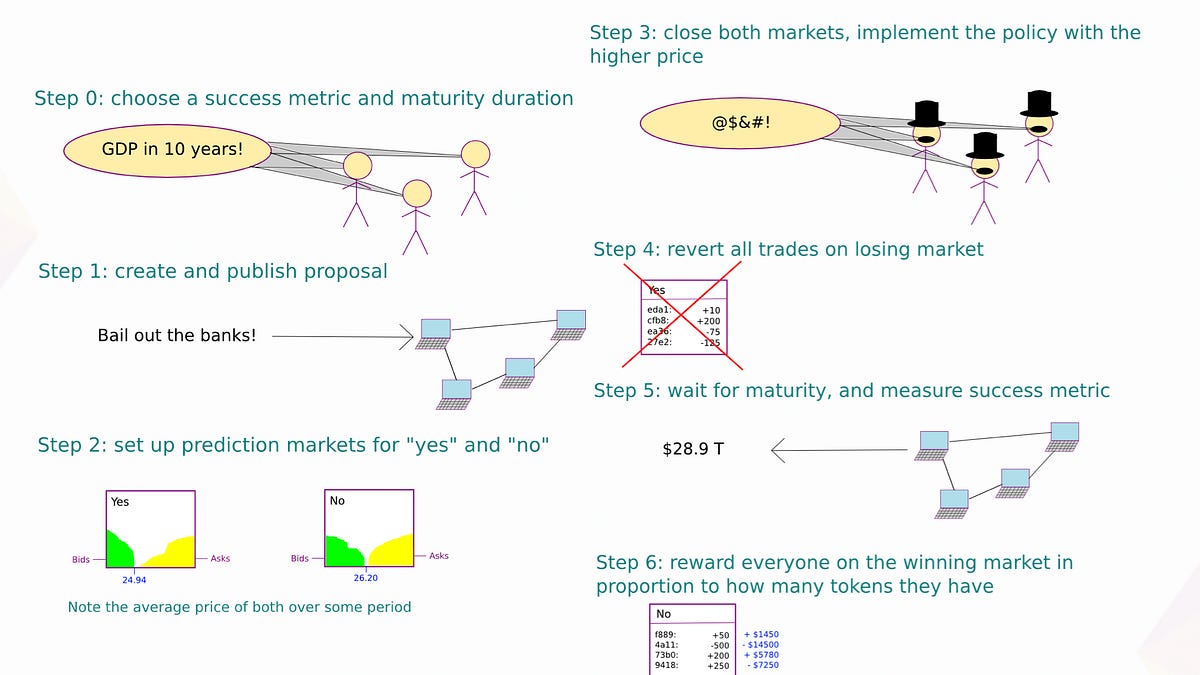
Let's say we have the situation in the diagram, we have a two policy options, "A" and "B", and we're betting on "if we adopt this policy, will the GDP reach the target?". Let's say that currently A is unpopular, so "yes if A" has a low price, and B is popular. Now imagine an oracle enters the market, who knows that A actually has the best chance of reaching the target, but B also has a good shot. In fact, they know that "yes on A" and "yes on B" are both underpriced - just "yes on A" moreso. Ideally, we would like this oracle to put their money on "yes on A". But if they don't have enough capital to change which market leads, they'll break even (by having their money returned when B wins) if they do that. Instead, they should bet on B, which they know to be a worse option, because it'll actually fire and they'll still make some profit. The market doesn't get to learn all the information that the oracle has.
Is there some way to structure the markets so that our oracle instead bets on A?
That way the market should judge bets based not on their absolute value, but on the degree of risk that the bettor is willing to take on. An oracle betting 100% of their capital on A should be treated as a maximally strong signal regardless of the size of said capital. Now, if even that signal isn't enough to move investors away from B... well, you can't really stop them without turning the system into an aristocracy.
Of course, ensuring that the total capital information is accurate is going to be complex - how do you prevent rich people from creating 'proxy investors' who bet 100% of their borrowed funds? - but it seems on a similar order of magnitude of difficulty as 'prevent people from insider trading'.
Thus, we should expect that even if our oracle knows with certainty that A is the best policy, and invests all their money into it, they're unlikely to be able to unilaterally change which policy will actually be implemented. They will therefore be incentivized to bet on B succeeding (which is also a winning bet), and now that we're revealing that they bet 100% of their capital on it, all we've done is magnified the signal of that bet. But this is bad - our oracle is betting in a way that moves us away from the policy they know is best.
Most of the prediction markets I've seen use sets of binary options that are complete an mutually exclusive. The entity that handles the market would only sell you for, say, $1, a complete set of those binary options.
So you could not buy "A", you could buy a pair made of a copy of "A" and a copy of "not A". If the oracle knows that "A" is true with p ~ 1, they would know that "A" is underpriced (it should be ~$1) and "not A" is overpriced (it should be ~$0), so they would buy ~infinitely many pairs of "A" and "not A".
If we had already decided on policy A, and were just trying to predict whether it'll work, what you describe would be fine. But in the article, we're trying to decide whether to implement policy A or policy B, by having two separate markets, one for "what will happen if we do A" and another for "what will happen if we do B", and one of those two will get voided.
Market 1 has options A, not A. Market 2 has options B, not B. At the end of the trading period, void the "losing" market and reward the winning one. It's trivial to implement if you're using e.g. electronic payments and you forbid "cross" trading between A and B.
And is there a predictable step 7: one dollar one vote.
What if "billionairs" already feel they they have won up to step 6, and feel legitimated in that step 7.
'I’m not a medical professional, so I can’t speak much to medical solutions.'
and in spite of this, proceeded to suggest we intentionally infect people at the outset of the coronavirus.
Claiming, falsely:
'As of yesterday total known deaths were 1384, a number that’s had a six day doubling time lately. At that rate, in four months deaths go up by a factor of a million, which is basically the whole planet. So unless growth rates slow by over a factor of four, there’s probably not time for a vaccine to save us.'
You'll have to forgive me if I don't take any of his claims about the future organization of society seriously, as he seems to lack something critical ever time he tries to imagine how people other than him might behave.
Also this:
'To me as a youth, I think the theory that many men want to have sex with men looked like a conspiracy theory: implausible, with no direct evidence shown, & the sort of thing people would want to claim even if not true. I now believe, though I've never seen very direct evidence.'
Truly a bizarre way to conceptualize the world.
I'm the first to agree that Hanson has pretty big blind spots, and he's about as non-neurotypical as they come (and therefore seems to often fall into a trap of terrible assumptions about how others will behave), but this is an awful example to use.
"they would likely have saved many, many lives"
This statement is loaded with unfounded assumptions. Governments and epidemiologists, if even if they'd agreed with Hanson, might have had a tough time convincing the population to go to their doctors to be infected with Covid-lite.
There are dozens of interventions at every point along the way that might have saved many many lives.
What I find most inexcusable is Hanson, a self-styled numbers guy, justifying his urgency with a completely unfounded extrapolation.
'At that rate, in four months deaths go up by a factor of a million, which is basically the whole planet'.
This is a completely, laughably unserious analysis.
As to the 'futarchy', I think other comments here point out the flaws in any such system better than I could.
If familiarity is what you seek, look for echo chambers.
Seeking contrary opinions for their own sake is not virtuous.
Seeking out "heterodox opinions" from people with an established track record of being misinformed on a topic is downright foolish.
Do you agree that it would lead to colossal losses by the disinformation promulgators and those they influenced when their predicted outcomes failed?