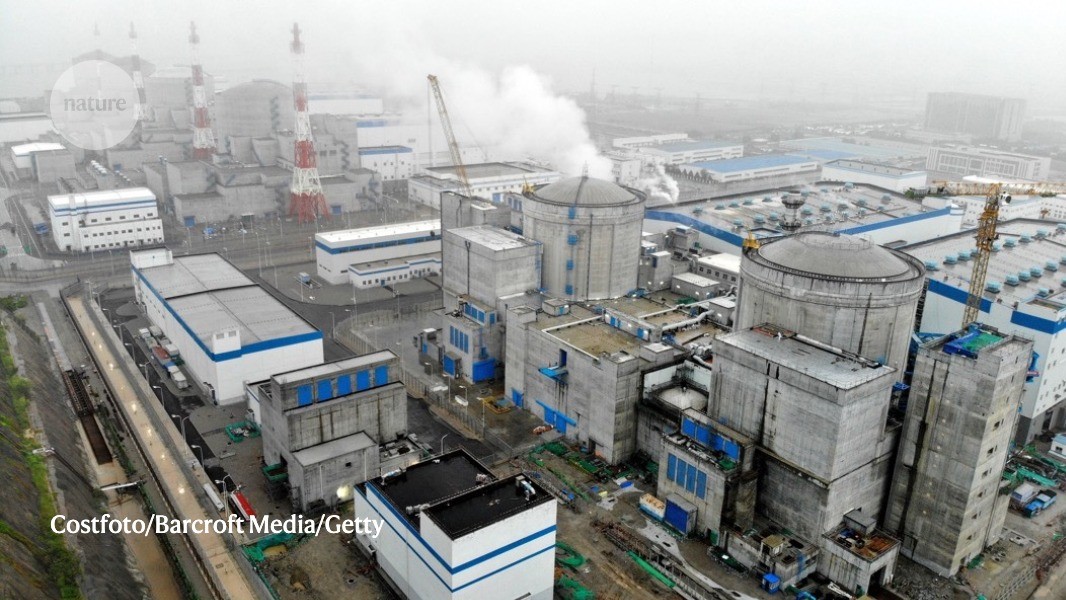
China prepares to test thorium-fuelled nuclear reactor
If China’s experimental reactor is a success it could lead to commercialization and help the nation meet its climate goals.
nature.com
199 points · by mm321 · 5y ago · 213 comments
While German politicians still ask for the internet to be printed for them.
Just as a funny little tidbit here, I've been trying to gather documents to apply for my permanent residence here in Germany. When I got to one document proving I had been contributing to retirement, I was lucky to find that the German authorities had an online service for it. So I went to request my documents, but, in the name of saving paper, they were going to mail me a copy.
... and then you realize it's because everyone who knew better saw it as a dumpster fire and found another job.
Actually I am kidding, both paper and toner are cheap here but we are not luddites like you guys :)
Austrian here, but its funny how Europe in general is still so walled from technology, I'm not just talking about people don't know how to use apps or that. Im a developer and I've worked remotely with clients from Silicon Valley and now I work with local companies and I must say the wiligness to learn something new and to explore new things is just not there.
The current company has a product almost 20 years old and still runs on old Java code. Which is fine, dont fix what is broken, but now we need to rewrite everything in new Tech stack, and thats where I come in, I got hired to help the transition. However, the people are so not in to work on something new.. they just want their Eclipse and Java. I dont know if this is a culture thing or what, but they are just not fans of technology as it seems.
It's what their new CTO was familiar with and he wanted to get something more familiar.
That's actually somewhat reassuring. I still print of long PDFs, because I actually want to read long documents rather than skim.
It actually surprises me a lot how little effect it seems to have, at least in her case, to understand what science is telling you
as a tech guy, I must say I don't like reading anything on screen. Not even retina display. Something about having light emitting to my eyes makes it uncomfortable. Paper are just more pleasant to read. Hope they come up with better E-Ink type of tech soon.
How do you feel about dark mode with an OLED screen for true black (pixels off)?
The ecosystem has improved a lot in the past few years and most major OSs and applications now support it. For browsing the web, there's DarkReader[0] which works very well (on Android you can use it with Firefox).
While I've never been particularly sensitive, most of my book reading nowadays happens at night with the lights out, on a 6.67" OLED display with low brightness, pure black background, and amber text.
Pfizer seems to be much more on point on the fabrication and regulatory aspects, it was a much needed partner.
So I wouldn't call this a great strategic victory for the UK. Especially since it also cost them quite a bit of goodwill in Europe.
[0] https://en.wikipedia.org/wiki/Dorothee_B%C3%A4r
VORRSICHT! (gräphicäll contännt, mäntäll präppärräyshun äddvyzzed!)
[1] https://www.klatsch-tratsch.de/wp-content/uploads/2019/04/do...
[2] https://www.gameswirtschaft.de/wp-content/uploads/2018/03/Do...
[3] https://images.derstandard.at/img/2019/04/10/dorotheebaer.jp...
Vee häff ze paua to shrink wrap all of you!
Jaja. So is dat. Echt jetzt.
Jawollja!
Maybe for state-backed projects. That "lawyer-based" government means very strong and predictable rules that protect investments. It starts with property law. People building big things, thing bigger than skyscrapers, want strong ownership rights enforced by a responsive legal system. The west has that. China does not. Protecting fixed assets in placed like China or Egypt means keeping politicians and soldiers on side, most often by giving the government a large ownership stake in the project. That limits innovation. That limits mobility.
I often wonder how different things might be right now if Al Gore had been a well known republican, whether acceptance of anthropogenic climate change wouldn't have been such a political issue, or if all the other forces at work would have been the same.
But then they lost their ambition - a major point being when they stopped trying to develop their own computing technology and just reverse engineered IBM chips instead.
I rather say, it has to do with economic realities: there was a joke in eastern germany something like:
we got no toilet paper, but a cosmonaut, hurey.
edit:
"Keine Bretter für die Laube
Für das Auto keine Schraube
Für das Klo kein Papier
Aber Kosmonauten haben wir"
non rhyming translation:
"No wood for the hut
no screw for the car
no paper for the toilet
but a cosmonaut we got"
However there were alternatives: once in office, Beria made an effort to get rid of East Germany, in an effort to end the cold war. However the rest of the polibureau ousted and executed Beria, because they feared that all this was too destabilizing (then they got the Hungarian uprising under Khrushchev, which was much worse; also Krushchev later fired his co-conspirators in the coup against Beria - Malenkov and Molotov) See: https://en.wikipedia.org/wiki/Lavrentiy_Beria#First_Deputy_P...
I am not entirely sure about it, but the question of who is on top seems to make a big difference, when talking about a very authoritarian political system.
The RBMK wasn't an horror, it was simply meant to exploited in a certain way, and containment was integrated. At the Chernobyl plant the guys committed a serious boo-boo (the very possibility of a disaster is common to all designs, there is no absolutely full-proof design, especially if the guys can shunt actuators/fiddle with captors/whatever).
At what price for democracy and for human rights? And how is China progressing on transitioning to renewable energy? Hint: it doesn't [0].
(Not that western lawyer-led nations do better...)
Having promised a reduction of 65% by 2030 [1], I guess they do count on those nuclear projects working out in the end, but at their scale and with 85% of their energy consumption coming from fossil fuels [2], they do seem to have their work cut out for them.
[0] https://www.carbonbrief.org/analysis-chinas-carbon-emissions... [1] https://climateactiontracker.org/countries/china/targets/ [2] https://ourworldindata.org/grapher/energy-consumption-by-sou...
https://en.wikipedia.org/wiki/Nuclear_power_in_China#Future_...
Renewable energy plants produce 27.32% of the gridpower, and projects are everywhere.
Carbon emissions are growing simply because the economy is booming even faster.
The best nuclear engineer in the Chinese government isn't going up against the US political establishment, they are facing off against people like Bill Gates or the US nuclear industry's Elon Musk equivalent. Although the US population isn't as relatively wealthy as they once were so the traditional strategy might not work out.
It's also currently building 35 nuclear reactors around the world.
https://en.wikipedia.org/wiki/BN-800_reactor https://en.wikipedia.org/wiki/Akademik_Lomonosov
It's widely accepted that renewables, efficiency, carbon fees and global legislation are the leading ways to cut emisions.
Nuclear is cool tech, it just seems people are strangely monomaniacal about it and I've never understood why.
Maybe it's like "flying cars" and it caught people's attention at an early age and persists as a idea even when it's not actually as generally useful as decent public transport and city planning.
Coal tops Wind as primary electricity source in Germany presently.
https://www.dw.com/en/germany-coal-tops-wind-as-primary-elec... https://www.iamexpat.de/expat-info/german-expat-news/coal-ov...
When you close your nuclear reactors, say hello to Coal.
By whom? The benefit of nuclear power is that it is low on CO2 emissions (unlike fossil fuels) and can produce sufficient amount of power for an industrial society (unlike renewables)
Unlike renewables, fuel-based energy sources like nuclear (and coal/gas) do not reduce the amount of energy available to Earth's biosphere.
The failure of just a single dam - the Banqiao in China in 1975 - killed more than 150,000 people.
Way more than all the deaths from nuclear power, ever.
[1] https://www.britannica.com/event/Typhoon-Nina-Banqiao-dam-fa...
In particular Fukushima was in a stupid place, engineers were well aware of the the many 100s of years of experience with earthquakes in the ring of fire and calculated that a large expensive wall would be required to protect plant. The sensible place to put the plant was in a different prefecture.
Politics intruded, the plant was put in a stupid place, and the expensive wall was shrunk.
Also, it's a fallacy to think the CPC simply ignores popular sentiment. Fukushima had as much of an impact in China as it did in Japan - all new plants were paused (http://edition.cnn.com/2011/WORLD/asiapcf/03/16/china.nuclea...) and it may have factored into the decision to go all-in on solar and wind power over the past decade instead.
That's what I meant by:
> While China isn’t going to face similar voter pressure, one accident like Fukushima could make things really chaotic quickly.
The way to substantiate this is to look at data because otherwise it would lead to unnecessary scaremongering, precisely the things holding nuclear energy back amongst other reasons (cost, etc.)
Put it in another context with far greater consequences than Fukushima disaster - the current Coronavirus pandemic and possibility of links to Wuhan Lab, one accident and it shut down the world and caused millions of deaths. Far more than all nuclear tragedies combined. Not to mention, the economic toll and far reaching consequences of the society.
Kind of boggles my mind why the society doesn't look at Level 5 bio labs in the same exact or more serious way than Nuclear power plants. Even if Wuhan lab hypothesis is incorrect, we should have more resources and focus on how to make these GoF studies/Level 5 labs secure, and essentially as safe as nuclear power plants or better. Public awareness just isn't there.
Origins of Coronavirus should be investigated with 100x more rigor than 6 people touring the facility from WHO for 3 days only to see presumably a massive coverup.
Also nuclear is a brittle technology, disrupt society (refugee-crisis or a economic crisis) and the technology decays and degrades fast.
This applies to every electricity generation method except small-scale hydro, and maybe small pockets of coal.
Everything else needs advanced materials manufacturing - high-tech steels, fluids and ceramics for oil drilling and fracking, rare earth mining for magnets for wind turbines, all kinds of crazy stuff for PV.
Small-scale hydro and small-scale coal can't support society.
China is a technocratic autocracy. Although they rely on the approval of the masses, they can plan long term, instead from election to election. And they calculate whether it's worth or not to manipulate the public opinion on certain topics.
I think French nuclear energy companies profited off that handsomely.
It's largely a secular trend in most of the world as nuclear energy usage has continued to fall, mostly for financial reasons.
There's this myth that Germany started burning more coal in response to the nuclear shut down. That kind of never happened. Coal proportion in Germany has been slowly shrinking for years, just like in most of the rest of the world. Peak coal was around the same time Fukushima happened. It actually dropped almost as fast as nuclear in the years after: https://www.cleanenergywire.org/factsheets/germanys-energy-c...
The only thing other than renewables that has had any growth in Germany is gas. But it's not nearly as much as the amount of coal and nuclear that disappeared from the market. The real story is that the energy market has nearly doubled in 20 years in Germany. Fossil fueled plants combined are now only about 40% of that. With coal gone and the overall market continuing to grow, that will drop to single digit percentages pretty soon. Like nuclear in Germany today.
The French nuclear market is slowly shrinking as well. They too are shifting to renewables and are slowly shutting down aging nuclear plants from last century. They are still building a few new plants of course but it does not compensate for the lost capacity. A lot of aging plants are reaching their end of life in the next decades. Most of them will not be replaced probably. And with decades long planning cycles, you can kind of tell by noticing that plans for those are simply not being conceived. Just not a thing. Most ongoing nuclear construction in Europe is many years late, billions over budget, and simply the result of planning cycles that started in decades ago.
The long term plan was to next make a breeding version of the reactor and use thorium directly but development was cancelled.
Those using government funds can label it as "military research" or something similar and then they're looking at a least a few decades of no-one asking them where the money went and why.
> In the US and other western countries it is mostly by commercial companies
> this requires decades long planning and commercial companies are unable to work unless they get quick results.
and yet that didn't stop SpaceX from leapfrogging entire nation-states in rocket technology, being the first to develop fully reusable rockets that land themselves, and as a result, are by far the cheapest option for launching things like commercial satellites.
I don't see why commercial companies can't accomplish similar things in the nuclear power space.
There are western startups working on thorium powered molten salt reactors, see this 2019 video: https://www.youtube.com/watch?v=ps8oi_HY35E, from another comment in this thread [1].
Maybe you should head over to the US Department of Energy website and take a look [1], [2].
Nuclear research is nice, but doesn't help one bit compared to building reactors even with 50-year-old tech.
This thorium experimental reactor in China, is just that, an experimental one. If everything goes well, they'll have a commercial version in 2030, but it's way to early to estimate how likely this is.
[1] https://www.forbes.com/sites/arielcohen/2020/10/29/the-futur...
[1] http://thebigpicturemagazine.com/wp-content/uploads/2014/11/...
from [2] https://en.wikipedia.org/wiki/THX_1138 ?
The west is so fucked. Meanwhile in the UK we’re reintroducing Imperial units, getting the UAE to invest in our infrastructure and fighting inane culture wars on Twitter.
The lack of proactivity and long term planning for things that matter, combined with academia’s lurch towards publishing treadmills instead of truly novel innovation means we are surely going to fall behind. At this point China’s future hegemony is all but assured.
I just hope you understand what you wish for.
In the past western politicians have gotten us to the moon, introduced universal healthcare and created the New Deal. All whilst operating as a democracy.
It seems to me that modern politicians have lost sight of the power they wield to enact change. They’ve certainly lost the ability to convince the electorate of any given position.
They’ve become reactive, self-interested hucksters. We need politicians with vision, integrity and backbone. Not authoritarianism.
Not sure how we inspire the bright people to get back into the civil service.
In past, western politicians didn't had to appease the mass as most people didn't use to live the modern life we do today. And the lobby we see today simply didn't use to exists. Now we have turned so much greedy that we only see short term advantage.
But China is different. In democracy votes are important. For China party is important. Party is eternal for them so they need to develop manufacturing, improve energy. CCP needs to think about their party future too because they might have to fight against whole world. As a result we can even see recent crackdowns, investment in research like nuclear etc.
What I feel is if more 50% of people are greedy/bad/egocentric democracy simply doesn't work. And the way housing/inflation/ overwork of printers democracy is prone to more harm.
Of course all of the above is my personal opinion so please don't feel afraid to post your opinions :)
Thank you.
Just because the current state of affairs is more concerned about trendy topics like wokeness instead of 10 year plan for the future doesn't mean we're want authoritive governments.
Soviet Union actually looks better... before their fall
Maybe I was just the one crazy person who thought the Soviet lifestyle and society was dreary, but I don't think I was. If you think the soviets looked better, you're likely looking at the past through rose colored glasses. Most people would have done anything they could to avoid living that "better" soviet life.
https://www.power-eng.com/coal/eia-u-s-coal-fired-generation...
https://www.iamexpat.de/expat-info/german-expat-news/coal-ov...
Now if you want to talk about breeder reactors in general (namely on the uranium-plutonium fuel cycle), then yeah that's in the many billions range. That was more for infinite world-scale sustainability rather than cost specifically. LWR converter reactors have always been known to be cheaper than breeders.
Meanwhile, actual democracies can't place nuclear reactors and other facilities wherever they please. Citizens would object.
But to call them inefficient? I think you're wrong. They are extremely efficient when the government has an idea, it's executed quickly with minimal regulation and red tape getting in the way.
They also don't make as many mistakes as they use to as a developing nation. Credit where it's due, they recently got a space probe orbiting Mars and that's no easy feat [1]
You sound like you don't know much about thorium reactors and i suggest some basic reading like [2]. They are much safer than conventional reactors. Your concerns about waste leaking is uninformed as the reactors themselves require much less design safety considerations.
Before anyone accuses me of being pro-china government, their human rights and transparency are extremely sketchy and i can see why it's hard to trust them.
[1] https://en.wikipedia.org/wiki/Tianwen-1 [2] https://www.forbes.com/sites/energysource/2012/02/16/the-thi...
I shudder at the thought of this kind of government (and civilian extensions thereof) handling radioactive material at an unprecedented scale.
For all this talk about climate change dangers, the West is taking the most suboptimal approach.
China lives or dies on the approval of it's populace and they have made it abundantly clear that air quality and public health are what they care about and so it will be so.
In the mean time they have electricity. I think it's what an engineer would do.
I have been hearing about this all my life. And I don't think we will see any progress in our lifetimes. We have a cultural problem with over-promising and under-delivering regardless of who is in power.
We cannot even get regular nuclear power plants installed without interference from foreign NGOs interfering in Indian politics, local anti-nuclear fear-mongers and Christian churches.[1]
[1] https://en.wikipedia.org/wiki/Kudankulam_Nuclear_Power_Plant
30 years waiting time before one can start to demolish the reactor. That shows how dangerous this technology really is.
Where it should be noted that playing it safe does not refer to anything physical. Playing it safe for climate means nuclear, playing it safe for accidental deaths means nuclear, playing it safe for your election campaign... somehow, that means anti-nuclear.
The least of our problems is any country moving to carbon neutrality too early.
Unfortunately, China is nowhere near carbon neutrality, and is not really moving in that direction with any speed at the moment.
If a fusion reactor with an energy gain of 100 and stable operation in the 10_000_000 second range were announced tomorrow, we would be only 20 years away from breaking sod on the first commercial-scale plant -- if the process goes very smoothly.
From there it would be only 30 to 50 years before fusion was making a significant contribution on a global scale, if it can compete commercially.
But its easier to just start a weapon from natural uranium.
(Not a China spambot: just wish politicians weren't all the same)
China's government seems to be taking The Stepford Wives as an instruction manual.