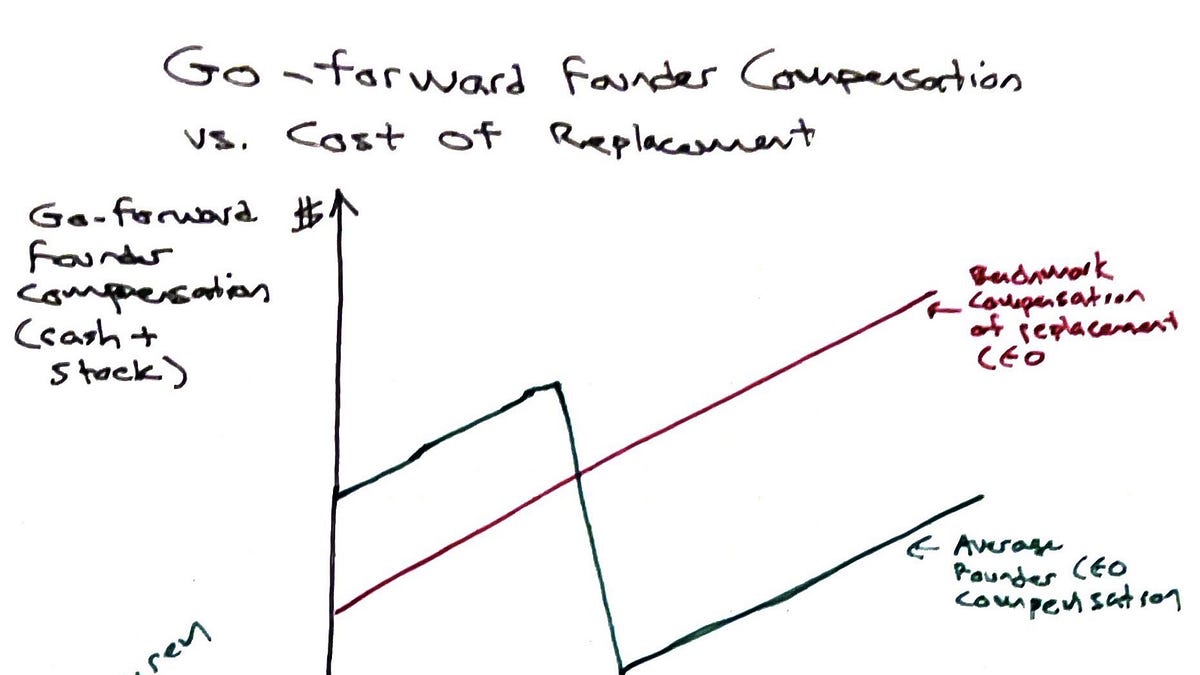
Let’s talk about founder compensation
After 5 years, almost 100% of founder CEOs are compensated LESS than a replacement would be on a go-forward basis.
auren.substack.com
94 points · by aurenh · 5y ago · 91 comments
When I was first getting into startups (late dot-com boom to about 2009), the assumption was that your startup was your identity, and an expression of your power to change the world. You owned it, or a big chunk of it, and you got rich by growing the size of the company (and hence your share value). This is the Warren Buffett, Jeff Bezos, Steve Jobs, Page & Brin, and Zuckerburg model. Control and ownership stake are the forms of "compensation" that matter here - instead of you taking compensation as CEO, you paid out compensation as owner of the firm, and slowly gave away equity in exchange for deals that would make the overall firm worth more. The article alludes to this model with "your entire life and self-worth is wrapped up in the company".
But the whole premise of this article doesn't exist with that model of a founder's role. Founders don't take compensation; they own the company, and dole it out based on who increases the value of the company most. Founders put their allies on the board, they don't take orders from the board. Founders wouldn't consider an outside CEO, so that comparison would be moot.
It makes me think that the "change the world" phase of tech startup history is over, and we're now in the "fill in the gaps" phase, where a "founder" is a hired gun that slots into a VC's portfolio. Which I've suspected we were getting close to for a while now, but if true, it makes the job description of "founder" a lot less attractive. If you're going to be a hired gun, why not work for a FAANG and probably make a bunch more money?
https://www.forbes.com/sites/venkateshrao/2012/09/03/entrepr...
Strong investors now will literally assign their voting shares to the ceo and not take board seats even in a Series B round.
Valuations on early stage companies have never been higher—we’re talking eight figures for pre-revenue businesses—which means millions of dollars before hitting the ~20% equity for a round.
Founders sometimes have shares worth multiple votes, the board is entirely them (since the huge supply of money gives them leverage), and VCs are so afraid of being labeled “founder unfriendly” that they defer almost entirely to founders.
Whether it’s good or bad is a much longer thing (some of each, of course) but it’s certainly not founders working for investors. It’s never been less so.
The biggest implication is that the primary "customer" of the founder is different in these two versions of the role.
My experience is that founders who internalize that their role is to create and manage investment vehicles for venture capital have a different and higher leverage relationship with investors, including compensation, than founders that think their primary purpose is to build a company.
https://news.crunchbase.com/news/bigger-checks-days-to-close...
I don’t think it’s over, but it has shifted into what was previously known as lifestyle businesses.
There isn’t much room left for “change the world” startups that have broad impact unless you come prepared with a massive war chest to outspend your competition. Most famous startups still have to buy their customers often through the IPO stage, which is why we still see companies like Uber or even Gitlab being cash flow negative when they go to market. If you’re not prepared to spend your way into the market, you’re unlikely to get very far (there are exceptions, but they are rare). So yes, this space is mostly a VC game.
However, I know of more small tech startups than ever before that are bootstrapped or have minimal investment. These small companies aren’t targeting highly competitive, broad markets like ride sharing or Git hosting. They’re playing into a founder’s personal passion or addressing unmet needs in their own domains. They won’t be the next unicorn but they’re producing good work and making a difference close to home.
In many ways it has never been easier to start a small startup. Working for a decade at a FAANG job or even a good tech job with an eye toward savings can give someone plenty of savings to coast for years while they start up. Tooling has never been more accessible for rapidly assembling prototypes and gathering customers. Even knowledge about starting companies and scaling software is freely available online.
> If you're going to be a hired gun, why not work for a FAANG and probably make a bunch more money?
One of my unpopular tech opinions is that “just get a FAANG job” isn’t as easy as it sounds. I know many smart people, including some who went on to become successful entrepreneurs, failed to get FAANG jobs after years of trying. I know several more who got FAANG jobs and then burned out or failed out. If money is your goal and you can get in then it’s a good option. It’s not the easy button, though.
The world still needs companies that are actually looking to change it, we've barely scratched the surface on what we can do with what's available to us.
Taken together, do these observations imply a structural change to how venture and startups work?
When I was starting my first company in 2012, your point on identity rang true -- I tied my identity to the startup and so did our early employees. Now, many of the startup CEOs (and venture studios, angel funds, incubators, etc.) seem more like money managers and financial engineers.
...and I guess this might be why compensation expectations are changing.
Thanks for sharing your thought. I've been bothered by the way startups seem to work nowadays and I haven't been able to fully articulate why. The above is helping me clarify that.
EDIT: as I try and clarify my thinking here, it sometimes feels to me like many startups today feel more akin to private equity (PE) projects. In such a scenario, you'd expect founder compensation to change (as per the original link). It'a also in line with Suster's post + observations of hedge funds and PE shops funding more startups[2].
[1] https://bothsidesofthetable.com/the-changing-venture-landsca...
[2] https://pitchbook.com/news/articles/how-hedge-funds-are-lead...
Sadly this also works in favor of VCs, who get an excuse to raise 10-20x larger funds and live off of the management fees.
Take a first time founder for example.
You’ve been working on an idea for a while. You’re just now getting traction. You likely don’t make much, if anything at all. Either because you are pre revenue, or you’re putting everything back into the company.
Now, a VC comes by and says I’ll take 20% of your company in exchange for $2 million.
Another VC comes by and says I’ll take 20% for $2.5m.
And so on.
The founder now has a hard decision. Do you take the money, grow the company A LOT faster and be able to pay yourself a salary? Or, do you continue to grind away, hoping the business grows organically, which could take 10-20 years? Do you even have enough savings to wait that long? Are you killing the business by not taking the money?
Okay, so let’s say you take the money. If you’re a repeat founder you know what to do. Don’t do a priced round, or if you do, don’t create a board. If you do create a board ensure founders still have majority. Essentially put everything in place so you don’t get fucked. So the option for you to be replaced by a hired gun doesn’t even exist. This sounds reasonable right?
Well most first time founders don’t even know you have to do these things. Or even if they do know they still might have zero leverage and take the money anyway, knowing they’ve relinquished some control. Knowing they will likely be replaced in 3-5 years.
This is how VC works now. The leverage has shifted completely.
I don't think this is entirely true, as always it varies by VC. Each person is different.
Also VCs as a category know that they cannot bully founders and overplay their hand too much because if founders perceive that they are about to be diluted into irrelevancy or replaced they still have these little weapons called constructive dividend and constructive salary that they can "pay" themselves in so many various forms that VCs will be left wondering what the hell happened.
As a founder, can't you just demand that you keep 51+% of voting shares? Or more, if you intend to sell at any point?
Or put poison pill clauses into the company founding docs with provisions if you're removed?
How can a VC force you out?
Look at Clubhouse. It reached Unicorn status while still at, essentially, Alpha. It would be silly for the founders not to take $20M home during those rounds right?
Finally, there's the fact that psychologically the founder often believes they know best, and has a higher level of expectation for the company's prospects than a cold-eyed third party who wasn't part of the founding story.
If a founder has been diluted down then they will have every reason to move on.
To answer the question though it’s all about leverage. You can’t go into a situation like VC funding without it. Leverage can almost be anything, but is commonly:
- revenue
- traction with customers
- traction with users (if d2c)
- a previous exit
- nepotism
It’s in a VCs best interest to take as much of the company as possible without causing disruption. That means making you feel like you didn’t get shafted in the deal. This dynamic shifts when you have leverage. So instead of you taking a term sheet and just eating whatever they give you, with leverage you set the terms. But again, you’ll need a lot of leverage, likely almost every point above, in order to get a deal that isn’t complete garbage (save for nepotism).
People are always going to take advantage of other people if they can or if things are structured that way. It is traditional for VCs to take advantage of founders. It is harder for them to take advantage of people who know there is already funding and are coming in after.
And VCs will go into excruciating detail rationalizing all of this.
What about the programmers who are actually building the software and often getting a pittance in relative compensation even though the business is 100% reliant on them to solve most of the problems (which are technical).
(I say this, as a software dev at a startup).
Note how very few of the non-labor class will refer to themselves in those terms.
My impression spending time with investors has been that they need productive assets for their portfolio of depreciating cash, and they need exposure to companies in markets where they perceive growth. To get that exposure, they're usually in a few companies in a space already, so as a founder, your company is just one of many. I'd like to propose what a more cavalier approach would look like.
The next piece is venture isn't regular value investing. The participants in a given fund (LPs) probably have a horizon of 5-7 years for the total age of that funds portfolio, where they are expecting one or two of upwards of 20+ companies to hit.
VC money isn't a loan, the equity a founder sells them is the ticket price VCs pay for admission to the market exposure they need. (Buy the ticket, take the ride.)
When you look at what founder/ceo comp should be in that relationship, just as one reference point, a technical founder can probably pick up a consulting gig for a quarter million a year. It has no equity, taxed as income, discounted to risk, no leverage, no scale, all opportunty cost against life and running a year of startup runway, and they're just running a one person time and ass rental business, but that's a founder's base BATNA in the comp discussion.
Founders typically pay themselves less before later rounds because of some conventions, but you can't moralize what makes a successful company. Myths about frugality and the protestant work ethic are uncorrelated to returns in venture portfolios. (PE is another story imo, because it doesn't invest in growth, it invests in ways to optimize existing cash flows)
So when it comes to founder comp, if a round gives a company 18-24 months of runway to get to their next growth stage, I'd measure comp against the value of that binary outcome. Either the founder gets you there, or they don't.
It's hard to imagine, but if you have a portfolio of cash and you need for it to grow, and you believe in a startup, you need as much of that cash working for you in that company as you can stuff into it. If you need one of your companies to have a 30x return and you can't predict which one it will be, any "savings" the founder provides back to their company with frugal comp that comes at the expense of any early stage growth trajectory at all, results in vast value destruction. e.g. If you put $10m into a company and then the one person responsible for all that capital is paid less than some random interchangeable consultant, I'd say you've earned that loss honestly.
If a founder took the money from a round and put half of it in a pile on a beach and set it on fire, it literally shouldn't matter to an investor because the investor now owns something better than cash, which is equity in something that is growing. Surplus cash is opportunity cost against growth runway somewhere else. I've seen a few companies who should have set half their cash on fire, because the money made them lazy, political, and stupid.
So in terms of what it's reasonable to mark founder salary to, the two co-ordinates I'd reckon with would be somewhere between their consulting opportunities they could just walk away to today, and just setting half your money on fire.
I write, am not an investor or founder, this isn't advice, but the conversation from the OP seemed too polite to be useful.
Come on now, do you really believe this? Investors absolutely should be extremely upset if the company is squandering the resources it purportedly requires in order to execute on strategy and grow.
I looked up OTM options and it looks very similar to the first sentence. Basically, you (the founder) tie your compensation to the success of the company. You win big if the company wins big. Can anyone disambiguate the two situations in the quote further?
So while they are similar in terms of economic impact, the equity can have other rights attached (eg voting, ROFR for dilution etc) that a founder might want. Also crucially you already have the equity so you don't have to pay up to buy it (as you would in the case of a call option).
Finally as always there may be tax implications which make the difference meaningful. Tax arbitrage is often part of the calculus for any kind of weird compensation package.
For the most part, your salary is affected by supply and demand. As soon as you leave your job, the demand to fill your position goes up. If you don't leave, the demand stays the same. The demand to keep your position filled won't be as high as when a vacant position needs to be filled. Am I missing something?
That sounds like poor accounting that's overly dismissive of the outside world. If it's going to cost $X to fill the position, why is the person currently in the position worth $X (ignoring for the moment that filling the position will also often actually add a bunch of one-time costs like recruiters/interview time/signing bonuses..., but potentially also be offset by unvested bonuses/stock/whatever that the departing employee is relinquishing).
If you are in charge of salaries, and you don't pay attention to the fact that you're paying $0.7X for someone that you'd have to spend $X to replace, you've put yourself in a weak position compared to the companies who are immediately willing to pay >$0.7X for that person. The demand has already gone up, you just weren't paying attention.
An employee is like a subscription, you pay on an ongoing basis. And they can quit on you any day. Paying an employee currently and in the past doesn't necessarily mean you have no demand for their services in the future - having someone in-house who'd be happy to continue working for you is basically the best-case scenario in a role that you still demand. Don't try to exploit it by hoping they don't notice they're being shortchanged...
Assuming a replacement of equal skill, the demand to keep the position filled is the same as the demand to backfill it, because either action results in the same number of people in the same role.
This is the best description of Coasian Theory of the Firm I have heard in ages
We've had a bullseye object lesson in the US over the past year and a half where company owners are complaining endlessly about being on the low side of the supply curve, trying to force the supply to act against their own interests via government action. Suffice it to say, I don't agree that supply and demand is the primary driver in salary budgeting, it's power.
Most will pay less than your current job. You only need to find one that pays more.
They might do that because they lack of engineers is what is holding them back from growth.
Or they desperately need a certain skill set.
There is a lot of money sloshing around and opportunities to get paid more elsewhere.
Now if you are underpaid it might be you are in the 30-percentile and 70% pay more so you can walk into a pay raise with eyes closed.
Logically you are right that the current company should pay more. I think there are too many companies whose business model can’t support all staff being paid what they can get on the market. They rely on people being loyal.
(They could survive if they became more efficient but few companies seem interested in really doing that)
Your statement makes sense if there are only a handful of people in the market that can provide what you provide, but for a job that can be done by thousands it doesn't hold.
The irony being that nobody would notice if these exist or are prevalent specifically because there is no token doing the advertising
https://docs.olympusdao.finance/
Disclaimer: I own Ohm
Would probably be a nicer working environment fur uber- and onlyfans-like markets.
[0]: https://github.com/MolochVentures/moloch/blob/minimal-revenu...
I don't understand why you'd prefer to work in a structure governed by contract-written-as-code compared to contract-written-as-anything-else. Seems like you could put any arbitrary set of rules in a regular contract too.
It's a bit like a company/cooperation/nation which rules are defined and enforced by smart contracts.
Despite the name, a smart contract is just a software program. It is not a legal contract nor is it recognized as such in a court of law. As such it has no legal force.
When that changes, I’ll sit up and take notice. Until then, the crypto folks are just spinning their wheels pretending one is like the other.