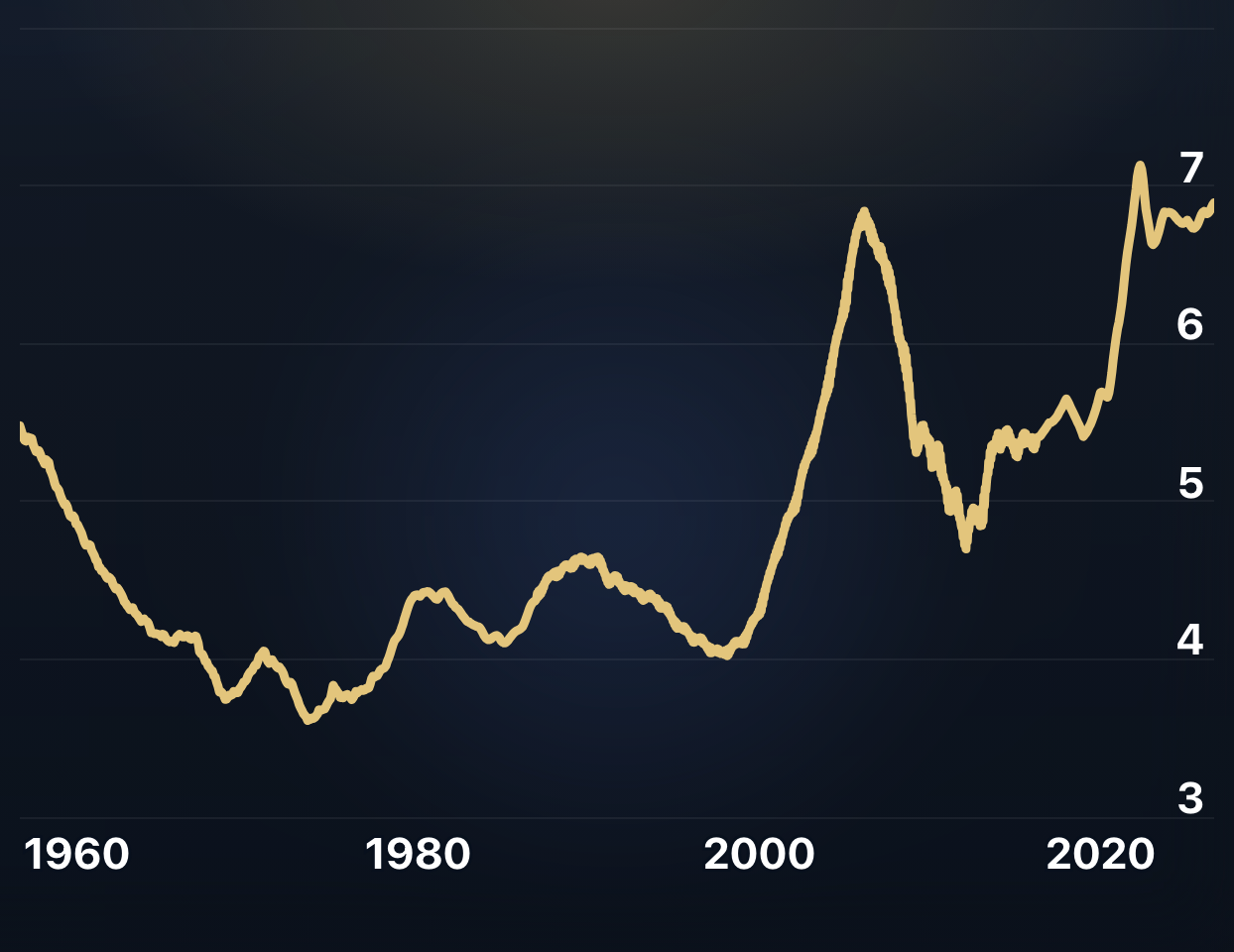
Home Price to Income Ratio - Updated Chart | LongtermTrends
How affordable are homes in the US? This ratio divides the Case-Shiller Home Price Index by the US median annual household income.
longtermtrends.net
544 points · by hncurious · 5y ago · 676 comments
Average interest rates in 2007 were 6.34% vs ~2.80% today. [1]
* 6.34% / $2,000 monthly payment / 20% down (~$65k) >> $328,319 price of home
* 2.80% / $2,000 monthly payment / 20% down (~$98k) >> $489,794 price of home
Homebuyers will make purchasing decision based on their monthly mortgage payments, instead of the home price.
When interest rates fall, the home's price goes up but the monthly payment can stay the same. Therefore, increases in home (and other asset, since lower bowering costs can drive institutional investment in assets higher and non-linearly) prices can be driven higher without any change in supply / demand dynamics.
Some hypotheticals to consider:
* as rates approach and touch 0, what will drive up home prices then?
* what happens when rates go up?
Shelter has changed from a base need to a commodity that's traded in a rigged system and the societal implications of this are frankly terrifying.
[1] https://www.abc.net.au/news/2021-08-26/fact-check-are-house-...
Even a slight economic advantage is being multiplied if you take advantage of housing and stock markets.
Just having comparable incomes and earning power is no longer enough to give you economic parity with your friends and neighbours. Which is not a good for overall social harmony :-/
Wage stagnation has meant that if you don't have real estate, investments and additional contributions into your super you are going to be in an entirely different wealth class to your peers once you hit your 50s and 60s.
This may not be a fun ride for many over the next 20 years...
1) It's tiny
2) There's no water
3) It's not buildable given current zoning
4) Utilities are miles away / cost to attain utilities is prohibitive
Even in my area, where we still have lots of open acreage, the cost of bare land has jumped considerably in part due to zoning - yes we have land, but local authorities aren't going to let you start carving up farm land for subdivisions. There's a middle ground here and I'm glad that's the case rather than it being 100% preserve or 100% build.
the problem is that in our desirable cities, where people want to live (as evidenced by high prices per sq ft) we have more or less stopped the natural progression of single family houses into low-rise buildings, low-rise into mid-rise, and mid into high-rise.
It has been proposed that since land doesn't respond to supply and demand, but housing does, that property taxes should apply only to land and be increased to remove most of its value. Keyword: Georgism.
Even in Adelaide metro and suburban areas, land is not cheap anymore!
- Housing prices plummet to $600,000, assuming people are willing to spend the same per month.
- My monthly payments are identical to had I bought at $600k at 6%. If I stay there, I'm not much worse off. It's harder to pay off the home quickly.
- If I move out, and I rent out my home, it covers monthly payments approximately exactly.
The only time the owner is in danger is if:
1) They need to move.
2) They can't rent out the original property.
Rent works out since while the home is a liability, with 6% interest rates, the 2.5% loan is an asset.
As a footnote, what I expect is actually happening here is people are anticipating high inflation. If that happens, this isn't a bubble. Real housing prices might be fixed, at least looking out a few years.
That's not actually sustainable. You have repairs you're going to need to do, sometimes unexpectedly large ones. You have tenants that move out, and then marketing expenses and/or vacancies. If you're unlucky you have bad tenants that do damage or don't pay or need to be evicted after not paying.
It can work temporarily (unless you are unlucky), waiting for a better time to sell. But most people who need to move don't really want to be in the landlord business, and it is a business with financial risk and headaches.
You are a lot worse-off. If you buy at 6%, and then rates go down to 2%, you can refinance and your home is valued at a higher rate. IF you buy at 0%, you bought the house at the peak, and cannot refinance the debt.
You cannot borrow for rent, so rents follow income growth more closely. So in some expensive real estate markets, if no income growth, rent might not cover your mortgage repayments.
You'd eventually have to pay 6% on the $1M.
>- If I move out, and I rent out my home, it covers monthly payments approximately exactly.
In any situation where interest rates go to 6%, there will probably also be some upheaval that affects your earnings and ability to rent it out at the present rental rate. The risks are correlated.
I'm not sure how it works in the US, but where I live, you have a fixed interest rate for a couple of years max, after that you pay the market rate.
So in your case, if you had a fixed interest rate for 3-5 years, after those years pass, you'd have also a massive increase in mortgage payment, plus your house severely depreciating.
That's why price to income is an interesting metric. High inflation without income rise just means people feel worse off and a correction will occur. Housing, along with many other things, are competing for people's wallet. Interestingly, covid is causing a labor shortage and income to rise at the low ends. I suspect stagnating in the "middle income" ranges.
That's going to be a nasty wake-up call for a lot of people.
On the other hand, if the fed decides to allow inflation instead of raising rates, then the value of my loan will melt away and my home’s price will keep going up (that’s what has happened so far).
There’s also a very clear distinction between the idea of housing and home ownership. People need a place to live, they don’t need to have a property investment. You and I need healthcare, but neither of us need to own a hospital.
You could always walk away. Better to be under water on a mortgage than own it outright. This is called a strategic default. Lenders know this which is why they require a substantial down payment (typically 20% in the US)
Most people wouldn't do it if they're slightly under water. But eventually many people would consider walking away and taking a hit on their credit score, which get totally wiped out after 7 years anyway.
Even with a fixed interest rate, you still owe the entirety of your borrowed amount on the $1m purchase to the lender, but your property value may drop if the interest rates go up because, assuming the market value is tied to the interest rate, new buyers won't be able or willing to borrow $1m to buy your place at a rate higher than what you borrowed your $1m at. For the same monthly payment as you have now, a new buyer may only be able to borrow enough to afford a $900k home.
Someone with the same income and monthly expense limit as you wouldn't be able to afford your home, assuming rates went up, which is why the value might drop - fewer buyers.
New homes are built rapidly and supply is plentiful. When we say home, it almost always mean condominium.
Yet, the house price is rising in Japan.
I can think of a few reasons for that, like mere fact that home loans are available to virtually anyone who is employed and recieve average wage, old homes quickly lose value in Japan or people ditched the countrysides and concentrate to a few major cities.
I think home loan interest rate just reflect the inflation rate of the currency in that country. House price goes up simply because anyone can loan a money for.
So long as the credit is available, house price stays the maximum amount of money average people can loan for and it's increasing.
If rate goes up, it just mean the inflation rate goes up.
The house price goes down when
1. No demand. People don't want to live that place anymore.
2. Loan is not available.
3. The government turns into Communism and give all citizen a same house for free.
I think something like that could work to reduce housing costs in the USA, but it would likely require a brand new city to be the guinea pig to prove the concept here. Something like those self-contained retirement towns that spring up, but maybe when the residents die, they rebuild them? Macabre, but interesting!
In Japan, the land is scarce and fragile, humidity weather, constantly facing earth quakes, typhoons. So the house will be damaged faster than the typical western countries.
Each time we face the massive earthquakes, the house building regulation will be updated to mandate new and improved earthquake resistant structure so building built with old regulation lose market values. The same goes for all disasters like tsunami, flooding, land slide and all.
You must also consider the fact that air conditioning wasn't popular 30 years ago. The houses built before that era were optimized for the natural ventilation. it's totally inefficient for the air conditioner.
Old houses also has the Internet issues. Most of the house in Japan are massive condominium. The optical fiber was a thing after 2000s. It takes a lot of money to wire optical cable inside the existing building. So most of the buildings in Tokyo are still using VDSL.
Other infrastructures like power line, water and gas starting to rust so it must be replaced. The cost of doing that to existing house is expensive in Japan and it doesn't increase the value of house that much. Especially for old houses that need replacing because it had gotten so much damage from humidity, earthquakes, typhoons and remember, it was built before the current housing regulation for the resistance for these. So it's more reasonable to just scrap it and rebuild it.
I am living in a standalone old house in Tokyo unlike most of the people. Then, I realized the value of condominium in Tokyo. It works as a gated community, the segregation based on income. We are implicitly achieving the segregation by the condominium.
Which is crazy, right? People max out their "borrowing power" at low interest rates and take on huge loans, without considering that the declining interest rates that fueled past appreciation don't have much room left to move down, and that they'll be underwater on that huge loan if interest rates go up* and the value of the property declines.
*EDIT: To be clear, I mean interest rates on new loans being higher than they were before, not that the loan is variable-rate.
No, because this is not accurate:
> Homebuyers will make purchasing decision based on their monthly mortgage payments, instead of the home price.
Homebuyers make their purchasing decisions based on the options available to them. They are not paying $x because they can afford $x+1, they are paying $x because that is how much they are willing to spend on that specific house in that specific location. The latter portion of that statement is important because implicit in it is the competitive nature of humans, and so it manifests as people competing to purchase land and being willing to pay as much as they can afford in exchange for the utility from that specific house in that specific location.
That utility can be in the form of access to income opportunities to lower future volatility of income, access to other people of similar or higher income so your kids can go to school with their kids, access to airports, downtowns, outdoor recreation, etc.
If you are projecting increased demand during your entire lifetime for the piece of land you are purchasing, then it makes sense to pay as much as you can afford, as it will only get more expensive. If you are projecting a receding economy and/or decreased demand for the land you are buying, then it does not make sense to pay as much as you can afford, but rather scale it to some measure of what utility you will get out of it.
I think this is the above commenter's concern; homebuyers are not adequately pricing the risk of rising interest rates. If interest rates go up, demand falls and you're left in a highly leveraged position that amplifies your losses. Monthly mortgage payments don't make the leverage apparent. Sticker price does.
This is similar to how increases in local incomes are actually captured by landlords rather than workers. If housing is scarce and people need it to live, owners of that housing have the bargaining power to raise prices to capture available income.
And their neighbors will have already found out they had to sell for lower amounts, resulting in some others walking away instead of bringing money to the table at a sale. At thus begins the downward cycle.
Negative is inevitable, imo
If the value of your home rises, you've effectively taken out a hugely profitable leveraged loan, which is historically pretty common. Which is far from guaranteed of course, but broadly speaking it was an amazingly lucrative move for many many people.
Inflation is going up because of a mix of supply shocks and fiscal stimulus. Not necessarily a bad thing but it's out of the realm of monetary stimulus.
Low interest rates in Japan failed to drive inflation. Ask any Austrian economist and they would tell you that low interest rates are guaranteed lead to malinvestment, an artificial business boom and high inflation. You know, if it was that easy then central banks would have raised interest rates a long time ago. Probably shortly after 2008. Whatever is going on is way beyond what monetary policy can do.
At 0%, monetary policy simply stops. Game over for monetary policy. Central banks do not matter anymore.
I don't like the feeling of a market where trying to be a rational actor barely helps.
>> the declining interest rates that fueled past appreciation don't have much room left to move down, and that they'll be underwater on that huge loan if interest rates go up* and the value of the property declines.
The price you can charge for something is related to how much other people can pay for it. If houses are usually bought with loans (which they are), then the availability of loan funding is a major influence on the price of a house. When funding is plentiful -- another way to say this is that interest rates are low -- the price of a house will be high. When funding is hard to find -- or interest rates are high -- the price of a house must drop to compensate for that.
There are some other options out there for veterans or first time buyers, but those are the normal options.
https://www.rocketmortgage.com/learn/30-year-fixed-mortgage-...
If central banks are GUARANTEEING asset inflation of >2% - that's an 10% return on 5:1 leverage - that beats the S&P.
If you can get an interest only loan, and be cash-flow neutral - as long as central banks keep a mandate for assets to appreciate >2% (spoiler, they have to or irresponsible governments fail) - housing is a good investment.
It sucks that they've manipulated the market so much. But when >50% of the economy is debt and the cost of debt is price fixed, that's a lot of manipulation...
Interest rates are irrelevant when you need 20% down and it will take you a decade to save that up while renting, because of said multiple.
This is such a weird home buying myth and I don't understand how it sticks around.
...and less than 1% of recent mortgage completions are with 5% deposits (the minimum here)[0]
There is one big reason deposit size matters: affordability and risk. PMI doesn't exist in the UK, it's built in to the rate. When you're stretching what you're borrowing to the maximum (thanks to these high price/income multiples) every 1% on a mortgage can be the difference between relative comfort, and being 'House Poor' and living with constant anxiety about rates rising before you can refinance.
At the moment with 10% down:
- 25 year fix: 4.64%
- 5 year fix: 2.50%
- 2 year fix: 2.10%
With 20% down:
- 25 year fix: 3.80%
- 5 year fix: 1.70%
- 2 year fix: 1.40%
The other thing, that some other commenters have mentioned is that most lenders won't lend at high LTVs on high value properties, or on certain property types, like flats (minimum deposits of 20% on flats are common, which is particularly problematic given that they tend to be the most affordable properties).
[0] https://www.financialreporter.co.uk/mortgages/95-ltv-mortgag...
You end up paying more in the long run when you add on PMI. I think they are internally conflating "should be avoided" with "can't." I do that with personal things all the time when I tell myself I can't do something that I shouldn't, but actually can do.
Also, the original submission noted that median homes cost 7x median income right now. That does not equate to 10 years of savings from responsible people.
Also, 5:1 leverage is extremely generous, and in a free market they would never happen because it’s insanely risky to the lender. That’s ignoring the fact that 20:1 is pretty common these days anyway. The only reason you can get such a generous loan is because the US government is responsible for it, and they’re the most inept financial institution on Earth.
People with big piles of capital have a great time during times of low rates, whereas the cash poor working class (even those on high incomes) still get squeezed out by lending criteria and price inflation.
> That does not equate to 10 years of savings from responsible people.
I don't agree with this. If you're putting 40% of your take home in to rent and property taxes then saving only 20% of your take home (say 12% of your gross) per year is a reasonable approximation. Saving a whole gross income (the 20% deposit if the remaining 80% equates to 4x income) is going to take you ~8 years. And most people suck at saving. And in 8 years property prices can easy go up 50-70%.
https://www.calculatedriskblog.com/2021/09/urban-institute-m...
Today's House Prices Are Over 40 Percent More Affordable Than The Housing Boom Peak:
https://blog.firstam.com/economics/todays-house-prices-are-o...
>"The affordability gain from increased house-buying power, however, was offset by the third component of the RHPI, nominal house price appreciation, which reached a record 19 percent compared with a year ago, eclipsing the record for price appreciation of 17.5 percent set in 2005."
I'm pretty debt averse, so that resulted in me buying "less" house than the banks were willing to fund, but it was in the area I wanted, relatively new, styled to my taste, and from a reputable local builder, so from my POV I couldn't figure out why I'd buy MORE house.
I still live there, 21 years later.
That's right, interest rates cannot go up, or else these people will be screwed.
The same for stock market.
Ok, so we bail out these people/investors at the cost of catastrophic failure in the future.
Because money/markets are irrelevant, all that matters is access to cheap money and access to central bank bailouts.
What I wonder is - is there any way out of this curse of growth with all the money spent into those inflated prices at this point that does not mean complete economic collapse?
> at some point the ECB will have to face up to the fact that the low interest policy doesn't work.
And repeal the zero lower bound or what? Face up to what? Interest rates will be low as long as supply of labor outstrips demand for labor.
The only growth that is observed is businesses which are serving the bubble. Eg. construction industry having a boom as well as cryptocurrency startups.
I find this attitude baffling. If you bought a car or a phone and paid in monthly installments, you would want to know for how long you'll be paying, not just the monthly amount. Why is a mortgage different?
Is it the duration, where your brain sees 20-30 years, and substitutes that with "forever"? How would you feel if, after 30 years, when you thought you finally paid off your mortgage, the bank would say "Oh actually you have to keep paying for another 30 years"?
I personally know multiple people that do this and like you I can't fathom why but they do. '"Need" a new couch? How much does it cost me per month? Oh yeah I can afford that.' Nevermind that the couch they don't really need (but want) costs them way more and they will very probably need/want a new one before this one is paid off. Same with cars and many many other items. Sellers perpetuate this, especially on bigger ticket items. I suppose it's a "natural progression". People can't afford the item they want. Sellers have no more buyers. But if you sell it to them with a loan and a small monthly payment, suddenly the buyers can afford it. How do you think 96 month car loans came about?
Pretty much all home buying decisions are normalized on a 30 year fixed mortgage. When figuring out what you can spend its easier to figure out what you can afford per month ans extrapolate your purchase price from there.
For that matter most car buying decisions are done the same way based on a five year loan (maybe seven these days).
In both of OP's examples the hypothetical borrower pays the same amount per month, for the same number of months. A lower interest rate does not affect the duration of the loan. In neither case can the bank simply extend the duration of your loan.
You can do this with all your purchases though: anytime you buy anything, don't look at the sticker price - figure out the equivalent monthly cost for the expected lifetime of the item. This can have a dramatic impact on your purchasing habits.
-The purchase price of an item (that happens to be paid in monthly installments)
-The monthly cost of owning an item, expressed as price/lifetime (looking only at purchase price, and ignoring maintenance etc.)
For example, if you pay for a car in 96 monthly payments, that does not mean the car will last 96 months. And the car definitely won't last longer if the number of payments is increased to 192.
Replacing affordable price and decent wages with cheap credit makes banks and companies happy but is a very bad deal for the little guy.
That isn't entirely true. For most people, the amount you need for a down payment is a pretty important consideration as well, especially for a first home where you don't have any equity in an existing home that can be used to purchase your new home.
I've known people who saved up for years to buy a home, then interest rates dropped and prices went up. The mortgage might be roughly the same with the same percentage of down payment, but they don't have enough cash to make the necessary down payment.
Then low down payment loans introduce distortions if their own.
No, because not everybody is so risky to get a mortgage.
The prime majority of rational people don't buy such major life assets with debt.
I suspect these two phenomena have different causes overall, but low interest rates are a common factor that cause all asset prices to increase.
On the housing side, I suspect consumers purchase the house that their cashflow can comfortably support, not necessarily the one where they believe it is correctly valued, because the assumption that house values only increase means purchasing a well constructed house is almost never a "bad deal."
I'm not sure what the "solution," is, but knowing that voters hate when their home values fall does not give me confidence that prices will decrease in the long term.
[0] https://www.statista.com/statistics/953641/sandp-500-ev-to-e...
You cannot infuse trillions of extra dollars into the economy without inflation. There's no magic pill - there must be consequences.
There are some incredibly complex feedback loops in the economy - especially in the housing market - but inflation isn't the issue for most first home buyers. Inflation does, however, hit people with savings harder - every dollar you have in a savings account is slowly losing value. That, however, is quite intended since savings accounts are poor tools for economic growth (banks can leverage the value for loans but there are more efficient investment methods - and that leaves us with all our eggs in one basket which might be a quite irresponsible bank that's pumping out subprime mortgages).
1. In a very very infinitesimally unmeasurably minor manner.
Great point. And to explicit what you're alluding to: we live in a world where factories around the world are running 24/7 producing trillions of items with infinitesimally small values relative to global wealth. But none-the-less, these goods at up to real value.
* https://fred.stlouisfed.org/series/MYAGM2JPM189S
Their central rate has been <1% since 1995.
Stocks and equities in the US have been going up for 10+ and the infusion of "trillions of extra dollars" wasn't present for all of those years. Canada has had increasing home prices, barely slowing down in 2008, and it hasn't had QE.
It matters who gets the new money and what they spend it on.
The CAD has tracked the USD pretty closely in terms of value so even if there wasn't explicit QE there was definitely sufficient inflation to devalue the Canadian dollar.
Actual inflation is generally low aside from short-term issues, but "asset inflation" if you want to call it that is high. I think the most important thing in terms of day-to-day existence is CPI-type measures that reflect your ability to consume things with money. If you can't do that anymore, then it becomes a real problem for everyday life, as people are unable to afford things they need. But that's not that situation we're in.
The situation we're in is that assets are over-valued across the board, including in the stock market and housing. I think the risk here is that once you're in this situation, getting out of it is really hard. If we allow housing prices to fall (by raising rates, for example), what happens to all the people who are now underwater on their mortgages? If value is erased from the stock market, a lot of people are going to be left holding the bag. Is there a plausible way we can get out of this situation?
Yes, tax the hell out of the wealthy in order to reduce their total share of the money supply (which is driving asset inflation), shield the middle class, and provide better housing, social services and benefits to the working poor. Home prices would settle because supply would go up and the range of bids on a given property would be more egalitarian.
If we are responsible with the new revenues (we won't be) we would also destroy about $5-7T of what's collected to remove it from the overall supply to prevent reoccurrence.
On topic: my experience of housing prices in NZ is that people bid up house prices to the point that they can only just afford the mortgage payments.
Creating more housing doesn't "fix" the problem, because the more wealthy buy two or more houses, and are happy to leave one empty. I've left a house vacant in a tight rental market because the hassle of a tenant was not worth the risks for me (possible gain was a very small percentage of my income).
I am in New Zealand, and New Zealanders bid against each other in an almost zero-sum game for the properties that exist... We are borrowing from overseas to pay for it, so most New Zealanders gain nothing and global finance is the real financial winner.
Yet, politically the game is difficult to change... We have a left leaning party strongly in power, and they are struggling to create a more level playing field so that people can afford to get a home (rather than pay rent, which is more expensive than a mortgage).
Edit: also we can only lock in fixed interest rates for up to 5 years and most people only lock in for 1 or 2 years because short term rates are cheap - the 30 year mortgage system is completely foreign to us.
Housing has become more affordable.
People worry about inflation, but forget how awful deflation is.
(And on a side-rant, it’s really bizarre how the hyperinflation of Weimar Germany is cited as enabling the rise of the Nazi party. The timing doesn’t work. They came to power during the depression-era deflation.)
I'd agree with this. I think housing in my area is wildly overpriced, but I still bought a 100 year old condo for a solid million. Compared to renting, I got double the space, plus parking, plus a private garden, plus an outdoor patio, and my monthly costs went up about 25%.
Normally though, taxation is just a matter of the property value. Often, cities with lower housing cost have higher tax rates (because the people working the sewers aren't any cheaper and they need to get paid).
Many cities also have owner occupant or primary residence abatements, so the landlords pay more in taxes than the resident owners. Some cities though split homes in one of several categories, and single families may be taxed differently from multi family or condos. Sometimes multi family and condos are taxed less to encourage higher density construction, but it wouldn't change anything if you're a landlord or not (aside for the tax abatement). Landlords can deduct some of their expenses from their business' taxes though, and I think (don't quote me) their property taxes are part of that. Your millage may vary.
(Municipality: Cambridge, MA)
Even 'worse' is dual income, no kid families that are delaying and skipping child costs. Thus with "double" the cash flow and shared costs, couples afford higher prices at a lower cost.
So doubling of income tripled the amount that could be spent on housing.
But wait, there's more. People buy housing with debt, and a doubling of the monthly payment on a mortgage more than doubles the price that can be afforded. So that household paying $800/mo could move from their $195k house into a $600k house with a $2500/mo payment.
So, a doubling of income has the potential to increase the amount of house a household could afford by six. Granted, this ignores things like taxes, and most people don't spend their entire raise on housing. But this fact is probably what helped drive prices in places like California into the stratosphere.
The crux of the problem is probably that income follows a roughly pareto distribution. When housing is limited, the poorest households drop out of the market. And when populations grow but a town doesn't, housing gets bought by people higher up in the income distribution curve. And past median, incomes climb quickly.
If you have 30k houses, in a town with 60k people, then housing will be affordable to a median income. But if the population grows to 120k, but housing doesn't, then only the top 75% of households can afford a house. Median income, to top 75% is a huge jump.
Housing is a great way to establish a level of security for your family and kids; but there's a finite number of houses with proximity to good schools, jobs, and other necessary resources, and so families needed to dedicate larger and larger portions of their income to compete against other dual-income families that were bringing new money to the housing market.
If you have single income households, and all of a sudden everyone's a double income households, you're not any better off. You'll get inflation, especially in housing. People will point out that stay at home moms weren't THAT pervasive, even decades ago (not as pervasive as us younglins would think), and that may be correct, but double professionals as a common thing is still more recent. We're making some (slow) progress toward wage equity on top of all of it too. That's a good thing, but it doesn't change much when people are bidding against each other.
But all things are not equal: It's not as simple as "back then it was 1 income families against 1 income families and now its 2 vs 2".
Not at all! Now you have 1 income families, 2 income families, 2 income families with no kids, 2 income families where both are software engineers, etc. All of these always existed in some form, but now it's very visible.
If my partner and I (we're DINKs, both in software engineering and highly successful) go to bid on a home, and a single working parent with a partner who stay at home, and 3 kids, try to outbid us... Well, let's hope for them that the single earner is a world famous neurosurgeon, else they're not getting that home.
One way out of that is simply to increase the supply of desirable neighborhoods. The number of those are finite, but can be increased. The hard part is how to do it?
Sometimes I like to imagine there existing something like Kickstarter but for cities. You get a few thousand people that want to build a house but can't afford land, a handful of employers, and maybe a University that wants to establish a new branch and they pool their money and buy a couple square miles in the middle of nowhere. They divide it into lots and start building. Property values rise, and as that happens leftover lots get sold to finance construction of infrastructure, schools, fire departments, and so on.
E.g. it's a lot easier to have two working people in a couple make $300K total vs only one person making $300K. It would be interesting to go back in time and correlate the rise of dual working couples vs housing prices adjusted for other factors e.g. inflation
https://www.pewresearch.org/ft_dual-income-households-1960-2...
Given that long-term unmarried couples are both increasing in number and (I believe) more likely to be dual income, this tells the opposite picture.
My reasoning was that we were experiencing rapid asset inflation fueled by low interest rates and COVID stimulus, and our cash was losing its value relative to housing by the month. I figured that this propping up of asset prices is likely to continue, as any administration that lets housing / 401k values collapse will get massacred in elections.
The issue is that a lot of that created value is being isolated out of circulation and is pooling in investors that can, at a moments notice, pull the rug out of a number of great companies if they sense a panic. Wealth inequality creates the opportunity for instability in the form of extreme sudden market rushes alongside reducing the purchasing power of most folks. We're in a rough spot.
One can get 20% leverage at ~4% on a stock portfolio.
One can get 2000% leverage (5% down) at 2.9% on a house.
Granted, the leverage on the house requires paying interest and 1/3600th of principle each month. But, unlike the stock portfolio, it's not callable.
What would happen to the if everyone suddenly agreed that there was a hard-cap to how much the global economy can grow; Especially if that cap was somewhat near to where we are today?
How do you solve the core problem of "climate change" (which I'll define here as the unsustainable use of natural resources) without essentially implementing a hard cap of the global economy. This question isn't just about electricity versus oil. It's about trash, disposable (or planned obsolescence) consumer goods, fish/wildlife, forests, ect...
You could interpret the change in climate is just a single symptom of this runaway train. And any effort to pull the brakes is likely to cause the whole train to derail and crash. Maybe we'll make it to mars before then. Or maybe there will be a massive decrease in human life (war or another pandemic) and this whole question will solve itself.
I would love to see some estimate that takes more into account like household income, tax breaks, and interest rates. If I have a interest deduction, my relative taxes are lower. If I have children, my taxes are lower. If I have historic property, my taxes are lower. If I have solar, my monthly bill is lower. All these things make owning a home easier and allows people to buy more home.
Education is another example, prices largely mirror federal subsidized loan values. I'm not arguing that government should get out of housing, people should realize that the value of something is relative to the demand especially when the supply is largely fixed or has linear growth.
If you have the exact same income and rates are at today's 3% vs 2008's 6%, the payments on a $1.0MM home mortgage would be $4.2K vs $6.0k. The difference between those two payments is about $40k/year of gross income difference.
A person in 2021 with the exact same income as 2008 would be paying the same for a $1.4M mortgage per month as the person in 2008 at a $1.0M mortgage.
I don't own a home, so I'm not saying this to justify my purchase, but if I just take the info in the graph, I actually wonder whether there is a lot more room to go in the market. I wonder if we are looking at another 20-30% appreciation before the top?
I have no idea.
If you account for inflation and interest rates, and look at median home price, a home earlier this year was CHEAPER than home in 2005. Roughly the same monthly payments before accounting for inflation, because of the interest rates (6.X% vs 2.5-2.8%ish). That alone makes a huge difference.
People are also becoming more financially literate. Once folks are able to crunch all of the numbers on their own, start calculating how much rent costs, how much money they will make from asset valuation, how much they can save from using HELOCs instead of credit or other types of loans, they're willing to spend more, too. There's the tax deductions, but that got gutted, so it's not that big anymore.
one can say the down payment increases, but it increased slower than the market did, so if you just sat on investments since 2005, you can make a BIGGER down payment now than then, proportionally. At current interest rates, even with PMI, you're potentially better off doing a 3% + PMI than putting a large down payment (unless you're expecting a market apocalypse the likes of which the US has never seen).
We could crank up the interest rates to 10% and home values would tank. It wouldn't reduce monthly home costs any though.
I don't know how to have a useful conversation about such topics, I understand your frustration. I suppose everyone has good intentions and is trying to help at the same time by sharing their theories - which could be bad or good, but definitely hard to digest, as a reader
It's because economics is seen as a science but ignores (not completely) human behavior. You can't test economic theories with the scientific method because there is simply no way to create a market vacuum to test.
This is why behavioral economics is so interesting IMO. It's not definitive but it at least it provides explanations.
That does not describe what economics has looked like for a few decades already. These days, it’s all about human behavior. Just look at the sample of newest papers collected at NBER:
https://www.nber.org/papers?page=1&perPage=50&sortBy=public_...
If you look at these, it should be clear that most of published economics these days is basically social science done using quantitative methods. The homo economicus has always been a straw man, but these days it is laughably so.
The scientific method doesn't require laboratory controls; statistically controlled experiments are just as consistent with the scientific method.
Now, there are branches of economics which are, more of less overtly, not empirical science but essentially theology, the Austrian school being the most well-known, overt example, and they and their practitioners tend not to be distinguished from those of empirical economics when covered by the mainstream media...
Engineering takes theoretical principles and pits them into practice. Here's what the free body diagram of a structure might be, but how do you ensure it stays up with abnormal conditions and a client who's going the extra mile to cut costs?
Imagine if in engineering, constants changed the more precisely they were measured. pi is different in the USA because China measured it more precisely yesterday. Or if weather patterns changed to exploit the weaknesses of a building to maximize damage.
I don't think econ is theoretically irrational, it's just that the application in the public eye is seldom isolated to simple, static systems. When applied to simple systems, I think econ is quite reasonable and makes accurate predictions.
I also tend to think we software "engineers"(haha) confuse our high salaries and prowess in one domain with a general level of intelligence that lets us outsmart experts in other fields.
Really though, this is a very difficult problem, and it very likely won't be solved on an anonymous discussion forum tailored to techno-news.
It's all mixed with politics, and generally policies are implemented to keep people short term happy, but long term not so happy.
And more to the point, what can or should I do on an individual level?
The OP was about home price to income ratio, and just like in one of the threads, I basically shopped based on monthly payment, not total price. I don't have any anchoring on the value of a particular structure or lot. Should I have made different choices?
This video explains the basic mechanisms pretty well: https://www.youtube.com/watch?v=PHe0bXAIuk0
They can't. Providing supply will suffer the wrath of BANANA/CAVE/NIMBY anywhere you dream of living. Constraining demand will either get you voted out of office or devastate your political network or both, depending on which policy you attempt. You're competing with a whole planet full of people that want to live here and have more means than you.
Seek property where demand is lower and development isn't effectively outlawed. Forget any livable cities or high population states. For 99% of you that means living far away from your preferred locale among people you probably loath. If that's not acceptable then keep renting or live in a van.
The good news is many of you can work remote. That is an affordance you can leverage to great benefit.
Parent comment is vitriolic but not actually wrong. Myself, I take great comfort in the idea of huge swaths of liberal, well-educated millennials and xennials migrating out of coastal cities and into small towns across the South and Midwest. Can you work remotely? Want to own your own home on a multi-acre lot for $100k, and live in a place with sunshine and warm weather nine months out of the year?
Sure, you'll end up living in the most conservative parts of deeply red states -- but try it. Live among people you disagree with -- we're all still Americans, it'll be OK -- and if enough of your friends and fellow Ivy alumns make the jump you'd be surprised how easily you could turn Texas or Georgia nicely purple.
We've got to end the big sort, at any cost. And the hilarious difference in cost of living is probably our last, best hope.
(By the way, the county where I grew up is considered 'progressive' due to its proximity to the NOVA area)
I grew up in the American south, and migrated to California as an adult. As a Black person I can say this doesn’t work as well in practice. It’s better than the old days (when my mom was growing up segregation was still legal and the military warned her parents to be back on base before sunset.) But I’d much rather live in a welcoming area.
Living in a place with no amenities, an extremely regressive/borderline extreme social climate and a lack of economic opportunity for people who don’t have remote tech jobs and it gets depressing really fast. Also when you try to buy healthy food from a dollar general.
Totally unviable for tech workers to live in most of the solid red areas of the country strictly due internet capabilities, or lack thereof.
See this report for details: https://lao.ca.gov/LAOEconTax/Article/Detail/675
The folks at YIMBY Action are a great resource if you're serious about making progress on this kind of thing.
TBH I would have said the same thing 5-10 years ago, but I think this notion is outdated now.
I live in a famously NIMBY city (Seattle) and things have changed a lot in the last 5 years. I would guess that single-family zoning will be gone within 5 years.
Although I don't buy it, some people even argue that SFH zoning is already gone in Seattle due to ADU/DADU reforms.
Even just straight up rolling back to zoning codes that existed in 1960 without much further change would do a lot for supply. Los Angeles in 2010 had a population of 4 million and was zoned for 4.3 million homes. Los Angeles in 1960 on the other hand had a population of 2.5 million and was actually zoned for 10 million homes.
Another issue with increasing supply/density: where is every household going to park its 2-3 cars?!
(Disclaimer: I've been watching tons of City Beautiful and Not Just Bikes on Youtube)
The most amazing example of this was the stamp-duty holiday to help stimulate the market for a few months during covid. The maximum you could save was £15k. The average house price increased during that time by about £16k...
The real problem isn't supply at all, it's the distribution of supply and the choices of people to live there.
The Midwest and the South are both way ahead of California on the whole "just build more housing" thing, for example, and have been for many years. And yeah, it makes us somewhat cheaper than a coastal city if you have California dollars to burn. But our Price-to-Income-Ratio's are still in the high 5-7+ range too, just like everywhere else.
We have basically zero population growth, and every single stray piece of land is getting built on right now (record high construction, record high new housing starts, for the past three years straight) and housing prices still rise 10% to 15% every single year like clockwork, with no end in sight.
"Just build more" sounds really pretty, but that alone will never get housing prices back down to a real-world-affordable figure for most people.
Seems fitting that in the 21st century we flip that on its head. Cost of living in SF or Seattle got you down? Go East, young man! Head down to Texas or east to Ohio, and register to vote when you get there.
Be the change you want to see.
The solution is, and always has been, to increase supply, specifically in the form of increased density.
Since you asked, another idea would be to slap a vacancy tax on top of this.
It's the same equation as crypto mining, as long as there's a return on investment they will continue to buy up GPUs.
It is more financially and emotionally rewarding for me to prep leetcode, solve software problems, etc. than it is to deal with home renovations, plumbing repair, etc. on a home.
Plus the flexibility of location is huge. I can follow the job market much easier if I am not locked into an address.
In the current NIMBY climate, my neighbor is struggling with the red tape to repave her driveway. Building a new home around here seems about as improbable as a hobbyist making the first human Mars landing.
[0] https://www.npr.org/sections/money/2019/03/05/700432258/the-...
I do agree on the problem of NYMBYism though. There's a funny-if-not-so-sad dispute here in Berlin at the moment, where the leftist state government is desperately trying to build public housing while the leftist local government in the district of Lichtenberg is blocking a major developing due to local concern. Sadly I can't find an article in English, but I am sure there are dozens if not hundreds of examples for that.
Rent control won’t work for the same reason a price control for food or cars won’t work.
However keep in mind there's two kinds of rent. You can rent a house, or you can rent money and buy a house.
Historically and across countries there's been some willingness to restrict mortgage LTVs and interest-to-income ratios. At least in some European countries the interest ratio depends on a fixed interest rate (eg 5%) rather than the current interest rate.
We can create and destroy money more easily than we can create and destroy homes, maybe that's a worthwhile lever to try.
Price controls for medicine are proven to work, based on single payer European systems. They cost cheaper and provide better outcomes than the US system.
Yet here we are.
meanwhile people are very much homeless, whether they are millenials or not, whether they react strongly or not.
2. Only actual Americans can own property in America. Single-fam, multi-fam, land,etc. doesn't matter.
Exactly no one needs to rent houses if mulit-fam exists and actual houses aren't speculative instruments or places where foreign nationals hide their money.
1. Everyone is forced to sell their lakehouses, cabins, ADUs? Detached mother-in-laws? (wtf is "Exactly one house?")
No one is ever able to rent a single family home ever again? Right now 14.5 million households / 44 million residents rent single-family homes in the United States. They're... out of luck? On the street? Gotta save for a down payment? If those houses are force-sold, don't you think people-other-than-the-current-inhabitants will come in and buy them?
Actually, can anyone ever rent ever again? Or is it a buy-vs-homeless dichotomy here? Or do towns have to become miniature companies and play landlord? Or states?
2. Timber companies are forced to give up their land, bankrupting all of them and driving the cost of wood sky high. Mobile home land must now be sold, except no one can buy it. Farms except for sole proprietors are forced to give up their land (sorry partnerships, amish, people with discontiguous lots, and everyone who wants to eat this year, you're out of luck)
IMO you should focus on laws that let people build more (eg, ADUs, duplexing) rather than getting out the stick and hoping there won't be huge side effects.
For your first proposal, I wonder about folks buying a house through an LLC or trust as folks often do to protect their privacy. Are we banning that? I also wonder about inheritance - if I own a house and my parents die, leaving me their house, how long do I have to sell one to be "in compliance?". Maybe their house needs work and I'd like to spend a few months or a year fixing it up to maximize what it'll sell for. Is that ok? And speaking of timing - I remember during the wave of foreclosures after the last housing bubble, banks kept a lot of houses off the market for a while to moderate prices, rather than listing everything at once and panicking the market further. Seems like banks ought to have some leeway to maximize their return (e.g. if a house has a pool and is foreclosed on in the late fall, maybe they judge that waiting until spring would get a better response from buyers).
okay, but what if I have (an opportunity for) positive cashflow, minimal savings, and want to move away from my parents' house? does it just suck to be me or what?
2. Can corporations still own commercial property? And can foreigners own corporations ?
What about people who want to live in cities? How do they come together to build say a small condo building? Do we only allow co-ops? How is that financed?
When you say "Americans", do you only mean citizens or permanent residents? Where do temporary residents live?
How do people move to new cities/states? Where will the new housing come from?
I really think a lot of the problem is our generation grew up watching too many movies and they just think it's normal to live in some high end condo in Manhattan while working for Enterprise Rent-A-Car. That's not realistic.
But it has got out of hand. I earn 90% more than most full time workers. And like 50%+ of "households" out there, it's just me, so no dual income. And I don't think it's appropriate to expect 40 year olds to still live with a bunch of roommates like they did when they're 22.
Forget the 2K ft^2 apartment in Manhattan or Mission District, I can't even afford the starter home out in Jersey or East Bay or Beltway DC. These aren't the mythical "McMansions" that everybody always uses to deflect from the affordability crisis - these are the exact same properties on tiny lots that a single-earning non-college-educated factory worker or postman or paper pusher could easily afford for his family in previous generations.
And if I - earning 2x-3x more than most workers - can't afford these basic homes, how the hell does everyone else who earns the median income of $60K do it?
By living in a rural area or not on the coasts.
>And I don't think it's appropriate to expect 40 year olds to still live with a bunch of roommates like they did when they're 22.
I guess that depends on your culture. It's pretty normal to have multiple families or roommates in other countries.
The only legit way I can see to fixing some of these issues is to ensure you do not let investors outside of your country buy up property. China is notorious for this. Secondly maybe you limit companies like Blackrock as well. I really dislike the idea of rent control. I don't think people that own a few properties should be punished and pushed out of the market. This just leads to larger corporations owning everything.
You have to take interest rates into account. The amount you pay, monthly, for a mortgage of the same size is very different at different interest levels.
What people care about is their monthly mortgage payment - that's what makes a home affordable or not.
(Which isn't to discount that downpayments are a percentage of home cost, and that's pricing people out of being able to buy anything at all, even something they can easily make repayments on.)
Although it's more likely that they'll just remain stagnant, which would be just fine.
Interest rates will not be allowed to increase faster than the property market can absorb. You can count on that; the political imperative could not be more clear. The next crisis will probably be some novel flavor of financial recklessness.
Is this a direct result of our fiscal policy? Have we destabilize the economy in order to create the richest muilti-billionaires?
Five years ago, we moved into a 3,000 square foot house in the Annapolis suburbs. We are right on the water so it cost a princely $485,000. But it was easy to get a house in the neighborhood for $300,000 or so, or just 4 times the county’s median income. As a result, the neighborhood has lots of young families (many without college degrees!), retirees, etc. Today, the house next door is under contract for double the price, and is smaller than ours. As far as I can tell, there’s no billionaires or even centi-millionaires anywhere near us. Just upper middle class people whose 401ks have done really well thanks to the Fed printing money like crazy, not to mention upper middle class welfare like more than a year of deferred student loan payments. (Lower income folks with student loans were already eligible for income based repayment.)
Reaganism has won so completely in America that even AOC doesn’t want to tax upper middle class people. But these are the people directly competing with the middle class for fixed resources. They’re the people driving residents out of gentrifying neighborhoods, driving up the price of coffee, etc. There’s not enough 0.01%-ers out there to move the needle on these assets and services.
That seems to be a typical view on income and wealth in this country: people's opinions are wealth are out or proportion with reality by factors of like 100. For reference, upper middle class technically starts at around $120k/yr, so $10MM could pay 80 years of an upper middle class income. So there's no conceivable way an actual upper middle class family could actually save enough to be consider what the public thinks of as upper middle class.
In my experience the kind of people this heuristic selects for is around the same monetary threshold you’ve noted in the low 6 figures.
Median income is $56K for Australians in general, and about $90-$110K for areas of Sydney that have water views.
Recently the federal deputy treasurer made a speech that younger residents of the city should consider moving to the country to afford a home. The not so minor issue with this statement was that you have to go very far down the list of towns by size in the state to get to a place where he himself could afford a home on his government salary of well over $200K a year!
Why are the rich getting tremendously rich? Because the Federal Reserve has printed money at an astonishing rate, which inflates asset prices. Who owns the most assets? The rich do.
People are so focused on taxation (because it's something the average poor or middle class understands) when the real issue is the Fed (something most Americans aren't even aware of).
Still, the point still stand: federal income taxes are quite progressive, and would surprise most people who wave their angry fist asking for the rich to be taxed more. The problem is mostly at the state and local level.
The top 50% pays 97% of federal income tax.
If you include most types of taxes, including social security, you end up with something a little less polarized: the top 1% have an effective tax rate of a little under 34%, while the poors are around 20%. One could easily argue it's not progressive enough, but it's still not the usual narrative of "I pay more taxes than millionaires".
A a handful of ultra rich abuse loopholes to death to pay very little, and these people are averaged in the statistics (so the average rich person actually pays more than the stats show, if only a little). It's a minority though.
This is exacerbated by capital gains and dividends being taxed at a lower rate; if the gains due to asset inflation were being taxed at 37% instead of 15%, then at least all this money printing would help balance the budget a bit...
The top 10% of Americans own about 85% of the wealth in America, and the entire bottom 90% only own around 15% of it.
This was just last year. The norm is far lower, but was inflated by stimulus checks.
https://ourworldindata.org/grapher/urban-and-rural-populatio...
and normal homeowners stopping densification out of fear of reducing the value of their own home or just not wanting the riff-raff living near them. These people are really the ones doing a directly harmful thing for pure selfish greed. They're not super-rich, they're just people's parents. But they're trying to make money by excluding others instead of doing anything useful.
My take is that we need to treat housing as an actual human need, and there should be penalties for buying houses to rent or for investment purposes outside of ones primary residence. That sort of exists in the mortgage interest tax deduction but with rates near 0 that’s become far far less effective.
There are lots of people who don't want to own a home (e.g. who value the mobility/flexibility of renting), and people who are unable to afford the fully loaded homeownership costs. In these rent-vs-mortgage discussions people often overlook the non-mortgage homeownership costs which can be very significant and hard to predict. I say this as a person who found myself needing an unexpected $25k+ roof replacement in my first year of homeownership.
I suspect living standards for the bottom quintile would actually fall if they had to maintain their own homes. E.g. how are the people who can't put together $400 in an emergency, the minimum wage employees living hand to mouth, etc going to be able to afford to replace an unexpected leaking roof (a $10k+ problem) or a broken water heater (a $5k problem) or refrigerator (a $500+ problem)? A lot of basic amenities are legally mandated for landlords to provide that I think low-income tenants would not be able to maintain on their own. A landlord with a larger net worth is better able to absorb these cashflow problems and keep the property in a healthy state.
> The amount of private equity in housing
I think this issue is, at least at the moment, overstated. Could be a problem in the future though.
In China, where housing costs are skyrocketing as well, there are protests when enough housing is built to start to make it affordable again.
Putting the majority of a person's life savings into their house is, in the end, a pretty bad idea.
FYI, mortgage interest on an investment property is also tax deductible. In fact, there's no limit on it like there is on your own personal-use home. It's basically treated like a business expense (which, arguably, it is).
These homes are not owned by billionaires either. It’s an asset class that’s very broadly distributed by its definition; most people own their homes.
I think it’s mostly driven by macroeconomics. Near zero interest, population growth (organic or through immigration) and historical real estate appreciation all fuel this trend.
That said, it doesn't do much for down payment.
* https://awealthofcommonsense.com/2021/03/what-if-housing-pri...
Here is the same chart but for California regions
If we filter out skilled IT professionals (and other high-paid jobs), fundamentally rich people and also extremely poor (homeless in developed countries and those living in stick/garbage huts in the "3-rd world"), the rest mostly spend almost all their income on paying for their home.
We invent new technologies but average homes become neither more affordable nor more perdurable.
The fact most of the ordinary people can never afford buying/building a home without taking a loan they will have to pay for decades to come seems outrageously absurd to me.
- How do you keep so big part of the population working all their lives otherwise in jobs they don't like if not by necessity?
- How can you earn as much passive income as possible (landlords, investors)?
Why do you need this? I always expected working time to keep decreasing but it doesn't. Humanity generally achieved 8x5 work week but doesn't seem progressing any further. If I had more spare time with same income I would continue my education and spend more time on hobbies, side projects, leisure, fitness and family (all these can still keep people busy contributing to the economy).
> How can you earn as much passive income as possible (landlords, investors)?
Why do you need this? As every normal person I would love to have passive income covering all my needs but "as much passive as possible" sounds like a waste of effort. I only want as much as I can reasonably spend without wasting my time on inventing new problems.
As jobs and facilities are becoming more centralized. Cities are expanding and rural towns are shrinking. So even without any population growth, houses that people actually want become more expensive.
And the second problem is the expectation that a piece of land near a city will always be more in demand tomorrow than it is today. This is almost certainly true based on the first point and doubled by the fact that populations are still expanding. This expectation means you can buy a house for way more than you believe it is worth since you know it will be worth even more later.
The only solution I can possibly see is moving more people from single family houses in to apartment buildings which allows virtually infinite supply within close range to jobs and facilities that people demand.
Besides that, rentals are often way too expensive (matching or exceeding a mortgage payment in big cities) without providing a similar amount of value:
- Can’t do what you like to the interior, like painting walls.
- Not built with the same sort of layout homes have. For examples, loads of three bed/three bath rentals meant to be split by roommates, but not many with a nice room for a home office.
- Often does not provide an important amenity (like AC).
- Almost definitely less space.
- Likely less peaceful, especially if noise insulation between units is poor. (Getting bothered by a neighbor is a lot easier.)
If we want to attract the type of people who want to buy a home to instead rent for the long term, those aspects need to become better. Apartments need to be more desirable than houses.
And that means the folks building apartments and the apartment management companies need to offer a lot more for less. And since apartment buildings are also investments, that will never happen, because the ultimate goal is profit.
I feel like in both cases, it comes back to the fact that property is an investment. It doesn’t make sense for anyone to loose value on an investment, which means there is an inherent pressure to make prices go up over time
This is convenient in a lot of ways (e.g. apartment-first cities have better public transport and less segregation) but doesn't really solve this particular problem. The apartments still are very expensive and the prices grow rapidly. Again nobody except rich entrepreneurs can afford buying them without a mortgage and the rent still is everyone's single biggest expense. I even suspect even Hongkongers living in "cage homes" still spend the most of their income on these.
The HK problem seems to be that they are so overpopulated that even apartments have run out of space. Most of the world does not have this problem and will never have this problem because the enviornment would collapse before the population of Australia or the US fills apartments on every block of land available.
>though housing is extra difficult because the quality has also changed immensely (indoor plumbing, electricity, etc.).
This blog goes over both those points. https://awealthofcommonsense.com/2021/03/what-if-housing-pri...
tl;dr:
1. inflation adjusted mortgage payments are actually down
2. houses have gotten much better since a few decades ago.
If you had told me "Houses have gotten much better, but the cost to manufacture the things that make them much better remains the same" then you'd have a point.
I see this argument over and over. "You're so much better off than your parents, what are you complaining about?! For example in my time we couldn't even fly, and now with your "low wage" you can! Proof that the wage is not so bad!" Well BS argument. For example, now we don't fly in fully manually built airplanes, that were designed on paper, with hand calculators.
> 2. houses have gotten much better since a few decades ago.
I'm sometimes reminded of this when I see old footage of shows like "Lifestyles of the Rich and Famous". Many mansions from the 1980's kind of look like dumps.
1. Decrease housing prices 2. Increase wages
We haven't seen meaningful wage increases for a long time now, so perhaps it is time. Maybe this is just a symptom of wages not tracking with inflation, and the solution is to pay people more.
At this juncture, it seems most appreciation will arise from supply issues, which aren't new to the post-2008 world. And while we do have lots of unoccupied housing nationally, we don't have it stock in areas where it's most needed: e.g, job centers. You can easily find a $10k home in Detroit if you wish.
The graph would be helpful it broke out metro versus rural areas, in addition to factoring interest rates.
The solution is not to pay people more, it's to increase the supply of housing to the point that people can pay drastically less for housing. Look at China: apartment towers on every street, each 30+ floors easily. Where is that kind of density in the U.S.?
_I'm_ content with my pay now, perhaps others aren't and there is little they can do about it. How might we even define "content" for a cohort as large as "anyone buying a house"?
There's nothing to worry about.
So nowadays there are many people who want to live in a city but can't afford to, and there are many homeowners in the towns who haven't seen much appreciation of their largest asset.
Meanwhile back in the 50's someone could afford a house in the suburbs on a single income (a laughable concept today) because it wasn't many times more expensive than a house in a small town.
If you bought at a high interest rate and then rates drop you really make out, and that's less likely to happen to people buying now.
It also ignores interest rates. Unless you're paying cash, the price of a home doesn't really matter -- what matters is your monthly payment. If you bought a house in the 80s, a huge chunk of change every month went to bankers, not to principle. So the fact that you got a "cheap" house doesn't really matter, because you were still paying an arm-and-a-leg for it.
Read Progress and Poverty, he predicted it all over 100 years ago, and provided the solution. https://oll.libertyfund.org/title/george-progress-and-povert...
I love George as much as anyone, but valuing land independently from what is on it is very tricky. Yes, yes, i know there are a bunch of suggestions for how to do this, but none of them seem to work well easily in practice.
Over the next 2 months, i awkwardly would try to mention it in conversation to everybody haha. Most people patient enough to listen agree but see that there’s no hope of change because everybody’s lifesavings/nest are tied down to the value of their homes already.
One thing it made me realize is I should probably look into buying land more.
The biggest determinant of homes people buy is not the total price, but rather how much cash do they need for down payment, and what will the monthly payment be.
With low interest rates and increased credit availability ( you don’t need 20% down payment in many cases now), people on the same income are actually able to buy a more expensive home.
I think looking at monthly mortgage payments to income ratio over the long term might actually be more informative.
I agree this is mostly how people decide, but it's not necessarily a good idea. buying a very expensive home at historically low interest rates is a significant risk. there's a good chance you get upside-down on that loan over a 15-30 year period. better hope you don't get divorced, lose your job, or need to relocate during that period.
Start with home price of $250k for example. If you can manage a 5% down payment (arguable) then the loan is for $237.5k.
With a 30 year loan at 3.5%, the principal and interest is $1,066.48 per month. Gross this up by 0.7 for taxes and insurance to get $1,523.54/month.
Lenders will typically allow your payment to be as much as 28.0% of your gross income. This get us to income of $5,441.23/month or $65,294.76/year.
The multiple now if $65.3k income to $250.0k of house or roughly 3.83X.
1) Right now we are at zero short term rates, and moreover mortgage rates are propped due to Fed purchases of Agency MBS
2) Say rates go up 2% (not crazy) in parallel. So now your 3.5% becomes 5.5% which is still historically moderate. However, the 5441 required monthly income from your formula is now 6877! 26% increase.
3) What then? Prices go down?
I watched this play out in real time as I purchased my home. Rates dropped, prices went up to fill the gap. Owner got a bit more money vs the bank instead.
Basically I gave my money to a different person, but the "all in" was about the same.
If housing interest rates stay low or drop, prices will keep rising. Absent wage inflation that ratio will go up.
If inflation flows through to wages as it seems to be in process of doing, the ratio will stabilize or drop.
What we’re seeing is a lack of housing, not middle class people buying up housing they can’t afford.
Personal savings rates are at all time highs. So it's very possible the landscape has shifted under our feet. The past is not prologue to the future...
I don't see the line crossing 3 anywhere on that chart.
[1]Which translates to 4.2 on a 80/20 loan
The chart is for the average house, but the median income. Maybe the higher income are skewing the distribution of house prices.
The US has a strong incentive to inflate their way out of debt post Covid. But the optics are catastrophic if they do it overtly. So they’ll keep reporting it low as long as possible. Look around you for reality.
If I’m right, you’ll want to take on as much fixed rate low-interest debt as you can stomach. Which explains why housing is getting expensive faster than you are.
That is a link to the banker's manifesto. The ideal scenario [in the manifesto] is for home prices to far eclipse yearly income, and for houses to be owned by banks instead of occupants. Everything old is new again...
This then begs the question: what will happen once rates go up even a bit, and houses suddenly require a 50% larger monthly payment.
Median salary is about 80k AUD in Western Australia. Median house price is 840k.
Even with 2 full time salaries of 80k your maximum would be 480k.
Asian cities are way more expensive than american and european ones. Home price with a multiple of 15x to annual income is surely high.
> Price to Income Ratio is the basic measure for apartment purchase affordability (lower is better). It is generally calculated as the ratio of median apartment prices to median familial disposable income, expressed as years of income (although variations are used also elsewhere).
Hong Kong is having a price to income ratio of 44.69 https://www.numbeo.com/property-investment/country_result.js... with Price per Square Meter to Buy Apartment in City Centre of HK$ 253,655.52 (32k USD)
Side question, is the data highly sought after that the website is fetching US$20 to download?
Given sufficient savings, the price range for home shoppers is controlled by the monthly outlay which is driven by interest rates.
Sub-3% interest rates in 2021 means that the same monthly cost drives the headline house price a lot higher than 6%+ pre-2008.
I believe the way they're currently handling "lowering payments" in delinquent loans in the United States is by offering 40 year terms on loans as adjustments. Rather than foreclosing, they offer a more palatable monthly rate by extending the loan for 10 years.
(Src: https://www.theatlantic.com/technology/archive/2019/02/singl...)
Why average numerator divided by median denominator?
Does someone know the origin of this trend? And why the two countries don't show the same trend?
https://www.corelogic.com/intelligence/comparing-two-home-pr...
No doubt housing is expensive and getting more expensive. But I’ve always wanted to see the mortgage payment plot too.
I just purchased a house in July for 3.7x my yearly household income. The above fact makes me feel better about the purchase ;-)
No more renting a house for years. No more apartments. If you are in a long term contract, you get equity.
I'd bet on a horizontal. (<-- PERSONAL PREDICTION HERE) The government is in a bind now -- they cannot just allow a housing pop because that affects the middle and upper-middle class voter base. Ending ZIRP would also pop the equity bubble -- again bad for the wealthy and middle-class voter base.
The best they can do is try to contain it. We've already seen the government too scared to reign in monetary policy in 2009-2021 even when things were good -- so thats a good indication of how scared they are to normalize things again.
The best they can do is allow controlled inflation, as they are doing, and allowing real prices to stabalize on an inflation adjusted basis.
Unfortunately, in all this, US fiscal and monetary policy has truly punished the young.
Last prediction I heard was that everything was going to crash today. Now it's next week. Next week will it be November? 2022? 2024? 2030?
Over and over again, I see newly minted retail investors discover the only hard part about investing; actually knowing when things will happen. If you can't say when the MOASS (or whatever the "bad thing" is this time) will actually happen, it's useless to keep doomsaying about it in the meantime.
Evergrande could end up tanking the Chinese real estate market and a take bunch of banks down in the process unless the CCP steps in and nationalizes it.
People who happened to own property in a pre-gentrified area would have negative costs. Just holding the asset as prices rise would be worthwhile. In a socialist scheme that owner would be everyone/the government.
Meanwhile, someone moving into that same area will be paying more for the already baked in price rise assumption which may entirely cancel out the expected future asset price increase. Who pays and who benefits is random and unrelated to any useful economic input, like building homes people want in areas that need people.
But then how do you price in the uncertainty? Maybe the market collapses for several unrelated reasons.
Feels like there should be an insurance/socialist answer to this problem, where the risks and rewards of property investment are shared between people with no control over them.
Land value tax is one element of this.
Normalising renting and having democratic control over the landlord/renter contracts is another.
Singapore seems to do well with this, but not sure how translatable this is. Feels like the kind of thing that needs to go very wrong before the sensible approach gets taken.
Society generally seems to need to touch the fire to believe it's hot.
edit: business idea - private land value tax.
You buy into a corporation, that corporation buys lots of buildings in popular locations. You pay a land value tax to the corporation and a market rate 'rent' for the building.
As the land value tax rises, you might get priced out and be forced to move to one of their cheaper homes (or cash out) but if the land value tax gets too high for anyone, the corporation can sell the building to someone else at market rate, or if the location is great, knock down the existing building and rebuild more compact apartments to spread the land tax over more owners.
Basically the Singapore model, but private. You get to live in cool places, move easily (if the scheme is big enough) and profit from the insane property bubble with hedged risk.
But really covid was the perfect opportunity to let the housing market collapse and reset buying us an additional decade. Wasted opportunity by bailing out landlords.
Since you’ve given an anecdote, I’ll share mine.
I make more than the median income where I live. The closest place that matches 2x my income is more than 100km away from me and it’s a mobile home.
My current apartment is 3.5 times what I earn, but that’s because I bought it 5 years ago when it was 4.3 times what I earned. If I sold this apartment today, then someone earning the median income would be paying at least 7.5 times their income.
30+ years ago my parents bought a house for less than what I paid for my apartment. They also earned more than 2x what I earn now. So they might have been in a similar situation to you had they not gotten divorced. People buying that same house now have to pay 10-12 times income if they make what my parents did. Closer to 20 times income if they earn a median income.