72 points · by SubiculumCode · 5y ago · 74 comments
> By aggregating VOC-associated and antibody-selected spike substitutions into a single polymutant spike protein, we show that 20 naturally occurring mutations in SARS-CoV-2 spike are sufficient to generate pseudotypes with near-complete resistance to the polyclonal neutralizing antibodies generated by convalescents or mRNA vaccine recipients
So there are 20 known potential mutations which, when all put together, creates a virus that would be nearly completely resistant to existing vaccinations.
> however, plasma from individuals who had been infected and subsequently received mRNA vaccination, neutralized pseudotypes bearing this highly resistant SARS-CoV-2 polymutant spike, or diverse sarbecovirus spike proteins.
So, perhaps unsurprisingly, if you've had the virus and then received a vaccine, it appears that you have a very high level of immunity, including to future potential variants.
I cannot pull the paper itself, did they test people who were breakthrough cases following vaccination (instead of infection then vaccination)?
> By aggregating VOC-associated and antibody-selected spike substitutions into a single polymutant spike protein, we show that 20 naturally occurring mutations
Aggregating ... into a polymutant spike. That means they put all 20 mutations together, each of them carefully selected from variants of concern or antibody attachment sites, into one single spike protein. Basically they created the most crazy supermutant resistent spike they could. The chance of which would be astronomically small in nature. And their conclusion is that even then a good dose of vaccine allows the body to eliminate it.
Natural immunity targets far more locations than just the spike. Whereas the Pfizer vaccine only targets that spike.
So it presents a scenario with crippled natural immunity vs the full capabilities of the mRNA vaccine.
Which means in this "super mutant" scenario, the mRNA will always need natural immunity be effective, but natural immunity will only need vaccination if both the spike is mutated as described, and if non-spike targets are also mutated to be resistant.
Which is far more unlikely than the already unlikely "super mutant" spike.
> And their conclusion is that even then a good dose of vaccine allows the body to eliminate it.
That's not the same thing I got from the conclusion, it sounded like you needed to have a previous infection + the vaccine to clear it. What am I missing?
If the cell is infected by multiple viruses, sometimes there's crossover where the instructions for one get mixed with the instructions for another. So, yes, multiple mutations can end up being combined of they infect a single individual.
It actually doesn't even have to be the same virus. This is how many zoonotic diseases develop -- take a piece of a virus that can attack humans and combine it with a different virus that doesn't attack humans.
Mutant ABC is the target. First Mutant A becomes the predominant strain. There might be some Mutant AB or AC in the population, but the controlling factor is currently Mutant A.
Eventually, Mutant A therapies/vaccines are introduced and Mutant A starts to lose its hold. Mutant AB isn't treated by the new treatments (or they're less effective, or Mutant AB goes undetected longer, etc.). Mutant AB becomes king of the hill. Repeat with Mutant ABC.
All this would assume that there's no Mutant B or Mutant BC or Mutant AC that increases in prevalence. All the mutations would have to build up over time or occur simultaneously by coincidence (or you could get a combination).
It's just basic evolution - organism follows the niche. We have a hard time recognizing it because generation turnover is so rapid. Instead of taking ~30 years for 2.5 offspring, it's a few days for millions of offspring.
I don't think mode of reproduction matters much when we're talking at this scale. While the virus creates stable clones across generations, I would think they're more susceptible to mutations and any viable mutation is quickly amplified exponentially. Just like the old high school bio experiment to demonstrate antibiotic resistance, only your respiratory mucus membranes are the medium. Those bacteria reproduced asexually.
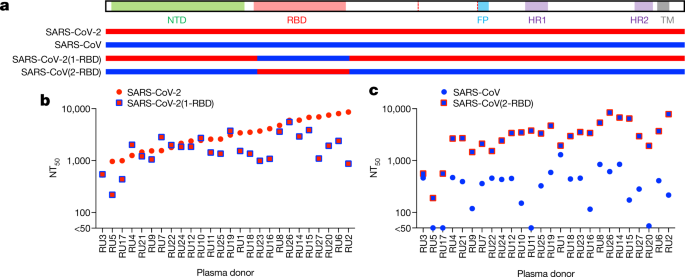
The 20 mutations they mention was a set of 20 mutations to a single spike protein that they then attached to a carrier virus to test plasma neutralization. It's not the full space of possible mutations that could cause immunity escape, but it is one that they found with a plausibly low number of mutations that it could occur in the wild that would result is almost total escape for vaccinated or previously infected.
An interesting result was that the infected then vaccinated individuals developed antibodies that targeted a very broad range of coronaviruses, including their engineered virus, delta, many other variants, and the original SARS.
It's suggested that future vaccines could be engineered to produce this broad immunity.
The immune system is almost terrifyingly complex.
Glad you brought this up, but from what I understand this isn't actually all that interesting (read: surprising). mRNA vaccines target the spike protein because it's functional and well-conserved. Natural infection means your immune system sees many more proteins.
Why would someone get vaccinated post infection?
Antibody levels drop rapidly after an infection, if they persist at all.
Getting a vaccination after infection re-triggers the immune system and makes antibodies more likely to persist for longer.
Reading up on this many months ago it seemed likely that natural infection plus a single vaccination would be equivalent to two vaccine shots.
There was research about only needing to give one shot of vaccines like AstraZeneca to people with previous infection. It was considered too complex to manage, and the research as to efficacy wasn’t finalised, so they stuck with two.
Having had Covid, plus two shots of something like AstraZeneca is presumably somewhere in the region of a standard two-shot-plus-booster campaign.
I don’t really understand much of this paper, but given other comments it seems to be a reasonable idea.
While lots of people got diseases like smallpox and measles only once, others would get them several times. The difference is what part of the virus your antibodies selected to attack.
The spike protein seems to be both extremely important to SARS-CoV-2 and relatively unchanging.
If your body creates antibodies to it, you will have immunity on par with the vaccines.
If your body doesn't create antibodies to it, you have a mixed bag of immunity. Getting a vaccine buffs that up.
Immune systems are very buggy learning systems. This is good from a species survival perspective, but not always for a specific individual.
Or they stand a very high risk of creating and releasing the doomsday variant they are worried about in the first place...
(For the record, if spike proteins were themselves in any way harmful to life on their own, Moderna and Pfizer wouldn't be the primary vaccine vendors for the US right now.)
I think it's fairly well accepted that they can cause myocarditis [1], which has killed some [2]. Better than getting the virus, but they appear to be capable of harm. I've naively wondered if the young men are getting jabbed in veins, rather than muscle tissue.
1. https://www.cdc.gov/coronavirus/2019-ncov/vaccines/safety/my...
> There is a whole different suite of antibodies (known as immunoglobulin As) in the nose and lungs, compared with those (immunoglobulin Gs) that we measure in the blood. The former is more important as a barrier to infection. Natural infection, because it is in the nose rather than a jab in the arm, may be a better route to those antibodies, and nasal vaccines are being investigated too.
Existing vaccines prioritize reducing the risk of illness after infection, rather than stopping infection in the first place. CDC updated their vaccine definition in Sept. 2021, to make this distinction clearer.
So if I'm extrapolating correctly: any vaccine which can stimulate production of this or similar polyclonal antibodies should prove exceptionally difficult for the virus to overcome through evolutionary pressure.
Anyone more intelligent than me on this topic able to help me understand how likely this is to come to fruition?
If that is the case then we would want vaccines that include more mRNA instructions for creating more unique viral proteins to expand the number our immune system has been exposed to. I have no idea how challenging that is.
Technically it's easy, Moderna already has multi target vaccines (for other diseases), one with 7 different targets. It can be as easy as literally creating 7 different vaccine liquids and then mixing them all in a single vial.
The problem is deciding what to put in, what ratio, possible side effects, etc... Lots of combinations which can mean lots of expensive and slow clinical trials.
The human adaptive immune response is massively parallel, and you can liken it to multiple progressive selection rounds for antibody candidates. As such, it is intuitive that this process would create a set of antibodies that targets not just a single antigen in multiple ways, but multiple antigens in multiple ways, resulting in more robust response (see polyclonal b-cell response)
As for the latter, the issue, as already stated, is in understanding the side effects and efficacy profiles of said vaccine. Clinical trials are long and expensive processes.
Which is why we need gain of function experiments to accelerate this process and get ahead of the virus so that we are prepared for the eventual successful mutation.
If you have labs picking-and-choosing what mutations to make (what usually happens), then no. That's just hubris. People stumble around in the dark, occasionally find a truffle, and pat themselves on the back for having such a great truffle-finding method.
Even for good artificial selection systems, mutational space is so gigantic that it's hard to cover properly: not just the point mutations (i.e. converting one amino acid to another) but also insertions, deletions and transpositions. There's no artificial selection system I'm aware of that can recapitulate mutational space.
For example we can try spikes from different related viruses, or pick and choose various other tricks, like furin cleavage sites, for example like in this rejected 2018 EcoHealth coronavirus research DARPA grant proposal:
https://www.ncbi.nlm.nih.gov/pmc/articles/PMC7872131/
molecular biology specific to coronavirus https://www.ncbi.nlm.nih.gov/pmc/articles/PMC7131312/
sars specific literature https://www.dovepress.com/understanding-the-molecular-biolog...
https://www.nature.com/articles/s41579-020-00468-6?error=coo...
> Killer T Cell is loud, obnoxious, and quick-tempered, resulting in rivalries with many cells. He also despises it when a non-white blood cell forms a friendship or relationship with one of his kind. As an immature thymocyte he went through training at Thymus school, where apprentice cells like himself learn to become Mature Thymocytes.
Season 1 is streaming: https://www.netflix.com/title/81028791
From the date of the first vaccine, until 2 weeks after the second vaccine, the immune system goes through many changes enroute to gaining protection from serious illness. It is recommended to avoid immune system stress, exposure to any pathogens (e.g. visiting hospitals), physical exertion, etc. during the 2 week period immediately after the first vaccine. If one is infected with anything earlier than 2 weeks after the 2nd vaccine, it will be recorded as an unvaccinated infection.
Anyone (vaccinated, partially vaccinated or unvaccinated) who gets infected should immediately avail themselves of early treatment options, e.g. monoclonal antibodies (free and available in some states), upcoming antiviral tablets from Pfizer and Merck (in trials) or other therapeutics on the global market. Early treatment speeds recovery. Without early treatment, the graph of outcomes becomes complex.
Vaccine schedules can be designed to give the killed version first for some immunity followed by live vaccine to provide more robust immunity.
None of the COVID vaccines so far are live attenuated vaccines as far as I'm aware.
Why not just develop anther vaccine or two? Wasn't the point with the mRNA vaccines that they would easily be tweaked to target another spike?
https://en.wikipedia.org/wiki/Antibody-dependent_enhancement
https://www.nytimes.com/interactive/2021/08/10/us/covid-brea...
Minor live infections to build immunity is called variolation, it's a tactic that was used effectively historically against smallpox, but effectively got obsoleted by vaccination, which doesn't kill as many people.
To confirm efficacy they gave the vaccine to half of a population likely to develop the disease naturally. Then they compared how many people for sick in each group. That's why testing took a year instead of 2 months, they have to wait for enrollees to get sick naturally.
If we ignore ethics, I guess we could get more nuanced efficacy information out of a small sacrificial population. But that is just not done. Not even during a pandemic.