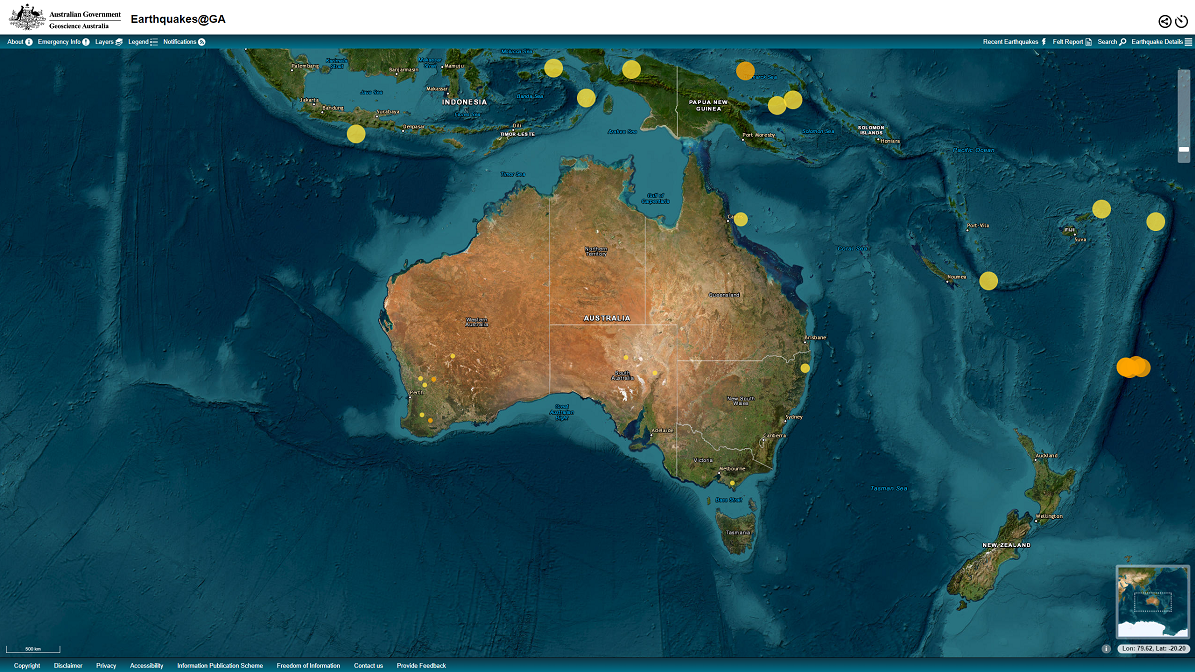
Earthquakes@GA
Geoscience Australia monitors, analyses and reports on significant earthquakes to alert the Australian Government, State and Territory Governments and the public about earthquakes in Australia and overseas.
earthquakes.ga.gov.au
73 points · by jp0d · 5y ago · 83 comments
On average 100 earthquakes of magnitude 3 or more are recorded in Australia each year. Earthquakes above magnitude 5.0, such as the destructive 1989 Newcastle earthquake, occur on average every one-to-two years. About every ten years Australia experiences a potentially damaging earthquake of magnitude 6.0 or more such as the magnitude 6.5 Meckering earthquake in October 1968.
The effect of this is that the maps in my car are already out by several meters. It's sufficiently bad that it'll sometimes jump to a different road.
Geoscience Australia developed the new "Geocentric Datum of Australia 2020" (GDA2020) to fix this, but not a lot of software has been updated with it as of 2021.
See: https://www.ga.gov.au/scientific-topics/positioning-navigati...
From 1994 to 2020, the physical difference was about 1.8m (that’s comparing it with another map projection, but what else can you do?), so in what should be the worst case scenario (if they were actually using accurate maps which I think would reasonably imply nothing worse than GDA94), you should have less than two metres of drift, and the only time that’s ever going to matter is when you want to identify service roads distinctly from the adjacent main road. And continental drift is probably still even within your car’s GPS sensor’s margin of error. No, I don’t think you can reasonably blame continental drift for road jumping; it’s typically going to be bad map data, with roads simply being marked in the wrong place. I have a 2010 Mazda 3 with maps from 2010, and out in the country its maps are commonly out by 10–20 metres, with the largest deviation I’ve observed where I know the route hasn’t changed in at least the last couple of decades being about 150m.
To my mind, the real doozy about these geodetic datums is that they’re time-dependent, including a prediction of continental drift. I have no idea whether the car’s maps system does do that, but it should be doing something like storing all coordinates in GDA94, rendering in MGA94, and projecting GPS coordinates into that coordinate space, so that continental drift’s effects are negligible.
(I’ve wondered casually about continental drift in map projections before, but never gotten round to investigating the reality of it. I didn’t realise they could be time-dependent until today. I must get round to asking my dad about it, as he’s done quite a lot of maps and projections stuff.)
GPS doesn’t have anywhere near the precision you think.
Yes, magnitude does not equal seismic intensity and all that, but Australia has never in recorded history experienced a M7+ earthquake, while Japan alone experiences one every couple of years and New Zealand has had 4 in the last 5 years.
I assume you're using moment magnitude [1] since it's the most common measure. In fact every 2 integers is a 1000 times increase [2] so M8 is 1000 times more powerful than M6.
[1] https://en.wikipedia.org/wiki/Moment_magnitude
[2] https://en.wikipedia.org/wiki/Moment_magnitude#Definition
https://en.wikipedia.org/wiki/Richter_magnitude_scale:
> Because of various shortcomings of the ML scale, most seismological authorities now use other scales, such as the moment magnitude scale (Mw), to report earthquake magnitudes, but much of the news media still refers to these as “Richter” magnitudes. All magnitude scales retain the logarithmic character of the original and are scaled to have roughly comparable numeric values (typically in the middle of the scale).[citation needed]
I have lived here my whole life and never experienced an Earthquake.
those are facts but they're not really in context.
https://en.wikipedia.org/wiki/1961_New_South_Wales_earthquak...
Wikipedia has a whole list of significant Australian earthquakes, if that's not it.
https://en.wikipedia.org/wiki/List_of_earthquakes_in_Austral...
At the time the quake began I was still in bed (being a Monday I should have been up a getting ready for school - perhaps it was school holidays and that's why I thought it was a Saturday, I must check that up later).
I'm almost certain that I was asleep when it started and it woke me up (more evidence for school hollidays?). Initially I was confused and wondered where the almighty noise and rattling-type vibrations were coming from. My first reaction was that it was a jackhammer and the Council was digging up the street (an all too common occurrence as the asbestos cement water pipes broke frequently (yes, you read correctly, they were asbestos) - but all the noise and action seemed too localized to be in the street. I immediately jumped out of bed and tried to run across the bedroom (a very large room that I shared with my brother) and traversing the room was a bit of a task as my feet were slipping from under me. Even though I'd never experienced an earthquake previously it was immediately obvious to me what was going on by the time I was about one half meters from my bed. Being a techie even back then, as soon as I'd figured it out I stopped and watched everything that was happening - 'roof' dirt coming down from the cornice after it had separated from the wall, the clothes cupboard door rattling like crazy and the floor boards bouncing to the extent that it was difficult to walk (but standing still was OK).
I wasn't the slightest bit scared even the moment when I realized what was happening, if anything I had a kid's excitement of a new experience. I didn't try to escape out of the room either (methinks not a good move in hindsight), I simply watched from the center of my room until it was over. It's hard to be accurate about the quake's duration but I'd guess it was about 30 second, perhaps even 40 but that's unlikely as time dilates in circumstances like that. .
From the docs, I reckon I was about 90km from the epicenter. Similarly, the Wiki list of quakes is fascinating, I never realized there were that many.
I've never thought to look up the details previously as it hasn't been in the forefront of my mind until now. It's been an interesting experience down memory lane.
"A Seismologist tells @abcmelbourne it’s the biggest earthquake Victoria has experienced since European settlement" [2]
1. https://en.wikipedia.org/wiki/List_of_earthquakes_in_Austral... 2. https://twitter.com/bridgerollo/status/1440467927140999174
For future reference, during an earthquake if you’re inside it’s usually far safer to climb under a desk or table, stand in a doorway or up against a wall in the center of your house rather than going outside. Falling trees, power lines, broken gas mains, and even soil liquefaction can be very dangerous.
https://www.ses.vic.gov.au/plan-and-stay-safe/emergencies/ea...
> many of them were surprised that Australia gets earthquakes too.
While we do, ones that are widely noticeable let-alone alarming are quite rare.
It roughly felt equivalent to the 2014 Napa Quake (which was also a 6). For normally geologically-quiet Melbourne, however, this would be the strongest quake ever recorded.
It was kind of funny for a Californian. Although the strongest earthquake I've ever experienced was in Indiana. Go figure.
That is…unexpected. I’ve felt two here in Indiana in 50 years, neither of which were all that notable other than the fact that we almost never get them.
(Knock on wood)
The few early news articles I can find seem to confirm not much serious damage in Melbourne.
If you search twitter for "Chapel Street" you can probably find some footage of a wall collapse.
Nothing too serious all in all as far as I can tell. No reports of injuries that I've heard.
While there are plenty of small tremors in Australia that usually go unnoticed, ones that are widely noticeable let-alone alarming are quite rare.
There are faults and stresses within the continental plate but they mainly produce smaller earthquakes with lower frequency but they do happen. Given the population density people rarely feel them. So even a moderate quake is a huge novelty. I can understand why people are so excited and sharing it on social media. I am probably about 700km away and I only barely felt it and it might be the only earthquake I feel in my entire life.
we're geologically very stable. (but also as a whole continent moving quite a lot)
No damage here, but lot of junk fell over in the kitchen.
"In an emergency" has always been allowed reason to leave home during the Victorian lockdowns.
More importantly, I am worried your comment has breached the Victorian Standards of Acceptable Speech (VSAS). "This is poor satire" - expressing your own opinions is strictly forbidden and is punishable by years in hard labour camps or by firing squad. Though this sounds extreme, it's really for the safety of the people, to protect them from dangerous thoughts. Please be careful about what things you share online.
(note: this comment is satire)