744 points · by decrypt · 5y ago · 367 comments
Google has been doing this for a while, as can be seen when the reporters wrote about it 2 years ago: https://www.theverge.com/2019/5/17/18629789/google-purchase-.... HN discussed it at the time: https://news.ycombinator.com/item?id=19942219
You can see the information it has already collected if you use Google, by visiting: https://myaccount.google.com/purchases
Though oddly my list is empty. I wonder if I disabled this feature at some point?
The help docs: https://support.google.com/accounts?p=orders&hl=en, explain how you can delete this data if you want to.
From the screenshot, the items are part of the "Purchases and Reservations" activity category that the parent points to. According to to the help documentation of the category, it specifically refers to purchases made directly within Google Search, Maps, or Assistant. I personally have precious few (4) items in this category, particularly when compared to the large number of purchase confirmation emails sitting in my Gmail account. And there is a UI for deleting the purchase records from my history.
Meta-comment, I find discussions of this type tend to elide the distinction between data used for personalization with data used for advertising. Say what you will about the very fact that the same organization has both, but I do think the distinction is both important, and communicated well neither by Google nor by anyone else writing on the topic.
Personalization of what, exactly, if not ads? What's the proper distinction, in your view?
If I receive a travel reservation confirmation email, I receive a calendar reminder on my phone a few days before the trip.
This is personalization. But years ago Google made a commitment not to use Gmail data to customize ads (after initially doing so). So there's a real difference between personalization data and ads data.
Closer to home for me, we are legally barred from using Fitbit data for ads or allowing any system (or person!) in the Ads organization to access it in any way. But nobody said we can't personalize your Fitbit experience based on data derived from, say, your Fitbit exercise history.
So, my gmail is fname.i.lname@gmail.com. I see SOMEONE else's purchase in my history. That persons name is shown as fname lname@gmail.com. Same as mine except .i. is three spaces.
WTF? Does Google have a bug here? Is there an actual real life human I could send this to?
Edit: the only purchase I see of mine are for Apps I bought from the play store. These don't show up in the link that the Googler posted above.
And not just obscure standards; email addresses are very much public-facing elements of email. The expectation when you register an email address is that that address is now uniquely associated with you. The public does not expect that an email might be delivered to other inboxes than their own.
Why does gmail elide dots again? There must be some reason why a big email provider would deviate so egregiously from the conventions all other email services comply with.
/me not a gmail user, except for certain account recovery purposes.
I was an early GMail user and have a common-ish name. I probably get 30-50 emails a month from confused people ranging from contracts to receipts to racy photos.
I sought support but never got anything official and commenters brushed it off. But I'm pretty sure it was similar to your issue.
As an example name.lastname, na.melastname and namelast.name are all the same email address.
Ironically, since the only purchases my Gmail contains receipts for are for someone who isn't me but apparently decided to use my email address, whatever database these are feeding that Google thinks is "about me" is steadily being corrupted to death by a complete stranger.
Oh well :)
Not going to be so great when they engage in criminal activity that points back to you. I do a password reset on their account whenever I find someone using my email. Then you can change the email to a throwaway or delete the account. It's unsafe to let it be.
"We never use your Gmail content for any ads purposes" emphasis mine.
That might qualify as deceptive.
The weird thing is that page doesn't even list the purchases I've made from google itself. Does it even work?
Recently discovered these all seem to be unlinked, after I has to change my payment instrument in a dozen different places.
Honest question here, why do people put this in their response? I don't think there is any chance that one might thing "kyrra" is speaking on behalf of Google.
But once someone says "I work for X", they must also say that they're not representing the company. Companies get a bit upset if their employees appear to be representing company positions without authorization, even if no reasonable person would thing they were.
Source: I work at Google
Disclaimer: Googler, opinions are my own.
Disclaimer: I am not a googler, opinions are what google tells me to think.
Some comments I see (not speaking of this thread per se, but in general on HN) are really close to conveying internal company information. Which is beyond mere opinion and only available to someone inside the company. Some people clearly use the disclaimer to elevate their "opinion" to the level of authority.
It indicates that "Gmail, Chat, and Meet may use my email, chat, and video content to personalize my experience and provide smart features. If I opt out, such features will be turned off."
It's strange that this major privacy setting is buried specifically in the GMail section and not mentioned in the main Google account Privacy Checkup. I never knew it existed.
Might have just been to the EU/UK users though?
I do wish gmail would keep track of all my purchases. Keeping a folder named "shopping" is ok, but it could be so much more.
Next to each purchase I'd love to see: - link to a manual, youtube videos about this product. - remainders when stock is low (for things I might reorder).
Zero respect for Google or Googlers just like I have 0 for perverts.
I think we deserve to hear from Google about this one. Unless we have already?
IIRC, that's why Amazon purchase emails are utterly useless now. They realized Google was getting their precious customer data via Gmail, so they cut off the flow years ago.
It's another example of how the modern economy has many consumer-hostile incentives that have actually led to regressions rather than improvements.
I liked getting an email with the item, price, shipping, etc. Now it’s just an order number and shipping notice and I have to click on the order to figure out what items are coming. Particularly fun when I order 6 items and they get split into 6 shipments. Or just trying to keep track of my dozens of Amazon orders.
I switched to Walmart as they send useful product updates.
It's the opposite.
Amazon wants you to click back into the store to buy things. One way to do that is forcing you to view orders in the store instead of your email inbox. They care more about that than Google seeing your purchase history.
Also, that’s a great state of things today… Amazon has to make their product worse because Google won’t ever stop siphoning.
I still have a Gmail, but I’m properly compelled to kill it, finally.
Yeah, and there's nothing you can do. I don't even use gmail anymore, and the emails are still garbage. I think for awhile they used to include a truncated name of one of the products in the order, but it looks like they even removed that (sometime around August 2019, based on my emails).
Unrelated observation: in my original comment I added a second paragraph noting that this regression was due to the incentives caused by modern capitalism (and it is: owners trying to extract maximum value for themselves, even if that means hurting their customers), and it immediately started getting downvoted. Then I change "capitalism" to "economy" and it started going up again. Some people are really sensitive. It must be blasphemy to criticize the invisible hand and the wisdom of the owners ti guides. I guess right is whatever they do.
I didn't realize why, but it's always annoyed me how little info is on Amazon's order confirmation emails, forcing you to click the link.
This is why!
To be honest, I actually think it's probably more privacy-conscious to eliminate as much information as possible (but no more) from these kinds of emails. While I suppose Amazon is concerned with competitive behaviors from Google, I'm more concerned that Google or any other actor with access to my email could look through my purchasing list, or my library reading list, or...
Email is an insecure and non-private medium, but we often use it for items that require some level of security or privacy. I'd prefer if more companies held that information closely.
But that makes them useless for what they are, especially the shipping ones: "You made three orders recently, one shipped. If you actually want to know which one (and you haven't memorized your order IDs) click here!"
This is actually a pretty annoying regression for me, because I buy things from many sites and have no way to search my overall order history anymore.
> Email is an insecure and non-private medium, but we often use it for items that require some level of security or privacy. I'd prefer if more companies held that information closely.
It is, but there's no better system and ruining email doesn't solve that privacy problem (e.g. Amazon may sell this information). At a minimum, it should be a setting so people can opt to get useful emails if they want to make that tradeoff.
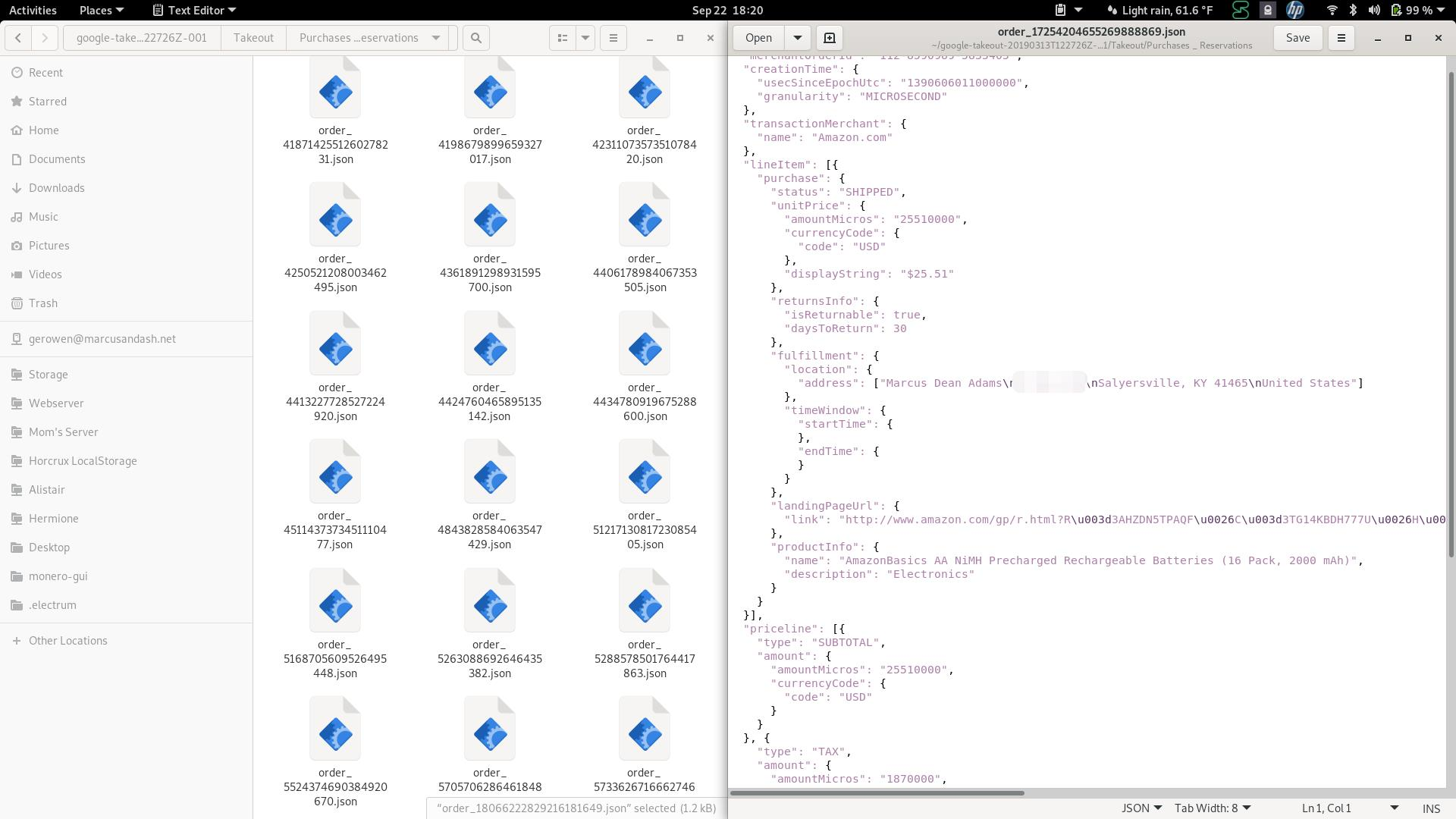
I see Amazon as doing something similar, but less targeted at gmail specifically.
Would be nice if Amazon only made their e-mails to Google addresses (Gmail or otherwise) useless.
"You bought a toilet? Would you like another 4 toilets?"
I mean, ffs, maybe recommend a bidet or installation tools.
Google literally buys a copy of most people's credit card transaction data.
>Google has been able to track your location using Google Maps for a long time. Since 2014, it has used that information to provide advertisers with information on how often people visit their stores. But store visits aren’t purchases, so, as Google said in a blog post on its new service for marketers, it has partnered with “third parties” that give them access to 70 percent of all credit and debit card purchases.
https://www.technologyreview.com/2017/05/25/242717/google-no...
Downside is Gmail search is a lot better than Fastmail's. But otherwise it's worked great.
[0] https://mjtsai.com/blog/2020/06/01/unhelpful-amazon-order-co...
I'm sure the advertising PMs were happy to support this decision because it got them more page clicks, but my understanding is that the underlying motive was privacy.
0: https://www.nytimes.com/2019/06/04/opinion/google-purchases....
(I'm not saying this harm is not "worth it" in some sense, but it's a very real consequence of these giant cross-financed markets - see also mobile operating systems and web browsers.)
https://blog.google/products/gmail/new-settings-smart-featur...
Seems a bit odd for the poster to enable it, and then complain. The text seems fairly clear.
Oh, wait... The screenshot shows the Takeout as being from 2019. Why post about it now?
I just went through the Google's "Privacy Checkup" and it wasn't clear to me where this setting is.
Also is the Takeout from 2019, or are there purchases from 2019 in a current Takeout? What specifically are you looking at in the screenshot?
In typical Google fashion, you had either the choice to enable everything or nothing. I want the tabbed inbox, I don't want smart compose, or assistant integration or... anything else from that post, really.
They also lock all kinds of basic features of Google Maps (like manually set and store my home address) behind the permission to record, store and processes indefinitely my location history.
Same with something I can run Google Maps with my account logged in so that Google thinks I am one heck of a super traveler, and shopper of things.
Something that watches random YouTube videos for me, and randomly clicks on ads for me.. :-)
Uploads random photos into a Google Photos account for me :-)
That’s be heck of a lot fun!
I have been getting a lot. (a couple a week, which is a lot compared to zero for N years.) ((I was a customer of Postini before google bought them and integrated them into gmail as, IIRC, their spam system...))
Privacy is such an illusion.
[0] https://www.vpro.nl/programmas/tegenlicht/kijk/afleveringen/...
Translated from Dutch: "The stock market should be a level playing field: everyone has the same information. But unnoticed, terabytes of data have entered the stock market. Smart companies dive into the mountain of data that is collected about us, in order to be able to see Apple's sales or the number of Netflix subscribers before the rest of the market does. VPRO Tegenlicht delves into the world of 'alternative data' to see who will win on the stock market, and who will not."
Translated with www.DeepL.com/Translator (free version)
edit: ignore, I just read their privacy policy. God damn it. Can't trust anyone.
Technology is awesome, but it's fallen into the hands of a bunch of god damn authoritarians. Trust absolutely no one. Paranoid should be your default behavior towards any files you have a device that accesses the Internet. There's 10,000 tentacles seeking that data.
I run a basic GSuite organization and the two times I've had an issue with the service, I literally had a representative on either chat or phone support within minutes. It was a very pleasant experience.
Happy to spend my money on that. They did have to transfer me twice for a technical issue, but that was resolved too in the end.
Not being flippant. Google's whole business model is predicated on operating like this. An accountable Google would probably be a very different company with different products.
(I work on Gmail, but that shouldn't really be relevant here)
Google also does that if I don't use Gmail but send email to someone with a Gmail account, or send email to an address that forwards to a gmail account, etc.
People are not used to email addresses with personal domains. I've had people get confused by my email address when I speak it to them. I've switched to just giving out my gmail address if I ever have to speak it instead of being able to write it down.
And developers don't account for custom domains when obscuring your email address. me@myfullname.tld is usually obscured as m**@myfullname.tld. That's pretty bad on password reset forms since it lets someone easily turn my username into my real name. If I had registered with myfullname@gmail.com, they'd get nothing interesting.
I've found if you use something like firstname@lastname.tld people generally get it if they've dealt with any other business email addresses (in some cases it actually makes you appear more professional). They usually have your first and last names before you get onto email addresses so they can piece it together and validate it.
If you're really worried about password resets showing your domain get a second domain and only use that for online transactions, it can then be as obscure as you like. Sure there's an extra cost to that but it's a trade off of cost vs the level of privacy you want.
Or, you're part of the 95-99% for whom email and the Internet is of critical importance but because of the ease of access, and the technical minutiae, and generally misplaced trust in corporations, you never learn why this might matter.
Sorry to say it, but I find your comment condescending.
It combines bad user experience with giving them too much power.
Google is really not our friend.
>If you use #Google Photos, there's a non-zero chance that there are secret, yet public URLs attached to your photos that allow un-authenticated access to every picture in your account. Mine did, and I tested the addresses in incognito and tor browsers and they worked. #privacy
But for how long are they retained? Are they generated during the takeout process or do they exist since the photo was uploaded?
This is not cool for me because I don’t want my photos available to people other than me, even if they have my magic url with a token I didn’t create and can’t revoke.
Maybe I'm just too jaded at this point
Google's an advertising company. How is having a complete list of all the products I've purchased online not valuable? Seems like a great indication on what kinds of products Google can turn around and advertise back to me.
What do you estimate is the value of a dossier of all purchases I make over my lifetime? Or at least the ones Google knows about.
It seems to me that this is very useful and valuable.
Now If Google decided to hold the records forever or far beyond any legal requirements then yeah that’s getting evil.
> When you delete data in your Google account, we immediately start the process of removing it from the product and our systems. First, we aim to immediately remove it from view and the data may no longer be used to personalize your Google experience. For example, if you delete a video you watched from your My Activity dashboard, YouTube will immediately stop showing your watch progress for that video.
> We then begin a process designed to safely and completely delete the data from our storage systems. Safe deletion is important to protect our users and customers from accidental data loss. Complete deletion of data from our servers is equally important for users’ peace of mind. This process generally takes around 2 months from the time of deletion. This often includes up to a month-long recovery period in case the data was removed unintentionally.
> Each Google storage system from which data gets deleted has its own detailed process for safe and complete deletion. This might involve repeated passes through the system to confirm all data has been deleted, or brief delays to allow for recovery from mistakes. As a result, deletion could sometimes take longer when extra time is needed to safely and completely delete the data.
> Our services also use encrypted backup storage as another layer of protection to help recover from potential disasters. Data can remain on these systems for up to 6 months.
> some data we retain for longer periods of time when necessary.
> We keep some data for the life of your Google Account if it’s useful for helping us understand how users interact with our features and how we can improve our services. For example, after you delete a specific Google search from My Activity, we might keep information about how often you search for things, but not what you searched for. When you delete your Google Account, the information about how often you search for things is also removed.
Incredibly vague, there is no reason email purchases couldn't be included in this category.
> Sometimes business and legal requirements oblige us to retain certain information, for specific purposes, for an extended period of time.
Again, "business requirements" can mean anything at all.
Doesn't matter - I wouldn't want them storing purchase data for things I bought from other companies at all.
They might be using this order to show what you’ve ordered recently on results or use it as suggestions on Google Shopping.
"Consumer Gmail content will not be used or scanned for any ads personalization after this change"
No longer in effect?
https://qz.com/1014816/google-will-no-longer-mine-your-email...
That entire maneuver was just to plant tracking cookies into your OTHER browser, for use to track you later on. Dirty, dirty stuff.
Another thing is, do they have a back up of data from the Myaccount. Subdomain that users delete.
Still I trust google and amazon more than Microsoft and apple and Facebook. Just me personal view, I could be totally wrong. The ones I trust are simply more open about data storage and have less dark patterns and clandestine TCS. But yes, wide spread Gmail usage will make google see many things and they will collect a lot of data. Probably even more delicate data than what Facebook gets to see.
1. Log in to gmail 2. Navigate to account settings 3. Select an "enhanced privacy" option 4. Enter a credit card number
The user now owns all of their own content - no sharing without the user's permission.
Replies here show a lot of animosity and distrust... not saying I disagree in general, but on this particular point the response from multiple levels has been unequivocal that "this is not happening", and I believe it.
Only a fool would use Gmail.
If they are so evil and clever, I at least make them work through a lot of bull shit before they profile me.
My emails are at Fastmail as a paid user. Hopefully they are away from advertising companies. But, any Gmail user I have emailed would leak that info to Google.
- Oh, I dont know. Maybe i think my data is worth more than what they give you in kickbacks.
Google: X likes dildos
Dildo Salesperson: Google, who likes dildos?
Google: X
User X: deletes dildo receipt email
Salesperson: Is X still into dildos?
Google: Yeah, they just don't like receipts.
I made an account just to try it out but then I saw all the advertisements it added. Seeing ads based on the content of my email was really creepy. I stopped using Gmail and now I pay Fastmail for my email. It seems worth it to me.
I would expect nothing less of Hacker News veterans.
Apparently. Haven't tested myself yet.
After linking your credit history the targeting and linking of information that would follow would be a privacy blackhole that would be hard to recover from.