Garbage odyssey: SF's bizarre & costly quest for the perfect trash can
A baffling lack of curiosity on the part of many of SF's elected representatives leads to $427,500 being spent o produce 15 prototype cans.
Mission Local
66 points · by savanaly · 5y ago · 63 comments
That says nothing about the rest of this article, though.
Well, except the first question presented in the article is "why are we paying for any prototypes in the first place, instead of just using cans that already exist?"
Prototype costs seem pretty relevant to that question.
So this seems like a standard buy/build decision being turned into a political drama.
And the prototype cost is still irrelevant, we should only care about the total cost of ownership.
I can totally understand why a larger city like SF wants to spend some resources on this rather than just pick the next best off-the shelf solution without much thought.
They could come up with the best possible trash can ever invented and it wouldn't move the need on resident's quality of life.
Total waste of money.
I'm saying that, if you're going to go down this path, costs in this ballpark are to be expected. That is, I don't think SF appears to be overpaying for their quixotic custom trashcans. (Again, at the ballpark/order of magnitude level.)
Lastly, San Francisco is riddled with trash and dirty streets. It seems rather surreal they’d spend so much on aesthetic trash cans, that may or may not work better than the existing solutions, when the streets are literally covered with human feces.
https://www.npr.org/2018/08/01/634626538/san-francisco-squal...
Quotes from that article:
> San Francisco's streets are so filthy that at least one infectious disease expert has compared the city to some of the dirtiest slums in the world.
> "The contamination is ... much greater than communities in Brazil or Kenya or India," says Riley, who researched health conditions caused by extreme poverty in some of the world's poorest regions.
> ...
> There were no off-the-shelf models that met most of those requirements, except for the Bigbelly. But those, at a cost of about $3,900 a can, were deemed too expensive. Nor were they particularly attractive, she said. The PEL [product] can also fit most of the requirements. It costs $6,400,
My original point stands in that it's not blown out of proportion and should be discussed.
> https://missionlocal.org/2021/08/san-franciscos-proposed-tra...
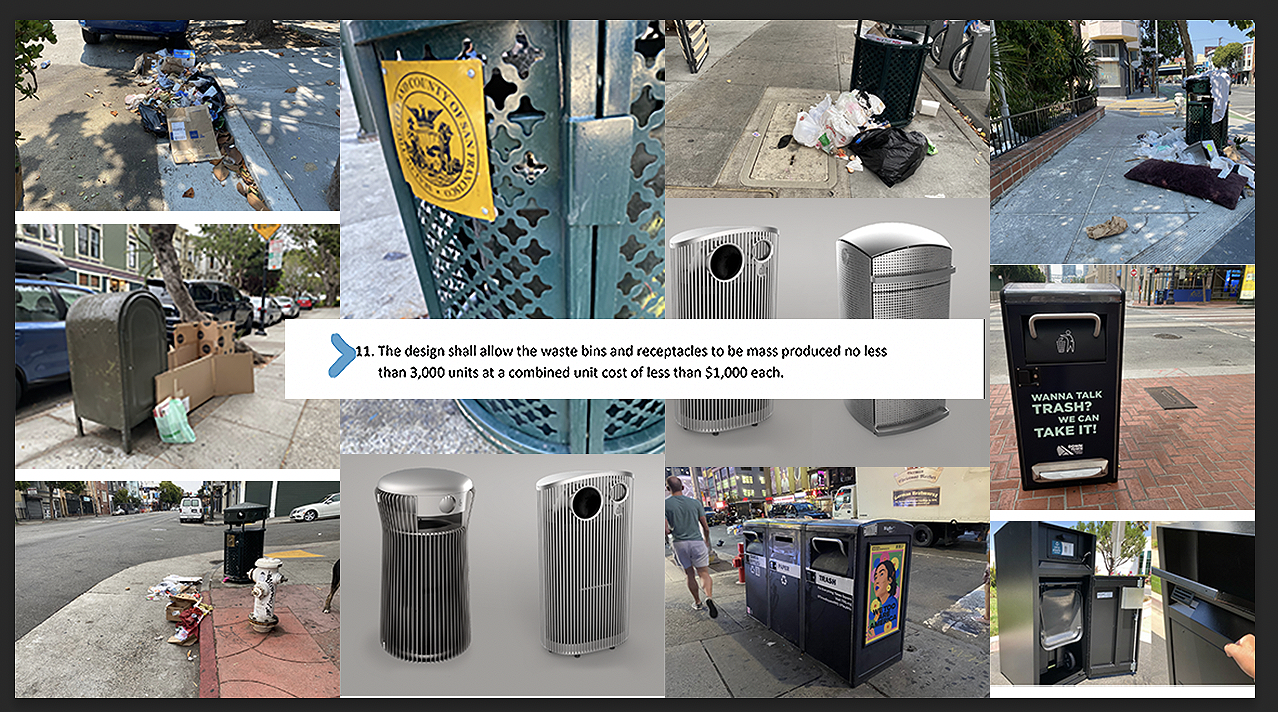
The actual three prototypes:
What's the solution, though? Obviously part of this is staggering corruption, but I wouldn't be surprised if a large part of the problem here is also just fundamental incompetence on the part of these middle-managers. This is exactly what I would expect to come out of the worst design-by-committee no-initiative meetings. Spiraling costs, no understanding or acceptance of tradeoffs, and zero shame about the failures of the process. This has incompetent management written all over it, but no one will be held accountable for these failures. How can that change? Should we keep a public record of the projects that city councillors are involved in/advocate for?
Or does it really need to change? It's kind of an issue of dueling narratives. There are some public projects that are massive, embarassing failures, and some that go ahead on time, under budget, and quietly. We only really hear about the first, and there does seem to be a group that benefits from pushing the idea that large government projects always and inevitably fail. I don't know how common it really is, and it's hard to trust any source as definitive on the matter anymore given the incentives involved. Although from what I understand, Cost Disease is a thing - the prices of public infrastructure has gone up an order of magnitude over the last few decades.
I'm sympathetic to the idea that there's a large amount of waste in government spending - I've worked for large companies in the past, and it's not a stretch to imagine government as just a larger, even less tightly fiscally managed enterprise - but I don't think "smaller government" is the panacea that some propose. Especially because I don't believe anyone ever actually tries to shrink the government; a solution that no one would actually implement is not a good solution. Are there any practical proposals to increase accountability and effectiveness of government entities?
Having worked in government, seeming incompetence is not the fault of administrators more than you'd think. The ideology of "government is the problem" has led to a lot of legislation that knee-caps good decision making e.g. forcing acceptance of the lowest bid.
Along those lines, as trust was retracted from government agencies expertise was often removed with it. Departments that use to keep technical personnel on staff to review policies and make recommendations were replaced with consultants who usually have many conflicts of interest.
I don't have good solutions, but it's a stick and multifaceted issue. There are no easy answers sadly.
Corruption is one, but are there actually incentives to run lean for a govt government here, or do they act like money is free.
The people working on the shed probably are the ones who most likely just want to get on with it.
While we're talking trash we should scrap the CRV... the most idiotic policy whose only outcome seems to be trash/recyling gets emptied out all over the streets.
As for garbage cans, they could just order existing inexpensive products from any of the many suppliers out there.
And then there is their Wine bottle recycling receptacle. Looks like something out of some cartoon. Looks so unique!
[1]:https://myparttimeparislife.files.wordpress.com/2015/10/publ...
Whether it's the planning department, sanitation, government contracts, etc, it's kind of startling seeing multiple high-level people get snagged. I mean the federal gov't through the DOJ has active corruption investigations going on - I assume the feds don't get involved unless there are some big fish to fry.
It would explain just how poorly SF is run despite one of the largest per capita budgets for a city/county (plus airport) in the US.
https://www.elkoplast.eu/underground-containers
Probably hard to retrofit in the middle of cities though.
Or even pneumatic trash tubes, like in NY:
https://untappedcities.com/2020/04/09/inside-roosevelt-islan...
Which would seem more appropriate for HN discussion.
Plus, as other commenters have said, it’s one of the most visible public works, so it contributes quite a bit to the character of the city - a unique look would be nice.
This is a city spending $55,000 per tent to "support" a parking lot camp ground with porta potties.
Spoiler: much of the cost is for 24/7 onsite security
Even with 24/7 security (and SF wages) the costs seems high.
https://archaeologymysteries.com/2019/02/26/how-did-the-roma...
So to the degree that this equipment breaks down or fails to deliver on the self-cleaning promise, those costs should be included in the total cost of the toilet, no?