225 points · by lalmachado · 5y ago · 146 comments
In general, though, you're right - I wouldn't want to try for the same kinds of shots with a phone that I get with a DSLR. My macro rig weighs about five pounds, which sounds like a lot and is in comparison with a phone, but between the damping effect of all that mass and the ability to get a good grip with both hands, it makes for a much more stable platform overall.
A little sway left or right can be cropped away, but missed focus ruins the shot.
[1] https://aaron-m.com/wp-content/uploads/2021/01/DSC1250-1.jpg
[2] https://aaron-m.com/wp-content/uploads/2020/08/DSC0772-240dp...
Gorgeous shots tho
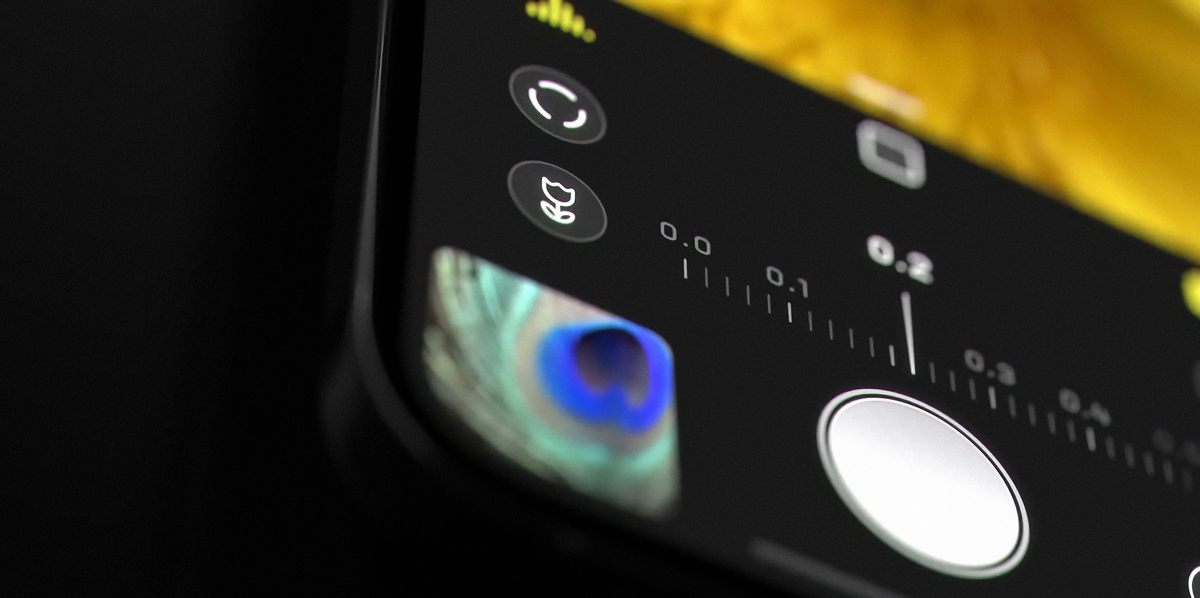
This bit in particular caught my eye: "What makes Halide 2.5’s Macro Mode so special? For one, it brings Macro capabilities to all iPhones." (not just the iPhone 13 Pro)
I just clicked buy on Halide. I'd downloaded and played with it back when I got my iPhoneXR, and I only upgraded from that recently purely because I wanted some of the camera advances.
$80 to buy specialised software for my $1800 camera (that also happens to be a phone) feels totally like the right thing to do.
And FWIW, the curse of SLR macro lenses is minuscule depth of field, so much so that many take many photos (presuming a perfectly stationary subject), bracket the focus, and stack by sharpness. It's a hugely involved process. A macro lens with a tiny focal length instantly has a big advantage, though depth of field is still going to be a problem given the fixed aperture.
It most real world scenarios I think the average person will have a much better chance of successful results.
This is basic math. It's interesting that someone else claimed it's "physics" as a retort, when yes indeed it IS physics. It's why you can make a tiny lens fixed focus camera that seems to have everything in focus, from near to far, because the DoF becomes enormous.
https://www.photopills.com/calculators/dof
(That site has different camera selections purely because the circle of confusion differs based upon the sensor size / resolution, so it's the relative values that you should pay attention to)
Take a gander at the DoF variations for a 4mm versus a 35mm FL system.
This is the reason why iPhones have to implement fake bokeh -- because the depth of field on tiny cameras is so much larger, even with a wide open aperture. But the inverse is that where you want a wide depth of field it is a feature of the size. It's also why people seem to be much more successful taking photos on smartphones, because the focus is much more forgiving.
A wide DoF is a function of those physics.
The image pipeline in the iPhone gets more and more advanced with every IOS release. The state of the art for computational photography is pretty amazing.
Full frame sensors have thin depth of field. Small sensors like an iPhone don't have that, so they fake it with portrait mode.
But when you do macro photography, having thin DoF becomes a drawback, so with big DSLRs you have to do focus stacking (which is unnecessary on an iphone).
I noticed it during my vacation in Italy. Yeah, I still run around with a big mirrorless camera with a huge zoom lens (Fujifilm’s weird X-H1 absolutely no one bought but I still love very much with the very large and heavy 16-55 mm F2.8 lens) and I’m sure I will only use its photos for my 2022 week calendar or whatever else photo projects I will do – but the photos from my iPhone still provided an instant satisfying value in the way in which they are instantly and easily shareable and just immediately can populate my digital live (even if I have the huge camera with me – which I don’t always have!).
These are two different ways of using photography and both are valid. More importantly, both benefit from any new capabilities you gain.
I guess what I want from my Fuji is to integrate itself more tightly and easily with my smartphone, something they really suck at. And I want my smartphone to be good enough in more situations. Like macro photography.
And the weird thing about macro is that even if you do have a big camera and great lenses (I have the 35mm F1.4, 23mm F1.4, 16-55mm F2.8 and I sometimes rent the 90mm F2.0) you might not prioritize macro photography, so if you just get a new thing that’s pretty good at it that just very cool to play around with. And I don’t think your sneering attitude is justified …
Apple isn't trying compete with a $3500 Sony A7R4 with a $1000 90mm macro lens. They're aiming for people who see the example "macro" photos and say "neat! I want to try that". Or the people who have already bought a Moment macro lens (or one of the other clip-on/screw-on iPhone macro lenses) and are tired of carrying it around.
edit: formatting
If I have to pick which of my heavy glass to carry around with me on a regular basis, the 90mm macro is going to stay on the shelf most days unless I'm specifically going out to shoot macro photos.
My iPhone Pro 13 is always going to be in my pocket.
Went for a night walk yesterday and saw a cool snail. The new iPhone 13 pro took a decent shot of the snail in the dark with automated long exposure and built in stacking. But I thought you know for a really excellent shot of the snail, if only I had with me my mirrorless camera.. AND macro lens.. AND tripod so I can get properly long low light exposure. Not to mention another 5-10 minutes out of my day to process the photo. Missing any one of these ingredients the iPhone wins.
But you know if I had to lug around all that camera gear I probably wouldn't have gone for the walk and seen the snail in the first place.
> As a photographer passionate about the natural world, I carry a macro lens with me no matter what project I’m working on, just because I never know what tiny detail of interest might present itself. Now with the macro capability of the iPhone 13 Pro, I feel like I have my “in-a-pinch” macro shots covered and I can leave the rarely-used macro lens at home.
Every real-world photographer I know is very happy that they can have both a cellphone and a full-size camera and choose appropriately for the situation.
Other smartphone manufacturers might be willing to do a product for, at best, a few million users, but Apple thinks focusing on fewer products is the better choice (for them, and, possibly, for all users because Apple can spend more effort on each design)
I would guess Apple’s target audience is everybody who wants to make better photos, whether they know about DSLRs or not.
Yes, they have RAW support, but I think they find that a nice to have, not a must for their product.
Most tech has limitations/flaws, and there is always a target audience that doesn't care about those limitations/flaws.
tbh something like a Nikon d300 with a 200$ lens does a better job in good light
Sole us continuously improving their cameras on every iPhone release. They spend a lot of money on doing it.
They don’t care about competing with anyone. That is not their mindset. They just get better every year.
You are making up a rivalry that doesn’t exist.
I disagree. I have both a dslr and mirrorless bodies and love that my 12pro also takes great pictures. Anyone who enjoys taking pictures should be excited about the cameras improving on an always with you device.
That said, I often break out my camera and use it's macro lens when I need serious resolving power.
“Wow,” was exactly what I thought when I saw the third crown image. Incredible.
I frequently find myself using my phone camera to zoom in on ridiculously small text on things, but my phone has always struggled with it. Good phone macro will be a feature I would use all the time.
I suspect a lot of current phones would do a good job with this task, but I'm on the lookout for something that will last me 5 years or more so the 13 pro is in the short list.
If I want to make my photos punchy, I can do that in lightroom. For those who don't use lightroom, you can do that in the built-in photos app. My old iphone 6s produces much accurate colors than my iphone 11. On the iphone 11, colors are way off and images are so over-sharpened that I can see severe haloing around high-contrast areas.
And those awful noise-reduction watercolor textures... I wish they would just leave some noise as-is. Get rid of chroma noise (which is relatively easy), and leave some luminance noise around. I mean, luminance noise are actually quite nice as they are similar to film grain.
I can get pretty close to what I want with raw(not ProRaw), but you know, I can't even capture raw with their default camera app even when they are bloating it with useless(IMHO for a stock camera app) features like portrait mode, cinematic mode, photographic styles, filters etc.
I mean, I get why they are doing it; obviously because people like over-processed photos for their instagram. But it's my pet peeve...
But interestingly enough there's an image processing programming language called halide, too [2].
[1] - https://www.nikon.com/about/corporate/history/chronology/194...