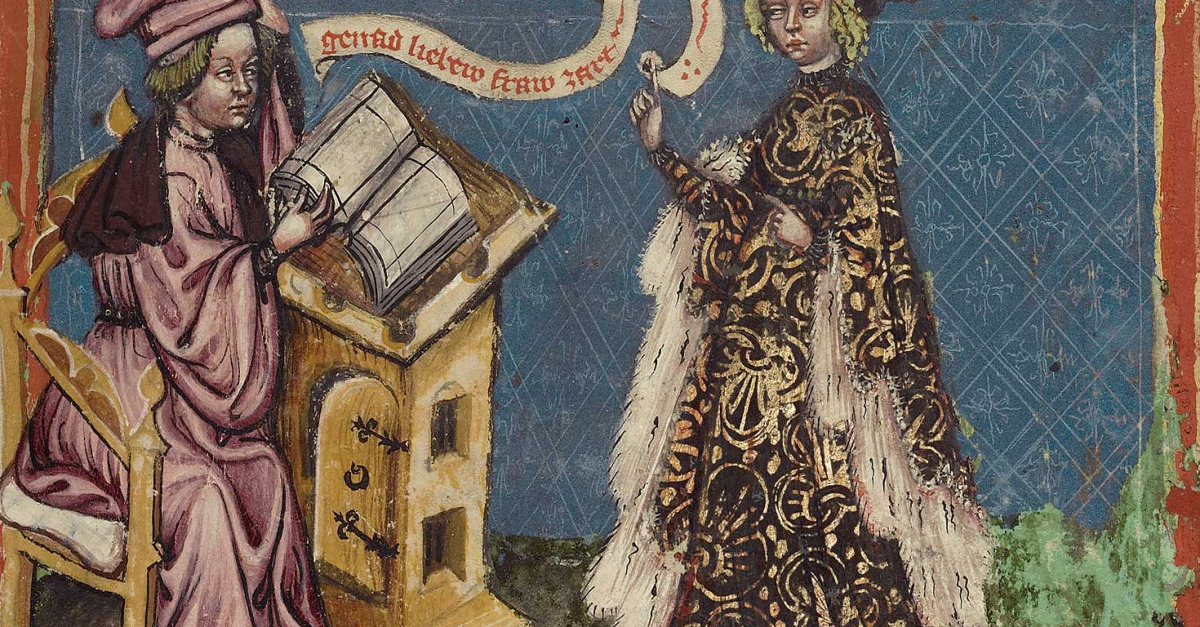
Save the Scribe | Mary Wellesley
On the blessed purpose of the women who worked with medieval manuscripts.
Lapham’s Quarterly
40 points · by drdee · 5y ago · 26 comments
>Not only men, but women were thus occupied, to whose insufficiency the defects of many manuscripts are assignable. (P. Sarti de Profess. Bonon.) This authority refers to the female scribes of Bologna. We may, however, believe the practice to have been general; for Engelhardus (anno 1200) reports an accident which happened to a nun in the exercise of her employment: "Cum soror una cui usus erat scribendi membranam, dum ad lineas punctaret subulam incaute trahens, oculum transfigit." Defective transcript is, however, not solely to be attributed to females; for the accurate and elegant Petrarch indignantly exclaims, "Who shall prescribe an effectual remedy for the ignorance and worthlessness of copiers, who spoil and confuse the performances they undertake?---At this time, every one who can redden letters or guide a pen, though void of learning, skill, or ability, assumes the character of a scribe. I should not censure their defects in orthography (for that is a long forgotten art,) if they would faithfully transcribe what is before them. They might betray their insufficiency, but we should have in the copy the substance of the original. They now confound both together, and, by substituting one thing for another, we can scarce identify the author from which they transcribed. If Cicero, Livy, and many other illustrious writers, could return to life, and re-peruse their own compositions, would they understand them, and doubting the whole, would they believe them to be their own, or rather, those of some barbarous people?"
Ugh! :-(
I didn't know about this part of the process of manuscript preparation. Apparently, awls were used to score or rule the guidelines onto a parchment, or to perforate an entire set of parchment leaves with very tiny "pricking" marks showing the desired spacing for the guidelines (which would then be identical on every page in that set).
http://web.ceu.hu/medstud/manual/MMM/ruling.html
So that explains "punctaret" (a very post-classical word).
"Then one sister, whose custom it was to write parchment, while she was carelessly carrying an awl in order to prick the lines, impaled her eye."
[1] https://www.youtube.com/channel/UCKSrgKjevPmNZxCAyTZP5cQ
Hunter-gatherers notoriously actually live off women's gathering labour, the hunt part is supplementary protein, and entertainment for idle jackasses: women do most of the work. Why do we allow reading of history to tell us scribes, and implicitly literate people were "mostly men" when evidence is at best one sided? Collectively, religious women may well have outnumbered monks. Men had to do other things, including dying in pointless activity far more than women. Marian reverence implies a religious status of women which demands economic relevance as well.
https://escholarship.org/content/qt4wc9g8g4/qt4wc9g8g4.pdf
Cross-culturally, men provide about 60% of the calories.
This makes sense when we consider how humans are different from most other primates. We have relatively long term pair bonding, which is unusual in great apes -- but very common in species, like many bird species, where males make a significant contribution to feeding the offspring.
The idea that men's contribution to food stuffs and the general welfare is a sort of supplement or entertainment, while "women do most of the work", is an early modern feminist myth, a product of a time when a lot of comparative anthropology had been considered but very little had actually been done. It's not dissimilar to how we discuss the wage gap, where the most basic number -- of hours worked -- tells a very different, more gritty story than the one characteristically told by feminists.
It’s very dependent on location, with far northern cultures being significantly more dependent on meat due to long winters. However population density isn’t uniform across cultures, most prehistoric people lived in warm climates.
Also, that link provides zero mention of the breakdown between calories gathered by men, women, or children. Hunting and fishing was far from an exclusively adult male activity in prehistoric cultures. https://www.science.org/doi/10.1126/sciadv.abd0310
https://www.unm.edu/~hkaplan/KaplanHillLancasterHurtado_2000...
The cultures surveyed are in Africa, Australia, India...
The article you link is an analysis of a burial mound in the Andean highlands and surveys a few other excavations in the Americas. It concludes "The sample is sufficient to warrant the conclusion that female participation in early big-game hunting was likely nontrivial—greater than the trace levels of participation observed among ethnographic hunter-gatherers and contemporary societies.". This leaves several questions open -- their survey is of the Americas, and we do have to acknowledge that widespread female participation in hunting is very unusual to find in hunter-gatherer societies today. Which one represents the ancestral state?
At present, it seems that in most societies, males contribute most of the calories.
To me, the laphams article is a re-balance which probably understates, more than overstates the contribution of womens literacy in the scribe records. Thats the point here, not the hunter-gatherer story.
Honestly, I think the breadwinner-homemaker dynamic makes a lot of sense.
Life has become harsher for everyone now that two incomes are required in order to remain competitive, and the work that women used to do as homemakers in a stable marriage has primarily been replaced by immigrant labour in insecure and underpaid jobs.
Yes, GDP has risen, but I don't think that necessarily means the new system works better.
If you look at employment rates per gender in 1950, you find surprisingly a lot women working. It is not like legend has it as if only middle class existed.
Notably, Rosa Parks employment mattered to her family a lot and loss of it caused the issues after protests.
Before automation and modern conveniences, running a household was a very demanding job.
Have you tried washing clothes using a bar of soap and a scrubbing board?
Or firing up a meal using an old stove? Or preserving foods (canning, drying, pickling) because no refrigeration.
Or drawing water for a bath from a well, and firing up hot water?
Never mind the kids…
Edit: Not aimed at you specifically. I just think people don’t appreciate that historically, both genders had to contribute a LOT to build a successful family.
By men too, it is not that men slacked. And a lot of work was physical and superior strength mattered. But there was ton of work all the time and even kids had to be useful.
The situation in which you have full adult boring her brains out being idle was not historical norm except for richest classes.
The article is an excerpt from the book, written by the author of the article.