133 points · by graderjs · 5y ago · 57 comments
No one wants to try nuclear for reals because people are frightened of it and world governments don't have an economic interest in building more nuclear.
We don't have an equivalent of an "operation warp speed" for developing next-gen CO2 scrubbing technology. I guess that's just not as cool to people as building tunnels under LA or launching cars into space.
Speaking of algae, we're not turning wasteland into algae farming ponds and developing more useful algae because, well, I don't really know. Even with CRISPR-Cas9 being in relative infancy, GMO algae seems like a low hanging fruit for not only removing carbon from the atmosphere but being a food source in places around the world where food is scarce. I mean, as an individual you can buy a kit that has what you need to genetically modify yeast to glow with jellyfish genes, so how far off are we from making species like chlorella more practical? Maybe it's because nobody wants to eat pond scum.
All I know is that the amount of effort we are putting into these solutions, although there is some effort in each of them, really doesn't add up to the message we are being told about climate change. It's both extremely disappointing and cause for raised eyebrows.
I maintain that, given how the majority of tax rebates and financial aid is still going to fossil fuels, unless we kick people out of that option for good, they will latch to the last dollar of subsidy or political donation until human life on Earth is beyond hope. The only way to kickstart changes and investments is to put executives in front a judge for the mass murders that are already well documented and be clear that they will be held responsible for the millions of deaths related to unusual climate events.
How did we stop populist from legally raising to position of power against after the 1940s? Nuremberg and Tokyo trials. Climate disruption is a much bigger threat and needs a gesture at least as big.
Well it's also worth noting that it's become like that because of the oil lobby's decades of scaremongering and the oversupply of natural gas which makes those plants the most profitable choice.
But still it's mostly a NIMBY problem. If smaller, mass produced, gen 4 reactors could be set up in some uninhabited areas we'd basically solve all that.
One of the reasons is that, according to many environmental activists, there is no such thing as “wasteland” that you could develop with minimal loss to environment. This is not a theoretical concern: read up on Ivanpah solar power plant, built in the middle of the literal desert, the place as deserving the designation of “wasteland” as any other place in the US. Activists forced the developers to spend tens of millions of dollars on relocating the desert tortoises living in that wasteland, at a cost of hundreds of thousands of dollars per tortoise - and that’s not even including the litigation costs. This also resulted in reduction of scope of the plant, reducing the total installed capacity, and reducing the amount of carbon-free energy we will get out of it.
The lesson here is that if the environmental activists are not happy about building solar power plant in the middle of remote desert, they won’t be happy about building literally anything else. They’re totally BANANAs: Build Absolutely Nothing Anywhere Near Anything.
Look up Southern Resident Orca
If the world's microbiome is geared to maintaining (rather than merely existing in / responding to) temperatures and atmospheric gas ratios within a fine margin that would be noteworthy.
I've probably drunk too much and it's too late at night for this conversation to be honest. I probably shouldn't have even pressed "reply".
The error bars of the IPCC report are our best guess on what we think we know about uncertainty. Sure, we could end up outside of it, on some heretofore unknown feedback, but it’s like betting our collective future on a longshot horse. The same applies to the assuming it will be much worse.
Similar to the recent / ongoing pandemic, there's tons of variables and I've made a similar argument to people who decry in a mocking tone the "scientists" with their "agendas" etc... like dude these are people individually who devoted ten years of education and research MINIMUM learning about one specific thing.. BEFORE they were taken seriously enough to even get a job. Pushing pixels and shovelling dirt are both important and necessary, but when it comes to complex matters, listen to the person who made a lifetime commitment to studying that thing. I get it, and apologies if I somehow sounded like I was brushing that away. As you say, I'm just curious.
So anyway I'll take this all with a grain of salt. Seems interesting but as you imply it's a bit overhyped. It's just another small wheel within an intricate mechanism of gears and the overall swing of the machine is to hotter temperatures, more carbon dioxide, nothing changes, the overall trend is still clear. As I say, I was probably too drunk to hit reply, but I'm glad I did.
Thanks for the reply, it gave me a chance to pause and reflect.
I’m not an expert on this stuff but from what I’ve read over the course of millennium. The Earth will achieve balance again (assuming no further human intervention)
For all practical reasons that won’t work for us. Using microbes as a carbon removal solution is a real potential solution! Specifically using microbes in place of fertilizers as a technique to improve soil health (which would increase soil organic carbon). Although it’s not 100% clear how well that carbon will be stored for the long term.
I’m oversimplifying the science no doubt but we can harness microbes to our benefit.
As a layperson I've read about the Vostok cores and understand how closely correlated CO2 concentrations and dust are as proxies for global temperature. Also I've read up on how phytoplankton essentially are the reason we have oxygen to breathe, so there are risks like ocean acidification that could kill us all regardless of temperature.
If some of those little buggers can give us an out or at least give us a longer grace period to sort our stuff out, I want in.
But it is also true that if you say, "Climate change is really only a big deal for the currently dominant flora and fauna, the planet as an ecosystem has been in many different states from ice ball to volcanic hell hole." :-) In geologic time it doesn't "matter" at all.
It is a good paper, and I've added it to the list of things that are changing that may influence climate changes (another is what happens with cloud formation when we have more moisture in the air due to rising atmospheric average temperatures, the IPCC model gives one result if we get more stratospheric clouds, and another if we get more clouds in the troposphere.)
Could we please not alter headlines to replace real words with made-up scifi words? The original headline uses "terrestrial," which is correct.
Also even in the context of scifi, "terrestrial" has a completely different meaning ("of the land surface", vs "of the planet Earth").
Inb4 'all words are made up' etc etc boring thread
Mods, can we get a fix?
EDIT: Thanks!
You admit your point is baseless but haven't internalized it emotionally, I guess.
"Terra" is "Earth" in Latin, and "teren" is Romanian for "ground". Can't "terran" be a shorthand for "terrESTRIAL" in English just because it's the name of a faction in StarCraft?
If you have better alternative, feel free to suggest one.
Edit to add: the best way to get a title fixed is to (quietly) email the mods using the contact link in the footer.
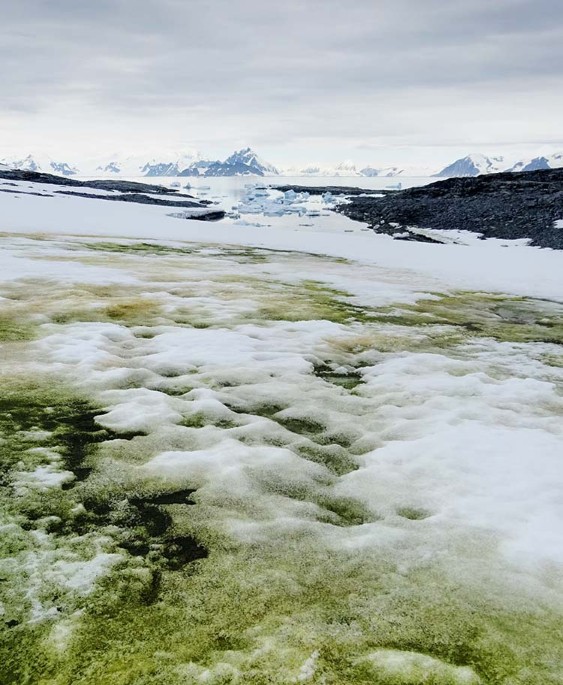
(Submitted title was "Remote sensing shows Antarctic green snow algae is important terran carbon sink".)
Second of all, you're talking about gargantuan quantities of oxygen (or nitrogen, or whatever). CO2 is roughly 1/2500 of the atmosphere, so to achieve a given amount of dilution, you can remove one CO2 molecule or add 2500 other molecules.
Finally, I don't know what the side effects of increasing global air pressure would be, but I'm sure there would be significant effects!
Anyway, as you said, any project that doesn't involve significantly scaling down anthropic GHG emissions and human settlement footprint will have significant effects. Planting trillions of trees will result in dead trees and environments destroyed. CCS at scale will involve ungodly amounts of energy + materials. Algae farming will alter the ocean's biodiversity already affected by warming + acidity + overfishing.
It's time to acknowledge that the Earth doesn't owe us a couple of large cars per household, exotic foods, meat BBQs and regular plane trips.
Of course all of this is academic in any event; addressing climate change by diluting the CO2 is a nice attempt at out-of-the-box thinking but it's not actually plausible.
It will be the collapse of the phytoplankton that will eliminate the the atmosphere necessary for human life.
Humans won’t be around to see the planet warm.
> Our study indicates that positive summer temperatures and a sufficient nutrient supply are key factors determining the present-day distribution of green snow algae on the Antarctic Peninsula. With the IPCC’s projected 1.5 °C global temperature increase, it is predicted that the 0 °C isotherm will increase in elevation and that positive degree days will become more commonplace and occur further to the south. This will likely open up new snow for colonisation by green snow algae, should an appropriate dispersal mechanism allow transfer to new areas. [...]
> A warming Peninsula, therefore, may see a shift towards fewer, larger snow algae blooms, resulting in a significant increase in biomass on larger outlying islands and the mainland. The coupled loss of blooms from smaller islands would be insignificant with respect to biomass and may be mitigated by southward range expansion or an earlier growth season. However, with multiple and often unknown species recorded within patches of green snow algae, and little known about the dispersal mechanisms, life cycles and plasticity of snow algal species, losses from these islands could represent a reduction of terrestrial diversity for the Antarctic Peninsula.
Humans will still be around to see the planet warm. The question is will individuals & society band together to limit that warming & adapt?