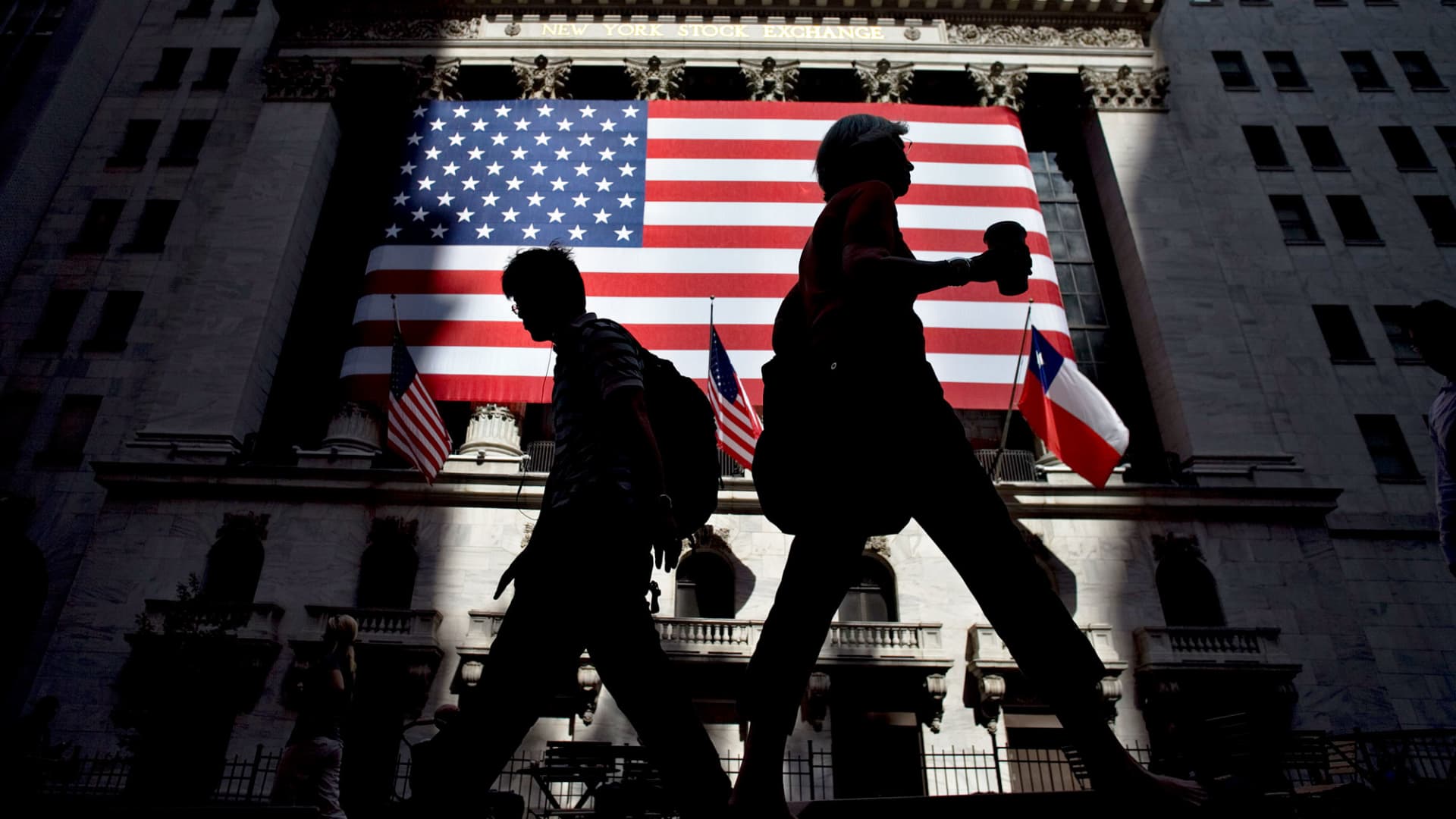
The wealthiest 10% of Americans own a record 89% of all U.S. stocks
The top 1% gained over $6.5 trillion in corporate equities and mutual fund wealth during the pandemic, according to the latest data from the Federal Reserve.
CNBC
393 points · by batmaniam · 5y ago · 558 comments
It compares a recent Stanford grad from a wealthy family to a 55-year-old who was scraping through the first 35-40 years of life, but now makes $190k/yr as a successful tradesman during boom time. The former will count as "poor" and the latter will count as "top 10%".
In other words, no, it's not comparing Americans of different classes. It's comparing Americans at different stages of life. Or just the ebb and flow of income over and individual's life (selling a house even in a modest area can easily put you into the top 10% for a year).
You need to follow individuals over their lives to get a better picture of who is struggling and who is thriving.
For reference the top 10% net worth splits at about $1.2M, so both of your points are important.
It's wrong, it doesn't account for debt. There should be a huge mass of people that are net negative. I think we're really presented with all the wrong information.
First we need to break down into a heat map of CoL which can act as an approximation of demand for the given region. Then we need to look at individual median (perhaps modal) cash flow, where your deciles land, and whether that's translating into profit when you calculate in inflationary pressures. Then you've got to look at average degrees of freedom given demographics like no-diploma, GED/equivalent, HS-diploma, and degree strata that indicate an upward move in purely economic terms. I think what you'd find is the vast majority of people are just on the treadmill, and will for the foreseeable future there remain.
I expect the median net worth (what's the method?) of a 35 year old is very much in the negative space. And I'd hope over a lifetime that the 65-74 cohort is breakeven - which is about what you've indicated - Zillow indicates the average value of a house is $264k.
To some extent this is how our system is designed to work, but the system itself is predicated on a slew of fallacious logic and wholly removed from any semblance of morality while dually being totally unaccountable for the destruction and extraction of value that it is founded on.
I should also add that power as a function of wealth had ought to be looked at. What is the effective cost of having a voice in policy? I suspect it's in the highest echelons of net worth that you can even begin thinking about leveraging the system, and locally at that. At which point, corporate personhood might had ought to be considered, how does that deform our distribution?
People with stocks have undergone a massive boom in the last 20 years, that boom is not sustainable.
As noted, even just selling a house in a random state like Wisconsin can easily put you in that bucket.
Top 10% by wealth is a different story harder to attain. It's frustrating that we pay for things with taxes on income and not wealth, because it hits the upper-middle-class harder than it hits the people with all of the equity.
https://www.aei.org/carpe-diem/evidence-shows-significant-in...
If, "by a large number," you mean 10%, then you're right.
Edit: Upon reflection, my comment was both flip and inaccurate. In sum, I was talking out of my ass. Phew! That stinks. My bad.
OK, let's take a look, because the GP was arguing about income mobility across different years of a person's life - intra-generational mobility -- not earnings compared to your parents -- inter-generational mobility. That distinction was the key point made. And the GP is basically correct:
From two studies about intragenerational bottom[1] and top[2] income mobility:
* 53.1 percent will have experienced at least one year within the top 10th percentile
* 36.4 percent will have encountered one year within the top 5th percentile
* 11.1 percent will have experienced one year within the top 1st percentile.
* 70% of Americans spend at least 1 year in the top quintile
* 61% of Americans spend at least 1 year in the bottom quintile.
* 42% of Americans experience at least one year in the bottom decile
Summarizing:
"Taken together, these findings indicate that across the American life course there is a large amount of income volatility. Rather than a rigid class structure, the top and bottom ends of the income distribution are fairly porous. This finding provides an interesting and important caveat to the overall story of rising levels of income inequality across the past 40 years." [2]
Note that a key issue when studying mobility is that you need to do it across a few business cycles. If your study is only during an economic expansion, then it's not going to be meaningful, as life changes tend to clustered around contractions and recoveries, and several such episodes are needed. Thus the studies I selected cover 44 year periods. Some of the studies are for 5-10 year periods, and that's really too small.
---
[1] https://www.researchgate.net/publication/271598246_The_Life_...
[2] https://journals.plos.org/plosone/article?id=10.1371/journal...
That's not what class means.
Irrelevant because the subject here is wealth not income.
Year-to-year income variation doesn't imply the same degree (relative to median) wealth variation.
Some people are stuck in the lower quintiles, and some people "stuck" in the higher ones. Other people float around or jump due to life events.
> The same holds true for those lower on the income ladder. While just over half of Americans reach the Top 10% at least once in their careers, only 14% stay in it for a decade or more, Hirschl found. (The minimum income threshold for the Top 10% was $141,000.)
https://money.cnn.com/2016/01/07/news/economy/top-1/index.ht...
I'm in my middle 50s. I have friends who have lived below their means all their lives and invested in wisely-- almost all of these people have sizeable savings now.
I also have friends of my age who did not live below means. They spent what they had and invested almost nothing. Predictably, they have nothing to show.
The system works. It's been foretold in investing books for decades.
Today, we have resources like Bogleheads, Mr. Money Mustache, Dave Ramsey, etc. they all preach the same message, and the message is overwhelmingly truthful.
Accumulating wealth is relatively certain, if you follow the process. There will be rare exceptions, but that's true of most everything.
US is high in social mobility. #27 and improving
If you have information to share, I have an open mind. I suspect it will be less outragous than the 10%/89% headline, though.
https://www.forbes.com/sites/aparnamathur/2018/07/16/the-u-s...
While it is true that much of the recent wealth in the U.S. is self-made and not entirely inherited. It's also true that a child born poor in this country is far more likely to stay as such than they are to become part of the top 10%.
If we lived in an egalitarian society, then pointing out the wealth of the top 10% might be divisive, but considering that our current wealth inequality is worst than 1774 France, then I believe it's a fairly accurate picture being painted.
https://www.theatlantic.com/business/archive/2012/09/us-inco...
how many of them get to the top 20%, how many more get to the top 30%? in other words, there's no need to be the best basketball player to succeed in life.
> but considering that our current wealth inequality is worst than 1774 France, then I believe it's a fairly accurate picture being painted.
wealth inequality is a meaningless measure, as J. K. Rowling increased it the moment she published her first book, and made it even larger with subsequent releases. If you look at the statistics of it, it might look as if she took advantage of her readers by making them financially poorer by the cost of books they bought. Obviously, the stats have no concern of non-monetary value exchanged here, and proclaim wealth inequality instead.
A fine thought. Though in a world of increasing inequality (Gini coefficient, etc), the "winner takes all" dynamic makes it more and more necessary to actually be "the best basketball player to succeed in life."
"Rather than using the more traditional metric of income, this study uses educational attainment as the basis for defining upward mobility."
The Atlantic article seems like more of the same: comparing brackets and ignoring mobility.
[1] https://review.chicagobooth.edu/economics/2017/article/never...
It doesn't really make sense to be mad at the 10%, because it will probably include you or others in your family unless you are really stuck.
And there are a lot of people who are stuck. Let's not diminish that. But we will never address that if we are conflating them with young people who just happen to have a low income today but have every reason to see themselves in the middle class.
The article refers to the top 10% wealthiest, everything you mentioned is related to income.
"The problem with America’s semi-rich" https://www.vox.com/the-goods/22673605/upper-middle-class-me...
The wealthiest do tend to be older because they've accrued wealth over a lifetime, but it's definitely not true that if you're old, you're wealthy.
Wealth is not income, and neither are class.
But not controlling for age is still a major omission. A lot of middle class people are in the top 10% as they near retirement because they've been saving throughout their life. How many? The article doesn't say.
If you restrict to 65-69 age group, the median only shifts to about 270k, 90th percentile is a little under 2mm.
To get to 1mm net worth at that age group, you have to go up to about the 80 percentile.
It seems you are correct that the 90 percentile shifts a fair bit at retirement age (65-69 is peak net worth) but it doesn't effect the middle very much, and you have to be > 20% to catch that 1.25mm number at any age group.
If you wanted age normalized wealth, the top 10% would probably be a lot of rich kids whose peers have negative net worth. I'm sure that's an interesting cut, but it's a different topic.
This, this, 100 times this. I wish I could upvote you 100 times. Yes, exactly that. I agree with you 100% on this.
Age is not a major explanatory factor in wealth inequality. (The fact that the mean income in the 35-44 age range is much greater than the median income at the 65-74 age range, that has the highest median of any age range, also underlines this.)
[0] https://www.visualcapitalist.com/visualizing-net-worth-by-ag...
[1] https://dqydj.com/average-median-top-net-worth-percentiles/
no, what we should really measure is property, ownership. the richest people pay little to no income. many years ago, before i learned about today's economic system, i remember being impressed upon hearing that Steve Jobs only took a $1 salary. now i know this is just incredibly beneficial tax-wise (along with a bunch of other tricks that aren't available to the non-propertied class).
seriously all this talk about 'measuring income' or whatever is just a distraction from the underlying property systems and relations in our current system.
"In the coming years you’ll read a lot of columns agonising over how to ‘fix’ Silicon Valley. Most will be technocratic, evacuating politics from the discussion. This is, after all, the framing that allowed Silicon Valley to grow so powerful in the first place: a binary choice between technological development on capital’s terms, or remaining stuck in the past. But structural problems require structural solutions. Rather than relying on ‘ethical’ founders or investors to change the system, we need collective action to challenge it.
This will mean undoing the labyrinth of intellectual property rights, which are intended to protect corporations and commodify information. It will mean revisiting the funding model that gave rise to the ‘go-big-or-go-home’ culture responsible for so many wasteful start-ups, shifting away from the return-driven venture capital model, and towards a state-backed social entrepreneurship with public responsibilities.
It will also mean building worker power, within the tech industry and beyond it. Within it, the long-term goal must be a union culture encompassing all workers involved in production. That means not just the highly-paid software engineers but contractors packing boxes for Amazon, or driving for Uber, or cleaning offices in Silicon Valley should all have representation in decision-making structures. And beyond the confines of the industry, a wider-organised labour movement needs to offer resistance to technology being used to facilitate increased worker exploitation through surveillance or regulatory arbitrage.
None of this will be easy, of course. Reclaiming the emancipatory potential of technology will require prying it from the clutches of capital. But that is a worthy fight. If the task of politics is to imagine a different world, then the job of technology is to help us get there. Whether technology is developed for the right ends — for the public good, instead of creating a privatised dystopia — will depend on the outcome of political struggles."
Once you start looking at the numbers behind this, it's almost guaranteed that the real picture will be less outragous and suggest different policy prescriptions than whatever you might think looking at the headline.
Or maybe you already know the details, and already know what we should do. But if so, you got your information from elsewhere, because the article doesn't offer much.
[1] http://www.pensionrights.org/publications/statistic/how-many...
Democracy ought not be a meritocracy, but the economy should be, which means some people will and should be left out of decisions.
I would love it if the government could grow the number of people who, on their merits, help guide the economy, and there are groups of people who are unfairly barred from access to the economy and that is bad, but the idea that everyone should get a say in what happens in the economy is very much against the capitalistic principles upon which the US economy is built upon.
That's by and large a great thing, because it means that the people getting the richest are largely the same people who are providing the most value to others, and so it aligns incentives with useful production and useful work in a decentralized way.
We can zoom into examples to understand better. Why is George Clooney so rich? Because he added a little bit of value (say, $3 worth) to the lives of millions via his acting skills, and he got a slice of all that value add.
This is not to say it's perfect, and I could go on about why it's not, but the central point is that "merit" (i.e. income/profits) is defined by one's peers opinions about your unique value add to them.
Maybe that's helpful? I do think there are marginalized groups and that should be accounted for (ideally, in my limited understanding of the problem, by raising those groups up), but I don't think "baseline" should be, "Everyone is equally involved in steering the US economy."
The Walton heirs have over $200 billion. I guess Alice Walton ($60 billion), who killed someone with her car in 1989, nine years before being charged with DWI for driving her car into a gas meter is one of those epitomes of meritocracy. Or the Koch heirs, the Mars heirs and so on and so forth. The economy is designed for the benefit of the heirs of the St. Grottlesex set, of this meritocracy you speak of.
Double the speed limit in a residential area, kills kid, acquitted: https://www.kmov.com/news/former-st-louis-county-officer-fou...
The primary objective of the US government for its people should be to provide everyone with the same basic opportunities. What they do with those opportunities is up to them, like it is in any other country which already does these things.
Access to education and universal healthcare + a livable minimum wage at the very least.
Once your children are fed, happy and healthy and you don't have to work 2 jobs to make ends meet, you have more time to spend with your kids and provide them with an upbringing which will allow them to have a fair chance at becoming one of the people who make those decisions.
There's obviously a major influence on US democracy coming from the decision makers of the "economy".
So the question is, which is more important, and to whom? The majority doesn't have much of a say in the economy unless they band together, which is nearly impossible in a diverse and (intentionally) divided US.
A flawed democracy also means that the kind of drastic change that's needed to correct this imbalance can't happen.
>Access to education and universal healthcare + a livable minimum wage at the very least.
I'd add that doing so is also smart economic policy and is good for capitalism.
By expanding the pool of folks who are decently paid and educated, we expand consumer spending (which is ~70% of the US economy) and the skilled labor pool.
Both of those will encourage the broader pool of healthier, better educated people to engage in entrepreneurship, growing and stabilizing the economy over the medium to long term.
And even with such spreading the wealth, the top 10% will still be plenty wealthy. It's a win-win, IMHO.
tl;dr: There are compelling economic/capitalistic reasons to increase wage floors, enhance the social safety net, improve edudcation and generally spread the wealth around, not just those around societal good.
I mean sure, democracy isn't optimal for selecting the best people, but do you think those 10% that do own most of that stock were selected by their skills and abilities?
I'm open to, and often am, wrong, but I know of no other, more accurate, less corruptible system.
However, in 1825 Jefferson noted that, much like today, the country was becoming increasingly controlled by what he termed 'monied in corporations' and therefore seemed to be eroding the achievements of the revolution:
[T]his opens with a vast accession of strength from their younger recruits, who having nothing in them of the feelings or principles of ’76 now look to a single and splendid government of an Aristocracy, founded on banking institutions and monied in corporations under the guise and cloak of their favored branches of manufactures commerce and navigation, riding and ruling over the plundered ploughman and beggared yeomanry. this will be to them a next best blessing to the Monarchy of their first aim, and perhaps the surest stepping stone to it.
https://founders.archives.gov/documents/Jefferson/98-01-02-5...
Alternative take: everyone already does have a say in what happens, as they participate. Nobody gets to dictate their own terms, though, but neither does anyone in politics.
But generally yeah, I do think everyone does get to participate, and that's a Good thing.
The conventional trickle down hypothesis is that giving the rich money lets them do their job more efficiently because of centralization. That is basically a belief that only people who do not believe in a liberal(or free) market would have. The idea that 300 million decision makers are worse than a handful of billionaires is absurd. If the work of these billionaires is truly needed then let people make that decision for themselves and give them the option to avoid them.
Well, most decisions are outsourced to the board members, who's membership is the main thing shareholders vote on.
Mandatory reporting kicks in at 5 percent ownership. At 10 percent, the SEC considers you an insider[1]. Before that, I doubt board members even know you exist unless you talk to them first (and they aren't taking your calls or mine).
[1]: https://www.sec.gov/smallbusiness/goingpublic/officersanddir...
I don't know what scrutiny that brings, but Warren Buffett has been careful not to get Berkshire Hathaway designated it. I believe the limit is/was 10%, but then you could ask the Federal Reserve for a higher limit, which they did because of Bank of America or Wells Fargo I believe? I don't know a tremendous amount about it, but from what Buffett was describing, it wasn't the fed asking them about their bank holdings, they were asking the bank about them.
https://www.investopedia.com/ask/answers/040315/what-can-sha...
It's not injustice that people can't vote to control what you learn, read, eat, or do. If you write a book, our government isn't suddenly not a democracy because people can't vote on what you write even though you technically now have more power over other individuals since you can control what goes in your next book.
Not taxing the rich, capital gains as income, seems to contribute to inflation about as equally as government social spending due to both second and third order effects of policy influence and economic consequences.
I'd say you're half right, here. The Fed prints money spends $80 billion a month on treasuries and $40 billion a month on mortgage backed securities, so if you're a government contractor or you have a lot of real estate assets, you're effectively robbing everyone else's savings and devaluing their wages.
The idea that inflation is killing us is simply not true.
The 90%ile is $129,000/yr individual income.
But wealth and income (from work) don't have anything in common. You may earn those 100k year after year, but it would still take quite a while until you land into the wealthiest 10%, if ever.
Say you live in NYC, you have a stay at home partner and 2 kids.
Your living paycheck to paycheck.
I'd consider anything less than 200k for a family to be working class. As in your unlikely to be able to survive for extended periods of time without working.
If your monthly expenses are 9k, even your take home is 11k your in for a ride if you lose your job.
Unemployment has a miserably low max benefit.
I'd much rather the economy be controlled by the top 10% of a productive society than by the 1% of a bureaucratic structure.
people seem to think the Soviet economy was ran by a single person decided everything about the economy. while in practice its actual implementation was rife with personal and organizational infighting to reach Stated or unstated goals.
The wealthy who own large portions of the controlling interest in these companies are sometimes the visible leaders of said corporations, but many of them live out of the limelight and control the rest of us with puppet strings.
Kind of an important caveat, no? It’s the entire principle behind having a democracy.
If they're doing a bad job, the recourse (at least in theory) is to elect better leaders. What recourse do we have when the rich abuse their power?
"The stock market isn't the economy"
https://www.bloomberg.com/opinion/articles/2020-10-27/stock-...
https://www.nytimes.com/2020/05/10/business/stock-market-eco...
https://tcf.org/content/commentary/stock-market-not-economy/
This is one of my favorite Kai Ryssdal-isms.
While this is true, it's not true to a lot of people: politicians and us regular-folk alike often equate the stock market's performance to the state of the economy (hence why this is a saying at all).
I like to think of the stock market as an insight into wealth-transfer (from the poor to the rich, obviously... it doesn't flow any other way in the US at this point). When stocks do really well, especially those of service/retail companies, the already-rich are getting richer, generally at the expense of the rest of us.
That's not true. Sam Walton and Jeff Bezos got rich by improving the lives of their customers. You might complain that the improvement came at the cost of exploiting workers. I disagree, but for the sake of argument I'll concede at the margins Amazon and Walmart could pay more. But the bulk of their wealth came from 1) them stealing it from other capitalists, keeping a portion for themselves and passing the rest onto their customers; 2) creating it ex nihilo and dreaming of something (AWS) that never existed and creating it.
https://www.cnbc.com/2021/08/18/61percent-of-americans-paid-...
> Remember, this reflects only those who pay no federal individual income tax. TPC estimates that while the number of households paying neither payroll nor income taxes also rose significantly, roughly 4 out of every 5 did pay one of these two taxes.
The trick is that "income tax" is used as a technical term in the headline, while the colloquial use of it is quite different (average readers would probably consider their payroll tax to be "income tax").
[0]: https://www.taxpolicycenter.org/taxvox/covid-19-pandemic-dro...
Based on the headline, I would have assumed that 57% of people had enough deductions/low enough income to be below the bottom income tax bracket. Which is correct, based on what you said.
So its very easy to use this to your advantage and appeal to emotion, when convenient, or pass tougher tax laws that never affect you, which is even more convenient.
I did an anecdotal test with a few people near me. They read this as those people pay no taxes. Most people aren’t thinking about the specifics of state, federal, FICA (SS + Medicare), sales, property, and more.
I can’t think of any good faith reason this is done.
Because the majority (50%) of the money spent by the US Federal government is mainly from federal income tax.
https://www.taxpolicycenter.org/briefing-book/what-are-sourc...
There’s no breakdown of capital gains taxes. Or how much taxes are not captured because of loopholes or tax benefits that go to this segment or that segment of income level or wealth.
OTOH, I don’t know how many services come from local government that isn’t the federal government.
These are simplified examples/points. The point remains both the original stat and this one portray a skewed narrative.
I don’t think this changes anything for my original comment. One could say it even bolsters the case as it is another example of how misleading a quick stat can be.
Of course, in addition to the lying by omission, the true irony here is that the "lack" of "federal" taxes paid by the masses is more so a symptom of a deeply inequitable economic system than the counterbalancing endorsement of the status quo the OP likely envisions it to be.
How about turn your question around and ask why the top CEOs (especially in tech) pay $0 federal income taxes claim they did pay taxes when they are referencing having paid sales tax, as if not paying sales tax is even a real issue, is in good faith.
This points to the larger problem of inequality and how the water is beyond muddy now.
The fact that you took it that way is evidence of how the original comment is misleading to many people.
Here's a page which talks about the effective tax rates of, as far as I can tell, all taxes people in the USA pay:
https://itep.org/who-pays-taxes-in-america-in-2020/
This is far more useful for the discussion about how we pay for common goods than "61% of Americans pay no federal income taxes".
(Never heard of ITEP before this, but they claim to be non-partisan, FWIW.)
In practice most countries have a few hubs where most of the wealth is created (typically coastal cities), and the taxes collected there fund the rest in the form of redistribution of wealth.
It's 100% absurd and untrue to say "a very large portion of Americans don't pay for any of government" when most of us pay something every time we get a box of crackers or put gas in our tanks.
And if you're going to follow up and clarify with a much narrower way that your statement could be taken to be true, then I'd like to know why you opened with "a very large portion of Americans don't pay for any of government" instead of that much more specific -- and much less "the poors are getting a free ride" -- statement.
The narrative in general for the statistic is about lower socioeconomic people. If this was a good faith caring about tax evasion. Why would the focus be on the people with the least income and wealth?
I don’t think it would be if that was really the problem being cared about.
And yes the sales tax is part of the point. To give nuance to such a simple statistic.
Nobody on earth would ever read "not paying federal taxes" as meaning also not paying social security, medicare, sales or property taxes.
You agree not everyone knows what payroll taxes specifically go toward or that there’s even a separation of federal income taxes and payroll taxes as distinct things, right?
It's like responding to "Joe didn't pay for his main course at the restaurant" with "yeah but he paid for some of the appetizers."
The benefits of society as a whole are not equally shared. The wealthiest in society benefit the most from a functioning and stable federal bureaucracy.
It turns out that only about 20% of taxpayers send more money to the government than they receive in aggregate across all forms of taxation and transfers. Another 20% of taxpayers roughly pay their own way, providing about as much tax revenue as they receive in transfers. 60% of taxpayers receive more in transfer payments and other distributions than they pay in taxes (not that surprising with things like Social Security).
tl;dr: across all Federal taxes and transfer payments taken as net, 20% of taxpayers are paying taxes that are transferred to 60% of taxpayers.
Individual States have diverse taxation structures, so the net taxpayer statistics likely vary widely.
This isn't much different than Rome, which of course the US is modeled on.
The only solution is a wealth tax for the next 10 years which dovetails into more sensible taxation on capital gains to prevent this from happening again.
The thing is that most CEOs of Fortune 500 companies aren't even in the 1%, which requires $11.1MM in assets:
https://www.investopedia.com/financial-edge/1212/average-net...
[1] https://www.equilar.com/reports/83-equilar-associated-press-...
Basically, Fortune 500s are probably minting about 100-200 1 percenters a year. A drop in the bucket compared to inherited and capital gains wealth.
Do you have a source for either of these claims? I can’t seem to find a clear one, especially for the latter claim.
That said, there was some debate over the influence of Rome on early American political debates, with others citing either "classical republicanism" or the pre-English Civil War debates on the English constitution as more important influences (for example, JGA Pocock or Gordon Wood).
https://www.investopedia.com/terms/m/marginalpropensitytocon...
At a median wage of 50k a year...is there discretionary income or are large amounts of people living paycheck to paycheck in America?
The issue is that there are too many people earning less than x.
https://taxfoundation.org/publications/latest-federal-income...
Why do you think that if they receive 47.7%, they should pay 90% of the taxes?
Also if you haven't figured out by now that the investor class has figured out how to shelter almost all of their income from taxation, you haven't been paying attention. Time to make them work for their tax dodging ways again IMO.
I am also aware of previously badly implemented wealth taxes that hit just about everyone because of their very low threshold. So have a high threshold this time, say 10 or 50 million $$$, problem solved.
Maybe I would feel differently if I were one of the lucky few with a bug out bunker/castle/estate in New Zealand or inside a dormant volcano, but alas.
It means their income is very low: OP is just pointing out how US society is very very polarized between a small group rich owners (10% that own almost all the stocks) and and a big group of poor people (60% of the population).
> Federal income taxes do not include payroll taxes. The Tax Policy Center estimates that only 20% of households paid neither federal income taxes nor payroll taxes. And “nearly everyone” paid some other form of taxes, including state and local sales taxes, excise taxes, property taxes and state income taxes, according to the report.
Nice cherry-picked, but meaningless, statistic you've got there.
That would be true if it were a credit, but it is a deduction.
From 1975 to 2018, the difference between the aggregate taxable income for those below the 90th percentile and the equitable growth counterfactual totals $47 trillion.
"Trends in Income From 1975 to 2018" https://www.rand.org/pubs/working_papers/WRA516-1.html
Also the 2020 tax code changes allowed for 100% deductions against your income for donations to some kinds of non-profits. That plus being able to withdraw from 401ks, plus having large drops in income, means many people would not have anything to pay. You can always spend more than you earn (on certain things) and nullify your taxes that year. You just have to have more than you earn already, whether its savings, credit card debt, or other capital. So it should be obvious thats not an experience most people ever have, if they are barely making ends meet to cover living costs monthly. But its always available.
https://static01.nyt.com/images/2019/10/04/us/tax-trump-weal...
Is there a particular point you are trying to make, here?
Almost half of americans have no federal "income tax" liability. They still pay a ton of federal tax on every paycheck they receive. Their income is absolutely taxed.
We won't know for at least another five years at a minimum.
Then, of course, there's unearned income -- very much so related to the topic of "stock ownership" that started this thread -- which, by definition, is acquired not through any meaningful contribution of labor to the "economy", but instead as a reward for the incidental private claim to profits our economic system happens to allow to people.
Do you expect to squeeze blood out of a stone as well?
I wonder if the wealth inequality is growing via transfer - aka "The rich get richer and the poor get poorer" - or if everybody is getting richer and the rich just get richer faster?
A good way to look at this might be some measure of the living standard / quality of life.
Over the last 10 years for example - did it go up for everyone? Or did it go up for some and down for some?
We have a lower percentage of the populace that is poor--but they still live with little or no access to health care, in poor housing with problems (pests, access to clean resources, food supply, rampant violent criminal activity, etc.) and in other conditions such that they may as well be in corrugated metal shanties with dirty water and little/no access to electricity and other "amenities".
The living standard and quality of life for poor americans is marginally better than for poor people in third-world countries. We put a better spin on it and (ab)use statistics to paint a better picture.
I have no experience of third world countries, but if I am destined to be poor, I would rather live in ex-soviet block countries like Czech Republic. They gave half-decent public services, healthcare, etc.
There is some truth to this statement. Just a few years ago (20018), the US added a record number of millionaires:
The number of millionaire households in the U.S. jumped by more than 700,000 last year, thanks to surging stock prices and housing values, according to a new report.
The U.S. now has more than 11 million millionaire households, according to Spectrem Group, up more than 6 percent from 2016. The number of new millionaires and the total population of millionaires set records. Spectrem defines millionaire households as those with at least $1 million in investible assets, not including primary residence.
Since the financial crisis, the number of millionaire households has nearly doubled. In 2009, there were just under 6 million millionaire households. It’s grown every year since, and is now well past the precrisis level of 9 million millionaires.
https://www.cnbc.com/2018/03/21/us-added-700000-new-milliona...
Whether people get replaced by AI/ML/Algos for middle-management decision-making, or they get replaced by kiosks and hamburger assembly devices at a fast food hut, there will be the owners of the means of production, and there will be the newly unemployed workers.
The fear expressed by the OP (and me) is over the long run, how will we keep the owners of all that capital and production from wringing out the lower 90% to the point where "snow crash" reads like a documentary?
Tax machines like you tax employees.
If renting and investing were more normalized and encouraged, I'd expect a different ratio of real estate : financial asset ownership.
But in 30 years, those same people will also have significant amounts of savings (ideally).
Not at all saying that there are no issues with wealth distribution, or stock-ownership-distribution. But the top 10% aren't necessarily the "elites". They could also just be your parents.
The poor simply can't afford stocks, and I expect the middle class to make different kinds of investment. Like property (buy a house), and low risk saving accounts that may be backed by stocks but the owner of the account is not the owner of the stocks. There may be a small part of gamblers who play the stock market like they are in Vegas, but I expect most stocks to be owned by very rich individuals or institutions, who can mitigate the risks by having lots of stocks, and also have some amount of control on the companies they invested into, rather than a millionth of a vote for small investors. Among the institutions are the ones that provide financial services to the middle class.
No, the interest rates for retail savings accounts are zero (or near as makes no difference), and have been for at least two decades. Basically everybody knows that they are completely useless by now, and that even "regular" people need to move to bonds or stocks in order to see any kind of return.
Such a joke. I remember when an ING money market was paying like some crazy 4 or 5% in the late 90's.
So my point is it's all relative.
They just follow the Fed funds rate up and down.
I've heard of them, but thought they vanished when the boomers left the workforce.
It would be more interesting to know what % of the market the top-1% hold.
My point is the 10th percentile household (~$200k income) has more in common with the median (~$70k) income household than they do with the top 1% household (~$530k). Or even the top 0.1%...
https://review.chicagobooth.edu/economics/2017/article/never...
It would be more interesting to see the breakdown of what's held in retirement and pension accounts vs. post-tax accounts.
To depoliticize ... I would interpret this statistic as an indication of the correlation between wealth and corporate stock ownership, which is almost tautological. If you own or help run a public company you are probably very rich.
And even in the hypothetical case where more of the "90%" are benefiting from stock ownership than ever, this statistic will always simply highlight the reality that running or owning a business makes you money.
https://www.investopedia.com/ask/answers/05/foreignownership...
If these assets were very risky or likely to cause a portfolio to never grow, the rich would absolutely not be utilizing them as much.
Everyone should give me ownership of their house so that I can kindly take care or this terrible risk on their behalf.
That would be ... not very outragous.
Sure, you can say 89% of stocks is too much and there must be other factors at work. But I refuse to be outraged until we control for the non-outragous factors, and see what remains.
Source: https://www.personalcapital.com/blog/retirement-planning/ave...
But it takes a bit more effort to combine this number with what the article offers into a coherent point.
If the top 10% has a lot of older workers-and-savers in it, then it's not very outragous.
Your numbers don't answer that very clearly. Are those people who have worked for 40 years? Does it include spouses who may have worked for less time? And how does the median (50th percentile) translate into the 10th percentile, and what's the wealth cutoff for the 10th percentile?
You can have an impact on the real economy with stocks. Look at what happened with GameStop. But that impact is done and decided by the wealthiest, who will reap the benefits of it.
But if you live paychecks by paychecks, having no money to put into stocks, you just suffer the consequences of this impact.
How are stocks not a limited resource? I know companies occasionally issue new stock to rise capital for new business ventures but that doesn’t happen that often no?
1% of US-based companies are publicly traded. And publicly trader companies only make up about 1/3 of national employment.
This is not true for the vast majority of employees and is a bit out of touch.
And it's a feedback system, next time they choose the red or blue pimp, their ballot will be worth less due to increase in lobbying money held by the 10-1-0.1% - lobbying money used to purchase tax cuts for the same 10-1-0.1%.
Securities are by definition limited. Splits and IPOs are the only places stocks are born, and those are carefully regulated.
And... while the language is inflammatory, it seems to me like the top are meeting the definition of "hoarding" them. That's what owning 89% of something means.
I live in a poor neighborhood in a reasonably large city.
I shop locally (even avoiding the more affluent neighborhoods), exclusively if possible, as a matter of voting with my wallet because the businesses in my neighborhood employ mostly local folks.
At large scale, yeah, you're right. But for a small local business, one or two extra regular customers can be a bigger difference (drop in a bucket vs drop in the ocean). Even something like shopping at a local big-box supports the local proletariat more than shopping at Amazon, where the proletariat isn't guaranteed to be local at all (and to be clear: it's more about supporting the proletariat than the capitalists).
The bottom 90% of Americans held about 11% of stocks, and added $1.2 trillion in wealth during the Covid-19 pandemic.
The top 10% saw the value of their stocks gain 43% between January 2020 and June of 2021, according to the Fed. The bottom 90% saw stock wealth rise at a lower rate — 33%.
So, yeah. It's stocks owned by these folks -- people with normal houses and normal cars and normal jobs, but with a ton of disposable income to stuff into Robinhood accounts -- that seem the most unfairly distributed.
Mainstream discussions are generally about "the 1%" vs. everyone else, or Biden's income threshold of $400,000 (the top ~5%).
https://www.aei.org/carpe-diem/evidence-shows-significant-in...
I would guess the correct headline is something like "of the shares held directly by private American individuals the brokerage accounts of the top 10% hold 89% of those shares". Which sounds perfectly plausible.
Does the article writer understand this or are they confused as to the meaning? Is this artical and discussion just gibberish all the way down or is it me whose not understanding?
Also, now the system will be forced into hyper-drive. Those who have benefited from the scheme so far will benefit even more; the crony system will need to incentivize its proponents into an increasingly deep trance as the fraudulent nature of the scheme becomes increasingly difficult to ignore. Those who have been harmed by the system will be harmed even more. There will be a tiny percentage of the population living a blissful life of ignorance while resentment grows within the majority of the population. The narratives around everything; politics, the economy and society are going to fall apart. We might actually end up with some kind of anarchy.
We’re using their wealth (which naturally includes a lot of stock because it can be held in tax-deferred retirement accounts and has the greatest growth expectation historically) to identify the top decile, then we find that they, err, own a lot of stock. How surprising.
The top 10% could own anywhere between 10% of the wealth, and 100%. If the top 10% own 15% of the wealth, that means everyone's basically in the same boat. If they own 100% - that means 90% of people have nothing, and 10% have everything - sort of like a fiefdom. That doesn't seem great. What's the best for society? Some might think it's when 10% owns 10%, period - as evenly distributed as possible. Maybe - but I don't think I agree. Though it's not likely the 100%/0% hard line.
Anyway - this article is saying that we're getting closer to the 100%/0% direction than ever before. At least in terms of stock ownership. Whether this is a good or bad thing is up to your own interpretation.
"The Swiss National Bank owned U.S. equities worth a record $162 billion as of end June, reaping the benefits of a rallying market.
Data published on Friday showed the SNB held shares in 2,642 companies, including a $6 billion stake in Amazon Inc. and one worth $1.1 billion in Exxon Mobil Corp."
[1] https://www.swissinfo.ch/eng/swiss-central-bank-owns-record-...
Something to think about: the Fed has been POURING money into the stock market, to keep "the economy" stable. They don't have to use money in that way; they could also use money to actually help people (theoretically anyway)
No, that would require fiscal policy. The president would have to come up with a way to use the money to create jobs or at least invest into something with a future benefit. cough infrastructure bill cough
The poor already spend most of their money so they barely lose out but they benefit from the employment opportunities that inflation gives them. Inflation raises the price level for basically everything including wages. This means you need to keep changing jobs frequently but this is mostly because nobody is joining unions to bargain collectively.
If the rich buy stocks and it turns out those companies did a good job at providing goods and services then you didn't lose out at all as a poor person while the rich merely did their job of supporting companies with their money. This is because inflation increases the value of future income streams and good companies tend to have reliable future income streams. If the companies are overvalued and their valuation grew much faster than inflation that just means that there will be a correction and the value of the stock will vanish with that correction. I don't see anything unfair about this.
The real problem is that extracting economic rents distorts economies and drives inequality because the other party cannot refuse. Real estate is a common example. People speculate on the value of the land and sometimes even keep it vacant because they know they get to rip off a future buyer because that buyer needs to live where the jobs are.
Perhaps in a disinflationary environment more poor people would save money and there would be more upward mobility. Of course, rich people would use hedges to make more money rather than just hedge against inflation, so that investment wouldn't go away. People that hoard currency lose out in all but a deflationary environment.
Either way the idea that a class of people who take their dollars and put them in deflationary or disinflationary hedge investments lose while a class who keep cash in their mattress (if they're lucky enough to have savings after prices rise) win in an inflationary environment is missing a lot of economic behavior and dynamic and IMO is oversimplified and wrong.
In any distribution other than one where everyone has equal wealth there must be inequity--that is mathematically unescapable. If there are at least two people who do not have the same wealth, then necessarily the top N% will control M% of the wealth for all M, N with M > N.
Furthermore, these sorts of wealth-inequality stats are typically used by disingenuous media outlets as a propaganda tool to support the political goals of their ownership. Reading such articles with a large dose of skepticism is a necessity.
https://review.chicagobooth.edu/economics/2017/article/never...
If we can't address inequality without inflaming envy then we're better off not addressing it at all. We'll just end up creating more tyranny in the pursuit of ending tyranny.
asking for a friend who is into stonks. :)
</s>
Yeah and you'd crash the entire middle class's retirement accounts.
The site also says 33% earn more than $100K. I guess the majority of the leftover 11% is owned by the people in the 10%-33% bracket.
[1] https://dqydj.com/household-income-percentile-calculator/
If anybody finds a reliable recent source for this wealth data, please share. I'm not seeing anything particularly trustworthy with a quick search.
Hopefully the Fed is trustworthy enough...
90% to 99% own 35.8% of all assets, and, the remaining 1% own 29.2%. So the top 10% own 65% of all assets.
however, to answer your question, i would guess the majority of US based HN readers are in that 100k+ bracket. the audience here skews very high income i would guess.