104 points · by Bostonian · 5y ago · 173 comments
When asked why they universally point the finger at phones. This affirms my confirmation bias but seems plausible as well.
Teachers universally believe all sorts of things that turn out (or long ago turned out) to be false or detrimental. They may be right about phones or they may be wrong, but I'd guess their professional intuition on stuff like this is no better than random chance.
"One such factor [of increasing ADHD prevalence] may be audiovisual media exposure during early childhood. Observational studies in humans have linked exposure to fast-paced television in the first 3 years of life with subsequent attentional deficits in later childhood." [1]
but also
"The diagnosis of attention-deficit/hyperactivity disorder (ADHD) among children and adolescents has increased considerably over the past decades. Scholars and health professionals alike have expressed concern about the role of screen media in the rise in ADHD diagnosis. However, the extent to which screen media use and ADHD are linked remains a point of debate. (...) The available evidence suggests a statistically small relationship between media and ADHD-related behaviors. " [2]
Really?
Professionals keep up with developments in their field, insist on scientifically valid studies to inform their methodology, and so on.
In this case we are not talking about professionals, we are talking about teachers.
They pick a theory that sounds good then ignore any evidence that it isn't valid.
https://www.educationnext.org/stubborn-myth-learning-styles-...
For this reason, when they say X is caused by Y, it may well be, but not because I put any stock in their pedagogical expertise.
Veritasium did a very interesting video on the subject: https://youtu.be/rhgwIhB58PA
I bet the same children could produce great results with a complete gamified test that used various tricks to pull their attention back to it.
Focus/Attention and patience are the skill that is degrading and proficiency in it is probably the pre-requisite for any successful growth in most other academic skills.
I'd be curious to see if those skills are being explicitly taught in preK and Kindergarten.
My kids play some gamified educational games and loved them.
Society has changed a lot. Compared to a few decades ago, in more households both parents are working. Moreover, I would assume that we (parents) spend more time working or thinking about work when we are at home. Which leads to less time focussing on family.
My wife sees several symptoms of this: parents expect the school to fix/improve behavioral issues in their children (iso them). Parents now come with excuses for their children not doing their homework. Plenty more examples like this..
This could be the typical trope of "things were better when we were young". I do feel like parents these days spend less time raising their children. (which perhaps is partly due to.. phones, but I think is due to a much broader societal shift)
E.g. here's one random analysis - https://qz.com/1143092/study-modern-parents-spend-more-time-...
I guess my assumption was based on the fact that women are increasingly more active in the workforce in the past few decades: https://ourworldindata.org/grapher/female-labor-force-partic... (roughly from 40% to 60%)
A smartphone is an easy scapegoat, but I think its role is greatly exaggerated. People simply like to complain about things they are not used to. It does not mean it is not the root cause, only that a “gut feeling” reasoning can easily be wrong. Not so long ago teachers were still trying to “correct” left-handedness.
That said there are certainly many issues surrounding modern use of smartphones (starting with microtransactions), but I doubt that it is the main issue there.
By the way: While I can’t find the website where I read it, there was supposedly a period before widespread TV, when reading too many books was considered a developmental issue for a child.
Ah yes, the old days before the mobile phone was invented, when teenagers everywhere were writing novels in their spare time.
Teenagers who didn't want to be writers weren't writing back then. Same as now. Although the average teen is almost certainly "writing" more than ever because the primary mode of communication now is typing, not talking.
Before computers could fit into your pocket the same was done using paper and called "passing notes".
I was, and my friends were. Still have a big box of old letters up in the attic someplace
* anecdotal data from me and a dozen or so friends. I assume results will depend a lot on the human's manufacturing date. Mine's in the 1980's :)
The skills to read txtspeak are the same as to read normal english. The grammar and vocab rules are slightly different but its still fundamentally reading.
I think its worth questioning the test and whether there has been a shift in reading/math skills since the last iteration which de-emphasizes skills the test pushes. Mental math in particular is a skill which was borderline relevant with the advent of calculators and is highly questionable when everyone has a calculating machine in their pockets 24/7.
We should expect that we need to adjust our educational standards from time to time less we continue to teach alchemy, or meta-physics.
For instance, non English language learner's reading scores are unchanged over the last 3 decade. It's crashing lower for ELL students.
Dive into other metrics and you see the pattern of the lower performing groups performing worse and better performing groups roughly holding.
That said, the emphasis on rote memorization through multiplication tables has long been utterly useless. So, there is fault in the purpose of instruction as well. As an aside on this notion of rote learning, I recall some of my high school's top students (by GPA) could not solve a simple ODE, despite getting the highest score on the AP Calculus exams (granted, this doesn't mean much when such a score can be attained with a 70%)
[1] - https://nces.ed.gov/nationsreportcard/subject/field_pubs/sqb...
2x = double it. 3x = triple it. 4x = double it twice. 5x = ... 6x = triple it then double it. 7x = ... 8x = double it thrice. 9x = from 10x subtract it once. 10x = put "0" on the end.
That gets you everything but 5x5, 5x7, and 7x7. That's just 3 things to memorize instead of 55. I usually get the 5s by just halving 10x, which then handles every case but 7x7. The overhead of doing 2 (sometimes 3) mental additions isn't much worse than memorizing everything as a singular operation and this way of doing things makes it a bit clearer what multiplication represents rather than being an arbitrary thing to memorize because teacher said so.
To hell with primary school. Memorizing is for suckers.
You can find sample questions here: https://nces.ed.gov/nationsreportcard/nqt
Comparing the way teenagers text to reading an actual book seems a bit ridiculous to me. Have you read a 13 year old's text thread? The standardized ways of measuring reading performance have much to with vocabulary and comprehension skills. Are you suggesting that if kids can read each other's texts, and maybe Instagram comments, they are in good shape?
I love to read fiction, but for me its just a hobby. Is the ability to read an old book actually all that important? I never actually read any of my textbooks in high school or college and I even stopped buying them because I realized how pointless and expensive they were. I'm well into my career and haven't ever touched a book related to my field. Communicating with my boss through email or chat is far more important than any formal reading comprehension.
I'd say if anything, modern day literacy is more about understanding fragmented conversations, reading between the lines and conceptualizing meaning, understanding context and being able to converse with colleagues including familiarity with memes, recognizing clickbait and being able to sort through misinformation. All of which is are skills the older generations exceptionally lack. Perhaps they are the ones who are actually currently illiterate.
As someone with kids, I’d say the public school educators and teachers we dealt with very much mirrored your attitude, and that’s a big part of why scores are down. Lots of soft curriculum, math games, but no emphasis on learning things like multiplication, grammar, vocabulary, spelling.
When looking for a home in the NYC metro area (one of the wealthiest in the country), I was absolutely appalled at the quality of the schools in 90% of the places I looked. As an affluent person with the means to choose, I chose to look elsewhere. The experience got me thinking, however: 90% of people go to terrible schools because they don't have a choice.
Taxes are continually cut. Districts are gerrymandered so the most residents don't get an equal say. Interest groups take over local and state politics and de-prioritize investing in the future in the name of profits and short-term political gains. If nations grow great when people sew the seeds of trees in whose shade they will never sit, then we're in the clear-cutting stage of our society.
This study provides quantitative evidence that something is wrong with education, but there is qualitative evidence as well. The frequent politicization of events and susceptibility to fake news indicates a lack of critical thinking skills.
https://www.aei.org/carpe-diem/chart-of-the-day-administrati...
Also, the article clearly has a political axe to grind. For instance, they compare the Chicago BOE to the Japanese Ministry of Education. The Japanese Ministry of Education is actually called "The Ministry of Education, Culture, Sports, Science and Technology." You can read their Wikipedia page, but they're not directly involved in providing education to the population, so it makes sense that they would have a small staff:
> The Ministry of Education, Culture, Sports, Science and Technology (文部科学省, Monbu-kagaku-shō), also known as MEXT or Monka-shō, is one of the eleven Ministries of Japan that composes part of the executive branch of the Government of Japan. Their goal is to improve the development of Japan in relation with the international community. They are responsible for funding research under their jurisdiction, some of which includes: children's health in relation to home environment, delta-sigma modulations utilizing graphs, gender equality in sciences, and other general research for the future
https://en.wikipedia.org/wiki/Ministry_of_Education,_Culture...
It's a good point. I don't know the budget, but NY has a lot of admin overhead with a 13:1 teacher to admin ratio.
edit: for the country overall, 54% of the spending is going to teachers, 27% to staff. It is a high number compared to OECD average which is 15% to staff.
https://www.independent.org/news/article.asp?id=10527
The school problem looks like healthcare - failing not for lack of money in the system, but for dozens of other reasons.
The tax base just evaporates. I've seen literal unincorporated swapland turned into a subdivision, well more of a little city, for the 'haves', complete with its own elementary school. Top rated, of course.
Bussing attempted to solve this problem, in my belief in the wrong way. For a public good, especially one for non taxpaying class(children), the state should probably take the taxes and divvy it up fairly. I'm a big believer in personal property rights, hard work, all that jazz...but not that rich children deserve a better education than the less fortunate.
https://nieer.org/2019/01/31/research-shows-high-quality-pre...
> Past research has demonstrated that positive increments to the non-cognitive development of children can have long-run benefits. We test the symmetry of this contention by studying the effects of a sizeable negative shock to non-cognitive skills due to the introduction of universal child care in Quebec. We first confirm earlier findings showing reduced contemporaneous non-cognitive development following the program introduction in Quebec, with little impact on cognitive test scores. We then show these non-cognitive deficits persisted to school ages, and also that cohorts with increased child care access subsequently had worse health, lower life satisfaction, and higher crime rates later in life. The impacts on criminal activity are concentrated in boys. Our results reinforce previous evidence on the central role of non-cognitive skills for long-run success.
https://www.nber.org/papers/w21571?utm_campaign=ntw&utm_medi...
> In second grade, however, the groups began to diverge with the TN‐VPK children scoring lower than the control children on most of the measures. The differences were significant on both achievement composite measures and on the math subtests.
https://my.vanderbilt.edu/tnprekevaluation/files/2013/10/Apr...
American school systems are expected to provide special needs care. One aide for a child with severe disabilities might cost as much as their teacher. This is one of the most common reasons for charter schools giving the impression of producing higher scores at lower cost – if you don’t have a robust program, the most expensive students won’t enroll.
American schools also enroll a very broad range of students with the expectation that they’ll make it all the way through high school. That includes children of recent immigrants who have very limited English proficiency, and the deeper poverty which the U.S. allows without tracking those kids into early graduation or a secondary system. When you compare international test scores among socioeconomic-matched students, the U.S. scores well – not Finland but solidly among our peers.
Illegal migration is a big problem, but I'd also counter that this problem should be mostly confined to the Southern states and CA.
When you examine Goodschools data for a given area, there is a very high correlation between the White/Asian student population and the overall performance of the school, including for Black/Hispanic children.
Additionally, how much have politics impacted results for the worst performing students? Anecdotally, its a lot harder to expel or discipline certain consistently disruptive students now.
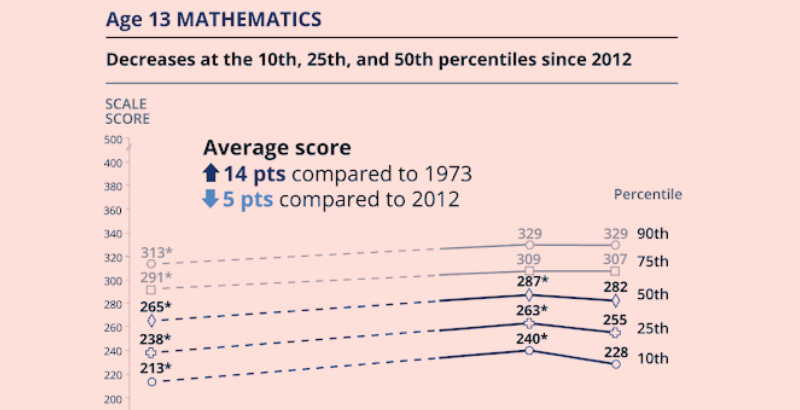
More ominous were the results for 13-year-olds, who experienced statistically significant drops of three and five points in reading and math, respectively. Compared with math performance in 2012, boys overall lost five points, and girls overall lost six points. Black students dropped eight points and Hispanic students four points; both decreases widened their score gap with white students, whose scores were statistically unchanged from 2012.
I notice the attempt to blame common core, but... Nobody ever actually implemented common core (No True Scotsman). The whole thing was completely messed up by educational corporations "buying" state boards of education.
Unfortunately it’s horribly spent. I wouldn’t mind testing a voucher program to see if that would add some innovation by letting parents choose how to spend the $13k allocated per their student. All spending instead is going to a snowballing administrative bureaucracy. Oh well.
America doesn't "track" students and teaches everybody. Other countries flush away the lower performing students to non-academic education as the years progress.
We see what this does even here in the US. Every charter school always manages to claim to be "cost effective"--except that they always manage to do this by effectively flushing the lower performing (read "expensive") students back to the public schools. When you force the charter schools to accept via lottery so they can't cherry pick only the decent students, their cost effectiveness vanishes.
And, by the way, the Gates Foundation actually had solid research about this from following several programs. For middle school age and below students, you need to spend roughly $15K per student (and that was 5+ years ago--so adjust upward), hold class sizes at about 15 students maximum, and have 2 adults in the room. This allows you to bring poorly performing students up to average over several years.
ALL of those programs were eventually cancelled for lack of money. Everybody wants "educational excellence" until somebody hands them the bill--then everybody pisses and moans about cost.
The only people who don't moan about cost are the upper class--they fund the hell out of the schools their kids go to. Funny that.
Also, you yourself provide explicit examples of de facto "tracking" in USA, just the separation is based on parents' financial means instead of educational attributes.
This study was about 13-year olds. Most countries "flush away" (thank you for using a gratuitously denigrating term here) their students after 13, not before.
Also don't forget that generally non science path are for the second rate students in europe, and the HES are generally also targeted to drop out students, and you get such results.
That particular test was funny as the students were arguing the course prepared them for another tests, yeah, correcting primary school level essay needs an actual course to find French mistakes. That tells everything on the so call great Swiss education.
Obviously there are a billion other things that could affect these scores, such as electronics or the general societal and technological trend (and I am as guilty as anyone) towards shorter attention span, lack of delayed gratification, etc.
I've been shocked to see how little interest the public schools have in educating students who are more advanced. We live in Menlo Park, and it's like pulling teeth to get the school to allow our daughter to do advanced math. Many families are leaving the public schools because of this, and we're considering our options as well. This is a sharp contrast to my experience growing up and going to public schools in Sacramento, where there were (and still are) many good options.
But at the school level, the principal has fought us every step of the way. He didn't even want to do a math assessment, which the district had promised. He literally did not want to find out what level our child is at. And the teacher has said that she does not wish for our child to learn any new math skills this year.
How do these people call themselves educators, when they aren't actually interested in educating students?
Reviewing 'Trend in NAEP long-term trend reading average scores for 9- and 13-year-old students', we see the score has fluctuated between 255 and 263 for fifty years.
What am I missing?
Is the data from the NCLB tests consistent with the NAEP results?
The decline in learning was astonishing. Many of these children simply did not do any reading at all for a whole year.
> The long-term assessment is a crucial piece of data for another reason: It was administered to students between October 2019 and March 2020, making it a final snapshot of academic trends before the emergence of COVID-19. Loveless said he hoped future analyses of how kids learned during and after the greatest disaster in K-12 history wouldn’t overlook the “deeper,” persistent stagnation that preceded it.
If testing for the 2019-2020 school year stopped rather than completed, then you've got a data problem because it's not clear that tested performance is independent of scheduling.
Also, even if the testing was all completed as scheduled, COVID-19 was on at least some student's minds throughout February, which could reduce test scores. It can be difficult to focus on testing when a not yet declared pandemic is starting up.
> The latest release comes from NAEP’s 2020 assessment of long-term trends, which was administered by the National Center for Education Statistics to nine- and 13-year-olds before COVID-19 first shuttered schools last spring.
Respectfully that is such a myopic argument that it is not even funny. If all one knows is how to press buttons to get some answers, one doesn't truly understand what one is doing.
Also, what if one doesn't have a calculator and needs to do some math? Or, do it quickly as a sibling comment made...
For example, say you need to do matrix multiplication. What's more important, knowing how to do it and when to apply it or meticulously doing the whole computation without a computer?
I chose this example because it's nothing more than a focus exercise and as the complexity increases, the chance of you making an error increases too. Most people know what multiplication and addition are but there would still be a high chance that they make small errors due to not paying attention.
On the other hand if you come across this problem, know that you need to do this now and let the computer do the operation you decrease the chance of such mistakes.
The same is true for many other concepts... What's more important, knowing every system call by heart or knowing how to look up their documentation? No, the important part is knowing what system calls are and when you might need them, for the rest it's just about looking up information.
The thing is, you can study a lot of things so that you can do them by heart and it's just an exercise of remembering. But if you grasp the logics of something or start seeing patterns etc. that's ultimately more valuable. It's true for learning a language too.. of course you can learn everything by heart but if there are certain logical rules for how certain words are built up, those are more important.
I'm talking about knowing the math and recognizing that I'm human.
> The long-term assessment is a crucial piece of data for another reason: It was administered to students between October 2019 and March 2020, making it a final snapshot of academic trends before the emergence of COVID-19.
It is very hard for most to take ownership of the fact that their child is a misbehaved little shit because they were raised from birth on iPad, YouTube and Fortnite instead of more enriching activities. Virtually everyone has a burned out dopamine loop at this point and it's impossible to get kids excited about education anymore. You want to talk about drug problems, this one is easily the worst.
Maybe it’s different where you live?
I see kids as overly exposed to dramatic information. Both of my kids thought they were gay prior to hitting puberty and realizing they weren't. Both of my kids have taken political extremist positions, one identifying as communist and the other identifying as a libertarian. Most of the children I know are participating in very adult discussions without giving any hint of their age. Children are exposed much earlier to sex and pornography and fringe groups.
In addition to this, reading and writing skills have anecdotally declined considerably. When I was 16, I read at least one book per month, usually one per week. Most of the children I've had experience with will never read a book unless ordered to, and have no desire to read one either. Children are unable to write coherently; they pump out barely understandable slang prose, throw it through grammarly, and assume that it's good.
Hell, for one other anecdote, my wife is in college right now and I've been reading her peers' essays for English and History class and I can't imagine how these people are capable of operating in society with their absolute bottom of the barrel writing ability. Professors are having to give passing grades to what could be considered 6th grade writing levels in order to not fail the entire class.
Maybe things were the same when I was a child and I just wasn't exposed to it, but I don't have a lot of hope in the education of the future generations with access to social media. I do feel a lot of job security, however.
http://archive.today/2021.10.14-112558/https://www.washingto...
Also regarding the rate of book reading - could it be that your childhood was not the norm? I too read a lot, but I was the only one on the school bus home who did, and it was so remarkable I was picked on for it. And complaining about a lack of book reading could be like lamenting we aren't all reading the newspaper anymore either - does that mean our reading and writing is worse? Is the general essay writing of this decade actually provably that much worse than a decade or three ago? Is the general population actually less literate or can we not remember decades past?
I'm not saying you're entirely wrong, but there's some "old man yells at cloud" vibes here too.
I am limited in my ability to only experience my immediate surroundings, and statistics are limited by sample sizes, bias, and reporting techniques. I can tell you, however, that the children I have direct experience with are generally worse at writing, reading, focus, and the ability to troubleshoot and critically think.
It is difficult to make comparisons to childhoods other than my own experience, but I was not an exceptional child. I made poor grades in high school and college, and was generally considered average in most subjects, and yet when I compare my skills and abilities at a similar age to the children I see now (most who are in exceptional private schools), I feel as though my toolbox was much more robust.
Granted, I was not nearly as good at memes and youtube and online social etiquette as children are these days. They are still learning quite a bit. I just worry that what they are learning does not prepare them to live a life in which they have to participate in society.