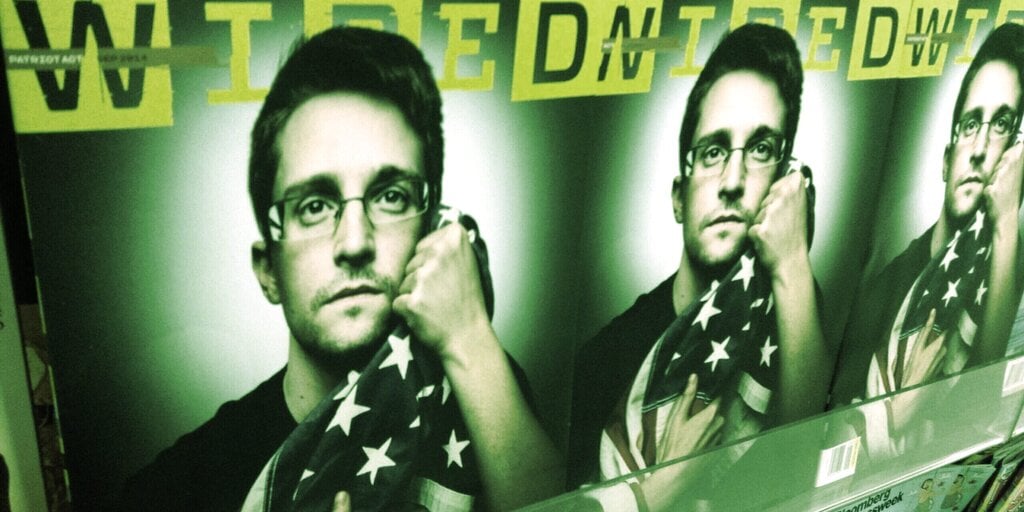
Edward Snowden Slams Sam Altman's Worldcoin: 'Don't Catalogue Eyeballs' - Decrypt
Privacy advocate Edward Snowden took to Twitter to criticize Worldcoin's retinal scan global crypto plans.
Decrypt
547 points · by beambot · 5y ago · 298 comments
Here's my take on it: You can possibly replace their biometric device with a random hash generator.
* If it works, it means the currency is not fairly distributed, but anyone sending valid hashes to their network is issued tokens, irrespective of whether the eyeballs described by those hashes exist. This is called a Sybil attack.
* If it doesn't work, it means there is some secret or centralized check that the network performs, which means the currency is not open.
This is why we still use proof-of-work in spite of its energy expense: it is simple to understand, it can not be faked, and it can be openly verified.
So, do not support this biometric-gathering enterprise.
Only losers will provide their real retinas. Smart players will obviously game the system and then dump the shitcoin on yet another group of losers.
Have you seen who they are going after?
> In order to test this model and technology, we have onboarded twenty-five Operators that run more than thirty devices in twelve countries across four continents (Africa, South America, Europe and Asia).
> To illustrate the success and potential of these Operators, we will dive deeper into the operations from the following five countries: Chile, Kenya, Indonesia, Sudan and France.
This is sickening.
Unlimited money!
Then again, even PoW coins with no premine can be unfair if most of the long-term supply gets distributed in just the first few years, leaving only crumbs for late adopters.
It's "fair" if you're referring to equal opportunity, not equal outcomes.
Most public places used to have bathrooms which anyone could walk into but no one could easily roll into on a wheelchair. That was equal opportunity.
Nowadays many places have been mandated to have bathrooms such that anyone who uses the space can access a bathroom without difficulty. That is an enforced equal outcome.
Which is the correct approach?
Imagine if half of all gold on earth was already mined in the first 4 years (and over 99% in the first 27 years) of gold mining millenia ago.
Fairness and equality are different. Imagine 2 people of different heights who can't see over a wall - equality is giving them both a ladder of exactly the same height even if that means just the tallest person can now see over the wall, while fairness is giving them each potentially different height ladders so they can both see over the wall.
The PoW equivalent (not factoring in premine) would be to give the first person the tallest ladder, and each successive person vanishingly small ladders, which doesn't really come under fair or equal. PoW with premine puts you in front of the wall so you don't need a ladder, plus it gives you a pile of ladders which you can sell to the people behind the wall, and maybe even some bricks so you can arbitrarily make the wall higher if you want.
The number of early adopters with “diamond hands”, as they say, who resisted the temptation to sell at $2, $10, $100, … is vanishingly small. History is littered with early adopters who bailed out. Everyone has had years of opportunity to buy into Bitcoin at a fraction of its current value, and if the gamble pays off then people can currently buy Bitcoin at a fraction of its presumptive future value. There’s no unfairness here.
Everyone has had equal access the entire time, and Bitcoin people have been doing their best to get as many people onboarded as possible so they’re not left with “crumbs” after a monetary transition.
Of course, it’s not totally unreasonable to have believed that Bitcoin wasn’t going to work out, but in that case people have no grounds to complain about unfairness - they simply made a wrong choice (by current appearances).
Making money by buying and selling bitcoin is zero sum. People are only making money because other people are losing out. There is no possible way that everyone buys bitcoins and gets rich from it. Bitcoins depends on the existence of rubes and the continual expansion of the pyramid to make money for "investors".
I weep daily for my zombie coins.
I'm certainly not defending any of this … however, it should be noted that "creators can allocate arbitrary amounts to themselves" is a typical thing even in regulated markets. Notice how Trump's new social media became a public company through a SPAC? The man behind that move has two degrees from MIT.
If you want to go down that rabbit hole, go for it. But people become very wealthy, very fast, via allocating "arbitrary amounts to themselves" even in regulated markets. Financial shenanigans.
If you haven't heard of the $100 million deli in New Jersey, feel free to Google that one.
Orbs will be remotely monitored and compared to other Orbs. Such monitoring is based on non-biometric metadata from the Orb, including battery level, temperature, and network strength. Anomalies will be flagged and lead to Orbs being deactivated. This anomaly detection happens in the cloud and therefore comes with higher security guarantees than device-level spoof and tamper detection.
It's a stupid idea. You can appreciate it's simplicity and how everything fits together like puzzle pieces, but it is ultimately a stupid idea because it lives in the real world and has predictable real world consequences.
High energy use in itself is not the issue, it's CO2 emissions. Energy can be locally abundant, renewable, yet remote, hard to transport to civilization. That would be an idealistic example of sustainable mining. Bitcoin mining isn't fully at that level of sustainability yet, but it's a solvable problem.
Bitcoin isn't for rich people. It's for all people. It's highly popular in deeply inflationary regimes, amidst refugees and particular immigrants. The fastest growth in Bitcoin addresses for years has come from the African continent.
No it's not.
These sorts of arguments fundamentally misunderstand the Sisyphean design of Bitcoin's proof-of-work algorithm: difficulty is scaled to absorb any changes in hash power, and expending hash power is rewarded with a chance of minting coins and/or collecting fees.
Bitcoin could be made sustainable and clean today, with no extra infrastructure, no optimised hardware, no new solar panel breakthrough, etc.: miners simply have to turn off their equipment, then difficulty will adjust downwards, and Bitcoin would become efficient enough to run off a solar-powered RaspberryPi.
That won't happen; and for exactly the same reason miners won't stop burning cheap fossil fuels as well as diverting as much renewable power as they can away from useful projects like electrified transport, desalination, aluminium smelting, HVAC, etc.
I could be wrong, but isn't this because distribution of 'free' worldcoin is centralized? Meaning you can create identities on the network that may or may not be tied to a real person's eyeballs, but that identity only gets free Worldcoin if scanned by lets say an Approved™ Orb scanner operated by an Approved™ Orb operator, who is (presumably) verifying that the orb is scanning real humans only.
This is basically Yet Another Shitcoin With Airdrop, but with some effort to try and control 1 human adopter = 1 free coin in the airdrop.
Regardless, that doesn't imply that the network is centralized / controlled, just the distribution of the initial 8 billion worldcoins is (philosophically, you might say that the centralization of the initial distribution of coins means that the network is effectively not decentralized, but presumably the network is running similar code as any other blockchain).
And why should CPUs get the vote?
I wonder if the NSA is one of their investors?
Justifying the use of proof-of-work appears to be a fallacy of relevance though
You need a form of scarcity to prevent a Sybil attack. Solved cryptographic puzzles of an adjustable difficulty is one such form of scarcity.
Does this address your concern about relevance?
How is it irrelevant?
The concept is simple: give everybody an equal amount of coins. You need a unique identifier / derivative of it
What prevents anyone from mass-generating unique identifiers?
First, retina scanning output hash is deterministic - it is supposed to generate the same result for the same eyeball. So it can't be replaced with random number generation.
Second, network does not interpret hashes, except for making sure that single hash is awarded funds only ones. Network however pays attention to whom is sending the hashes. It must be "legitimate" Orb units, likely considered to be legitimate because their public keys were whitelisted.
Third, process of distribution of initial tokens is obviously NOT OPEN. You need a "legitimate" Orb unit to participate. Which has nothing to do with how the network will behave for users already on-boarded.
Fourth, PoW has nothing to do with it. PoW is antisybil for people who might add new blocks. PoW has nothing to do with people who just want to transfer or hold funds. Or even with people who can create money according to network rules.
His argument is valid, what stops you from replacing the retina scan with a random hash replicating a different person scanning each time and collecting new tokens? What ties the hash to the actual retina other than the device that you can mess with?
or leaked
Admittedly I never bothered to read about it but the problem they are solving is purely the distribution. Currently there's just no way to do a fair distribution where everyone gets equivalent amounts of it except perhaps with KYC but then they have to store way more personal data.
I'm much more comfortable with someone having a hash based on my biometric data than having my passport and other details.
Same here. My point is - fair distribution is just a means to achieve a goal of "more equality". As a mean it is an equivalent of giving man a fish instead of teaching him how to fish. At most a PR stunt.
Actually, the lowest state of the art false positive rates for biometric id is achieved by iris scans, so I have to wonder why they went with retinal scanning in this case.
Note that I'm not saying you can intentionally cause a false positive or false negative very easily. These are both highly reliable identification methods. But they're not deterministic, so if you're hashing the literal scanned signature, the hash output won't be deterministic, either. Presumably, what they're doing isn't hashing at all. Normally, for biometric id you just store the signature in a database and use a thresholding function to match against it when new scans comes in.
They didn't. It's an iris scan. The article just used "retina" and "iris" interchangeably for some reason. https://worldcoin.org/how-it-works
I don’t know much about retinal scanning. But for this use case, wouldn’t it be trivial to fake via something like different coloured contact lenses?
So the distribution seems completely centralized. A central authority distributes the coins however they wish.
Today they might use a process involving eye scans. Or maybe not. There is no way to check. Tomorrow they might change their approach however they like. And we would have no way of knowing.
The issue that seems to be overlooked is that there is no way to look at a hash and decide if it was created via scanning an eye. The hash is signed via some key that - according to the makers of WC - sits in an eye scanning device which behaves a certain way. But we have no way of checking that.
It includes a projection graph that has a scale in 500m user increments and 2 years. Then you have the real data: over 6 months they've signed up 120k users. Or to put it another way - their real data doesn't even appear on the scale that their projections are displayed. They've basically extrpolated from 0 to 1.5bn. Oh and the graph lists sign ups per orb as if manufacturing the orbs is the limiting factor for signing people up to your shitcoin.
It also claims they're going to give out thousands of these orbs. But these orbs are the trusted hardware devices for generating unique hashes from biometric data. So if 1 of these thousands of devices falls into the hands of a hacker who can crack the hashing algo they're done. Not only will they have no guarantee that the users are unique, and probably they've also leaked huge amounts of biometric data. They actually mention this on their how it works page - don't worry guys, they'll make it hard to spoof! Honestly. It'll be tamper proof!
I kind of understand how you could try and argue that these devices are ok if you're going to have a small number of them extremely securely protected, but the plan is literally to manufacture 4,000 of these per month and hand them out to random people. Honestly, it's like they've just never had a conversation with someone who thinks critically about anything.
Having met Altman, "fluffy bunny" is not a too far off assessment.
Is there a word for knowingly becoming the villain because you've decided that the force of Moloch in civilization is unstoppable and if it's not you who uses your power to take control of something vulnerable and weak, someone else eventually will, and they might actually be malicious.
The regulation can take into account several factors to make the barrier for smaller projects not too high.
Except that making more rules doesn't actually remove social problems. You have to pay for judges, lawyers, courts and prisons; and the lives of rulebreakers get ruined. And the problem persists.
Engineers sign off on a building, if it falls hundreds could die. We don't do anything that grandiose usually, but sometimes software can have extreme impact on the world, and thus we should be prepared to consider the consequences of our actions thoroughly.
FYI this project (and basically every cryptocurrency project) already falls under some kind of financial regulation in most jurisdictions.
Similar to tax and accounting regulations, as you grow these regulations grow, too. For example you might need to provide risks and threats analyses for your technology.
You're liable to provide this information to the best of your ability given context (e.g., they wouldn't require a 30 page risk analysis from a indie hacker who has 20 users). If it turns out that you provided false information delibrately, or acted in bad faith, there are consequences like fines, bans, and so on.
Of course, based on your technology the government can prohbit you from bringing it to market, add constraints or require more info.
> sends eye-scanning Orbs (his name) to Africa to pump up the value of Altmanbucks that his team owns 20% of
I'm laughing now at how cartoonish this guy is, but might not be laughing later when my children must Surrender to the Orb to pay off their fathers' crypto-debts.
I understand what Sam is going for here (equitable distribution of wealth) but this is absolutely the wrong way to go about it.
Not for or against Worldcoin with this comment just saying there is likely a different motive.
So con artist and VCs created "crypto" where every con artist has there own money
When VCs hate it, it means it really, really good.
There's no such thing as the money supply. There are many currencies, each one with its own supply.
I doubt very much that the masses will be scanning their retinas into The Orb so that they can get Worldcoin, but these people are not going to stop coming for your retina, your DNA, even more of your digital fingerprints, etc. Sadly, they're eventually likely to get it all.
But now, I can see a clear line between the data we're collecting today and the data that would be that much more useful like DNA.
Not mine! But WTF, I'm just a paranoid weirdo.
If I have access to the data of 95% of people in a society, I have enough to model and predict behavior, and maybe even the hooks to inject information and influence future behavior.
The long tail of paranoid weirdos who spend all their time and energy fighting to maintain their privacy are irrelevant to the goal of societal domination.
SV elites have understood that you can wrangle money and control out of unsuspecting and uninformed consumers for decades. Which is exactly what they are doing here via. a new shitcoin; they get both control and money!
I'd say they are very much in touch with the real world.
Does the specific mechanism they're attempting to employ raise some concerns? Sure. Instead of the vitriol though, how about some suggestions for a better mechanism?
Trying to tear people down who pretty clearly seem to be making a good faith attempt to make the world a better place is reprehensible in my opinion. What does that say about you?
Also, >Trying to tear people down who pretty clearly seem to be making a good faith attempt to make the world a better place is reprehensible in my opinion.
Seriously? What an absurd notion. Oh hey, X attempt was in good faith! What a terrible person you are for criticizing it... Not to compare Altman with people like Lenin but I suppose that by this logic, one is bad for criticizing revolutionary demagogues because their hearts were always in the right place?
You should never let your minors or relatives or friends close to this app. If somehow they scanned their eye with this Blockchain app, it will stay.
Your personality and opinions may change but this will be a mistake you will always regret.
This seems like a solution to a problem that isn't really a solution.
2) currently some countries planning/want to implement covid check-in at every place you wanna enter
3) and now you have to worry that some private company want to make a modern fingerprint (irisprint?) that most likely is going to be used to at least another way of ad tracking.
However with 3) you won't be able to easily protect yourself - you cannot change eyeballs. Maybe you will have to wear some special contact lenses.
- Iris scans have false positives at scale
- You can have eye surgery changing your iris
- Cheap scanners can be fooled by photos, so you'd need to require live-tissue scanners which are really expensive
Apart from the arguable concept itself, I'm genuinely wondering why betting on yet another scanning device, instead of using fingerprint scan, which is now available on most smartphones ?
Is it that much more reliable that it's worth going through the pain of engineering a new hardware ?
Finally, how they could expect any other reactions than doubt, fear, and reject, out of this solution, while fingerprint and face detection already go through so much ethical issues ?
It looks to me like they're targeting people who are not as concerned or thoughtful about such issues.
Could Altman perhaps sit down and fucking program something himself? Show us your code.
That or orb-owners will just set up a booth in poor areas of the world and give people cash for a scan, pocketing the distributions forever.
From the article: "We use the open-source Semaphore[19] zero-knowledge proof system to transfer the uniqueness of IrisHashes to the uniqueness of user accounts, without linking them."
Now, of course, one needs to trust that Worldcoin is actually doing what they say they are doing, but that is a different discussion.
Edit: I see now that they are saving this data during field testing. But it looks to me that the long term plan is to use ZK crypto to unlink the hash from the account. Snowden's "hot take" ignores this.
https://semaphore.appliedzkp.org/ https://z.cash/technology/zksnarks/
See this page: https://worldcoin.org/privacy-during-field-testing
We collect the following data through the Orb after the user gives us their consent: Images of users’ body, face, and eyes, including users’ irises (visible, near infrared and far infrared spectrum) Three-dimensional mapping of users’ body and face
If their system were hacked or misused by authoritarian governments, the damage would be huge. And they're basically telling the world "trust us, we'll figure it out" without proving they can do it.
The risks as I see it are authoritarian governments figuring out the tech and using it. Or compelling Worldcoin to do their bidding.
Storing hashes in itself doesn't seem like it can be abused. Suppose Worldcoin has a database of a billion hashes, then an authoritarian government decides to compel Worldcoin for some nefarious purposes. What then? What bad stuff could happen?
Right, and that's a big part of the problem.
With all of the data abuse that the industry has already engaged in, it's silly to trust any company just because they say "trust us". Worldcoin has given no reason to trust them.
I guess if you want to be part of the new world currency you better not have any disabilities or disfigurements.
"“What’s in the case, Buschel?” Seersucker bunched in his fist, knuckles white and shaking.
“Damn it, Turner,” the man jerking free, the handle of the case clutched in both hands now. “They weren’t damaged. Only some minor abrasion on one of the corneas. They belong to the Net. It was in her contract, Turner.”"
Like other crypto projects, they misleading fit their data with the wrong curve. If you fit growth numbers with an S-curve instead of an exponential, you get results that are highly sensitive to noise in the initial data:
https://constancecrozier.com/2020/04/16/forecasting-s-curves...
This is why it will end up being the case that the actual number of users signed up for Worldcoin in 2 years was assigned a probability of ~0.00 by their growth model.
Still, there are so many ways this is bad, it's not even funny. Starting with the question of granting anyone without a retina access to the technology...
The scan is in no way tied to your account at any time.
Many of the comments here would be better informed by reading how this process works. There are issues to discuss, but a lot of what's in these threads has nothing to do with the actual workings of the project.
>We collect the following data through the Orb after the user gives us their consent: Images of users’ body, face, and eyes, including users’ irises (visible, near infrared and far infrared spectrum) Three-dimensional mapping of users’ body and face
I'm very doubtful about this. This process is either completely centralized (which means privacy is at risk), or not going to work properly.
My experience has been: the more you think about the Sybil problem, the harder it becomes.
Let’s ignore the fuzzy utopia talk and pretend that this is just a creepy plot to get a hash of every single person’s eyeballs.
What’s Sam’s next move?
What do you do when you have the hash of everyone’s eyes?
The same thing you do with everyone's Amazon purchase habits, porn watching habits, and their social media behaviour: sell it!
The only real question is to what end, and to be honest one need only look at the dystopia the CCP are creating with their survielence model in Xianjing to see how pernicious this all is when it's in the wrong hands.
You have entities hell bent on creating some sort of minority report type prediction system, though to be honest I think it's more like Psycho Pass at this point: one where their is a clear divide between classes of people and their obedience to the system, which I guess in this case would be 'the Orb.'
In psycho pass it's a sort of Hivemind of the most brilliant to the most violent members of society to try and predict any and all possible outcomes.
Silicon Valley tropes have bled into real life for far too long, be it wokeness, to the fomenting of discord via social media as a business model to sway elections (something intelligence agencies and political parties have clearly made use of) or create discord in Society and to be honest it's exactly why SV's influence has to be curbed. The honest answer to what they will do with the data is: we can't possibly know, and that's why it shouldn't be done.
Auroracoin was trying to achieve a UBI drop in Iceland as a response to the calamity from the 2008 financial crisis, with noble goals but failed in 2014, and while I think it is something that I think should warrant more focus from developers and VC money it's hard to envision how they completely bypassed how Microsoft's ION [1] has been working on ID on the Bitcoin blockchain for years they could have built on top of.
I'd normally lambast anything MS has done, but it's open source and operates over the most secure network, why are we allowing Altman and his YC/SV cronies to hi-jack the narrative that collectively those of us in this space have been working on trying to address this in a trust-less manner for nearly a decade?!
0: https://en.wikipedia.org/wiki/Auroracoin
1: https://topbitcoinbuyer.com/2021/03/26/microsoft-launches-id...
If your wallet is unique to your person (eyeball) and the public key is ever leaked, everyone can see your account balance and transactions.
Would that be the case or am I missing something?
The device itself is likely tamper resistant, has built in DRM and will have a high fidelity camera + signal processor. So you will need a system to write a 200MP image on the surface the size of an eye ball.
Also, since the light passes through a lens in your eye, there are probably optical tricks that can validate the surface is curved like a retina and has been distorted by a lens.
Oh yeah. And the vascularization of the retina means that you can view heart rate pulses. So your image will need to pulsate too.
One could also imagine marrying this with a stereoscopic camera to image detect that a real face is. It could even ask you to smile or frown to validate it's a real face.
Lots of ways to harden this technology to the point where even intelligence agencies would struggle to defeat it.
Even without the Demolition Man scenario, an even worse issue is that you can't change your biometrics in case somebody steals them. Fake fingerprints are already easy to do, other things surely can be cloned, too.
Those are scenarios that biometrics are handling really well.
Biometrics against sophisticated attackers is not good idea. I don't encounter in my life "sophisticated attackers" that would spend time making copy of my fingerprint.
If you are person that has risk of running into sophisticated attackers then don't use biometrics and biometrics are bad idea.
For convenient security you want just enough complexity a bot wont automatically unlock it, for proper security something that can be even a bit unconvenient as long as it's more secure.
I agree, biometrics should probably be in the "breakable, convenient" category.
Personally, I don't see any reason to make overly easy for any of those parties. So no biometrical data to be exchanged for some new form dogecoin.
Don't underestimate the lenghts some people will go through for a harmless prank. But you are probably correct a modern phone's fingperprint-reader is probably not fooled by an etched stick of gummibear.
Incidentally - I always wanted to have a device that you could stick your finger into, that would use a, let's say, laser to etch different fingerprints onto the tip of my finger.
IIRC there was an attack that was able to get past the liveliness checks by putting the fingerprint replica (a thin piece of dried elmers glue) onto a real finger.
The sensible approaches for biometrics use them to unlock strong keys which never leave the device. If implemented correctly, this is somewhat resistant to offline brute-force attacks — certainly not impossible but not economical for going after most people.
In truth I have seen this done to mess with people using cellotape and creativity, so I have to warn you this is not a reasonable assumption.
> Biometrics against sophisticated attackers is not good idea. I don't encounter in my life "sophisticated attackers" that would spend time making copy of my fingerprint.
You don’t yet, but we’re talking about a new form of currency in this thread, not unlocking your phone to text your spouse or show your kids a youtube video.
Money is power, which will draw in sophisticated attackers who want to amass more of both.
I know a few kids and coworkers who absolutely would, if it would get a laugh.
Some people would set their pin the same as their debit card just to remember one number instead of multiple.
That is why finger print unlocking is quite great for day to day use.
Of course it is not enough for more complex security scenarios, but as someone else mentioned lock on my doors is quite easy to pick but still it is good enough for most of people.
But seriously, damn are this the best we can come up with other than captchas good lord so dystopian
Same with intentionally vague headlines. One this morning was "Why you should avoid this large European country after latest CDC update". It's a great signal that the article is full of fluff wording and unlikely to add useful additional insight and if I really care I should go check the CDC news bulletins for the actual news.