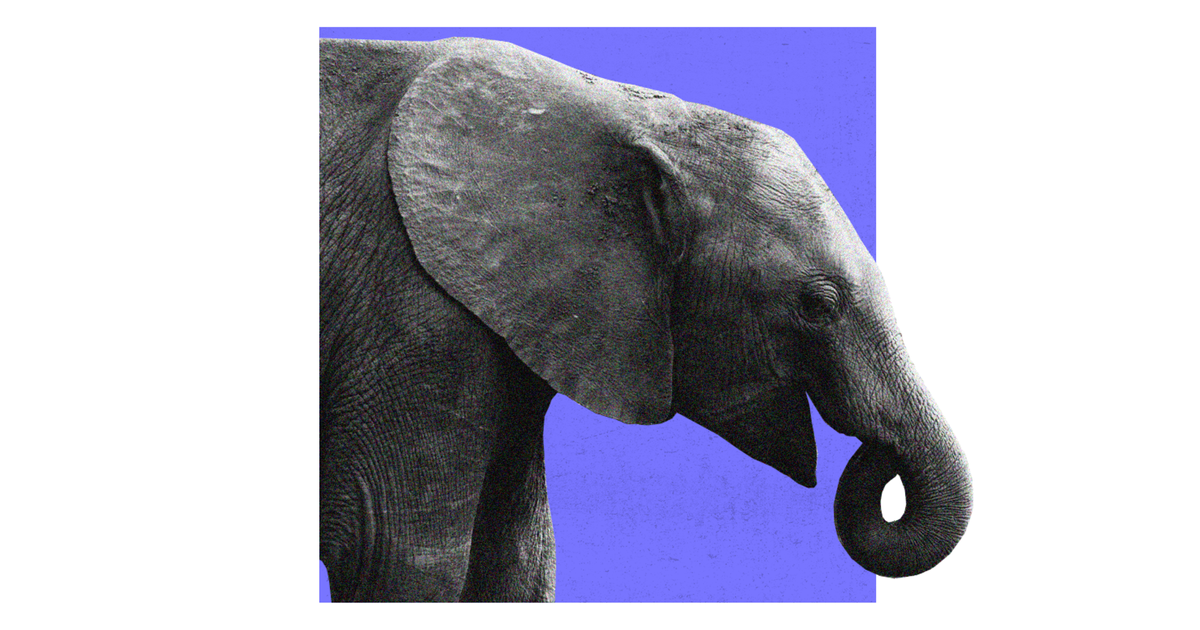
Female African Elephants Are Evolving Without Tusks Due to Ivory Poaching
Not having a tusk changes the anatomy and behavior of female elephants, disrupting the ecosystem. For male elephants, it can be fatal.
theswaddle.com
512 points · by amrrs · 5y ago · 298 comments
So it's a significant change, but it's not like this property was coming out of nowhere. It started off about as common as humans having green eyes.
Elephant poaching has been around since long before the Mozambique civil war. The number of tuskless elephants may have been at 2-4% prior to the war, but that doesn't mean that lower levels of poaching didn't push it up to that level from some much lower naturally-occurring level.
2-4% seems like a _very high_ rate for a trait that could negatively impact a female's chance of survival AND kills 100% of her male offspring.
When I think of selective breeding I think of humans picking out which animals (cows/dogs/wheat/etc) get to reproduce.
"They identified two likely genes AMELX and MEP1a, which are passed from mothers to the offspring on the X chromosome. But if a disrupted gene is passed in a male elephant, the elephant dies; the female elephant would instead evolve to be born without tusks. "
What would be the effect of this on male elephant population when taken to the limit (i.e. 100% of females are tuskless)? Seems to me that it'd skew the proportion of births towards 2:1 (assuming it's now at 1:1)? How significant impact would that have to the species as a whole?
So while a tuskless female may generate 2:1 females to males, that's (hopefully, depending on poaching) far from a stable birth ratio for the population, though active poaching may cause the female to male ratio for living specimens can be further skewed much higher than 2:1.
Later on they mention that if this genetic trait gets passed on to males, they die. So along with hunting, males are doubly at risk.
It may be advantageous for the survival of an individual to be born without tusks, but it doesn't sound too good for the survival of the species.
I ask because it’s not a change in the genetic structure of elephants. It’s an existing trait becoming more wide spread.
Like others said, it's evolution + natural selection. In this case the evolution part came long ago and now natural selection is making it more prevalent.
-- 18.5% of females were tuskless before the war
-- 50.9% of females were tuskless after the war
-- 33% of females were tuskless in the first post-war generation
Of the offspring:
-- 8.7% of females born to two-tusked females were two-tusked
-- 44.7% of females born to tuskless females were tuskless
It makes me suspect there's something else going on here that's not just good old natural selection.
Have they done any tracking to confirm the tuskless elephants are actually being born to tuskless mothers? Or could it be that the parents are actually affecting the way their offspring are born in some lamarckian-esque sense? If there'd be some trick animals can pull to change their offspring in some ways, that ought to be highly effective for long term species survival and should thus be highly selected for.
If a new predator is introduced to a population that selectively kills only certain traits, that mutation can become dominant in the population within just one or two generations.
Imagine if aliens came to Earth and killed everyone over 5'6" tall. That "evolution" would be essentially instantaneous.
I think it is ridiculous to think that more elephant are born without tusks as a kind of "random selection" or even adaption
I imagine the poaching process doesn't actually differentiate tusked and tuskless elephants, both types of elephants would fall into the trap and die? And then if it has tusks the poachers take them, if it doesn't have tusks the poachers just abandon the dead elephant?
Or does their trap actually trap them by the tusk?
The poacher could always hang around near the trap, but if you're doing that you might as well just shoot the elephant, not trap it.
Edit: I found an article[0] describing some poaching methods and apparently they do use traps! Including snares and a spiked board. But that it appears homemade shotguns and rifles are the most common method.
[0] http://www.open-earth.org/document/natureR_main.php?natureId...
Are 100% of tusked females giving birth to 32% of the newborns without a tusk?
What % of tuskless females give birth to tusked females?
By killing elephants with tusks the poachers are favoring elephants with the no-tusk gene.
This isn't a lot different than killing a dog that bites sheep, which is how we bred herding dogs. Or a wolf that eats your baby, which is how we domesticated dogs.
This trait already existed so it certainly wasn't "engineered due to mass poaching for ivory" as claimed.
In my humble opinion "evolution" refers to speciation, which takes very many generations.
> Evolution is defined as the change in the inherited traits of a population of organisms through successive generations… When particular genetic sequences change in a population (e.g., via mutation) and these changes are inherited across successive generations, this is the stuff of evolution… One can distinguish between two general classes of evolutionary change: microevolution (change below the level of the species) and macroevolution (change above the level of the species)… These [micro-evolutionary] processes can, but do not necessarily, lead to the formation of new species over time but instead result in fluctuating frequencies of traits within populations tracking ever-changing selective pressures.
https://www.nature.com/scitable/knowledge/library/evolution-...
This is artificial selection. When it occurs naturally, it's called Natural selection & it's the basis of evolution. The mechanism of both artificial and natural selection is the same -- increase of a trait in the population by selecting only animals with that trait to reproduce. Speciation is merely a result of this process.
Btw the pulitzer winning book "The beak of the finch" discusses how evolution actually doesn't need many generations to happen. What it needs is selection pressure -- events (such as severe draught) that force natural selection to happen within a handful of generations. It's a fascinating book on a fascinating study.
They 'evolved' into their present forms because they were forced/accelerated by the hand of humans through selective breeding.
"Is this a rectangle or just a square?" "A square IS a rectangle."
"Selective breeding" is a term used when humans engineer species on purpose. In this case it's the opposite actually, elephants are adapting to survive poachers. Selective breeding would be if poachers started raising tusked elephants in farms.
Was it "selective breeding" when MRSA arose due to our use of antibiotics?
Which makes it eligible for "Natural Selection"
Interestingly enough, there was a creature that very much looks like a unicorn, but it is a rhinoceros and not an equine.
> There are wild elephants in the country, and numerous unicorns, which are very nearly as big. They have hair like that of a buffalo, feet like those of an elephant, and a horn in the middle of the forehead, which is black and very thick. They do no mischief, however, with the horn, but with the tongue alone; for this is covered all over with long and strong prickles and when savage with any one they crush him under their knees and then rasp him with their tongue. The head resembles that of a wild boar, and they carry it ever bent towards the ground. They delight much to abide in mire and mud. 'Tis a passing ugly beast to look upon, and is not in the least like that which our stories tell of as being caught in the lap of a virgin; in fact, 'tis altogether different from what we fancied
- Macro Polo
https://en.wikisource.org/wiki/The_Travels_of_Marco_Polo/Boo...
They're hunted for their horns too...
https://en.wikipedia.org/wiki/Rhinoceros#Ways_to_prevent_poa...
If they were hunted then there might be a cultural record as well.
Source: https://www.google.com/search?q=shel+silverstein+unicorn
How is this ironic? Most cultures have prized animal products throughout recorded history, and many have practiced sacrifices, which is literally the killing of the being.
Plus, there are people out there who sincerely believe that Ivory works as an ingredient in medicine and they will seek it out.
But a lot of people want to/need-to "signal themselves".
Which reminds me, I'm not sure why cops don't try to move fake ivory into black markets, have sting operations where once they catch a dealer, instead of arresting them, force them to sell their fake ivory, undercut the market enough that poachers have incentive.
Probably China isn't that concerned about the problem.
Synthetic ivory is ivory.
You don't need natural imperfections.
Multiplication is a bitch.
People suck.
https://www.africanexponent.com/post/4981-civil-war-in-mozam...
All the planet needs is the short incoming fever.
Some elephants are born without tusks and live much longer.
Natural mating between tuskless elephants will dramatically increase.
This will result in the trait being propagated rapidly.
Another comment by Stevvo mentioned
> ... a trait that could negatively impact a female's chance of survival AND kills 100% of her male offspring.
If not, I imagine the only reasonable thing to do would be to educate and raise awareness on the catastrophic impact poaching has on the elephant species as a whole.
The biggest issue is that elephants cannot be profitably raised in captivity - they require too much food, too much space, and take too long to produce tusks.
...and if you allow them to roam in reserves, then poachers shoot them. I do wonder if it might work in another part of the world that could offer better security for large elephant reserves, without them impacting the native habitat.
It has also been tried with tusks obtained by elephants that naturally died, and that program failed due to smugglers bribing officials to insert poached ivory into the auctions [0].
[0] https://www.washingtonpost.com/news/energy-environment/wp/20...
I think the underlying issue is that demand is so high that there wouldn't be anywhere on Earth that could produce enough to stop cheap poaching in Africa, so it's easier to simply ban the trade entirely.
Maybe there's an opportunity for lab-grown ivory? [1]
[1] https://cen.acs.org/articles/96/i4/synthetic-horns-tusks-off...
There's also other species that have comparable bones. Supposedly, the melting permafrost is drowning the ivory market with mammoth ivory (which somehow is a cheap counterfeit, not an awesome curiosity): https://www.wired.co.uk/article/mammoth-tusk-hunters-russia-...
I kid. I kid. Obviously, injection-molded plastic is bad for the environment, regardless of its history as an "ethical source of ivory."
It's difficult to keep ethics out of discussions when facing the reality of life: that there is a massive amount of death and suffering, and it's a terrifying thing we're all forced into, including these elephants.
We have long had a culture where men prefer mates that are shorter than them, and women prefer mates that are taller. This results in constant pressure on the pool resulting in men being on average taller than women. Will this change over time as we outgrow this rather primitive preference? (Sadly, even many feminist women have clung to this preference.) Not all species "prefer" that the male is bigger or stronger than the female.
An obvious one is our reliance on modern medical technology, and drugs in particular. Are our bodies becoming less able to fend off disease?
The most important one for me is the balance between those genes that give us our selfishness and those that give us empathy and love. What impact does an ever more individualistic culture and an economic system that defines selfishness as a virtue have on our gene pool?
This is in contrast to the actual explanation, which is simply that if you kill the elephants with the tusks alleles and prevent them from breeding, you'll have fewer of those alleles in the subsequent generations.
I'd say this result is not so "deceiving," as someone who has prepared evolution curriculum in the past, the teleological explanation is extremely seductive, even for educated people.
This is more like dog breeding than about nature fighting back.
Yes, this is natural selection, the process through which evolution happens.
The poachers aren't selectively breeding for elephants without tusks. Quite the opposite. You are correct that it's a tautology - the elephants remaining are the ones without tusks - but that's exactly how natural selection works.
Yes they are, that is exactly what they are doing.
There is nothing natural about it. It wouldn't happen if not for the poachers.
I feel like I don't really know enough about the specifics of natural selection or evolution to have a strong opinion on this.
The poaching is definitely not natural, so it feels like this is not natural selection.
On the other hand, no one is deliberately breeding for this in any way, it's purely a side effect of these circumstances, which does feel more natural.
You could just view the poachers as an environmental hazard to tusked elephants, in which case this would be a perfect example of natural selection.
I expect that selective breeding could yield elephants that produce large amounts of ivory continuously. Elephant generation time is a minimum of 11 years (2 years gestation and 9 years for females to reach sexual maturity). The project would take many years.
Other animals produce ivory. Common warthog has a 2-year generation time. Hippo is 7 years. Walrus is 6 years. Narwhal is 7 years.
So, there was a change in the genes, but how do they connect this fact with poaching? I don’t see the relation. Surely, elephants themselves, cannot decide to change their genetics as a reaction to poaching.
The blond hair allele is recessive and can be hidden. Two brown-haired parents can have a blond child.
Poachers kill elephants for their tusks. A poacher won't kill an elephant with partially formed or no tusks, as it has no value to them. This allows elephants with the tuskless gene to survive and eventually reproduce where other elephants would not.
*) Humans are putting the pressure.
**) Are killed by poachers.
So the elephants aren't reacting to poaching -- the "reaction" is a random mutation that happens to align with external pressures, causing a shift in genetics for the population.
Not an idea i deeply hold as a truth, but fun to think about, and science doesn't expand by believing we've got it all figured out.
This interpretation of evolution is a myth that needs to be busted. Nothing is being "engineered". What is happening is simply: no tusks is an advantage. That is, no tusks means less likely to be hunted / killed.
As a result, the tusk genes in the gene pool are less available. The no-tusks genes more.
In short, and ultra-simplified, evolution is reactive.
Also, i imagine elephants have long gestation periods and live longer than say your average single cell organism. Meaning the "evolution cycle" if you will, is much more drawn out..
This is only true if "we" have very little imagination.
This is exactly what happened with the tusk-less elephants.
It’s more selection than “evolution” but they work together.
Those with large tusks are shot dead and thus only tuskless remain. Not much different with breeding dogs for specific traits which is way faster process than evolution to adapt a species to the environment
https://www.sciencedaily.com/releases/2013/04/130409095414.h...
https://www.discovermagazine.com/the-sciences/rapid-evolutio...
Elephants without tusks are the ones “allowed” to breed.
I was always quite confused by the fact that most animals look quite nice but given these results I guess humans can extinguish the ugly and leave the beautiful.
It also demonstrates that human efforts to stop poaching have not been successful (otherwise this evolution wouldn’t happen), but luckily, nature responds.
If only humans were harvested for bony growths?
Incredible, good
The way I understand this there was likely a very small population of elephants already without tusks, maybe some kind of genetic defect that happened to be an advantage once you add greedy people into the mix. Or what else is possible is that there was one off mutation that produced small family of elephants that poachers wouldn't touch and these spread over decades.
Think about this, if today Covid mutated to kill almost all people but spared 0.1% with a certain gene, you would suddenly observe entire human population becoming immune to Covid.
This does not necessarily mean any new genetic material or "nature responding". Maybe nobody noticed the gene and it suddenly became very visible and comprising large part of population (while it declined dramatically as elephant population did). We may have missed elephants without tusks because they were just freak of nature but now they become proliferating because it becomes an advantage.
EDIT:
Selective pressure is part of evolution process, but it is not enough for evolution.
Evolution requires both mutation AND selection.
So, if the mutation was present BEFORE poachers happened, you can't really say that Mother Nature RESPONDED to poaching by evolving new mechanism. The word "response" implies causal relationship between poachers and mutation+selection of better equipped elephants. But if the mutation has already been present then there is no causal relationship and this wasn't a new mechanism.
But this is exactly how evolution works. There are always mutations in every generation, and sometimes those mutations are beneficial. These genes are being selected by the organism's environment, and if the environment changes, then the genes that are selected will be different. That is "nature responding". Elephants without tusks (or very small ones) are more likely to survive and produce offspring.
Genetic Drift is always occurring randomly. Some elephants had a "genetic defect" to live without tusks before poaching. Some humans had the 0.1% resistance to the hypothetical super-covid before the disease.
As new environmental conditions emerge (human poaching, hypothetical super-covid, etc), some genes are far better adapted to the new environment (tuskless, covid resistance, etc). Those genes then thrive in the new environment and consume the available resources left by those killed off.
That's not how evolution works. Evolution doesn't ever involve a "feat of nature suddenly evolving defense mechanisms".
I don't understand this comment, unless it's a way to say the above, that evolution does not involve sudden spontaneous changes in response to an external stimuli.
On a related note, if "ability to evolve" is a characteristic that can be selected for that would explain why all complex life uses sexual reproduction. Mixing genes offers such advantages that most everything that can't do it is still basically bacteria.
I wouldn't get too attached to that idea... in a lot of cases, having one gene responsible for producing a phenotype can be a very bad thing, like oncogenes (responsible for the growth of cancers) and a bunch that determine development and/or aging.
> On a related note, if "ability to evolve" is a characteristic that can be selected for that would explain why all complex life uses sexual reproduction. Mixing genes offers such advantages that most everything that can't do it is still basically bacteria.
Again, sometimes. There are lizards and bugs that clone themselves (parthanogenesis) which can be really handy for when the population isn't doing so hot.
From the article, it sounds like this may have protected them from human predation, but there may be significant long-term negative impacts on the species due to the lack of viable male offspring.
Survive more easily for a couple generations, but go extinct as an all-female species after a couple more...
For instance, most responses to murder are natural in exactly the same sense that murder is natural. Things like a legal system and imprisonment are sophisticated group responses to murder, but they aren't somehow separate from our nature because of that, they are part of it.