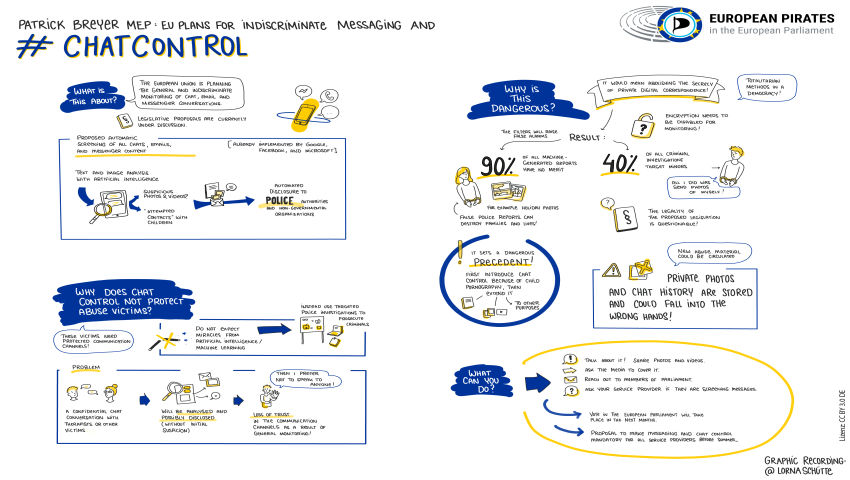
#Chatcontrol Explained
The EU is planning to allow messenger and e-mail providers to indiscriminately scan and detect all private communication for suspicious content that might indicate child pornography or grooming. Th...
European Pirates
414 points · by nix23 · 5y ago · 197 comments
Without art or literature that draws out the terror I don't think most people can really envisage the danger we're all being put in. Without popular consciousness of the problem, it's all the more likely to happen.
People don't realize how deep the shit is becoming despite all these. We have successfully amused ourselves to death. (as per https://en.wikipedia.org/wiki/Amusing_Ourselves_to_Death )
Links:
I'd really like to simply reference a classic movie or book as a conversation ender every time this shit cropped up rather than explain abstract risks from scratch in a less than engaging fashion.
Anyway. This isnt a problem I can solve.
Links:
Even under totalitarian communist rule, the vast majority of population were not political prisoners.
Honestly, 1984 should be enough as it's not a big jump from 1984 telescreens to Google/Facebook.
Black Mirror is just an example. And the whole “social media ruined the life of this one unsuspecting person” plotline is pretty boring and on-the-nose by now.
"Yeah, I never did feel great about the time that old search engine company renamed themselves "Web", but I guess the name stuck"
"Slaughterbots" (https://www.youtube.com/watch?v=9fa9lVwHHqg) shows a terror angle for some of what technology can do (drones).
And, if he writes a screenplay about it that probably means it already happened.
However, it becomes scary when the people with access are much less level-headed. There are people who think gay people or watching porn should require treatment. There have been power changes where people with drastically different views have an agenda to push, and your innocuous "not really that bad" is all of a sudden an imprisonable offense because you "think differently" and you might encourage others.
This sounds like the nothing to hide, nothing to fear argument.
The history allows such a state to construct a narrative where everybody else thinks you're guilty, based on your messages and porn history and so on. Cherry-picking, quoting out of context, etc. This allows the state to legitimise their actions, where torture would fail to do so.
Make everyone fear each other.
It's only not about things that are incriminating. Suppose you were a witness to something nobody was supposed to know about and now you're to be disposed of.
If they have your message history, they have your full contact list, your relationships with them, who you trust the most, where you like to hang out, who owes you money or favors you could call in. You're completely isolated. For sure you can't use any kind of ATM or credit card or find work anywhere they'd expect you to provide a social security number.
How far can you get if you can't buy gas or travel tickets? What do you do for food?
I think it’s a bit unfair to ask someone to throw away their (assuming American) 5th Amendment rights to make a point.
To paint with a broad and nonspecific brush, the UK government has regular surveys asking about drug use[0] which show that in the year ending March 2020, 7.4% of young adults used a class A drug. Possession of that class carries a maximum penalty of 7 years and an unlimited fine, supply and production up to life and unlimited fine.
Even for more mundane things like road traffic laws, if they were fully enforced then the only people with licenses would be those who didn’t drive.
(And are your memes fully licensed from the original copyright holder?)
[0] https://www.ons.gov.uk/peoplepopulationandcommunity/crimeand...
Yep, I'm fucked :D
They were doing that exact thing to selected citizens. So did FBI for alleged communists.
Bugging apartments, planting their own spies, opening up private letters, etc.
It's the difference between being able to point a gun at a few inconvenient people, and being able to point it at everybody, all the time. Eventually the temptation presented by this kind of power and control over people will intersect with some Erdogan or Lukashenko type with the finger on the trigger.
But they couldn't do it to everyone. Now with computers they can. You might think 1984 was written as a warning, but the powers that be see it as an instruction manual.
Yup, they wouldn't even dream about that magnitude.
In the past the EU passed a directive that required all ISPs to save what websites you visited. This was overturned years later, but it seems now they're trying again through a different angle.
Edit: https://en.wikipedia.org/wiki/Data_Retention_Directive
a lot of people in germany, basically do not care they thing they do not have anything to hide (which is probably right) but there are so many crimes which are just done in front of everybody and nobody did care (cum ex, wirecard, just to name some). it's like once the rich or politicans are involved they start to care.
Some people have been working on an interesting solution called StampChat which has a similar topology to email, but the messages are encrypted by default and the spam mitigation is done via sending tokens to the recipient (ala Hal Finney's RPoW) idea.
It's still a prototype, but there is one deployment over here: https://web.stampchat.io
The whitepaper on the protocol is here: https://www.stampchat.io/whitepaper.pdf
There's a faucet here if anyone is interested https://faucet.lotuslounge.org/
We're not doing an ICO or anything, happy to give out more tokens out.
I think spam and abuse are definitely significant problems.
The centralized systems are like medieval walled cities.
They exist because, for an average individual, there is no practical way to live outside their walls.
It's difficult to run your own email server. But, while the technical challenge may be difficult, the greater difficulty is in preventing your email server from becoming a bot in a spam network.
As far as I can tell, no EU organ has actually published any actual proposal or recommendation to introduce such mandatory screening as described in the OP.
My guess is that the actual proposal, when it comes, will not include industrywide mandatory screening or breaking end-to-end encryption.
Otherwise, my opinion is that this would be either impossible to enforce or the cost to do so would outweigh the benefits in a massive way.
I find "pro-" or "anti-" Brussels to be a false dichotomy. You can be _for_ the existence of the EU, but be critical of how it works, of the proposals coming from one of its institutions, and actively participate in improving the organisation.
Which is exactly what this MEP is doing.
Well, Marcel Kolaja, who was voted from the Czech Pirate Party to the european parliament certainly comments on these things - like on an earlier round for this in July:
https://european-pirateparty.eu/parliament-approves-chatcont...
He is in generally pretty active also in other important topics such as content filters or gatekeepers and other stuff:
https://european-pirateparty.eu/tag/marcel-kolaja/
As for the Pirate Party being "pro Brussels" it rather seem to to that they are ready to get involved in EU matters & possibly improve things.
Other parties anti-EU rhetoric is often not very constructive and populist, especially if the EU calls then on their shady deals.
Basically none of their voting base (young adults, mostly) has any idea about the origin of the party. They were lured to the party because it supports green and social statist politics.
Note: I don't think statism in itself is wrong, but I don't like the particular kind of state they're pushing for. I think their goals could be accomplished by supporting people more directly e. g. by supporting independent social organizations, which I think would be more in line with the original pirate ideas.
However I must say that their latest program (for the parliamentary elections) was acceptable to me. But they're nearly (4/200) out of the parliament now.
They would like to form their own group, but they don't have enough pirates elected from enough countries yet to qualify. So they're stuck with going with the best option.
Besides, as long as greens and pirates share the same goal ... the'll work out the rest. This way the greens may move away from the anti nuclear stance quicker.
I think the Czech nuclear program is successful mostly thanks to Dana Drábová. Other countries need to find someone like her.
According to Wikipedia, the Pirates and Mayors group got 15.6% of the vote at the last election last month and has 37 seats. https://en.wikipedia.org/wiki/2021_Czech_legislative_electio...
Is that not correct?
The coalition agreement aimed to resolve this issue but failed.
Messaging and chat control - https://news.ycombinator.com/item?id=28115343 - Aug 2021 (317 comments)
via pvg, prof-dr-ir (thanks!):
EU Parliament approves mass surveillance of private communications - https://news.ycombinator.com/item?id=27759814 - July 2021 (11 comments)
European Parliament approves mass surveillance of private communication - https://news.ycombinator.com/item?id=27753727 - July 2021 (415 comments)
Indiscriminate messaging and chatcontrol: Last chance to protest - https://news.ycombinator.com/item?id=27736435 - July 2021 (104 comments)
IT companies warn in open letter: EU wants to ban encryption - https://news.ycombinator.com/item?id=26825653 - April 2021 (217 comments)
Others?
for a second I thought got one heckin chonker of a promotion
We need P2P to come back and fast and make this hard to impossible to do.
People with knowledge and resources can and should host their own email and IM servers, on their own hardware, on their own properties.
Want my emails or IMs? Get a warrant to enter my property physically and try to decrypt my disks.
So as an American, are there any Euros that can enlighten me on whether or not there remain any procedural hurdles left for this to clear? Or is this being implemented in Signal as we speak?
https://european-pirateparty.eu/parliament-approves-chatcont...
1. If Signal does implement something like this, are they under gag orders so wouldn't be able to inform users?
2. What if they simply don't comply? So long as they don't have an office in the EU, is there anything that could be done? Users could just side-load.
I would guess not. At least if you mean gag-orders as used in the US by NSA etc.
That's because this would be a law, and not a "friendly favor" asked for by the police. A law is at least under public scrutiny in contrast to fisa orders etc.
Another question is whether EU police already is issuing gag based surveillance orders today. I'd like to know the answer to that too.
Signal would be banned from European appstores/IPs.
> Users could just side-load.
Yes. But that can be illegal. And is an option for only a small part of the population.
The fight is not over, and resisting legislation like this in the past has provided results. I am hopeful.
and if they don't get it through this parliament they'll wait until the next one, and so on
and once it's passed: the parliament has no ability to alter or undo it
The article in your link ("Parliament approves chatcontrol") is also misleading. What was actually passed in July 2021 was a temporary 3-year restoration of pre-Dec-2020 rules that allow service providers to voluntarily scan for child abuse (news release: https://www.europarl.europa.eu/news/en/press-room/20210701IP... , actual legal text: https://eur-lex.europa.eu/legal-content/EN/TXT/?uri=celex%3A...). Dec 2020 privacy law changes would have otherwise prohibited voluntary scanning.
Considering how it is currently not very popular, I don't have high hopes that this video will last longer than it could be had it been posted on youtube. Nevertheless, this is a step in the right direction.
[1] - https://www.vultr.com/apps/nextcloud
[2] - https://www.linode.com/marketplace/apps/linode/nextcloud/
Instead of talking about pedophiles, they should talk about racists and far right extremists using chat platforms, that would rally a big part of the press in support:
> White supremacists openly organize racist violence on Telegram, report finds
https://edition.cnn.com/2020/06/26/tech/white-supremacists-t...
> Telegram: why right-wing extremists’ favorite new platform is so dangerous
https://www.vox.com/recode/22238755/telegram-messaging-socia...
> Neo-Nazi groups use Instagram to recruit young people, warns Hope Not Hate
https://www.theguardian.com/world/2021/mar/22/neo-nazi-group...
> How far right uses video games and tech to lure and radicalise teenage recruits
https://www.theguardian.com/world/2021/feb/14/how-far-right-...
> Revealed: walkie-talkie app Zello hosted far-right groups who stormed Capitol
https://www.theguardian.com/us-news/2021/jan/13/zello-app-us...
> The UK social media platform where neo-Nazis can view terror atrocities
https://www.theguardian.com/politics/2020/jun/28/the-uk-soci...
> Are Private Messaging Apps the Next Misinformation Hot Spot?
https://www.nytimes.com/2021/02/03/technology/personaltech/t...
> The Cybersecurity 202: Extremists flocking to encrypted apps could restart debate over law enforcement access
https://www.washingtonpost.com/politics/2021/01/13/cybersecu...
It's not been proposed, it's not being voted on, and it's not coming into force any time soon.
There are two things that have been proposed:
1. Adding a temporary exemption ('derogation') within privacy regulations to ensure online service providers can scan user data for CSAM if the provider so chooses without being in breach of GDPR. In the US and elsewhere, providers who wish to do were already doing this. This just provides a quick fix to avoid GDPR from shutting down existing service provider's own child protection programs. More details: https://www.europarl.europa.eu/legislative-train/theme-promo...
2. Asking the EU Commission to investigate and analyze possible proposals for longer-term legislative solutions to this issue, by defining more clearly what service providers options and obligations are with regard to CSAM, and proposing various other ways the EU could protect children from abuse offline & online.
The EU's summary of the overall process is at https://ec.europa.eu/home-affairs/policies/internal-security... (even more detail here: https://ec.europa.eu/home-affairs/system/files/2020-07/20200...). The details of the derogation regulations are at https://www.europarl.europa.eu/legislative-train/theme-promo..., and there's more detail on the commission's ongoing analysis to eventually define proposals here: https://ec.europa.eu/info/law/better-regulation/have-your-sa...
One _possibility_ is that the commission could propose legislation mandating scanning of all messages and AI to automatically search for grooming. Some parts of that legislative option are mentioned as ideas to be considered (see the "Inception impact assessment" PDF in the commissions analysis) alongside various other options. There's nothing suggesting that this is the leading option though. That PDF also makes detailed note of privacy concerns as topics to consider too, and the resulting public consultation on that specific assessment received a huge amount of feedback against such measures.
So far, there is no proposed legislation like what's described in this video. If there were, it's likely that there would be major public outcry, and there is no indication that it would pass.
It's possible the commission could propose this, but it's also very plausible that the commission proposes some other framework of obligations, which makes it clear when and how online services must scan for CSAM, without mandating searching of all private communications. For example, mandating CSAM scanning of publicly accessible content online, and mandating that private message providers include "report this message" tools to allow users to report otherwise inaccessible content by themselves.
Of course, there is always the possibility that the EU could veer away from privacy protections into being a totalitarian state, sure, but nobody is currently proposing legislation along those lines. There's a wide spectrum of reasonable possibilities on the table here that would be genuine improvements. There's no need to panic about the imminent death of privacy quite yet.
I would urge people to read the linked texts in your comment. I think they will see that it is entirely possible to follow the (imperfect) thought process of the EU Commission from these primary sources, since they are quite readable.
15 years ago the EU made this into law: https://en.wikipedia.org/wiki/Data_Retention_Directive
This eventually didn't hold up in court, but it pretty much shows where the Union has been on the privacy scale right from the start when it comes to governments doing the snooping.
Any idea why the Breyer makes it sound like this is something which is coming though? Or why he's even talking about it?
It's difficult, because I too would be very concerned about this issue, once there's actually a proposal to object to! I'm entirely on their side on this issue, if reality were as presented here, but campaigning against a strawman that might never be proposed whilst disingenuously implying that it's imminent feels a lot like fearmongering to me.
Frustratingly, it would be quite possible & useful to campaign against this with nuance instead: "the commission is considering proposals to better fight CSAM - have your say, make suggestions & help define tech solutions to do this while preserving privacy", rather than "the EU is going to destroy all privacy ASAP". And it's not like we're short on other genuine issues to campaign on either.
2. Intercept and scan all civilian communication
3. ???
4. Yellowstone explodes
Messaging and chat control - https://news.ycombinator.com/item?id=28115343 - Aug 2021 (317 comments)
More info: https://www.chatcontrol.eu
But something about speaking to a camera seems to make it easier for people to express their thoughts in a digestible way. I tend to find that, for many topics, some random 5-10 minute video of a person talking to the camera will tend to be more informative than some random 5-10 paragraph article.
The problem is, that we (as in, "not the rich and powerful") are not playing the game of democracy correctly.
Protesting to stop a bill passing is the "you f-ed up, so you're panicking, and maybe you'll stop it" move. If it keeps happening, it just means you did not learn your lesson.
What you should have been doing is actively fighting to set rules the way you want them. Both by electing the right people and, more importantly, actually, funding lobbying efforts.
Cite any reputable social science that says that democracy is an actual thing implemented in liberal democracies. Then we can take it from there.
> actually, funding lobbying efforts.
Billionaires and multi-millionaires will outspend your gofundme lobbying. It’s simple economics.
And no, the rich can't outspend the population, if the population realized what's happening.
Not only is 10USD/EUR per month times the entire population just an incredible amount of money ... it's way more effective.
Most damage from lobby happens because corporate lobbyist are the only ones there. Just one publicly funded lobbyist there to remind the decisions makers of what is right and prevent their ability to rationalize would make an incredible difference.
But you need to pay that person.
Maybe we should actively fight against the existence of lobby groups. The lobby groups in most cases push for legislation that is good for them (companies) and not for the people.
And it's not inherently a problem. It's not even slanted against the interests of the population. The only reason we have a problem is because "the rich and powerful" understand that this is how democracy works and everyone else ... wishes it was different.
The solution to just about all our problems is simple: stop wanting democracy to be something it isn't and start "using" it correctly - namely, realize that to HAVE power you need to SPEND money. And no, taxes ain't it.
The great thing is that "the people's" money is way more effective (i.e. it's more expansive to get politicians to do immoral acts than it is for them to do moral acts). Plus, we have more of it (10EUR/USD per month times the entire population is ... a lot of money).
We just have to start.
I strongly oppose domestic spying laws like this, AND I oppose uneducated immigration too. There is no party that shares both of these views.
In other words the current system will always boil down to choosing between bad options that will screw you over some way or another. I wish there was an alternative...
Although for direct democracy to be effective you would need a highly educated and politically engaged population
Democracy requires compromise. There will never be a party that perfectly matches your views. You prioritize the ones you care about, find common ground and help those who will advance your interests.
I don't like uneducated voters.
It's like the naysayers for anything, such as startups. 'It doesn't work', 'it can't be done', 'nobody will let you', blah blah blah. And all the time you are doing it. What can you say to them?
What are you basing this on? The President of the Commission is, by law, proposed by the European Council and validated or not by the European Parliament. Since there was no single majority party after the election, it's not completely surprising that backroom deals led to a different president than the desire of the party holding the most seats.
If we could force somehow politicians to count on the same exact public exposure, from rallies to apparently trivial things such as tweets, that would possibly change something, but to me a similar scenario in this universe is near science fiction.
https://www.euronews.com/2021/02/23/how-a-rapper-s-arrest-in...
Why do you think freedom is made by the government and not the peoples?
The government that replaced it, did so on the promise of democracy and liberalism. It took less than 10 years for that all to go down the drain.
And then we've all seen 9/11 and what happened in liberal democracies after that, when various far-reaching anti-terrorism legislation was rushed through, and then routinely used by law enforcement in completely unrelated matters.
This entire argument - that Western governments are somehow exempt from the curse of corrupting power, and therefore letting them centralize more and more is not a problem - has already been disproven experimentally.
Realistically, targeted chat grooming on a major platform does end with responsibility over the platform. If the system is BS then it should be trivial to get the chat of any of the politicians involved in approving this. But from the past proposals, it doesn't look like that is "too trivial".
While technical folks think the tech world is untouchable by laws the legislative folks think everything is "perfectly" amenable to legislation and of course they're both wrong and the truth lies somewhere in the middle.
The most likely end result is that messaging for minors might have the monitoring (but remember Google, FB, etc already do this in a way). And of course even if it passes this is amenable to ECJ appeals, etc.