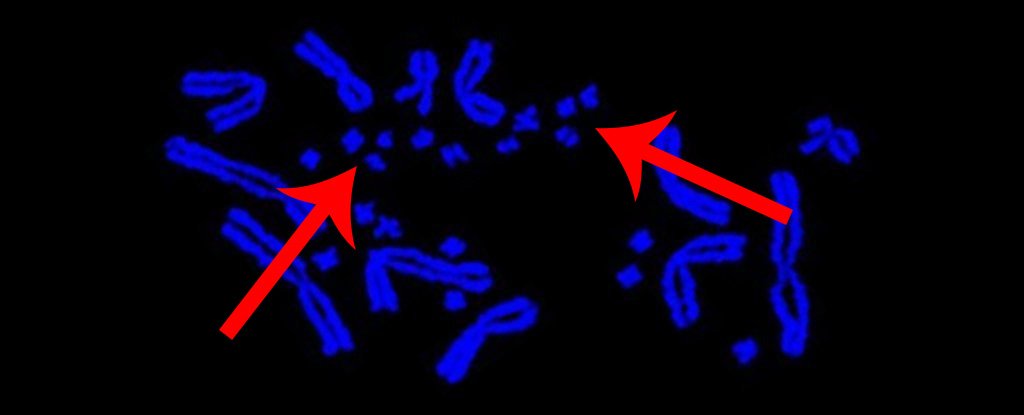
'Useless Specks of Dust' Turn Out to Be Building Blocks of All Vertebrate Genomes
Originally, they were thought to be just specks of dust on a microscope slide.
ScienceAlert
262 points · by georgecmu · 5y ago · 133 comments
If there truly is some sort of functional interaction going on then this is a very profound observation. As it implies the close spacing is for some kind of mechanical/electrical mechanism within the core of every cell’s nucelus.
It is interesting, but not for the reasons you may be imagining. And not a mysterious electrical mechanism.
It's well-known in the field that (e.g., in humans), chromosomes fold in on themselves in structured ways [1,2]. The functional consequence is not precisely mechanical or electrical -- rather, these folds bring regulatory domains close in 3D space to the sequences which they regulate (which may be far in 1-D sequence distance). These can be elements like "enhancers", which increase the level of transcription (DNA->RNA copying, the first step of gene expression); "insulators", which break up coherent blocks of gene regulation, etc. One of the mediating mechanisms is that regulatory proteins bind to these particular sequences; bringing them together in 3D space allows the assembly of a protein complex that actually carries out the relevant process (eg, transcription).
So, what's interesting here? There is extensive evidence of these contacts within mammalian chromosomes, but limited evidence _between_ different chromosomes. Insofar as the paper shows that mammalian macrochromosomes have homology to multiple reptile/avian microchromosomes (really, to their most recent common ancestor), it may be (speculation alert) that intra-chromosome contacts recapitulate contacts and organization seen in the ancestral microchromosomes.
(There are also "simple" interactions like wrapping of DNA on protein complexes called nucleosomes, like string on beads, but that's less interesting in this context.)
[1] https://en.wikipedia.org/wiki/Nuclear_organization#DNA_loopi... [2] https://en.wikipedia.org/wiki/Nuclear_organization#Chromosom...
This is correct, but only because "biological information" is utter gibberish without meaningful interpretation, from you not the comment that you criticize.
The more general statement was that people's horizon seems to be severely limited (except that the comment phrased it in an acceptably ironic mood). You practically proved them right
The Vermin only teaze and pinch
Their Foes superior by an Inch.
So, Nat'ralists observe, a Flea
Hath smaller Fleas that on him prey,
And these have smaller yet to bite 'em,
And so proceed ad infinitum:
Thus ev'ry Poet, in his Kind
Is bit by him that comes behind.
-Swift
Taylor or Jonathan?
> Flea
> prey
> bite'em
> ad infinitum
What is this telling us about former pronounciation rules?
> , in his Kind
this feels like it's only there to force the rhyme
I'm not an expert in biology, so I don't know if this is a new part, or it's a part that we already know but in mammals is made by small areas of the big chromosomes and in this animals this areas are on their own.
[1] https://en.wikipedia.org/wiki/Nucleolus
Edit: nucleolus -> nucleus
I think you meant "known subparts of the nucleus", right?
At some point, the sensing for analog effects became the most efficient way to achieve the result by exploiting flaws or unique properties in the individual components, sort of like that inductance backdoor where a particular set of instructions in a certain circuit leaks into another until it's energized enough to trigger it like a relay. Anyway, the result was unintuitive but worked.
Anyway, there's no doubt that after millions and millions of years, there are natural principles at the quantum and atomic levels that biologics are taking advantage of that we're basically only at the "allegory of the cave" level of understanding.
The micro is very much relative.
[0] https://quantum.ch.ntu.edu.tw/ycclab/wp-content/uploads/2015...
History has humbled us countless times. I recall a recent Veritasium video wherein famous mathematicians of centuries past labelled the concept of negative numbers "useless" (because they didn't understand how they could be useful). My high school bio teacher confidently claimed that the appendix was a "useless organ".
So does the Encyclopedia Brittanica, Healthline, and any number of other sources:
> appendix, formally vermiform appendix, in anatomy, a vestigial hollow tube
> The appendix has been identified as an important component of mammalian mucosal immune function, particularly B cell-mediated immune responses and extrathymically derived T cells.
It likely has some complex purpose, such as a reservoir for microbiome.
The idea that modern higher organisms have been "optimized" so that every part is essential is not well supported by evidence, and there are many examples of features that simply are historical artifacts or "not-sufficiently harmful". Many evolutionary biologists are comfortable with neutral theories consistent with the idea that large portions of the genome are not under strong (or perhaps even moderate) selection.
A person born without an appendix has no actual advantage over a person who has one, so selection doesn't really influence it.
The human body is full of things that truly serve no function, and it's also full of detrimental things, such as genetic diseases.
As long as it does not impact reproduction, selection has no impact.
I always think back to Richard Dawkins explaining how a particular vein in a Giraffe's neck is wrapped around a lower neck bone and has grown 2x to accommodate the long neck instead of regrowing in a more efficient way (not wrapping).
If the cost is small enough that other factors dominate your ability to procreate, it will spread to all of your descendants. If other genes in your genome make you reproductively successful, that gene edit will spread and spread.
It’s a good thing these cheap changes are preserved, or viruses and bacteria would have wiped out all multicellular life early on by practicing patience. We all have genes that make us less susceptible to some pathogens than others and if a bad enough variant comes around, suddenly we are over represented in the next generation. If the hits keep coming eventually our family reunion may be the only one being held.
The same logic would apply to male nipples. It's a flawed logic.
It's pretty much an on-site backup for intestinal flora :)
Why do we have wisdom teeth? Just because something is useless doesn’t mean it’s eliminated
https://en.m.wikipedia.org/wiki/Spandrel_(biology)
Of course, something that is currently useless may become useful as the environment changes. Or it may not. Personally, I find a healthy sense of detachment from purpose, and certainly from any sort of teleology, is necessary to become philosophically consistent with the evidence from evolutionary biology.
Your point of view about detachment makes quite a bit of sense to me, and if the spandrel idea proves true I guess we (Homo sapiens) will just have to take it on the chin...
That however hinges on the cost being high enough, if the cost is negligible then there is no real pressure either way.
Sometimes organisms carry things not very useful anymore for a looong time.
"Originally, they were thought to be just specks of dust on a microscope slide."
Even at this level, the platypus is a strange creature.
Yes.
Per the Wikipedia page, Micro chromosomes are replicated the same way as other chromosomes - mitosis.
Or, alternatively, that chromosomal-level organization is happenstance.
I agree though with your implication that it’s an interesting area of study. Perhaps there is an interesting mechanism to be learned or disproven.
If you haven’t come across it, the teams inject drugs that do nothing to cells but instigate an electrical field effect. What happens is regrowth of a limb to the correct “spec” even though that physical information is gone (limb amputated).
This suggests to me an equalizing effect exists, where fields and matter feed each other just enough to reach structural equilibrium.
Relativistic information network effects, proving what math objects create which field effects, and the social impacts, are going to become huge and blow away our current engineering goals of making hard silicon computers.
We might be able to use nature itself as our CPU.
We do not know how life organises itself. DNA is involved. We have some knowledge.
But what we do not know matters much more than what we do know.
A chromosome is DNA folded up. What was previously thought to be specks of dust on a microscope slide turns out to be very small chromosomes. Their function is unclear. Between many birds and reptiles these microchromosomes seem to line up with the normal chromosomes fairly well. The difference is relatively speaking fairly small. In mammals however these microchromosomes are much more jumbled. These microchromosomes cluster together in the center of a cells nucleus. This means they physically interact. They touch.
Now what this all means is as of yet not entirely clear. They most likely have some important function since they got preserved very well along evolution. Mammals however did something weird to these microchromosomes for unknown reasons.
Little did I know.......
Jokes aside, I wonder if we actually know enough to safely meddle with genetic materials, e.g. with mRNAs vaccines.
If we called mRNA a "protein print job" like pjc50 came up with, and we called our chromosomal DNA our "kernel instructions", etc., I think it'd be more obvious how silly it is to worry that mRNA is going to somehow alter your chromosomal DNA. The point is that there are a lot of different functional things and data structures made out of bits, and a lot of different functional things and data structures made out of adenosine, guanine, cytosine, and thymine/uracil.
mRNA vaccines don't modify your dNA. They provide a volatile blueprint of the corona-specific spike protein, so that spike proteins can be synthesized for a short time, analyzed and then discarded by the body.
The mRNA would be something like the print buffer that stores the currently printing document. DNA would be the document file stored on disk.
• take out most of the steps
• change the payload
• substitute one of the ingredients to trick the immune system.
If you said CRISPR, I'd agree – but we do know enough for mRNA vaccines.
To use a CS analogy, mRNA vaccines aren't Turing-complete, but CRISPR is. We understand both fairly well, but the implications of mRNA are much simpler than the vast, vast, vast implications of CRISPR.
The current generation of mRNA vaccines may be simple enough for the scientists to analyse, but I feel it will only be a matter of time before the complexity of such technologies grow to the point that it resembles art more than science. (I am looking at you, deep neural networks!)
The complications with mRNA vaccines like this have to do with keeping the mRNA intact during delivery and getting it into the cell so the protein gets built. That's the hard part, and the focus of all the patented engineering that differentiates BioNTech and Moderna vaccines. And the delivery mechanism, while complicated, doesn't involve anything genetic; it's a mechanical problem.
Do you have experience working with CRISPR? Is there a study or set of studies that concerns you, or is it the reality that negative results don't get really get published?
mRNA vaccines are injecting simple, engineered mRNA. This mRNA is expressed 100% of the time; what it does is very simple. I'd be confident using a new mRNA vaccine on day 1, so long as they're certain they picked the right protein, but I wouldn't be confident using a CRISPR treatment without a full medical trial.