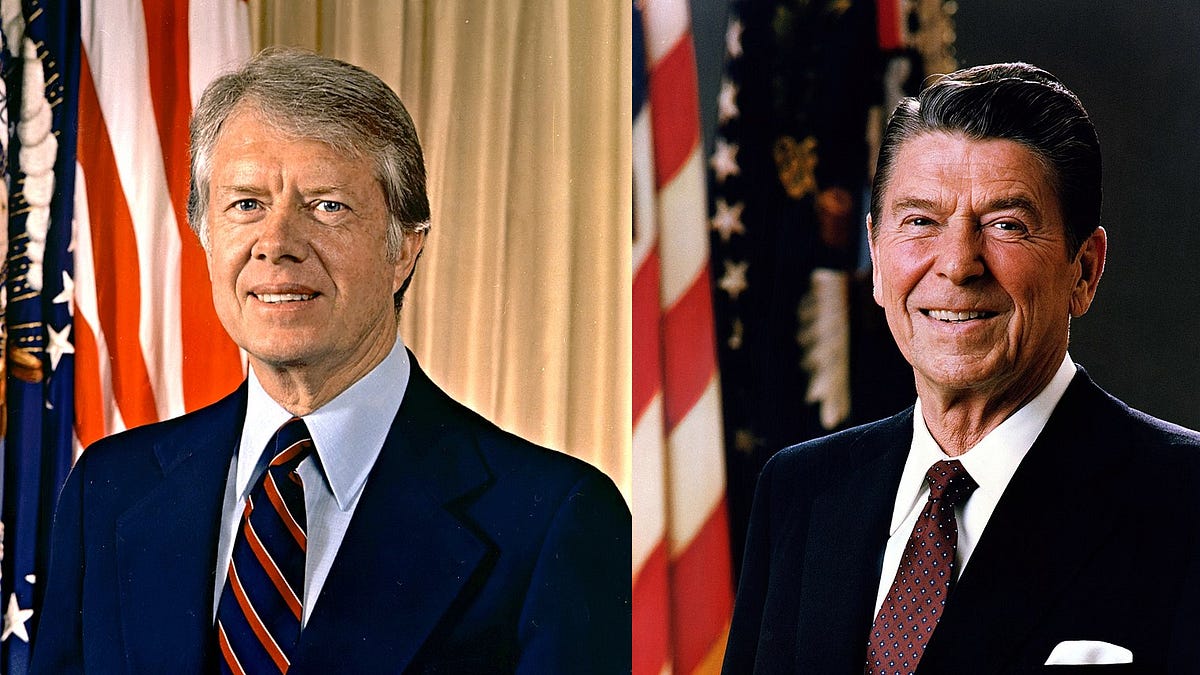
Much of what you've heard about Carter and Reagan is wrong
Debunking our narratives of the late 70s and early 80s
noahpinion.substack.com
190 points · by nabla9 · 5y ago · 242 comments
Yes, this needs to be debunked. I was in high school during the Carter years and I was into politics (seems odd for someone that age). There's a reason that Carter was primaried by Ted Kennedy in 1980: many Democrats found Carter too fiscally conservative. Carter was a deficit hawk. He pushed for a balanced budget and that upset many Democrats at the time because he wasn't proposing the large social spending increases they wanted to see.
I think Carter is definitely an underrated president who likely would have been re-elected had the Iranian hostage crisis not happened. He was a visionary especially in terms of the environment and global climate change (which his administration began to address). But he was much more of a centrist than a liberal - though the center has moved to the right since his time.
The gas lines disappeared literally overnight (I know this from personal experience) and never returned.
It's hard to overestimate what a disaster the long lines for gas were.
That crisis is still going on 40 years later!
First, it was the Clerical class that was most responsible for the overthrow. They were the ones with the organization and the power and the political networks. They then recruited the British to help them, who were the second most important factor. The British had intelligence assets in Iran. The US was basically a bagman, paying off $100,000 to some of the actors on behalf of the British, and for the clerics.
The U.S. simply didn't have a lot of intelligence assets in Iran, nor did it have any troops there, nor did it have a lot of sway over Iran. It was an intermediary between the actors that actually held power. One can argue that the payment of $100,000 - that was the sole contribution of the U.S. to the coup - was what made the difference. I doubt it. Then the US CIA chief played up his role in the coup in an attempt to gain political points.
Yet this complex history is boiled down to "US overthrows democratically elected government". I mean, come on.
But what's useful about such a narrative is that the U.S. (and also the U.S.S.R.) were involved in the politics of basically every country. Even if all they did was throw a dinner at their embassy or promise some foreign aid. So all you need to do is look at whichever side the U.S. was on in some local dispute, and then if that side won, you say "US forces nation to do X".
This is bad history.
UPDATE: people have been clamoring for links, so see this comment for more info: https://news.ycombinator.com/item?id=29102780
Wouldn't exactly call that "killing off nuclear power" - Three Mile Island and the movie The China Syndrome did that. The movie was released ~2 weeks before the accident on March 28, 1979.
Blowback keeps happening. IIRC, the modern Central American drug gangs were born of US funding and training of anti-Communist forces in the 1980s.
Remember it next time someone says, 'let's send arms to those insurgents!' Obama dialed it back, partly for that reason (AFAIK). Biden apparently has embraced a policy of 'restraint', with the idea that outcomes from US intervention often are counter-productive.
(I don't support it - instead, accept the challenge and find better interventions. Quitting is a bizarre solution IMHO. People still need freedom, and need help.)
Yep. The October Surprise by Team Reagan worked very well.
Another fascinating chapter from that era, if you're interested in the revolution in Iran and resulting US election, is covered in the book "October Surprise," by Gary Sick. While the author states soberly that we don't have all the details, those we do point in an unfortunate direction. That many in the Reagan admin would be behind bars and implicated with the Iran arms scandal less than a decade later has also largely been forgotten. The two events are thought to be unconnected.
At the time Reagan often said he "didn't recall…" Back then I thought he was omitting the truth, but then we found he had Alzheimer's a few years later, and turned out it was probably true he didn't remember a thing. Can't make this stuff up, folks.
There was also a good Frontline episode on the subject, but I've not been able to find it due to PBS' shenanigans. Maybe they lost the tape.
The topic of Reagan's decline in office is debated, but we should be wary of premising conclusions on it. Reagan was probably fully competent while serving as President.
(I have no particular admiration for Reagan, and found the rehabilitation of Carter in this post pretty compelling; I'm not here to stick up for Reagan, but rather just to point out a curious echo of the theme of the post in this thread).
Even my mother, a product of an FDR world, who threw shoes at Reagan on TV could not stop laughing about how over the top it was.
I credit Nancy. She saw the ideologues he put in during the first term where driving for a cliff and brought Baker, Deaver and Schultz in to right the ship. It helped to have someone like Tip O’Neil in the House who thought impeaching over Iran Contra would be bad for the country.
Reagan, like W Bush wasn’t incompetent, he was just incurious and easily led the farther he went up. Look at Reagan’s 1964 speeches and W’s Governor debates and it’s like they both fell of a skateboard and cracked their heads open once they ran for President.
The United States (Dulles) overthrew the democratically elected Mossadegh in 1953 and installed the Shah. Then Eisenhower, JFK, Nixon, Ford and yes Carter completely supported the Shah. The Iranian revolutionaries held that against us and in particular, against the then president, Jimmy Carter. Given what we did to them, they had a point.
The resulting hostage crisis was the smallest humiliation the US ever suffered. Compare that to Saddam sending an Exocet into the Stark or Israel strafing the Liberty.
Reagan made much of this crisis during the election, and the hostages were released on inauguration day. Then Reagan supported Iraq in their invasion of Iran AND also sold missiles to Iran. A strange foreign policy, mostly beholden to whatever Saudi Arabia and Israel wanted on a given day.
Carter negotiated end to the hostage crisis (Algiers Accords of January 19, 1981).
As one can see, conspiracy theories are not a new invention. This particular one has been investigated and debunked over and over (wiki has a decent overview for once).
Deregulation, privatization, cutting taxes, and tight money were all implemented in different developed countries in the late 1970s and early 1980s. It wasn't about personalities or parties, it was about reforming the postwar economic consensus that had run out of steam by the late 1970s. Even Mitterand had his U-turn.
The buried lede is that politics doesn't matter that much. Policies are chosen more based on "facts on the ground", which is sobering, can be reassuring to some, and also dispiriting to others if you want to effect radical change.
Wonks often use the phrase "moving the needle". That's about all politics can do proactively. Mostly policy changes are forced by external circumstances.
In reality, the political bandwidth of actual policy is far smaller. All developed nations swing from center left to right. Norway would be center-left, whilst Hungary would be right. Those are outer ends, most countries navigate a far smaller bandwidth, regardless of who is in charge.
In the US that bandwidth is from conservative to very conservative. The democrats are a right wing party.
Nonsense.
Those (both American leftists, and Europeans who listen to them) who say that "Democrats in the US would be right wing in Europe/Canada" have to (for example) then agree that all major political parties in Canada and every European country outside the UK and Ireland are right of US Democrats, because there is no significant opposition to voter ID laws anywhere. Macron's Les Republicains got elected because voters liked his vow to get tough on unions and union pensions, and privatize more infrastructure, neither of which appears in Biden's campaign platform.
Speaking of which, several European countries have privatized post offices; not just telecom companies that were parts of PTTs, but entire postal services. It is the rare European country that hasn't sold off at least part of their postal services. The EU explicitly requires postal monopolies to end in member states; whether government-owned or not, EU postal services do not have the USPS's monopoly on first-class mail. Yet no major party in the US seriously talks about privatizing the USPS.[1] Does this mean that American politics is "far to the left" of that of Germany and the UK, both of which have completely sold off their postal services to private investors?
PS - For another example, consider the liberality of abortion laws in the US versus Europe.
[1] And no, it's not because of the Constitution. Article I Section 8 only gives Congress the authority "To establish Post Offices", as opposed to requiring a government-run one. Certainly nothing in the Constitution mandates the USPS's first-class mail monopoly.
Fundamental progressive values available in western Europe since about 5 decades. Normalized to not even count as explicitly progressive, instead seen as just basics.
This might be a valid point if American unions had anything close to the level of influence over US society that French unions have over France, but they don't, so it isn't.
This depends heavily on how you measure left vs right.
Immigration, abortion, culture war issues(woke/anti-work/anti-racism), criminal justice, covid response, affirmative action. The line that separates left from right can be drawn in very different places depending on the locality.
Case in point, the right wing party in the Netherlands (VVD) that has ruled for a long time now, is fully in favor of a livable minimum wage, universal healthcare, accessible education, advanced safety nets for the unemployed and disabled. The issue of abortion has been solved in the 70s. They may tweak these systems to be more bare bones, but don't want to abolish them.
So that's our right wing. Far more progressive than the US democrats, which in this comparison would even come close to the far right. So the perspective matters, but to me there's one absolute point of view: without a livable wage and universal healthcare, the very word "progressive" shouldn't even be used. Without this foundation, you're OK with letting working people starve, or to let a sick person go bankrupt or die. Many countries wouldn't even call these basics progressive or left wing, they are found in deeply capitalistic and conservative societies across the world.
The woke in the US are an interesting case. They really are left wing, right now embedded in a democratic party that is comparably conservative. I smell conflict on the horizon.
Just to take one example from the article, the deregulation of airlines in the U.S. Check out the wikipedia article[0]. Carter supported the bill, but its history goes back to the early 1970s, and lots of other parties were involved in making it happen, most notably Congress, which of course had to pass the law.
Carter and Reagan were polar opposites. Carter was a fiscal conservative and Reagan was a spendthrift. Reagan was when the deficit floodgates opened. We've repeated this fiscally conservative Democrat followed by spendthrift Republican ever since.
  Carter  $70B deficit
  Reagan  $175B
  Bush    $350B
  Clinton $0B
  Bush    $1.4T
Obama $600BClinton for example, left at the peak of the DotCom bubble, and was bouyed by capital gains tax revenue, whereas Bush left during the Great Recession.
Obama clearly did increase the deficit as national debt went from $10T to $19.5T during his tenure. In other words, the debt increased by nearly as much as every president prior to Obama. Of course, we seem to find ourselves on an irreversible debt slope that is rapidly accelerating and I suspect that every future administration will outspend the one prior.
Deficit increases under these presidents isn't as much on the business cycle as you indicate. For example, Clinton enjoyed higher capital gains tax revenue, but he also signed legislation to increase taxes (which obviously impact the deficit). Conversely, Bush chose not to include substantial additional revenue in his recession-era emergency spending plans. Both were policy choices that entirely support the OP's point.
In fact, although Trump and Biden were not included in the list, they are following the same schema. Trump cut tax revenue and then didn't offset massive deficit spending on his way out the door. Biden's signature economic plan is stalled in part because he is making efforts at offsetting spending with increased revenue.
In Jimmy Carter's four years, the Federal Government's spending increased by almost 48%. In Ronald Reagans eight years, Federal Government spending increased only 53%.
https://www.presidency.ucsb.edu/statistics/data/federal-budg...
https://www.usgovernmentspending.com/spending_chart_1970_201...
If you look at the numbers, the Clinton "surplus" was merely some fancy accounting achieved by borrowing money from government trust funds, like social security.
What numbers? Care to cite them?
Social Security has always held its surplus in t-bonds. Ergo, the government has always "borrowed" from SS. So I'm having trouble seeing how it was magically different under Clinton. And also why republican presidents don't use the same "fancy accounting" to make their deficits look lower.
A balanced budget (i.e., zero deficit) or even a large but insufficient surplus doesn't stop the national debt growing. It's like a credit card. Even if every month you pay off what you spent the previous month (balanced budget), the interest keeps compounding on the principal you owe and your total debt keeps growing. Unless the government makes a serious effort at paying off the interest and paying down the principal, the national debt will keep growing. (Of course, the principal plus interest becomes the new principal on each compounding cycle, so the principal is a moving target.)
  Fiscal Year     National Debt           Deficit
  1994            $4.692749 trillion      $281.26 billion
  1995            $4.973982 trillion      $281.23 billion
  1996            $5.224810 trillion      $250.83 billion
  1997            $5.413146 trillion      $188.34 billion
  1998            $5.526193 trillion      $113.05 billion
  1999            $5.656270 trillion      $130.08 billion
  2000            $5.674178 trillion      $17.91 billion
  2001            $5.807463 trillion      $133.29 billion
UPDATE: Fixed table formatting.
However I tend to agree that prior to Obama, presidents from the Democratic Party were the more fiscally responsible.
[0] https://www.thebalance.com/deficit-by-president-what-budget-...
US Constitution: Article I, Section 8, Clause 1.
Article 1 Section 9 Clause 7 is closer. It says Congress has to pass an appropriation before spending money. That’s still not budgeting.
The 1921 Budget and Accounting Act says that the President has to submit a budget proposal. Congress modifies and passes it. The President signs that or there’s a continuing resolution.
No, Congress doesn’t control the budget, either Constitutionally or procedurally. The President proposes one and generally gets most of what they want.
In fact, Congress doesn’t even pass a budget. The President proposes a budget, required by law, and Congress passes appropriations bills, required by the Constitution.
Also obviously with the end of the cold war, what most of this articles miss, the US lost Europe. Before e.g. Germanys establishment pushed US nuclear weapons ("Jump!" "How high?") into Germany against a large part of it's polutation, after 1990 no country in Europe jumps anymore when the US says "Jump!", because the Soviet scare is gone.
One of the most fascinating theories that I've read on this is that this was the result of a secret alliance between Reagan's CIA and the Catholic Church. The basic outlines of the alliance was that the CIA supplied money and material on non-violent resistance (through deniable channels), the Catholic Church supplied the network and connections that could distribute them. Also the two aligned on other things, such as tying US foreign aid to abortion policies that the Catholic Church liked.
What does Poland have to do with all of this? Pope John Paul II was Polish, and so their test became the Solidarity movement in Poland. After that proved a success, they replicated it throughout the Eastern Block.
I first read this theory in a Mother Jones article back in the 1980s. And every so often I wish I could find it to read it again.
https://www.motherjones.com/politics/1983/07/their-will-be-d...
(Asides: My first impulse to find the article was archive.org, but after that failed, Google delivered on the first try!)
The disastrous response to Chernobyl also gave a boost to independence movements in Ukraine and the Baltics. Gorbachev has always been in denial about how his policies helped hasten the collapse.
The timeline does not work on this. Gorbachev was in power only from 1985, while Solidarity got thwarted in 1981, during introduction of Marital Law (key leaders got arrested, the strikes and protests were broken down, sometimes using lethal force). The Polish communist party justified these harsh measures with exactly the argument that it's still better than a foreign (Soviet) invasion of their country.
Through NATO they follow us along into dubious, pointless, dangerous US conflicts, sparing the US President from asking Congress for authorization, while bearing the brunt of extraterritorial attacks since there arent two gigantic oceans separating them from the conflict.
The US uses almost countless Europe located bases for missile shields against Russia and to many hawkish people the cold war is still going on as if it was the 80s still.
Europe still depends on Russia for energy so this symbiosis is seen as important.
But I think this changes because the UK was the only EU member state vetoing an EU military, and with them gone the EU can arm itself. Dismantling a lot of the need for the US, we can mostly assume it will be to keep out Russia and lessen the burden of NATO but there are a lot of values that differ if we are being honest.
As a European, I tend to agree with that assessment, particularly with countries like Germany.
Most of the US military presence might be gone compared to cold war levels, but the pro-US political presence mostly remains the same.
Which is actually quite astounding considering we are slowly entering the second decade of when this distancing started [0] and it had plenty of additional contributions since then [1].
[0] https://www.csmonitor.com/2001/0919/p12s2-woeu.html
[1] https://www.europarl.europa.eu/document/activities/cont/2014...
Public political discussion always considered the US, because of the scare of the Soviet Union, which was daily present (how many millions of kids in the 80s in Europe feared nuclear war?).
But already in 1990 when I was in the military the attitude had changed a lot.
The complete list of countries known to have nuclear weapons worldwide is The United States, Russia, the United Kingdom, France, China, India, Pakistan, Israel and North Korea. Now that the UK is no longer in the EU, France is it.
In fact France is surprisingly militaristic. For example it is the only EU country in the top 10 on https://www.globalfirepower.com/countries-listing.php.
[Edit] After 1990.
Sarkozy: https://www.spiegel.de/international/europe/thanks-but-no-th...
The dude rolled and 18 for charisma then got a +7 bonus.
Truth be told, Jimmy Carter was and is a good man. He leads a straight and modest life. As a president, he did not preside over a happy time and he was defeated soundly by Reagan.
Then Ronald Reagan was elected and the national mood was elevated. When Reagan ran for re-election, he won with 49 states. (Lacking only Minnesota, home state of his opponent. It was said that Reagan did not campaign there to avoid being a jerk.)
49 states won. It's historical fact. Don't let anyone re-write history.
The only good thing I can say about President Carter was that the peanuts they added to the commodities we were getting were really good. The canned meat not so much.
Interesting that the speech was initially well received:
"The reception to Carter's speech was overwhelmingly positive: Approving phone calls poured into the White House — more calls than when President Richard Nixon had announced the invasion of Cambodia — along with many letters of support." [1]
[1] https://www.npr.org/templates/story/story.php?storyId=106508...
I notice NPR didn't report the negative mail or calls arriving at the Whitehouse. I just remember the "we're screwed" attitude of family and friends along with election of 1980. It wasn't what the country needed. You can watch the speech today and feel the lack of hope.
To try to blame Carter's loss on some October surprise conspiracy theory is to miss the larger issue as to what the two campaigns were about.
By the way, I think Carter's malaise speech was spot on. But it's also why he lost.
A) When talking about deregulation, Smith looks at laws, but he should be looking at agencies even more. Agencies after all do most of the day-to-day regulation. How can Smith seriously ignore things like appointing Anne Gorsuch to head the EPA in 1981? At the beginning, Reagan nominations were known for their hostility to regulation, and Smith would have done better to check whether this was actually true.
B) Arguing that Soviet military expenditure wasn't a big deal because they spent more in WW2 is crazy. Smith is comparing a peace-time spend to a total war spend!
C) Oil's role in USSR's collapse is well-known. Well known enough to have claims by Reagan partisans that he convinced the Saudis to keep prices low to pressure the USSR. Is this right? Very debatable. But it's directly related to the thesis of the article and Smith completely ignores this.
I lived through that period and none of it was any secret — quite the opposite, it was current affairs in the newspaper!
It’s fascinating how much the mainstream narrative deviates from “the facts” even with them available to anyone who cares to check.
However, its pretty clear to me that the media's ability to assert certain opinions by asserting with more force is not conducive to a healthy long-term society.
Yes. 40 years of propaganda and hagiography of Reagan has left a significant minority of the US population in delusion about nearly anything political, including people who lived through the events in question.
Hell, a good subset of people are trapped in such an insanity bubble that people who had siblings die of polio in their youth suddenly decided vaccines are a giant conspiracy in 2021.
The process that Volker's Fed set in motion is with us today. Have a gander at the historical constant-maturity 30-year bond:
https://fred.stlouisfed.org/series/DGS30
Zoom out to the multi-decade view and notice something: a peak in late-1981 and a relentless slide toward zero today. You won't find a multi-decade channel like this in many other places.
These ever-lower long-term yields have played a major role in the housing market bubble that ended in 2008 and the one still inflating today. It could also be argued that this trend toward ever-lower long-term yields has been responsible the increasingly outlandish stock market valuations and the never-ending quest for yield (i.e. risk) that we currently see by institutions, individuals, and foreign governments.
I see this graph in a number of places, I think it's something 'talked about'.
The issue, I believe, is fundamentally demographics combined with decreasing marginal returns to tech and progress.
1970's was when the baby boomers were entering the workplace, and there were a lot of them, now, not so much.
For decades after WW2 American industry was 'ahead' of the factories in Europe and Japan which were bombed into nothing.
So there was a natural slowdown in growth afterwards.
Then every loosening monetary policy with a big bump in 2008 and an even bigger bump in 2021 and you have what you have.
"ever-lower long-term yields have played a major role in the housing market bubble that ended in 2008"
I think it's better to say they are an indicator of something material, but 'lower bond yields' are not the 'driver of housing inflation'.
That said, I agree with a lot of the things said in the article.
In the 1973/4 crisis the price of crude quadrupled.
In the 1979 crisis it more than doubled.
On both occasions the price hikes were combined with physical shortages which did huge damage to economies which were - and largely still are - dependent on oil for everything from transport to energy to plastics to food production.
And yet... these economic cataclysms have been almost sidelined from the official economic narrative in both the UK and the US.
Ask a typical British voter about the history of the 70s and they'll tell you the UK was bankrupt because of excessive government spending, and not because the price of crude went through the roof.
It's one of the reasons I consider economics a branch of propaganda and not a real science. Clearly the oil shocks were an economic catastrophe and were directly responsible for very severe inflation. But somehow the effects are still blamed on wage growth and (in the UK) unionisation - both of which were far more credibly an effect than a primary cause.
Poli-sci research is depressingly consistent in demonstrating that the average voters' views on everything are worthless. It's amazing the system works at all, even for very generous values of "works".
Research on voters' understanding of issues, and of the world, largely amounts to a less-funny version of that thing where a late night show has someone go out and get people to give incredibly stupid answers to easy questions.
Your second point is not an alternative to the first, rather it is implied by the first.
Not that Reagan supported a war between Iraq and Iran, played both sides, caused OPEC to fall apart and flood the market dropping the price to $15 barrel.
The way you put it sounds rather backwards and gives me "wet streets are causing rain" vibes, as if lots of government increase of the money supply won't cause demand for scarce resources and drive up their prices via sudden increases in demand with the newly available cash that can't be met by similar increases in supply.
The size of the US government's outstanding liabilities at the time isn't relevant, what affects prices is money flows, not stocks.
[1] https://en.wikipedia.org/wiki/Money_supply#United_States
[2] Back then the Fed wasn't willing to just expand its own balance sheet significantly on its own initiative as it is now.
That worked out well...
Even Reagan's defense establishment didn't want to give the muj shoulder-fired anti-aircraft missiles, until the mid-80s. That's what really turned the tide. Carter would never in a million terms have done that.
The solution is to dig in to statements of truth for yourself until you uncover verifiable facts. This is true as much for assertions in electoral campaign literature as much as claims of grand conspiracies to subvert privileges through widespread intramuscular injections of 5G microchips. Check the references provided, and if there are no references then check your gullibility.
[0] I could imagine good FAA reasons to approve it, but IIRC in the story it was some commercial issue that sounded way overboard.
True. There are certainly those who push and pull the narrative. That said, there is also the momentum and expectations of the masses. Once a lens is set it is very very difficult to correct it.
As so wisely put by mighty Paul Weller:
"The public gets what the public wants."
And
"The public wants what the public gets."
Put another way, aside from nefarious narrative actors, we also often have ourselves to blame.
I am familiar with a much better expression of this lesson by, of all people, bill gates:
> We always overestimate the change that will occur in the next two years and underestimate the change that will occur in the next ten. Don't let yourself be lulled into inaction.
Those events did not happen that long ago, and it's a 5 second search to find out what president signed those.
(hackernews won't let me reply to the previous comment, sorry about that!)
I mean, that's the extent of the "logic" as far as it goes. But enough for votes in the ballot box. The world is too damn complicated. I barely can get my tv to operate, and you're supposed to expect me to understand the ins and outs of federal reserve policy, economics, and climate change?
Mueller's report was damning. But the story it told was so complicated that only obsessed people could keep the details straight, and most of those people were heavily invested in the outcome one way or the other anyway.
Feeling cynical right now i guess.
Rush & others said such-and-such about Carter. Day. After day. After day. Until he believed it.
To throw a bone to a side that I usually disagree with, Smith could have also productively contrasted that latter century bipartisan fiscal irresponsibility with the relative sobriety of the New Deal just in terms of deficits and long term sustainability. It may seem weird on the face of it given how the New Deal tends to be portrayed in contemporary times by both the left and the right, but FDR might have been the last real fiscal conservative of the 20th century both in terms of rhetoric and policy until Bill Clinton closed out the millennium. Despite what seemed to be bitter acrimony during the Clinton administration, the Reagan-Clinton years were probably the last ones in which there was a productive competitive dynamic between both parties. It was also the last time in my memory that there was serious discussion of entitlement reform: that was really wiped out from public debate after 9/11. Back then, you could credibly argue that the competition between the parties resulted in better policy thinking on both sides. In contemporary times the competition seems more to result in more aggressive stupidity on both sides: they both tend to make each other dumber to own the cons/libs at the expense of the public.
Gives me a bad taste in my mouth to have to say something nice about a Noah Smith article.
Just look at the Dow since then, and sit down. The stock market is a weighing machine, as Benjamin Graham famously said [1]. Here's how the world's money weighed the two Presidencies:
Carter:
Starting Value: 959.03
Ending Value: 970.99
Performance While in Office: 1.25% increase
Reagan:
Starting Value: 950.68
Ending Value: 2,239.11
Performance While in Office: 135.53% increase
[1] https://www.goodreads.com/quotes/831517-in-the-short-run-the...
[2] https://www.gobankingrates.com/investing/stocks/stock-market...
Calvin Coolidge:
Starting (1923): ~90 (Dow Jones Index)
Ending (1929): ~320 (Dow Jones Index)
Performance in office: 255% increase.
What an amazing president - oh, wait...
I'm highly skeptical of the "very good president" claim too.
"Although the public liked and admired Calvin Coolidge during his tenure, the Great Depression that began in 1929 seriously eroded his reputation and changed public opinion about his policies. Many linked the nation's economic collapse to Coolidge's policy decisions. His failure to aid the depressed agricultural sector seems shortsighted, as nearly five thousand rural banks in the Midwest and South shut their doors in bankruptcy while many thousands of farmers lost their lands. His tax cuts contributed to an uneven distribution of wealth and the overproduction of goods. Many Americans were deeply in debt for having purchased consumer goods on easy installment credit terms."
"...Nevertheless, scholarly opinion looks upon the Coolidge presidency with skepticism, ranking him relatively low among American chief executives in terms of his administration's positive impact and legacy."
https://millercenter.org/president/coolidge/impact-and-legac...
* The stock market is not the economy, so you just are weighing how well big corporations that choose to float are doing. E.g. Amazon workers paid next to nothing, and local store goes out of business, and all of this is good for the index.
* Adjust for inflation
* Adjust for risk tolerance
* Adjust for interest rates, and how stocks compete with savings
* Adjust for change in what are considered good P/E ratios
* Adjust for technological advances
* You didn't mention which index
To give an extreme silly example to make the point - imagine Amazon was the only stock, you look at the last 10 years, and your currency is Zimbabwe dollars.
I would say the stock market is a weighing machine, but what is weighs is complicated. You could double the stock market by printing money, or taxing regular savings at 1% of principal per year.
The Dow (or S&P 500) is the weight of the world's expectations about the US economy, as much as any single number is.
No, you cannot "double the stock market by printing money." If that were true, then the Fed's loose money policies during the 70s would have doubled the stock market. They didn't, did they?
“Good numbers” - what does that mean? They are numbers for sure. I gave reasons why weight summing market caps might not be a perfect score, can you counter them specifically.
I agree printing money might not double the stock market. Are you saying money supply has no affect on stock market? It scares money away from savings and devalues risk.
I’m not sure you can pick apart my comment logically.
Trump has nothing as far as destruction of this country compared to Reagan. You want to trace the end of the American Empire -- put that blame on Reagan and his acolytes first.
I don't care who is the president, growing up in Billings Montana will always suck!
I grew up in the 70s and 80s, and can certainly complain about a lot of things about that time.
In your mind, what are the top few most wretched aspects of that time? I grew up in south central Los Angeles, and so gang and drug crime would be the top of my list.
I live in LA now and ride the bus through South Central, and I've lived there and I have found that place far more welcoming to me than I ever did back in Montana.
So, YMMV and the grass is always greener. But I'm a lot happier in the poor parts of LA than I ever was in Billings, Montana.
South central has enormously improved since the late 70s up through the early 90s. As a kid, I was personally shot up a couple of times from the street. Crack houses were everywhere, and the gangs were pretty terrifying.
I don't really remember the show but it brings to mind people drinking scotch out tea mugs and shouting "who's the slag what done the blag?" at some poor "snout".
To get a gang of villains in a shed up at Heathrow
They're counting out the fivers when the handcuffs lock again
In and out of Wandsworth with the numbers on their names
It's funny how their missus always looks the bleeding same
And meanwhile at the station, there's a couple of likely lads
Who swear like how's your father and they're very cool for cats
They're cool for cats (Cool for cats)"
Ronald + Maggie's relationship was legendary though, and defined the era of Boomers in their 20s and 30s.
When it comes time to vote, the PR machines start up and people are made to pretend they are thinking objectively when actually we are about as prepared as we'd be at a wine tasting. The analogy continues, because whatever we decided we think we were well justified later on, regardless of what actually happened.
I'm glad I read this article, it's well presented with sources, and debunks some quite important myths.
One explanation of why we should prefer democracy that I quite like goes like this:
Democracy is rooted in the belief that more than half the people are right more than half the time
THere are all kinds of holes that can be poked in this approach, and I sometimes do that, but fundamentally I stand by the basic conception that this describes.
I'd say that this is a glib simplification that conveys almost no information about the actual state of US politics at any level.
And I'm not so sure that it's the case when information required to make the choice is lacking, and agitprop is substituted instead.
That one's a slam dunk. Who wouldn't?
How so? The chart suggesting Volcker "saved" the US from inflation seems to suggest otherwise. The Fed was already trending towards what the "Volcker Fed" did. The "list of significant deregulations" on Wikipedia is actually listed as "Related legislation". Reagan had a greater number of deregulation legislation listed as directly related to Reagan's administration rather than in the "Related legislation" so there is some game playing going on as far as the significance of each administration.