Apple’s New Screen Repair Trap Could Change the Repair Industry Forever
The newest iPhone disables Face ID after a screen swap, unless you take it to Apple—or learn to microsolder. It’s a turning point for fixers everywhere.
iFixit
248 points · by fomine3 · 5y ago · 249 comments
Apple has hardened their hardware against attackers replacing components of the phone with compromised versions. Sure, at the same time it prevents 3rd party repairs, but I don't think Apple's only motivation for doing this was to screw over 3rd party repair shops.
When the NSA leaks came out, there was some sections that showed how shipments of electronics could be intercepted and backdoored. I would 100% believe there are groups out there that have or are working on chip level attacks for iPhones and other mobile products. Swap Apple's Face unlock chip with a custom one that includes other embedded profiles that can unlock the phone without the owner's knowledge does not seem far fetched.
A lot of the changes to the MacBooks seem to also have been done with device hardening in mind.
I cannot tell you how much damage my iPhone 12 Pro has taken without the screen cracking, which makes me personally think the reasons these changes have been made are not just related to 3rd party repairs.
The article even says that the repair shops have already found ways around it, so whatever element of "security" it provides is clearly extremely low. It only exists as a (low) bar against third-party repair, with "security" as an excuse.
As the saying goes "those who give up freedom for security..." etc.
That said, I’m still doubtful this is entirely for security. What’s frustrating with Apple is that their moves to secure their hardware at every level also have the effect of tightening their stranglehold on the ecosystem. Unclear what the core motivation is.
It can't be, otherwise Apples techs would not be able to replace it either. Even if it was, there wouldn't even be a reason to put it on the screen's ribbon cable. It could be integrated into the Apple-designed CPU, making the parts cheaper and more modular (i.e. easier to repair, even for Apple)
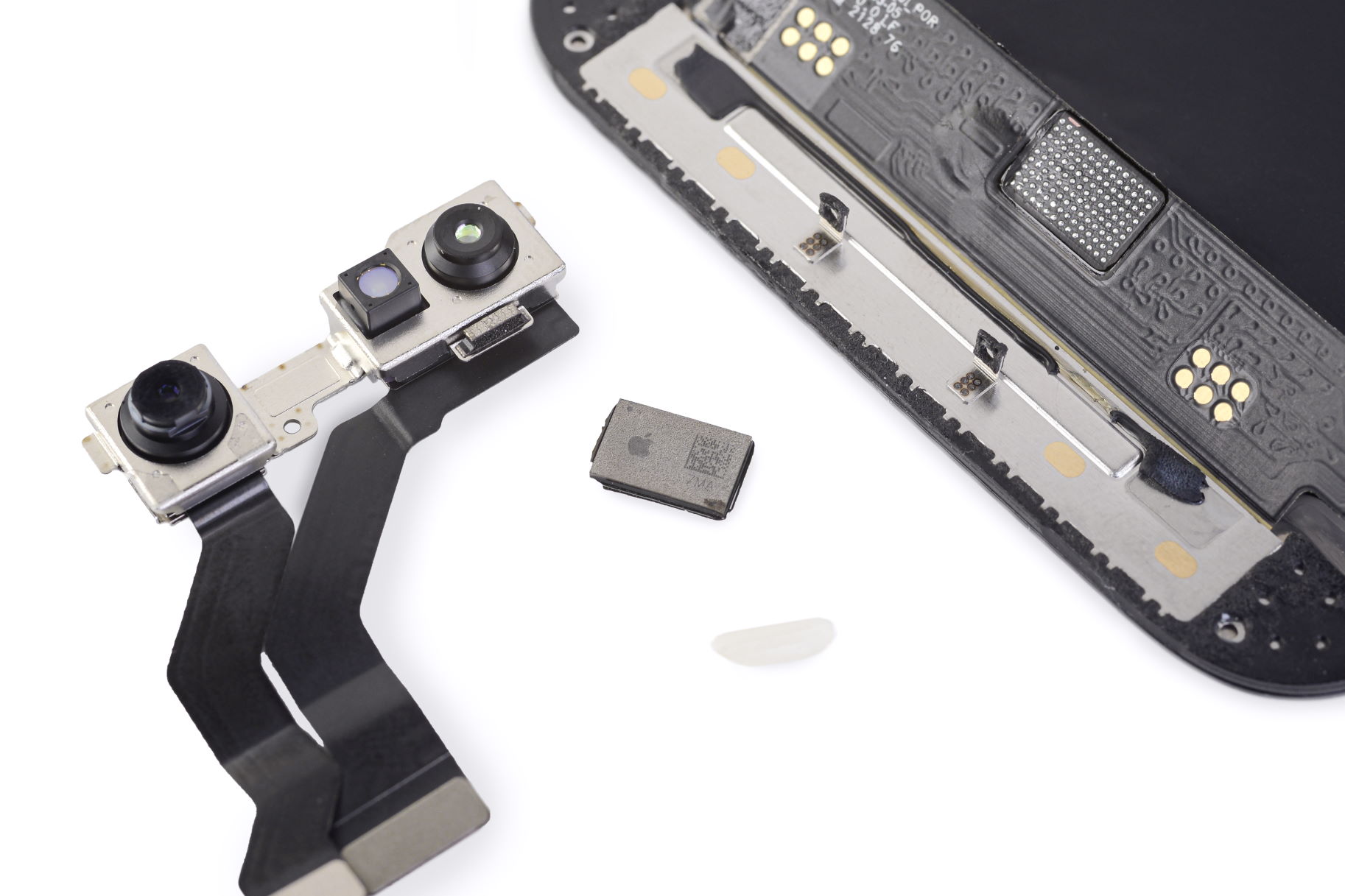
"The most sophisticated repair shops have found a workaround, but it’s not a quick, clever hack—it’s physically moving a soldered chip from the original screen onto the replacement. "
On iPhones X through 12, if you kept the Face ID hardware and only changed the display, Face ID would continue to work. On the iPhone 13 series, if you keep the Face ID hardware and change the display, Face ID stops working.
The chip which people are removing seems to serve only to identify the display - nothing to do with the Face ID system. Apple has been using this chip for years to disable "true tone" display functionality when the screen was swapped (unless it was programmed by a proprietary tool, only available to first-party repair shops) - they're now also tying it disable Face ID.
i'm all for right to repair and for apple to provide cheaper repairs and more authentic parts to resellers, but don't be obtuse about the reasoning.
the way around it, as i read, was to solder a chip to another board, which has some information authenticating the part and digital trust chain. anyway, i'm sure people like you just love to find reasons to hate apple, as it's grown to be a sort of cult rivaling the one that supports 'em
How does this look like from the outside? I think there are genuinely a lot of people who actually agree with this. Actually, I think almost everyone agrees with this to some extent: people only have a limited amount of effort they can spend managing different parts of their life. The conflict occurs for the parts where people do feel like they can make better decisions than Apple, but they can't because Apple won't let them. For most people, going to an Apple Store or AASP to get a repair is generally fine and saves them hassle. But for the people who are willing to save money to go elsewhere, or do their own repairs, it really sucks.
With a decent password, the adversary has to at least use a rubber hose. More important, cops can't legally use a rubber hose but they can damn well take your phone and point it at your face with no repercussions.
It is a strange mindset until you remember that obvious phishing attempts are still crippling organisations and so does ransomware and social engineering.
Relevant: https://youtu.be/kkCwFkOZoOY
Would something like this even remotely stop an actor with the resources like the NSA? Does this even remotely benefit people that are not being targeted by intelligence services? I'd guess no. Security benefits for most people don't outweigh the downsides. If they are so security conscious why even have FaceID at all? It's already been shown to be not that secure why not instead require users to enter a 15 digit password and use 2FA to unlock their phone instead? Is it that they value convienence over security in that case but not where it potentially loses them money?
They already have non-E2E-encrypted iCloud backups where they give access to the Feds and others.
Seems a lot easier than compromising some random repair shop.
A sophisticated hardware attack is probably going to be government sponsored anyway in which case that government can just request data from Apple directly.
Their platform is locked down so that nobody can carve out their own turf. No custom browsers with modern web features. No runtimes. Apple's rules and taxes, or you're banned.
I've never been afraid of batteries compromising my system. Or new screens. Apple wants the extremely lucrative device repair market, and this is how they get it. Screens are the most common and expensive part to replace.
I am, however, afraid of my device reporting files that the government doesn't like. The Russian FSB is salivating at Apple's new device spying "CSAM" capabilities. Apple built this system to satisfy totalitarian regimes so they could still sell their devices. It turns their entire platform into a dragnet so that intelligence knows exactly who to target. The FBI probably put pressure on the DOJ for these same capabilities too. Apple is deathly afraid of antitrust breaking up their gravy train and would bow to pressure.
This is about money. Apple wants it all. They need extreme growth to justify their stock price and future outlook.
Everything is about money to Apple.
Another case of "this doesn't affect me so there's no way anyone else would need it" that has recently plagued this site. This doesn't affect you but it does affect the millions of users that depend on the security of the phone - any enterprise level corporation with employees, government organizations, companies that deal with sensitive data, hospitals and other parts of the medical industry.
You're not afraid of batteries compromising your system but you're not the only person using these devices. Offering a more secure solution benefits everyone using these devices, even if you don't personally recognize a benefit from it.
It's a detriment to me. I don't need that level of security, so why should I pay extra for all my repairs which is effectively me subsidizing enterprise corporations and governments? Plus it's increasing the original development and manufacturing costs, so I'm paying a lot extra for something that doesn't benefit me at all.
If those companies and governments really need those security features, let them pay for them. I don't care if their phones cost $5k.
A monopoly like Apple, hoarding and gatekeeping the tech, raising their prices. Making 3rd party apps and services more expensive because they have less margin due to Apple taxes.
That's way worse than some invented boogyman.
For example iFixit clearly cares absolutely nothing for user security and is only motivated by money. They simply don’t care if devices are secure as long as they can sell repair kits.
Also it is clearly in ifixit’s interest to have unreliable devices that break often and need more repairs. This is true of the entire repair business - all they care about is money.
Not very informative, but, certainly easy!
Is that why they don't let you replace the microphone jack on a macbook and prevent their suppliers from selling me a replacement battery, keyboard or display?
How is this miracle microphone going to send you anything exactly, telepathically?
Which class of attackers are those hardenings supposed to deter? For three letter agencies, or groups with the resources to produce chip level attacks, this is child's play.
Scary high-end governmental supply chain backdooring with chips the size of a grain of rice are for fiction rags like Bloomberg:
https://www.bloomberg.com/news/features/2018-10-04/the-big-h...
Techniques like this; tying hardware together and not allowing legitimate owners pair them to work is purely anti-competitive garbage. We've seen this with coffee pods, automated cat litterbox cleaners, dish washers, inkjet printers, and more.
Apple finally wanted the market for themselves. And since they control the hardware, well, yeah.
This is either a disingenuous attempt to downplay the important of hardware security or an extremely ignorant analysis of the situation being described.
All of those examples have to do with one primary concept: DRM.
DRM doesn't serve the end user. Nor does the coffee pods with Keurig, all the stupid stuff around inkjet cartridges, cat litterbox cleaner, and more. They ALL do have to do with customer capture and profit enforcement.
If whatever infallible repair process and repair techs Apple is using internally can truly not be open to 3rd parties without compromising against such nation level attacks then at the very least protections against such attacks should be an option you enable which tells the security processor to never accept new hardware, not a forced default for all consumers which just happen to need repairs over time and are given only one place to get them.
But most of these anti-Apple comments can be overcome by buying a different device. They have different trade offs.
I don't think my main concern would be three letter agencies (they're going to find a way in to your average consumer one way or another). Probably more likely some organized crime gang backdooring cheap replacement screens and using that to perform an attack on financial data or similar. Attacker doesn't have physical access to the device, just manipulated the supply chain.
IMO this is a win win for Apple. They get to pretend the anti-repair shenanigans are for your protection, but they also have the option of turning around and selling access to you and your device to whoever they want.
The NSA spying isn’t comparable either. That was mass surveillance. Swapping a piece of hardware, which requires hands on the device, doesn’t scale to the point of being a threat like that IMO.
For me, the negatives of non-repairability outweigh the pros of the security provided. I’m not worried about the government swapping my screen to gain access to my device.
But they didnt think about that one...
It’s a false choice. If you give it to people, they will be manipulated into choosing ‘repairable’.
It also hurts phone thieves.
Once the device is locked up remotely it's impossible to sell, and you can't even sell the thing for parts since they won't work.
Cumulatively over every user, that seems to be a huge value add.
What specifically is being guarded against by not allowing users to replace a screen, as in this case?
https://www.youtube.com/watch?v=v6025_yK02U
If Apple laptops internal harddrive gets broken, currently they can not boot from external harddrive:
As to the supply chain issue, microsoldering is trivially easy for serious adversaries, as TFA suggests. Apple just wants that sweet revenue stream from people who drop their phones. That's what they're protecting.
So, in your scenario, someone would have to steal my phone, disassemble it, and replace the face unlock recognition chip with a custom version. Let's assume this is easy technically, i.e. you could actually do it in the iPhone 12 and the phone would happily accept the modified version (not a small feat if you ask me). Now, while I don't think it's absolutely impossible, the means to accomplish this are usually available to nation-state actors, and in cases like this one the xkcd 538 comes to mind.
Recently I had my XPS15 power cord plug break and while I waited for the spare part (that I could repair myself) I had the pleasure of borrowing my partner's MacBook which was an amazing experience compared to Windows. However, that experience is nothing to the cost and pain if something with the hardware goes wrong. Even when I forgot my Apple ID (as it had been so long) it took over a week before Apple deemed it okay for me to recover my password.
I get the seduction of using a snappy beautiful machine and UX, but I just don't think it's worth it tying myself to Apple and being walled in the whole ecosystem upgrade treadmill.
I do not see what is wrong this added security. For something that unlocks basically everything about me, it seems reasonable to not let it be unlocked at a moment’s notice.
However, I just don't trust Apple that much because they are at the end of the day a huge corporation that couldn't give a monkey's if my data was compromised. I'm a little guy and Apple isn't going to apologise or make it right if something catastrophic happened. The Fappening is case and point. These celebrities trusted Apple and completely outsourced their security only to find their privacy violated in shocking horror.
So, I understand where you're coming from, but it's a step too far for me.
The fappening happened because people got spearphished into sending others their account passwords. That jump started the 2FA push, but there is not much a company can do if you willingly give your authentication details to someone else. If anything, the fact that apple does not allow passwords to be reset haphazardly and makes you wait 7 days means they go out of their way to prevent regular people from being victims, possibly a result of the fappening.
A different, devil’s advocate perspective, might be that if you forgot you Apple ID credentials, you should not be trusted to reset your Apple ID. I have passwords from 15+ years ago in my password safe. I have never needed to reset my Apple ID.
The other thing to consider, is whether you’d be happy for an attacker to reset your Apple ID quickly. Apple lose a lot of credibility when iCloud started raining celebrity nudes to 4chan. They care less about you specifically as a user than they do about whole classes of users who’re much more likely to be phished and social engineered than you believe yourself to be…
It's a magician trick. Distract you with one hand while performing the trick with the other. Watch the dazzling performance while they further lock down your device.
I have never been able to understand that. I can appreciate conviction of not using any manufacturer's products as some kind of a political statement, but this?
How often does something with your hardware goes wrong? I assume it's single-ish number of events per year, but you choose to suffer every day for the experience you deem subpar in a windows device?
I would have bought the Framework laptop now if it wasn't for the fact that they don't ship to the UK (yet) and there's no 15" version.
But now I feel that this is not such an easy task anymore as components have to be carefully selected to not introduce a bottleneck somewhere by accident and I feel I just don't have the time for this.
What is anti-consumer about this? I am a consumer and active user of these products and I want this posture when it comes to the security of my devices. I don't want just anyone to be able to tamper with the hardware of my phone nor do I want anyone to be able to access my Apple ID or other info without some kind of time delay for me to take action to secure it.
I understand now the difference is that you're willing to trust that Apple knows best for you, whereas I trust myself to know what's best for me. I accept that you see this as pro-consumer from your point of view, but from my point of view surely you can see it's not? We just want different things.
What helped me get it was your point about security and that you'll have a different attack surface and will have made different security trade offs to me. Thanks for sharing your point of view, I appreciate it.
It would be the same as me hiring a security company to protect any other assets I have. I can either hire freelancers or I can hire a company that promises to run background checks on all its employees. That doesn't mean they know what's best for me but it does mean that I trust them to not hire someone who's been in jail for burglary.
I haven't noticed that as a user of Apple phones and laptops. The 4 year old iphone SE is working fine with the latest OS. I stopped using the 2013 macbook air because it was kind of falling apart a bit, not due to any weirdness from Apple. I'm not even sure what the "ecosystem upgrade treadmill" is.
I did have the issue of the screen of the SE being harder to replace than the 5 because it has a fingerprint scanner that can access your credit cards. I can understand Apple having security standards for that. The local repair shop still does it but it's £50 with an official part rather than £20 with some Chinese knock off.
Apple's products consistently last longer and hold their value much longer than the competition. That is the exact opposite of an "upgrade treadmill". I've used various Apple devices for as long as 8 years or so, then sold them to others who kept using them.
In addition, this entire thread just blew up today:
https://appleinsider.com/articles/21/11/09/upcoming-apple-so...
My personal devices were hacked in Russia a few years ago. 2 hours out of the hotel room to have dinner. They broke through - what I thought was - decent security of a linux os used properly. I only learned since the device had a 3g modem that would send a ping to my phone on every login. Since then, I assume any hardware is easily compromisable and dont mind the security theather vendors rely on to get sales.
Inconvenience to many means fewer repair shops. That, too, they have likely anticipated.
Relying on this "feature" to trust your device not having been physically tampered with would be poor judgement.
>One experienced repair shop told me they’ve been swapping screen chips since the iPhone X to avoid touch calibration issues and “genuine” part warnings; they’ve got the process down to about 15 minutes.
15 minutes is "impossible with this device"?
> How does this have nothing to do with security?
because FaceID hardware is NOT on the screen assembly, and the only part generating the warning is the hardware DRM ID chip.
Sounds like that's not a problem for sophisticated adversaries, such as, say, the United States Government.
Not to say that they won't find a way to get around that, just that the existing workaround doesn't create a security issue.
> I run a service with approx. 900k daily users
> I work for one of those staffing companies
> my purely anecdotal experiences of attending/organizing a few 500-person-plus hackstons
I then was a nobody working for a very large US company as an it architect. Stayed at an expensive hotel in Moscow, one of those few that visiting business used to frequent. That was it.
You can argue that the biometric sensor shouldn't be integrated into the screen, but you can't argue that the biometric sensor that is integrated into the screen has nothing to do with security.
If you don’t like Apple’s approach, use one of the other brands instead. The problem is no other mainstream manufacturers can be trusted to provide a device as secure and private as Apple’s.
I am a strong supporter of the right to repair, and it informs my decisions, but in many cases, I am willing to pay a premium for known, trusted and secure platform with hardened components from a trusted and secure supply chain. That includes the labour of installing those parts. There are cheaper options around if that isn’t important to me.
IMO, that's the same sentiment that comes up in the app store tax threads. Some Apple users say they're willing to pay more, but the reality is they're being subsidized by the users that don't need or want those features.
In the case of device repair, I don't see an issue with locking the phone as perfectly as possible from the factory, but once I buy it and own it I should have the option of putting it into some type of repair mode where I accept the risk of having it repaired with 3rd party parts.
If you want to pay 2x or 3x or whatever's needed to make up the difference that's fine by me. Just don't make me participate in that system because I don't need it.
> If you don’t like Apple’s approach, use one of the other brands instead.
There's not a manufacturer in the solar system that's going to forgo the use of parts serialization unless it gets prohibited with legislation. The money to be made by locking out competition is too appealing.
Well, true, but I have no influence on other consumers decisions, but they obviously see value in the overall proposition. I don’t demand a price reduction from my ISP because I don’t use torrents or tor.
If you don’t see the total value in Apple’s offer, buy something else.
> If you want to pay 2x or 3x or whatever's needed to make up the difference that's fine by me. Just don't make me participate in that system because I don't need it.
Buy a different brand, then.
I do agree that it’s very desirable to be able to simply and cheaply replace broken components. It intensely annoys me too, but, for me, it’s ok (not great) given the overall proposition, to ensure end to end security.
I replaced a screen, parts and labour, on my phone this week for AUD$45 with Apple Care. Can anyone else do that for $15 or $25 as you suggest?
I don’t see the other manufacturers being significantly better in this regard.
The big opportunity for Apple, in my opinion, is to figure out a more compelling recycling program.
> There's not a manufacturer in the solar system that's going to forgo the use of parts serialization unless it gets prohibited with legislation. The money to be made by locking out competition is too appealing.
Our points are the same, but one never hears this level of criticism directed at Samsung or Google. Are they any better? Maybe in a few different ways, but not as a whole.
But pretending that Apple is somehow the worst, when they are categorically far from it, is just disingenuous and frankly boring.
Apple is pioneering an extremely anti-consumer system and once they prove it'll be tolerated (and extremely profitable), every other manufacturer will do the same, so I don't think it's completely unfair to paint them as being one of the worst participants in the idea.
I definitely don't think Samsung or Google are better. They're the same and they'll participate in the same type of schemes.
The problem that I have is that everyone is going to do this. We'll have artificially restricted supply on everything we buy and the total cost of ownership will increase accordingly. I don't want that system, but I'm going to be forced into it because not enough people can understand the long term, negative consequences for the average person.
> Buy a different brand, then.
I do. I've always bought LG phones after they've been on the market long enough to be discounted. I try to get them for $300 or less and my cost average on phones for the last 6-8 years has been about $100 per year. I also pay $<20 per month for a phone plan that only includes 1GB of rate limited data and I limit my usage to important things like tethering my laptop for RDP.
It's easy to use "vote with your wallet" as a response to criticism, but some of us actually do. I do it because I can see a terrible future where parts serialization, planned obsolescence, and subscription repair plans foster an era of non-ownership. If we let it happen it's going to be nasty and anyone who's not rich is going to suffer pretty badly IMO.
Makes no sense. You’ve made a decision based on what’s important to you. I’ve done the same. Why do you think you’re more right than me?!
Which part of Apple TV, AirTags, or even iPad were not profitable from the start? Even assuming you mean AirPod instead of iPad.
While I dont disagree ( or agree ) whether Apple make these decisions on security or repair priority. Apple under Tim Cook have been very much a maximising profits company. Every single step, big or small he has been extremely cautious of revenue and profits compared to Steve Jobs. And the reason why Apple has managed to give precise forecast every quarter.
People shill alternatives all the time here, why not do it in these sorts of discussions too.
>The problem is no other mainstream manufacturers can be trusted to provide a device as secure and private as Apple’s.
As much as I hate to admit it this is pretty much true, and extends beyond just security and privacy for me, having an actually reliable (and power user friendly) ecosystem to dump my tech needs into has been a godsend.
Nothing except the lack of choice in the duopoly world, where Google is even worse.
0: https://support.apple.com/iphone/repair/service/screen-repla...
Capitalism and the mythical free market have given us two choices, each with very big negatives. I don't want either. I want a phone that respects and fights for my privacy and security, and is relatively easy and cheap to repair, and allows me control over what I run on it.
(And I don't consider platforms like the PinePhone to be choices here. I want contactless payments on my phone, as well as Venmo/Cash App. I want my banking and airline/travel apps. I want Signal, Slack, Whatsapp. I want the app for my local gym. These things either don't run on other platforms, or provide a janky mobile web experience.)
Completely agree. But this is always argued as it being Apple’s fault and not a market failure. Why don’t the supposedly better options ever gain enough share to be important?
> Capitalism and the mythical free market have given us two choices, each with very big negatives. I don't want either. I want a phone that respects and fights for my privacy and security, and is relatively easy and cheap to repair, and allows me control over what I run on it.
I mostly agree, but this isn’t an option we have. Again, is this Apple’s fault?
> (And I don't consider platforms like the PinePhone to be choices here. I want contactless payments on my phone, as well as Venmo/Cash App. I want my banking and airline/travel apps. I want Signal, Slack, Whatsapp. I want the app for my local gym. These things either don't run on other platforms, or provide a janky mobile web experience.)
Exactly. One doesn’t usually buy a thing based purely on one feature. All design has compromises, and we pick the most suitable from a limited set.
Disabling functionality is not the right way to implement this.
For example, if I’m riding in a train I feel a lot more comfortable unlocking my MacBook with TouchID than typing my password for all to see.
So it’s not true anymore and yet you seem to be claiming it is,
> but I recall an early story of an asian woman giving her phone to a coworker and being startled by the phone unlocking.
Do you? Is there any evidence or a link to a credible source? Seems like a weird racist trope. Given how popular iPhones are in China, we’d likely know if there was anything to this.
I was just giving them the benefit of the doubt to be charitable since it seems like the kind of thing that is fixable with years of technical development. I have no evidence.
> Do you? Is there any evidence or a link to a credible source? Seems like a weird racist trope. Given how popular iPhones are in China, we’d likely know if there was anything to this.
https://www.newsweek.com/iphone-x-racist-apple-refunds-devic...
I should add that I don't think asian people look alike and that it's racist to make those claims.
As far as I can see you are in fact lending credibility to a racist meme to support your own assertion about the security of Face ID.
> For what it's worth, the face recognition unlock is probably the most insecure unlock there is on the phone (and unsettling to me when I've tried it).
Is this code for shops that repair stolen phones?
I have 3 iOS devices, but I won’t pay a grand for a phone. I would rather replace my base level devices in 4 or 5 years when they start to age out.
I love buying their flagship hardware because next year's flagship hardware won't be expensive after I trade mine in for 70-80% of the next device's cost.
This 3rd party repair fiasco just corrals people to AppleCare+ which I also enjoy.
In one experience, I did not consider upgrading my iphone as the yearly increments are not impressive, but my current iphone needed some repair. At the Apple Store in person, myself and the specialist noticed that due to needing repair it would not be eligible for trade-up, but was eligible for complete replacement capable of doing in person on the spot with full data transfer on the spot, and the complete replacement was eligible for trade-up on the spot, so I wound up with the new iphone. (note, I don't remember what I had to pay if anything, and it is possible that I upgraded to a phone with lowered storage space or something which made my trade-in of a more premium model cover the whole cost, that year)
to sum up: because I paid full price and for first party support, I got a free replacement device and a free next gen device. Maybe there was a downpayment somewhere in there I don't really know. In that circumstance I came out ahead.
Mathematically, I don't consider myself coming out ahead compared to the FIRE penny pinchers and frugal people, as obviously even if I pay $200-$300 a year then its more than what the people buying 3-4 year old phones are paying once every 5 years. But I'm not in a contest against the luddite compromises they make. I am glad that I have the convenience of never needing to consider the device "too expensive and fragile" and that complete upgrades never have a sticker shock because what I would have to pay is typically 80% lower in cost.
I wonder if part of Apple’s motivation for getting rid of independent display repairs is to improve the brand, though. I’ve seen several aftermarket iPhone displays, and they are all massively inferior. Even a supposedly nice one from ifixit, with no mention on the website, emits linearly polarized light. It’s fine until you try to use it with polarized sunglasses on.
But I think this is a case of 'First they came for the socialists, and I did not speak out'. Once companies see that this is acceptable practice, they will all do it, and then there will be no choice.
We need right-to-repair laws.
I do want the ability to swap out parts.
I have no idea how to combine this... it's the same problem as with diffie-hellman key exchange but instead it's in a physical world where you don't have the double asymmetric encryption option since it's not how the physical world works.
Of course a lot of people will be all up in arms about independence and money and power etc. but nobody has had any solution for this yet. I have no idea how to solve those other practical problems without solving this cryptography problem first.
In a repair shop, they could swap out the component and you then re-sign everything with your SecureStick™ when you come in to pick the device up. You have to trust the repair-shop, obviously.
Alternatively, you could re-sign all components with a private key you generate yourself? But then there's no guarantee that nobody else did just that in transit.
Given a screen is probably 100x more likely to break this is consumer hostile engineering.
Imagine the following scenarios:
- It has been found that during assembly units that do not pass QA often has this chip fail, and thus making it easily swappable increases the production yield during assembly instead of PCBA.
- To create a security boundary for biometric data, as a rule the assembly that captures the data and authenticates it has to be separate from the application processor assembly. Swapping either then cannot be done surreptitiously. That makes the chip's job part of the screen assembly and not something else.
- A cost reducing measure between the sensor and the data processing chip over a high-speed serial connection turned out to be removal of buffers or transceivers but this meant that the signal lines had to be shorter and sandwiched against a large ground plane to ensure signal integrity and prevent frequent retransmissions.
"Hostile" engineering (which is not a word I would choose) would be any kind of security screw that doesn't improve over other screws. Think of normal Torx (which is excellent) vs. "security" Torx, or Apple's Pentalobe. Those exist for one reason: to deter the average user from undoing those screws.
The reason for deterrence vary, in some cases it's just a reduction of liability ("we made it harder so that Joe Bloggs has to be really sure he wants to screw up his device, therefore we are not liable for his screwed up device"), sometimes theft ("we'll use security Torx screws on those coat hangers in the toilet stalls, that way the teens don't steal them to sell them on the black market"), sometimes it's some weird protection scheme that never works ("if we make the screws just a tiny bit harder to find a bit for, they will have to come to us and we'll have to deal with all of their problems instead").
In most mass-market cases it generally boils down to liability and scalability. And waiving liability as a middle ground often doesn't exist because it doesn't scale well.
What does help is making it part of a brand's identity or marketing, that way the budget doesn't have to come out of any of the general product lifecycle budgets which then makes it seem to have the same bottom line which is the whole reason for-profit companies exist.
Yet its on the second most expensive part of the BOM, so nope.
> To create a security boundary for biometric data, as a rule the assembly that captures the data and authenticates it has to be separate from the application processor assembly. Swapping either then cannot be done surreptitiously. That makes the chip's job part of the screen assembly and not something else.
The chip can be unsoldered, so nope
> cost reducing measure between the sensor and the data processing chip over a high-speed serial connection turned out to be removal of buffers or transceivers but this meant that the signal lines had to be shorter and sandwiched against a large ground plane to ensure signal integrity and prevent frequent retransmissions.
Its on a mylar flex cable, so nope
Its just apple being pricks, much like requiring custom SCSI drive strings on generic hard disks back in the classic mac era, nothing has changed.
OK, they didn't reply to ifixit, but they can't keep silent about this forever. Some major media outlets will start asking this question and it would be interesting how they argue this time.
> A third-party can't compromise the hardware [..] a thief has no reason to steal a phone that they can't access, can't re-sell
This was already the case before component serialization.
> can't strip for parts.
Not true.
Shops can still harvest most of the phone's parts and use them for replacements. Apple will likely never be able to prevent the replacement of analogue components (like the screen) completely. The only thing Apple achieved by doing this is making third-party repair more difficult and expensive, which I suspect is their intention with this stuff.
But the reality is that if you impart a very strong force into the corner of even very strong glass, it’s going to shatter.