3MF file format and why it’s great
The most common and universal file format for 3D printing is STL. It was released in 1987 and it’s dead simple. An STL file describes a raw, unstructured…
Prusa Research
82 points · by danboarder · 5y ago · 85 comments
Text formats are good when human readable, but no sane person gonna read 1GB of data. Not even 100MB. Both numbers are reasonable now for very high-poly models.
They should have designed a true binary format, instead of zipped XML. Speaking of the STL format, it can be either binary or text depending on the header. When they have measured size, pretty sure they have used text variant of STL, otherwise they'd get similar sizes.
Also, the format is rather complex. One of the reasons why STL is so popular, only needs couple pages of code to support, almost regardless on the programming language. For optimal compatibility, one needs the official C++ only lib3mf library to read/write 3MF files.
> Text compression of number data is extremely efficient
Of course it isn't. It is arguably one of the worst there is. It can only ever by more efficient when representing a very low subset of values and the alternative binary representation is exceedingly poor. But those constraint would make the whole discussion kinda silly.
Serializing text, is after all binary encoding data. If you follow this with compression algorithms, you'll likely not end up too far away in either case.
Just take the example you gave. "A 5 digit integer is 3 bytes less than the double to store it". Yes, true. However, a 5 digit integer can also be represented by 12 bits.
And you can even pack them if this is all you really care about (there is a good reason why you wouldn't want to do this, as word alignment is much more important, as you would be able to directly map data to memory allocations, but let's for argument sake say that storage was king). For each 5 digit numbers as a text file, you'll need another byte to encode the line break or delimiter. I.e. 6 bytes instead of 12 bits, or 4 times wasted space. For a million values, 5.7 MiB instead of 1.4 MiB.
In almost all cases in practice one is only serializing a very low subset of values. A 1 TB file, no matter how efficient the encoding, could only contain serialization of less than 0.00005% of the possible IEEE 754 double values.
In other cases it’s the opposite. Convert a model from millimeters to inches, and that 1.0/25.4 multiplier gonna cause decimal representation to be much longer than 8 digits. Mechanical engineers are doing things like that pretty often.
> when humans enter data in some specific units
I don’t think it’s a reasonable expectation for a human to type 100 MB, or 1GB of numbers. People do work with triangle meshes that large. These models were made by specialized hardware or software tools, not by entering numbers. It’s the same story with images: they have too many megapixels now, and people aren’t entering millions of RGB numbers. Instead, people using scanners, digital cameras, and Photoshop to deal with these volumes of data.
> Text compression of number data is extremely efficient
The most expensive part is not compression, it’s printing and parsing. That code is very hard to vectorize or parallelize.
When software reads or writes large continuous buffer of binary data like std::vector in C++, the throughput is often limited by physical disk. On many modern computers that’s at least 100 MBytes/sec, often much faster.
I think it’s borderline impossible to print or parse float numbers that fast. Especially given that in 3MF, there’s some XML producer/parser down the stack who needs to escape/unescape these strings.
I think text is a good format for the "truth"; a binary one-to-one representation of that text to avoid floats parsing is the best alternative. Counterintuitive as it is, many times, the text representation takes less space (sometimes there are huge lot of little round values, for examples 0s or 1s or 2s, in some columns).
I often wonder why BCD file formats are not used.
   hex   => dec
   a.8   => 10.5
   f.88  => 15.55
   9.e   => 9.875
   11.8  => 17.5
   a.8E1 => 168  (15.5*16)
a.8E2 => 2688 (15.5*16^2)I ask myself though will it practically matter in the 3MF vs STL case, given 3MF uses a different approach to represent geometries that produces both more accurate and far more compact results than STL for a similarly high precision[0]?
[0] https://hawkridgesys.com/blog/3mf-the-file-format-for-the-fu...
> Text formats are good when human readable, but no sane person gonna read 1GB of data.
People are regularly editing the resulting G-Code file which is even bigger in size. They use old fashioned text editors for this which works because it's not binary but simple text with readable numbers. Then those huge files are processed with little 8-Bit computers which have barely enough processing power to move the motors.
Some common edits are:
Change in process parameters mid program, speed / feed rate tweaks to optimize production jobs, tool number change to run job on different machine / tool setup.
Big G-code files are my favorite text editor test.
As with any format, the tooling needs to develop, and then C++ is not a bad idea to write a library in I think.
I guess there's space for both file formats tbh. If you are sure your STL is correct, and are sure about the dimensioning, go for it. If you want to be a little safer, go for 3MF, with the drawback of a little larger filesize.
Yeah, if in a next version they will move vertex/index buffer data from XML into binary files in the same ZIP (3MF are ZIP files), will be better already. Printing and parsing numbers is surprisingly expensive when you have a gigabyte of them.
> C++ is not a bad idea to write a library
C++ is fine by itself. Still, should the format be simpler, the official library would be optional, as people would be able to implement support in any language without FFI. It’s hard to do in practice, which leaves the official library as the only practical option, IMO. At least that’s what I did when a client asked me to support that format.
As for need of the new formats, for one, modern CAD formats are insanely complex. These IGES/STEP/BREP files require many megabytes of very complicated code to deal with, such as this library https://github.com/tpaviot/oce These formats may even contain proprietary extensions. Also, they need non-trivial processing power to handle. Many people wouldn’t want a Core i7 with gigabytes of RAM in their 3D printers, inflates hardware cost and software complexity.
Besides, we now have high-resolution 3D scanners, and CAE software which algorithmically optimizes models by running numerical simulations. They both output triangle meshes instead of CAD files. Scanners often output point clouds one can convert into triangles, but hard to convert into CAD formats.
I just don’t like the 3MF implementation too much. XML is fine for kilobytes of data, but not many megabytes. If I would be designing that format, I would probably made it binary. Maybe EBML https://en.wikipedia.org/wiki/Extensible_Binary_Meta_Languag... would work for that; it does fine for MKV videos, which is also a huge pile of structured data with non-trivial performance constraints for producers and especially parsers.
Another minor thing, it was not the best idea to make name start with a digit. Most programming languages forbid identifiers like that for their classes / functions / namespaces / modules.
CAD data for products like Fusion360 or SolidWorks depend on a geometric modeling kernel, which is a complex piece of software. To do anything with that data, you need to run the kernel, and you need to run it the same way the software package does. While there is an open source kernel (OpenCascade), it's not as fully featured and in any case not compatible as the industry leader Parasolid.
To use CAD data in a printer or CNC, you'd possibly need to pay a license for the kernel, but also have the exact version available and therefore dozens of versions for compatibility, you'd have to support and debug running all those complex kernels, handle compatibility upgrades, have enough storage CPU/RAM/disk and so on. And then subtle bugs in different versions/kernels would result in different results. Imagine the support nightmare.
G-code generated from these files often contains that info, and some additional info specific to the job created. Same benefits of plain text.
Often, I get these files and that information being available, easy to read without having to have specific software is a huge win.
Humans do read these files :D
It's not the dumbest engineering data format I've seen (seen many, this is at least one you can parse).
But ffs, just use HDF5 people.
It’s not, but should the models be binary, the format would be much better.
> just use HDF5
Last time I checked (a few years ago), HDF5 was only possible to handle with the official C++ library. That library didn’t even support multithreading, when I tried to write 2 HDF5 files from 2 concurrent thread, the program crashed with broken data structures in some global variables deep inside the HDF5 library.
My computer has 16 hardware threads, the servers I’m targeting often have more of them, and I’d like to actually use that hardware. Single-threaded libraries aren’t OK in my books; not in 2021.
Adoption
STLs remain the most popular, today, on our platform. 3MF has been growing, but only in the past quarter did our users tell us in meaningful volumes that we need to support it - which we did, happily. The push to 3MF seems to be gaining momentum.
Expected benefits vs current state (again, small N and biases in my data)
1. Color/texture is a benefit, though creators include it to varying degrees based on their use case and the intended consumption. We support printers, general 3D designers/sculptors, and mechanical engineers - so our audience is broader than primarily/solely 3D printing. As such, adoption varies considerably depending on the user and use case.
2. Often, the model has more metadata (though rarely includes color, photorealistic renders, etc) and a smaller storage footprint. Benefits creators, consumer and platforms. Though again, adoption lags on the more advanced capabilities inherent to the format.
3. Support for assembly like models is a huge benefit! However, the average 3D printing oriented creator still prefers collections of STLs. In user interviews, I often hear the rationale for this is that there are (perceived) tooling and general workflow changes that seem time consuming - so the usual.. change/learning takes time.
Timing
Creators will drive adoption, as if often the case. We are seeing this increase every month on our platform (thangs.com), but the relative share of uploads still skews towards STL and other formats.
Platforms will need to adapt and take advantage of the format benefits to help consumers see the value.
Over the mid term, I am really excited about 3MF. The fact that there is a spirited discussion on HN about it, if nothing else, strikes me as a great sign!
Yes! STL actually does this, and I've employed it for years, but often find software isn't expecting / designed for it, and or others are not aware and use the bundle of files workflow and it's easiest to just go with that flow.
Model metadata is exciting to me, and it's for reasons similar to those found in other manufacturing contexts. JT is a great example, and in the 90's VRML actually got used for model + metadata representation by SDRC / FORD to communicate tolerances and other data along with the geometry.
Things are very slow to change. Decades for some of this stuff. We were capable of real paperless in the 90's, and still... Not there, but more there than not these days.
If nothing else, the growth in new 3D creators (be they mechanical, design/sculpt, AR/VR/MR/XR, printing/additive) will bring in new individuals less beholden to the way things have been done in the past. This is happening today.
If we look at those with some of the highest 'change cost', we can look to CAD and PLM within manufacturing. Most of the tooling in that category (design clients through to PLM) hasn't even come close to keeping pace with modern conventions. I'm as excited as you, even within that relatively small, change averse context.
I have only a quibble or two with 3mf.
Curved triangle representation is one, and lack of source topology is the other.
At some point, we need to generate real curves, and frankly I would be pleased with second degree curves. (The analytic ones, arc, comic, hyperbole, parabola)
When describing small features, and when coupled with machine process requirements, chordial deviation becomes a real issue. We either end up overloading path planner subsystem with a crazy number of too small line segments, or accept a cutoff of 16 ish and deal with undersized radii.
As far as I understand, we do not yet have those features in the output file specs just yet, and it sure would be nice if we did.
Frankly, arc and potentially second degree curves in general, fitting makes some sense at this point just to make use of firmware that supports it.
Software I am involved with has headed down this road to both resolve small features correctly so that they are printed correctly, and to enable feature discrimination so that tool paths can be generated with higher order formulas intended to improve on both machine performance and part quality, consistency.
I am fluent and trained many groups on high end tools, like NX. Sadly, I made a ton showing people how to do higher order things with the base toolset. (Almost nothing one cannot build to high fidelity these days)
I feel there is a lot of false value out there in those tools too. We would all benefit from the base toolset being extended and deepened some so broader adoption is on an incentive path, not so discouraged for license cost reasons as it is today.
And I get why. The hit in revenue would be profound and the skills needed to really use those tools remains a barrier, meaning there is no realistic volume strategy.
Still...
In my current role, I get the opportunity to use a lot of new tools. Have almost no dependence on the traditional CAD/PLM stacks!
I can use that stuff, and will at times because it makes the most sense.
But, in the additive sense, one can create with Python, or OpenCAD, Blender (!?!) Etc.
Voxels are becoming a thing, as are various mesh tools that are nor chained back to mega geo kernels...
I suspect as these people mature into the manufacturing and design scene, we will see another wave of changes on par with what NURBS and solid models did compared to wireframe.
And that clash? (With the traditional geometry stacks)
Might be epic!
In a good way.
One particularly interesting aspect, or potential I should say, is the non NURBS ways can be employed both in concurrent and parallel fashion!
Something like Parasolid can be employed in concurrent fashion, and that depends on model history being present or not and how it is shaped. We see that today when users of the high end tools really put the features to use.
However, there are limits and a a largely sequential compute path requirement on any given branch.
When one sets that aside to favor other ways of representing models, parallelism enters the game and the possibilities are very well aligned with additive.
One last ramble, because I live this stuff: Hybrid systems may well be able to incorporate both,,making the big tools bigger and that may be one outcome from that clash I mentioned above.
However it all goes, and I may well have it all wrong, we are headed into new and very interesting times.
>3MF, also called 3D Manufacturing Format is an open-source project developed by the 3MF consortium founded by Microsoft.
Everything Microsoft does is great. I wonder if i have to delete some registry keys to use it just like for my dvd drive /s
Is there anything stopping us from having multiple solids per file? If not, I don't see the reason for another format.
The mentioned benefit of having slicing settings in the file will not work. Slicing settings are not portable between machines. And not portable between different kinds of filament.
Can someone post the XKCD about additional standards? :)
I think TFA offered a pretty compelling argumentation why you should consider using 3mf for 3D printing and I think you glossed over it:
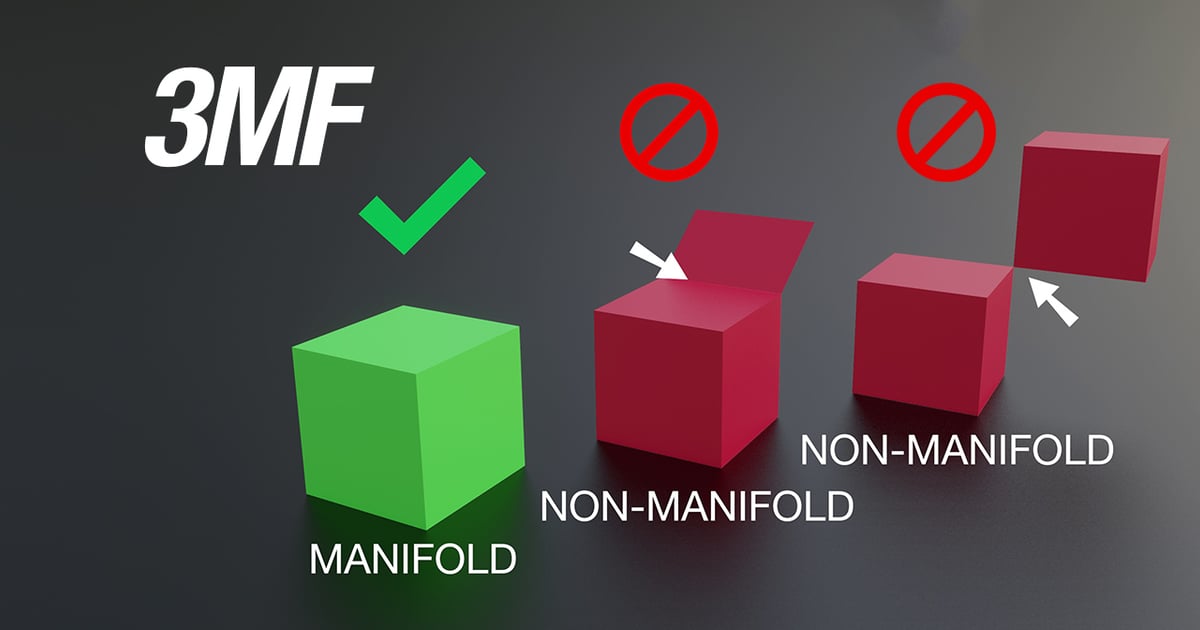
> 3MF provides a clear definition of manifoldness — it’s impossible to create a 3MF file with non-manifold edges, and there is no ambiguity for models with self-intersections.
Even this is enough of a reason for me to prefer using a 3mf if available instead of having to fix holes in a godawful mesh editor. "STL works everywhere" is true only if you consider incidentally non-manifold STLs as an issue with the software that produced them and not the format itself.
I would like to add another technical detail that I don't think is included in the article -- 3MF uses curved triangular tessellations to encode geometry. This means more accurate representations of geometries and smaller file sizes even with high detail.
If 3MF somehow makes self-intersection, and non-manifoldness, impossible cannot we run STL files though the same algorithm to end up with a "fixed" mesh?
What happens if you try to save a non-manifold model as 3MF? Will it magically fix the issue or will it fail to generate the file?
The algorithms and the vector compressions could likely be salveaged, but the whole positioning as a 'replacement' to STL seems like red herring marketing, with lock-in to whatever stdlibs they are providing.
It would have been better as a standard binary format, there are a number of choices...
I'm not sure about the ambiguity mentioned in the blogpost, as ISO standards are usually rather thorough. I suppose it's because most of software implementing AMF did so without the full specification at hand and assumed some things.
For me STL/AMF and 3MF are complimentary. When I design a piece in FreeCAD and want to export it, AMF or STL is good enough as FreeCAD doesn't know anything about the printer I'll be using or the settings I want. But once in PrusaSlicer it makes sense to use 3MF to keep everything tight, for example if I need to move an already configured file from home to the office.
This is exactly how I feel about all this. Logically, 3MF is superior to STL, but emotionally the STL feels like it is about "the model" whereas 3MF feels like it is about "the print settings, with an STL model happening to be in there too".
Wikipedia adds that XML 1.0 didn't come out until 1998 and started in 1996.
> Microsoft
Oh that makes more sense.
This post is (should be) `(2019)`, and 3MF first released in 2015 according to Wikipedia.
Well, thank god they are using a standard, interoperable, widely understood and supported text-based format like XML.
Any other solution would have been terrible, especially if yaml or json were involved.