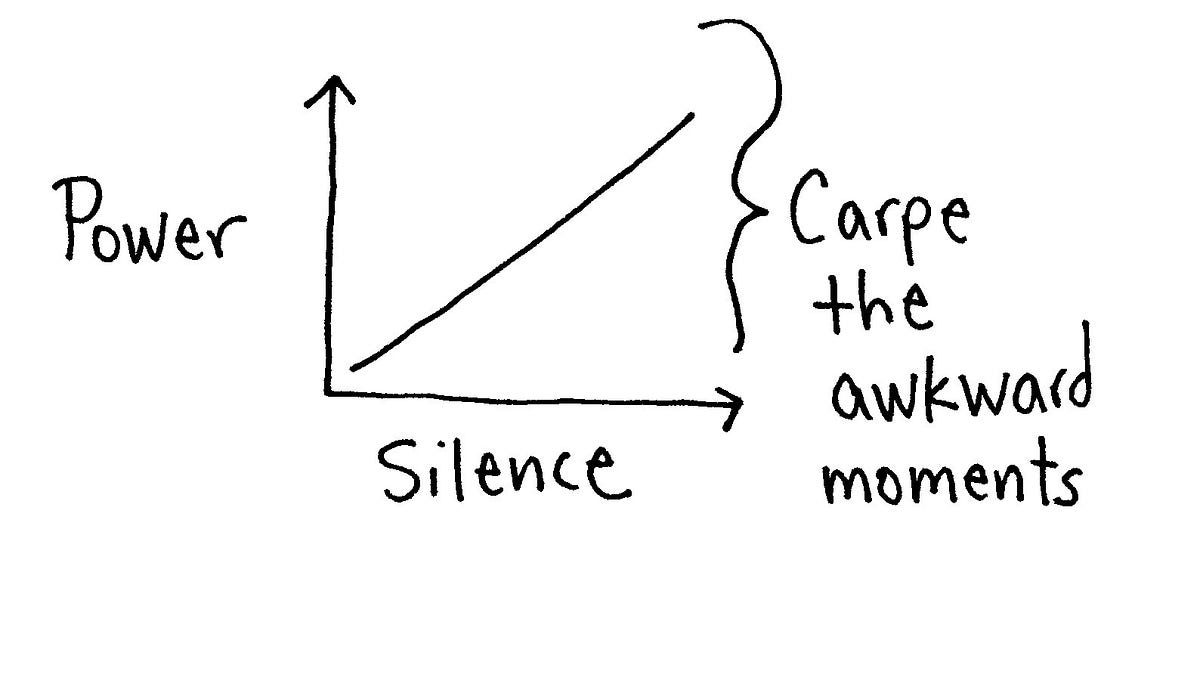
The many gifts of awkward SILENCE.
It's the best reply to questions you wish you weren't asked.
jessicahagy.substack.com
200 points · by jger15 · 5y ago · 80 comments
If the silence is focused on getting yourself to the place where you have the best compassionate, win-for-all decision about how to engage, that's great. If the silence is basically a refusal to have a relationship based in candor, that can sabotage a relationship.
Lots of dysfunctional relationships have a dynamic where one person withholds and withdraws and the other person gets more and more anxious and aggressive because they are desperate for the other person to engage.
Taken thoughtfully and critically, the idea of allowing silence is excellent. We should certainly not fill silence just because we can't accept it.
Silence. Analysis. Strong emotion. Withdrawal. Violent outbursts. Love. Sacrifice. All of it.
Daniel Schmachtenburger talks about this a lot, with lots of examples:
Not all business is zero sum.
Also, cultural differences have a big impact on how we experience silence. For example, in Finland 'active silence' can be a sign of respect and showing interest by concentrating quietly, but some cultures might experience the silence differently than Finns.
So often, both in person and online, I see people asking "can you explain what you mean by..." or trying to break your concern down further. At face value it seems like a good question, but among political types, it almost certainly is a device to either try and reduce your concern to a bunch of little things so small they don't matter, or to tell you you don't understand or have defined something wrong. If you want to stand your ground, its usually better to give nothing, even if you feel like you haven't explained well, or in an online discussion, if you feel like your counterpart has "won" by getting the last comment in.
...I mean, I do this all the time out of a genuine desire to understand the other person's thinking; it's not some ploy to "win" an argument or feel somehow superior.
Why would you want to stand your ground? Isn’t the point of a discussion to learn new information and reach new conclusions?
I don’t think that seeing discussions as a battle to be won is typically a good framework. Even if you reach the point that you consider winning, it is unlikely that much has been accomplished.
For example, if you're asking for a pay raise of $10k and your boss counters by asking why you need more money, it's not in your interest to go down that track.
When people pull this shit on my teams where inappropriate, they are in the cold as far as I’m concerned. Peers need to collaborate, not conduct themselves like apes.
In a natural adversarial context (procurement, legal, audit) that’s a different story.
When a coworker is acting like an ape, a moment of silence can inject some calm into the situation.
It felt like 5 minutes though.
Salary negotiation is one of those things I suck at and don't get the chance to practice a lot either. I wish there were more opportunities to practise
(If this is happening over email, turn a few seconds into an hour or so. Similar practice.)
If you immediately say "no" it could give the impression you aren't interested or even considering them.
By giving a few seconds of silence, it telegraphs, "I'm interested in this job. I'm considering this carefully."
Then, give a counter-offer*. After your initial silence, you can say something like, "That is an interesting offer. I really like $Company, and I want to work here. Could we (don't use I/you, use "we") consider $x+n? I think that reflects my skills and experience well."
And don't say anything else, wait for the other party to break silence. Don't elaborate on your skills, no "What I mean is..." -- they've seen your resume, your code challenge, etc.
It is hard to do, but it can be very effective. Just make sure you keep a polite but firm stance. If they won't move on base pay, move to looking at signing bonuses, equity, etc.
---
* You almost always should do this, by the way. If you are at the point where a job offer is extended, any place worth working at is not going to instantly rescind the offer because you had the audacity to ask. Its letting the sunk cost fallacy work in your favor.
Stay silent, take time to think, show excitement but not too much
Now, I see that the situation may have fallen in the case listed in the article: "You make the situation even weirder—but in your favor. You harnessed the attack and deflected it, simply by letting it linger in the air, like the emotional fart it is."
But on a more serious note: I tried that too. Doesn't work with certain people. Some get even angry, give you a "Let me finish talking!" lecture and continue talking for literal hours. What i started doing, was to just leave. Like, physically leave. Now that probably won't work if you're in a meeting or talking to the boss, so use with care.
edit: unless they're a "serial interrupter" as in sibling comment, we have one of those
I think the article is kind of strange though. It's framed in the context of negotiation and how to respond to questions.
> ...SILENCE. It's the best reply to questions you wish you weren't asked.
And yet, as you quoted, it mentions being attacked.
I think silence is often a good response to insults/attacks, but not in response to questions. The latter is rude and disrespectful.
I was being berated unfairly, verbally abused, accused of things that didn't happen, and gaslit. Instead of defending myself I actually tried the approach laid out in this article: "SHUT UP when you aren’t sure what to say". I wasn't about to defend myself when everything I do is suddenly on trial for some reason.
>The grey rock method is a practice where an individual becomes emotionally non-responsive, boring, and virtually acts like a rock. Emotional detachment serves to undermine a narcissist’s attempts to lure and manipulate, causing them to grow uninterested and bored. The grey rock method takes away what the narcissist needs and desires most–attention.
1. Express disbelief at the offer. You might just repeat the offer with appropriate inflection and body language, like it's hard to believe they are asking that much.
2. Don't say anything, no matter how uncomfortable it gets. Wait until the other party makes a concession.
I suspect professional sales people will be wise to this, but they probably already have a concession they are willing to make to close the deal.
So if a person asks you a question you don't like you just don't answer? Totally ignore them?
Am I missing something or does this seem rude and disrespectful?
I mean, if I'm not sure if the answer, why not, you know, just say so? e.g. "Hmmm... I'm not sure, can I get back to you on that?"
Or in the case of one of their example questions. "Can you work for free?" Instead of ignoring them, how about "No, I can't do that. My policy is not to work for free"?
What am I missing here?
Not ignore, per se. To ignore someone might involve continuing on about something else, for example, which is a much different thing than shutting up. Shutting up might involve making eye contact, raising an eyebrow. Perhaps a pained expression. Nonverbal communication.
> Am I missing something or does this seem rude and disrespectful?
It can be. Some of the questions are rude and disrespectful in their fundamental construction, so responding some in kind might be warranted. Hell, silence might be a hell of a lot more polite than called for.
But silence is not always rude and disrespectful. Consider for a moment a fool who's made an unreasonable ask or put their foot in their mouth. It might take them a moment for their brain to catch up with their mouth - perhaps after wondering a moment why you aren't asnwering, before they put themselves in your shoes and realize what they've done.
You might pause a moment to let them realize this for themselves, without having them suffer the added injury and injustice of you explaining, spelling out, and spoonfeeding their error to them as if they were incapable of realizing it for themselves, if only you'd be so decent as to just give them a moment. Or two. Letting them do their own self-critique may lessen their guard and defensiveness, as you won't come across as wanting to tear them down. Of course, this won't work well unless you can respect and trust the person to actually do such things.
In this case, if you squint hard enough, saying nothing could be seen as an extremely simplified version of the socratic method - the implicit question being perhaps "do you realize what you've just said/asked?" or "and what do you think I think about that?"
What the blog is suggesting only really works when communicating face to face, in person. But if someone asks me if I can work for free, and I simply stare at them, I think the most likely outcome is that they realize they've made a mistake by asking it and back peddle, or say something stupid.
> But if someone asks me if I can work for free, and I simply stare at them
Again, I think a better solution is to politely decline. It shows respect for the other person and I think it increases the likelihood of reciprocated respect. I don't see how ignoring them is better.
Disagreement/conflict is not necessarily rudeness. And "respect" has to go two ways; the silent non-response is often a good way to say "what you just said was vaguely insulting" (e.g. can you work for free) so I'm not going to dignify it with a response.
When someone doesn't want to discuss an issue to mutual conclusion (if only agreeing to disagree), don't discuss.
When someone's statement/question speaks for itself, don't speak for it.
c/f gaslighting as others have said. If you chose to be only passive in all conversations, you aren't sharing knowledge: you may be acquiring it, but across the specifics of a relationship this is in effect weaponised information asymmetry.
Seems like in the context of emails, silence is just ghosting, and is unprofessional. (Hope I’m wrong)
Being a jerk can yield benefits. See Psalm 37.
I am also including a very extreme example of silence being used for manipulation purposes by You Know Who, just before a speech before a hostile crowd. The Mexican artist Diego Rivera describes this in his autobiography, My Life My Art:
A few days later I saw Adolf Hitler address a mass meeting in Berlin, [...] As he prepared to speak, Hitler drew himself rigidly erect, as if he expected to swell out and fill his oversized English officer's raincoat and look like a giant. Then he made a motion for silence. Some Communist workers booed him, but after a few minutes the entire crowd became perfectly silent. As he warmed up, Hitler began screaming and waving his arms like an epileptic. Something about him must have stirred the deepest centers of his fellow Germans, for after awhile I sensed a weird magnetic current flowing between him and the crowd. So profound was it that, when he finished, after two hours of speaking, there was a second of complete silence. Not even the Communist youth groups, instructed to do so, whistled at him. Then the silence gave way to tremendous, ear-shattering applause from all over the square. As he left, Hitler's followers closed ranks around him with every sign of devoted loyalty. [...] [Muenzenberg] had been watching Hitler, then nearly at the other end of the square. He had noticed that the crowd was still applauding. Before leaving the square, Hitler turned and gave the Nazi salute. Instead of boos, the applause swelled. It was clear that Hitler had won many followers among these left-wing workers.
So you know, it CAN be a dick move.