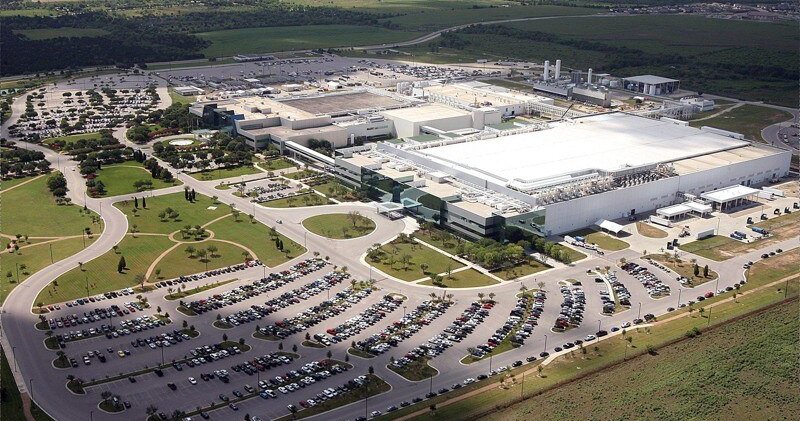
Samsung plans $17 billion chip plant in Taylor, Texas
The first major investment decision from paroled leader Jay Y. Lee
datacenterdynamics.com
587 points · by kungfudoi · 5y ago · 428 comments
Taylor is an ideal place for a large manufacturing operation since it's close to major highways and railroads, not too far from Austin, and land is very cheap.
*was
I'm between Taylor and Austin (Bagdad Rd, Leander). 1 acre lots along this strip have gone from ~$115k a year ago, to some recent sales at ~325k.
I can't imagine Samsung would put a plant in a 3rd world country like Texas unless they were getting significant tax deferrals from the state.
For anyone wondering, this is a unit of energy (100 nJ):
Apparently natural gas isn't easy to store, so basically there's not a lot of buffer, and everything needs to stay online or there won't be any natural gas to burn at power plants even if they were winterized, which some of them were.
I think some power plants may have even just shut down because natural gas was available but too expensive, and they weren't under a legal obligation to keep producing electricity.
Point being, to solve the problem, winterization of plants is just part of the problem.
https://www.ferc.gov/media/february-2021-cold-weather-outage...
Of course they said a bunch of things and made a bunch of recommendations the last time ERCOT fucked up, and they didn't listen to nearly any of them, so I would expect the same this time.
If you watch local news reporting, it's hilarious that they (politicians) have no idea what the "factory" does. I'm personally highly doubtful that a fab which hasn't broken ground will be producing viable 5nm at the 2H of 2024 as claimed (or cyber trucks for that matter).
Samsung for years has had a major facility outside of Austin.
Samsung Austin Semiconductor https://goo.gl/maps/nX9BFxHoVMCVKBLL7
And ERCOT is also based outside of Austin.
Austin is also the state capital, centrally located & home of one of the nations largest universities (UT), who has a strong engineering & CS program graduating thousands of students per year.
So it shouldn’t be a surprise that major companies have a significant presence in or around Austin.
Taylor was chosen because that area (northeast of Austin, just south of Taylor) is one of the last areas near Austin that has abundant amounts of wide open fields ready to be developed. They also got a good deal on the water usage, and of course the tax breaks from Williamson County.
My understanding is when you cross east past round rock towards Hutto/Taylor, the water aquifer being used changes to use water piped over from Carrizo-Wilcox aquifer.
In my experience (former firefighter here), it absolutely does. It also varies by call type, time of day, etc. So if we got a call at 2:00 AM and there was no traffic on the road near the station, we might leave the station with no siren out of respect for the people trying to sleep in the homes very close to the station. This would be more true if the call was a lower priority call in the first place. OTOH though, if the call as "residential structure fire with occupants reported trapped" our focus would not be on sleeping neighbors and there's a better chance that we'd be getting on the Q pretty much right out the door.
Another factor for us was that our station was right next to an intersection that was very busy at times, and known for many traffic accidents. So any call where we had to turn left (towards the intersection) out of the parking lot, there was a better chance we'd be hitting the siren and air-horn pretty much right from the jump.
Anyway, yeah, net-net, this is going to vary based on lots of factors: department policy / culture, geography, time, traffic, etc, yadda yadda.
Other things which are bothersome about a firehouse…
• They put the communications radio on some sort of loud speaker sometimes, so you get to listen to all the calls in the city.
• They have some sort of turbine that runs a lot. Maybe a hose dryer? I haven't gone to ask, but when I used to do audio recordings there were days we couldn't record because of it.
• Their backup generator optimizes efficiency by minimizing the muffler. The tests are pretty loud.
• The building department made me block up the windows on their side because I was too close to the property line and a fire might spread to the fire station. I say if the fire department can't keep fire from coming out my window and setting fire to their building 60 feet away, that's at least partly their fault. :-)
• They are a multi-tier bureaucracy. When their tree slowly fell over on to my building it took many months to get them to admit it was their tree and maybe they should cut it down. Lots of finger pointing between the fire department and various city levels and a few "dead parrot" conversations with different functionaries.
My main concern would be all of the communications equipment they typically have. Being that close to high powered transmitters can cause annoying interference.
I know I would attempt one. Try nice and some charm and see what comes of it. May end up popular with neighbors.
But power came back quickly, because I was on the same trunk as the fire station.
So do large grocery stores, for obvious reasons.
There have been literally hundreds of other grid disasters in New York, Chicago, the entire state of California, and yet no one would be surprised if the plant showed up there. Why?
Companies that are planning new nuclear units are currently indicating that the total costs (including escalation and financing costs) will be in the range of $5,500/kW to $8,100/kW or between $6 billion and $9 billion for each 1,100 MW plant.
Running an entire leading edge semiconductor plant on battery backup is a crazy proposition in my view. Especially, for intentions of surviving another Texas winter situation without any disruption to operations. Approximately 24 hours of full-coverage battery backup would have been required to bridge the rolling blackouts.
Last I checked (about a decade ago), the SAS A2/S2 lines accounted for ~13% of the electrical load for the entire city of Austin. Just look at the amount of power one EUV light source requires today. These lines will have potentially dozens moving forward. Then consider that all of the photo area accounts for a tiny fraction of total power consumption in one of these plants.
If it were even remotely feasible for the Samsung semiconductor lines to operate on standby generator power, they would have installed these units already and no losses would have been incurred.
They might as well be smelting aluminum behind those walls. Any backup generator power or UPS devices are designed for life safety and stopping the line without causing 10+ figure losses. You cannot run one of these facilities on in-house power. Another commenter proposed a nuclear reactor installation. This is actually not a terrible idea once you understand the scale. Putting 10-15 semiconductor lines around a nuke plant makes perfect sense to me.
[0] https://pitchbook.com/news/articles/the-bay-area-beyond-rank...
[1] https://www.cnbc.com/2021/01/14/silicon-valleys-share-of-ven...
Uh, maybe it's time to take a drive through Austin, but that was a pretty sleepy little college town 10 years ago. Most of my family lives in the central Texas region (San Antonio, San Carlos, College Station), and I presently live in Mountain View. I have a hard time believing SF-scale infrastructure was built that fast.
As an example, here's the UT wind tunnel: http://research.ae.utexas.edu/floimlab/Mach5.php
Here's the Moffett wind tunnel complex: https://www.nasa.gov/centers/ames/multimedia/images/2005/nfa...
According to wikipedia/some google-fu SV has just above double the high tech jobs as Austin
Not quite what you were asking about but it does deal with the TX grid.
I very much love the people I worked with at SAS. It was one of the best experiences of my life and I'm very happy to see them expand like this.
Wayne at Louie Mueller's BBQ had better add a few more pits, they're about to get a lot busier!
If you want to work on one of the processes in the fab (metrology, chemical vapor deposition, photolithography, etc) then an engineering degree (especially chemical engineering) may be your best bet.
If you want to design the chip architecture, then computer engineering is the degree path you want. Samsung has their own chip design subsidiary in Austin too, over on Highway 360 in west Austin, if I remember correctly, called SARC.
Austin Community College has associate degree programs designed for technicians.
I was a software engineer responsible for many of the internally-facing enterprise systems, as well as the intranet. I worked with all of these engineering departments on many different projects, so I had exposure to and visibility into many functional areas and processes of a truly global, high-tech manufacturing concern. In one of the random ways the universe has rolled the dice in my favor, one day a recruiter called me and asked, "Would you like to work for Samsung?"
These people told me that if you got hired into Intel, it was almost always as a design verification & validation engineer, and that getting an actual design (architecture) job was near impossible (especially as a recent graduate, even with an MS).
Is it the same for Samsung?
Samsung also recruits directly from Texas universities. I remember many Longhorn and Aggie engineers being hired straight from school every year. I don't know what your school situation is like, but I can also get you information about how that pipeline works.
I started in application engineering with an EEE degree, built a name for myself there over a couple of years, and made my intentions known once I built a good repertoire with my manager and mentors that I wanted to transition into chip design. They helped me network with the right people, and the chip design team took me on. Some of the skills I learnt at university, most of it I learnt on the job.
Networking > Qualifications to be honest. On the team we had Physicists, Electronics Engies, Comp Scientists, ML Engies, Mathematicians, Chemists and so on. Provided you can get a foot in the door and convince them you've got some skills that would be of use, then you're good.
Graduate degrees in physics and EE focused on semiconductor physics and manufacturing are also useful. I've known a few post grad/doctoral folks from nuclear engineering and optics that have careers in the field.
The courses we took had labs starting from soldering physical components on boards (actually wire wrapping) to hardware design tools.
After graduating, I went to work for Mentor Graphics, (now a division of Siemens). They create chip-level design tools of all kinds, the big moneymaker back then was Calibre Parasitic Extraction.
They also sell PADS, a PCB design tool that was popular. I did lead gen for both these products and steered away from design and into software.
However, you could go to work for any of the electronic design automation (EDA) companies and ultimately learn the design tools at great detail which might be a way to jump into a position on a design team.
At the very least you would be in a position to build a professional network with chip designers.
What color is the boat house at Hereford?
I reckon it's blue.
After working for Dell and some small start-ups for a while, I now help the federal government in various ways. I started working remotely full time in 2017 and live in the Hill Country. This is me.
https://www.linkedin.com/in/jason-phillips-2505a0187/
> As I've also primarily worked on in-house software only, I'm finding myself less and less competitive... Did you find a solution?
Yes, I had to solve this myself. Study, study, do side projects and then study some more. You have to become an expert in something on your own time. Whether that's full-stack software engineering, DevOps/SRE or whatever, spend six to twelve months studying and creating side projects. Create an AWS account for the free tier and get after it. When you apply, make sure to demo and speak to your side projects. In 2015-2016, I learned React, Angular, Nodejs, studied Kyle Simpson's "You Don't Know JS" series, Docker, AWS, and Python. That, combined with my enterprise full-stack development experience, was good enough back then.
I think it's easy for the grass to look greener somewhere else from where you're sitting, but I can tell you Samsung took really good care of me and was actually better run than most companies for whom I worked afterwards. Feel free to reach out if you have any questions.
Indeed, they will likely be busier.
Franklin's is a religious experience, imo. I went there several times with some SAS co-workers back in ~2013 when Aaron was still the cutter. Great times.
https://www.taiwannews.com.tw/en/news/4327937
Morris Chang spent 25 years (1958–1983) at Texas Instruments.He knows US very well.
Anytime someone says "impossible", I would take that opinion with a grain of salt.
  Manufacturing Equipment (12%):
  US: 40%
  Japan: 32%
  EU: 18%
  S Korea: 4%
  Taiwan: <1%

  Wafer Fabrication (19%):
  Taiwan: 20%
  S Korea: 19%
  Japan: 17%
  China: 16%
  US: 12%
  EU: 9%
[1] https://www.semiconductors.org/wp-content/uploads/2021/09/20...:
Or to quote Arthur C Clarke:
> When a distinguished but elderly scientist states that something is possible, he is almost certainly right. When he states that something is impossible, he is very probably wrong.
In their ongoing series on supply chains, the Odd Lots podcast had episodes on both TSMC and ASML:
* https://podcasts.apple.com/us/podcast/the-story-of-how-tsmc-...
* https://podcasts.apple.com/us/podcast/asml-the-obscure-power...
It’s essential to TSMC survival for their production to physically stay focused in Asia.
It is impossible with respect to current cost structure, without substantial government money, while getting the same margin. Of course it is entirely possible to throw money at the problem and succeed. Which is what Intel is trying to do right now with the help of US government.
He can be "exceptionally clear" and still biased in favor of TMSC.
> It is impossible with respect to current cost structure
Well, we'll have to pay a few cents (or dollars) more per chip then. It is infeasible for us to continue to depend on TMSC in the long term - it will be taken over by our largest geopolitical adversary by 2030 at the latest. We do not have a choice but to either on-shore, or shift production to countries with far less geopolitical risk.
Unfortunately at the same time for Taiwan, once the West's reliance on that area of the world for production becomes less of an issue, China's timeline gets accelerated much faster to the "No but really you're part of the PRC" point. Similar to how the PRC ratcheted up control over Hong Kong in 2020 when the rest of the world was basically "Sorry HK we got COVID issues k'bye"
I'd pay double right now for GPUs directly from the source, not from some sketchy third party.
Right now our EV/auto, space and even AR/XR industries as well as gaming and everything that requires chips, we are at the mercy of an external market that has a slant against the West. It will take some years to get out but we'll never not expect that in the future again. If costs go up costs go up, but availability should never be allowed to be used as leverage again, that is too risky and too costly long term.
Availability that is reliable is always more important than efficiency or cost, because right now lack of availability is costing lots of extra time that has the potential to lose entire industries, that is not acceptable in any way.
Very little margin and too much optimization/efficiency is bad for resilience. Couple that with private equity backed near entire market leverage monopolies/duopolies/oligopolies that control necessary supply and you have trouble.
HBS is even realizing too much optimization/efficiency is a bad thing. The slack/margin is squeezed out and with that, an ability to change vectors quickly. It is the large company/startup agility difference with the added weight of physical/expensive manufacturing.
The High Price of Efficiency, Our Obsession with Efficiency Is Destroying Our Resilience [1]
> Superefficient businesses create the potential for social disorder.
> A superefficient dominant model elevates the risk of catastrophic failure.
> *If a system is highly efficient, odds are that efficient players will game it.*
Hopefully that same mistake is not made in the future. It will take time to build up diversification of market leverage in terms of chips for availability. Hopefully we have learned our lesson about too much concentration, with that comes leverage and sometimes a "gaming" of the market.
This chip shortage, and all the supply chain problems during the pandemic as well, will hopefully introduce more wisdom and knowledge into business institutions that just because things are ok while being overly super efficient, that is almost a bigger risk than higher prices/costs. Competition is a leverage reducer. Margin is a softer ride even if the profit margins aren't as big.
> a full chip supply chain in the country
(emphasis mine)
TSMC is, after all, ALSO building a fab in the country, so it's not like TSMC doesn't believe in onshoring chips to the US. The fabs are {high capital expense/high recurring expense/high skilled labor} operations so the US is very competitive due to the labor value-add. Not every part of the full supply chain is like that.
To serve (aka reduce risk to) US supply chain interests in the short term, you also don't need access to the full stack domestically. You could potentially send a lot of activites that need low-skilled-labor to, say, Mexico, which is a much lower supply chain risk that Asia (aka thailand, vietnam, china). National security onshoring, which possibly has less tolerance for even outsourcing to Mexico, is likely a different story and more aligns with Morris' statement.
Depends on what the dream is. Bulk onshoring? Probably not while the geopolitical situation stays on the status quo.
But I don't think that's the attempt we're seeing here anyway. I think what we're seeing is the foundations built for the capability to bootstrap more robust manufacturing in the West if/when China decides that Taiwan really should stop claiming independence, and perhaps at the same time exerts its local power over that entire region of the world and thus South Korea as well.
With any luck, COVID (and tariffs) has transformed business for the future.
Until we're far enough removed from the situation, everything is comfortable again, and the MBAs start saying "you know, if we just offshored fabrication..."
However, in this case, South Korea is also a close US ally. There is little risk to the US that the headquarters of Samsung is in South Korea.
Rough order of magnitude, but for a lower cost wafer (think like 90nm or above, not 7nm), electricity and energy could be about 10% of the overall cost. As a lot of the capital cost of the automation and industrial equipment is the same wherever in the world you are, that might be an important factor.
Taiwan is an island that imports almost all of its energy. Texas is an energy rich state with lots of wind, solar, and especially natural gas that is exported to the world.
We talk about higher natural gas prices in the US with Texas seeing slightly above $4/MMBTU, but LNG prices in Asia are above $35/MMBTU at the moment, nearly an order of magnitude higher. The government of Taiwan is basically eating half the entire cost of LNG right now to keep costs low for businesses and consumers, but that’s not a sustainable strategy. (At the moment, industrial electricity is about 13¢/kWh in Taiwan even with the government subsidizing most of the LNG cost and 7-8¢/kWh in Texas.)
This is 100% politically motivated.
Purifying and growing high quality wafers is very, very energy intensive. This becomes more important as Moore’s Law slows and more of chip costs become just the wafer costs.
But the main reason Texas comes up is it has a very long history in semiconductors with a big workforce and lots of semiconductor companies.
In general I wouldn't expect US manufacturing to do a lot to lower production costs. More capacity in general obviously helps, and I could definitely see the US doing a lot to subsidize domestic production, if that counts as bringing down the costs.
Maybe higher wages will lead to more automation.
Samsung Austin Semiconductor has been fully automated since 2008-ish. One number I was quoted was that you only need 19 technicians on the floor to run the fab, compared to 500+ pre-automation.
You might be suprised how automated it already is [1]. Notice the OHTs (Overhead Hoist Transport)[2] running on a system of highways and superhighways on the ceiling. Each of these OHTs carry a box inside it called a FOUPs (Front Opening Unified Pods)[3] carrying upto 25 wafers. That can easily be worth $1M+ per box. They have standardized JEDEC interfaces so any process tool can accept a FOUP and get wafers out of it. The environment inside these FOUPs is ridiculously clean and each one costs $15k for what most people would think is a plastic box with a door in the front. FOUPs are used internally. If wafers are shipped, they're shipped in a similar box called FOSB or Front Opening Shipping Boxes [4]. These boxes are the reason automation happens with standardized "APIs". We don't need to know who made the process tool to hand them a box of wafers.
Another automation feature are the AGVs or Automated Guided Vehicles [5] that carry the same FOUPs and FOSBs [5]. They also can be equipped with a robot arm that takes a wafer out of the box and hands it over to the tool. The AGVs run on specialized roads inside the Fab and remains docked on the tool during processing.
Usually, there are hardly any humans around the tool. Material (wafer) is fed by AMHS systems, picked up by the same. Fab is probably one of the most automated manufacturing places out there. Way more than Automotive manfacturing.
If you're looking to do software engineering, I would highly encourage people to go work in semiconductor industry. It is just a fucking cool place and lot of room for improvement still.
[1] https://www.youtube.com/watch?v=MRlcZqqyBM8
[2] https://www.muratec.net/cfa/products/
[3] https://www.entegris.com/shop/en/USD/Products/Wafer-Handling...
[4] https://en.wikipedia.org/wiki/FOUP#/media/File:Front_opening...
[5] https://www.muratec-usa.com/machinery/clean-room/transport/A...
Also, Austin (and other parts of Texas) already have a fair number of chip fabs, and have for decades. I used to work in some of them. Samsung even has existing fab capacity in Texas. So it's not such a new thing.
The related chip shortage finally woke up the US gov on supply chains.
My question is why did it take this long? I have been worried about this for nearly a decade.
My next question is how many mask factories have we built in the US since we realized that was important?
There's a guy with a small company that makes N95 masks in the US. He got pissed when they came looking for a production increase. He would be happy to increase production, but nobody was willing to buy from him long-term. They'll just go back to importing cheaper product (probably from China) after the crisis is over. He basically told them to go pound sand.
I just Googled this and it seems a bunch of companies tried to increase production: https://www.nytimes.com/2021/02/10/health/covid-masks-china-...
The original guy basically said nobody wants to pay for anything, and I think he's right.
America needs to make steel again. Plastics. Chemicals.
We need to make electronics, fertilizers, tools.
Everything we need should be onshored. Especially if we expect a cold war with our biggest producer.
In general, I'd say we've been able to deal with issues by outbidding other countries and exerting international political influence.
> My next question is how many mask factories have we built in the US since we realized that was important?
We're so bad at building.
I'd add to your question with: how custom-built do factories need to be to be efficient?
I expect chip fab is very tailored, but can a t-shirt factory quickly pivot to surgical masks? How about N-95? Can a vacuum cleaner factory start building ventilators? How about HEPA filters? mRNA vaccines?
What are critical things we may need to ramp up rapidly, not just for pandemics, but for the next disaster, and can they be done without building dedicated factories just for those items?
Humans are fabulously general-purpose, so I'd imagine that the more automated the process, the more expensive it is to switch. This would put high-wage countries like the US at a disadvantage with regard to flexible domestic manufacturing. But I've no expertise in this area at all.
These are questions and guesses, not questions and answers. :-)
Look at the billions the US spends on military, all of it domestic. In US, the masks are simply less important than all that, as is healthcare in general.
It's not important. Masks don't effectively stop the transmission of SARS2 and N95 masks are only highly effective against something as infectious as SARS2 Delta if you wear them precisely as intended (and to go with that you need to take many other precautions that the mass population is never going to take with great precision on a day to day basis). Even the vaccines don't stop Delta effectively, which you can plainly see from the large outbreaks in highly vaccinated nations.
> My question is why did it take this long?
Because the US Government spends nearly all of its effort on dumb shit, like shuffling papers, playing at admin, processing lobbyist appointments, screeching out empty promises every 2-4 years, going on talk shows and managing PR, managing a globalist superpower clown show, projecting power to every corner of the globe for no great reason other than to fulfill the powerlust of those in control.
They're supposed to be running our government for our people. They're simultaneously running the equivalent of one of the world's largest governments outside of our borders. Think about that for a moment. Do I think the people in power can run the US Government, domestically, effectively? Hell no. Do I think they can then simultaneously run a gigantic other foreign system - military bases, personnel, war, huge embassies, global trade, sticking their noses in every foreign political issue and at all times - on top of that? Triple hell no.
If that happened, I'm curious what other manufacturing/product issues would impact other countries, and how long it would take them to adapt.
E.g., what tool manufacturing, raw materials mining, etc. are currently happening only in China and/or Taiwan?
And that's assuming that China didn't also sabotage industrial capabilities in other countries that depend on Chinese/Taiwanese manufacturing.
You're like a middle school kid who justifies violence with "talk shit, get hit."
How much does China pay you to shill on here day after day?
[1] https://www.forbes.com/sites/michaelpeck/2020/08/11/north-ko...
We have fabs in the USA right now. To speak of Austin alone, Samsung's own S2 has been here since the late 90s, and there are a handful of others here, too.
If we buy local, it creates domestic jobs. Wages go up too.
We need to onshore more.
The effective erosion itself is a policy choice, there is this thing called 'minimum wage' which you can use to make sure that there is more than just 'warm bodies' as the lowest common denominator in job requirements, and as a result everything above that has to be 'upgraded' to a higher standard as well, otherwise people aren't willing to do the work (just like is happening now). The examples are all around you.
There is no onshoring of talent or natural resources since they are not 'constructed' the same way and importing those are against the current ideas/fears of immigration and relying on third parties for goods.
In other words: globalisation isn't a choice, it's a side-effect from the needs of humanity. Reverting to a more primitive state that decreases those needs could be a path, but I doubt anyone would choose that willingly.
Besides those things, there is this concept of ideals or principles which are almost as important and it doesn't require any extreme form of meddling either. If people really care about something (say, the well-being of other humans and therefore not really being happy with an authoritarian regime somewhere) then that can be incentive enough. And if it isn't then some protectionism won't be enough either.
> We need to onshore more.
Simple solutions to overly complex problems is not the answer.
First, manufacturing output has steadily increased since the 90s. https://fred.stlouisfed.org/series/INDPRO
Second, the number of manufacturing jobs have steadily declined since the 90s. https://fred.stlouisfed.org/series/MANEMP
How is this possible? Automation. These plants aren't creating US jobs and increasing wages, they're simply creating more wealth for corporations which they would have done anyway overseas. And since Samsung is a Korean company, the wealth is being created in Korea, not the US.
They're also resolving some pretty serious national security concerns, so...
Yeah I mean look at how China has grown the last 25 years with their fully open markets. </sarcasm>
Every approach has pluses and minuses. Putting your own first is common and healthy. The US has been failing to do this for some time now, and the economy is pinned in a corner with no easy way out.
And you can make trade better for everyone period if you redistribute some of the gains of trade to those that it makes worse off. But… we don’t always do that…
It's not protectionism. It's anti-fragility. It's having strong domestic capabilities to meet our every need and not suffer when the world is uncertain.
It's having jobs and prospects for our future generations. The hope Millennials and Gen Z have is dim, and I can point my finger at a huge contributing cause.
Europe: https://www.reuters.com/world/europe/tech-is-make-or-break-i...
Germany: https://www.infineon.com/cms/en/about-infineon/press/press-r...
Korea: https://fortune.com/2021/05/13/south-korea-chip-semiconducto...
Japan: https://www.aroged.com/2021/11/23/japan-has-allocated-5-2-bi...
Non-OP USA: https://9to5mac.com/2021/06/09/us-chip-production-52b/
Key players are expecting an all out war with China:
France: https://www.economist.com/europe/2021/03/31/the-french-armed...
Taiwan: https://thediplomat.com/2021/10/taiwan-says-it-is-preparing-...
Australia: https://au.news.yahoo.com/chilling-warning-of-australias-rol...
AUKUS: https://www.theguardian.com/politics/2021/sep/16/what-is-the...
Japan: https://hamlinemidwayhistory.org/japanese-aircraft-carriers-...
China is fully aware of the cold war: https://abcnews.go.com/Business/wireStory/chinas-leader-xi-w...
Let me blow your mind far more:
https://en.wikipedia.org/wiki/Pentagon_UFO_videos
These aren't hillbillies. This is US government technology recording and confirming UFOs.
https://www.cbsnews.com/news/pentagon-ufo-report-released-ma...
And nobody is talking about it? This is completely related to the war with china.
It's all an attempt to prevent war with China. Though that does mean a peasant revolt in china is coming.
> It's all an attempt to prevent war with China.
So the Chinese have UFOs and we have a war with China but we are moving chip production to all these countries you mentioned to prevent the ongoing war with China?
I’d like to give you the benefit of the doubt here though. I think if you were able to be a little more clear I’d at least understand what you intend to say, but I find your comments here a bit confusing.
> And nobody is talking about it? This is completely related to the war with china.
Who isn’t talking about it? Assuming you’re talking about poor relations (“Cold War”) and/or loving chip production. It seems to me to be pretty common knowledge and is widely reported in global media sources and the Internet. Don’t the links you provide demonstrate that?
The UFO releases are either about telling China that we are aware of and can track their surveillance assets, showing China our new highly advanced classified assets, or else demonstrating the superiority of our current Air Force assets.
Both activities serve to dissuade the Chinese military from taking aggressive actions.
Is it China's UFOs? I don't think so.
https://www.cnbc.com/2020/02/28/elon-musk-says-the-fighter-j...
Elon is 100% correct the fighter jet era is over. Did you know Elon was on Trump's tech council? https://www.engadget.com/2017-06-01-elon-musk-leaves-trump-c...
>I’d like to give you the benefit of the doubt here though. I think if you were able to be a little more clear I’d at least understand what you intend to say, but I find your comments here a bit confusing.
The blow your mind factor is hard to address because of the roswell factor. I 100% don't believe those UFOs are extraterrestrials.
>Who isn’t talking about it? Assuming you’re talking about poor relations (“Cold War”) and/or loving chip production. It seems to me to be pretty common knowledge and is widely reported in global media sources and the Internet. Don’t the links you provide demonstrate that?
I guess I didn't make that clear. Obviously it's being talked about.
I guess step back for a second. The war with china is obvious. I never even talked about cyber aspect of the war, its not relevant exactly. A nuclear bomb is going to do more in the war than some BGP route stealing tech. The irony of it all, it's China's capitalist zones that are going to be robbed for 'common prosperity' at the same time that the cold war kills those zones like Evergrande situation.
If there's danger of a peasant revolt, war with the US would be a pretty effective way to prevent it.
French Economist article archive: https://archive.md/fcTkA ("brigades, or a division" sure doesn't sound like WWII)
Grauniad AUKUS article archive: https://archive.md/LFsoo
Lots of militaries prepared for conflict. OK.
What do the pentagon UFO releases have to do with war with China? You say it's completely related, would you elaborate?
And a peasant revolt in China? That's a big statement and I'd like to know more about your reasoning.
Yes, if there's one thing we should have learned from WWII, it's that capitulating to land-grabs results in the bad-actor stopping. If we just let them take over the entirety of the South China Sea, Taiwan, and maybe just half of the African nations they've been lending money to who will never be able to repay their debts, they'll definitely be satisfied and stop. Korea, Japan, and India have nothing to worry about. Nothing at all...
Noam Chomsky recently wrote similar to this. The military threat is really against china.
The point of a cold war is to prevent a real war. So when you hear about dick waving of the US military and allies. IT's about warning China from doing anything.
Housing alone is such a huge knock against CA for new companies. Even paying somebody 500k there leaves them feeling middle class when trying to raise a family.
Perhaps a bit of an exaggeration, but in Texas they build like crazy to support population inflows. If you drive through Austin you'll see every third or fourth house is getting torn down to be rebuilt into 2-3 houses on the same plot.
Fundamentally this just gives you a lot more runway to grow.
I don't know why anybody would start a company in SF these days, aside from VC being local and sometimes requiring it.
I have no doubt Texas will overtake CA in terms of economic output, but will take decades just due to previous inertia. Also remote work may be the true winner in the end.
I do think CA is still the place you want to be if money is no object though. Unfortunately that doesn't apply for most people. There may actually be a change in political winds that blow things back the other way though, just viewing this from today's lens.
There's been a lot of talk about Texas "turning blue" over the past few years and I wonder if these companies either moving their operations or building new plants there could be the tipping point.
- I am very much against TX's policy on this. However, how many people are affected by this policy Vs how many kids will be denied Algebra in CA now?
It is never 100% all good or bad policies in any place. It is always a mix. Rational people chose what's best for them and their loved ones overall.
Also, that was just a single example. If you want to stick to education, Texas lawmakers have also been trying to push a book ban for public schools just this past month.
There's also a bill targeting the concept of critical race theory that would ban curriculum where “an individual should feel discomfort, guilt, anguish, or any other form of psychological distress on account of the individual’s race or sex.”
This is significantly different from pros/cons like high taxes... there's a fairly strong current of anti-intellectualism across Texan politics.
I'm not sure these two things are meaningfully related.
> It is never 100% all good or bad policies in any place.
This argument works for about any systemic harm one can think of.
I mean, I get that some folks are into that but still.
As far as VC money goes, Texas has a ways to go.
Also California recently tried to pass a horrendous Prop 16 to enable outright race and gender discrimination in admission process. Luckily it didn't pass, but the politicians who supported it (Newsom, Harris) are still here to do damage.
We need a true industrial policy and state capitalist system similar to what Japan, South Korea, Taiwan, and Singapore have.
It seems the only thing those places are teaching is how to join a company, strip it to the bone, hype up the short-term 5% growth, and get millions of dollars in raises.
Or a system that depends on "voters" to know any of the nuances and details of manufacturing and supply chain importance, or actually vote with long term broad national interest in mind, instead of short term, out of narrow self-interest, and largely be ignorant of all manner of political, economic and other issues.
I would agree that onshoring more of the supply chain makes a lot of sense, but I think it must be an economically viable solution. I don't know exactly how to do that, but things like having a guaranteed market (like we do for food) might be part of the solution.
By the time you could produce such a focus of the industry, it would already have moved on and require different inputs that are not in that country.
To centralize all of this in one country is most likely impossible. It's not even a matter of throwing money at it. $100 billion won't get you there.
You're not half as amazed as Xi is.
> Yes, it will raise prices in the short and medium-term,
Right now we have cutting-edge fabs in Taiwan and Korea. If we were to follow your recommendation, we would also have them in PRC, USA, Japan, Germany, the UK, India, France, Italy, Canada, and Russia, at least. In fact, that's more or less how things used to be. The difficulty is that this would mean increasing world fab investment by a factor of 6, which would probably make them all unprofitable until chip prices also increased by a factor of 6. Permanently.
However, there is still one country that uses this policy: North Korea.
At what point do goods go from being non-critical/strategic to being critical/strategic? At what point did car companies have to worry about chips being "critical"? At what point did smartphones become "critical" to people's lives?
Things were not critical at all, and then when few people were looking, they moved across the spectrum to an area part that is considered critical by some measure.
Our public transit woes also demonstrate how little US politics cares about details, and how much they stomp all over the independence of a civil service that would.
So, I think, at least with regard to chips, your dream is coming true.
And no, rare earths are not contained in semiconductors specifically, but I assumed the parent comment wants to onshore more production than solely semiconductors, and rare earths are needed for lots of essential electronics.
You forgot China. If you institute strong controls over industry in a country the size (and culture) of America, you won't get Japan, you'll get China, and the corresponding anti-features of their system (such as authoritarianism in general, and companies acting as agents of the state in particular).
Very few people want that, and certainly not me.
There are far better ways to build robust manufacturing systems than complete government control.
If the supply chains have very little slack and products are designed with minimal material inputs, sure there may be some availability hiccup here and there, but how bad is that really and by what metric. At the same time many more people get to have access to modern goods due to lower costs and less unneeded material, less is wasted due to inventory stockpiling, and we are overall more efficient.
It even nets them a cool 3 billion dollars to do so, which I'm fairly sure is very welcome given Samsung's history of reinvesting this kinds of money for political gain.
I do wonder why this isn't more common though, pretty much every gigantic company already has an administrative arm in the US, it sounds like it'd make sense to move at least some of their production side there too.
On the other, do you happen to have sources for all that? Specifically,
- That the cost of this plant is going to be in any way excessive/odd compared to, say, TSMC's plant basically next door
- That the level of technical expertise required is inordinately hard to train in the US
- That the air freight from (also, why air freight specifically?) prices to and from there are a constant, easily disregardable thing and will continue to be so
Would help a lot to ground the conversation in reality a little bit more.
Perhaps other states are not willing to top the gobs of money Texas offered to Samsung. The Amazon HQ2, race-to-the-bottom strategy is alive and well
Every time a company expands in Texas there seems to be a tax break involved
In a lot of cases I'm sure their profits are small enough they don't pay any taxes at all.
>> Samsung spent years evaluating where to build the new fab, courting multiple locations and pitting them against each other for better incentives. But the ultimate decision came down to Samsung Group's leader Jay Y. Lee, who was granted early parole in August expressly to speed up crucial business decisions like the Texas chip fab. Accounting for between 10 and 20 percent of the nation's GDP, Samsung is often given preferential treatment, with executives pardoned for crimes in the name of ensuring national economic growth.
In 2017, Lee was convicted of bribing a friend of then-President Park Geun-hye, and sentenced to five years in prison in Korea. His sentence was revised down to 30 months, of which he has served around 18 months.
The Samsung leader bribed Choi Soon-sil, a pseudo-Christian cult leader nicknamed "the Korean Rasputin," who may have helped decide government policy during the Park administration. Park denied she held shamanistic rituals at the presidential compound, but was removed from office following the scandal. She has since been sentenced to more than 30 years in prison.
Lee gave Choi money and horses in an effort to ensure a merger within different subsidiaries of Samsung would pass, helping him solidify control over the company after his ailing father passed.
His father, Lee Kun-hee (who was also convicted of bribing a president, and subsequently pardoned), suffered a heart attack in 2014, and was left incapacitated as a result. But he was left technically in charge until his death last year.
With Lee now the group leader, he must sign off on all large merger and investment decisions, including US chip expansion plans.
Reference: Propaganda Due was not exposed until the end of the cold war.
note to the cryptokids: at least with using horses as currency you can pet them and ride them and race them for prizes!
Money corrupts spirituality, and it always has.
Is that really so different from how things work here?
Definitely check it out
Oh and she used to be a popstar too
Any source on that one?
Democrats would probably want to do years of environmental reviews. That's why you won't see anyone putting manufacturing in California anytime soon.