256 points · by tomohawk · 4y ago · 317 comments
Will this happen with the supply chain problems that we've had this year? For how long?
Both commonly happen after supply chain disruptions. Bullwhip effect happens over the entire chain, while group velocity happens on a single stage of it.
The high density region of cars is moving backwards.
Shipping things 5000 miles should not be cheaper than making them closer to home. Although shipping is astonishingly efficient, a retroactive carbon tax (not just for the current emission, but one that doubles it for back-charges) should be instituted on shipping worldwide in bulk. That will incentivize local sourcing.
It's not just for long-term global warming. We are a medium-scale disaster (small asteroid stike, supervolcano explosion, megatsunami) from worldwide starvation due to supply chain disruption.
I'm really glad alternative energy is so competitive, because it is local generation, and not just in the local powerplant sense. Poor places actually are a lot more resilient to disruption because everyone has a cow in the backyard and a garden.
Similarly home solar and storage are so much more disaster resilient.
Perverse economic incentives aren't just on the liberal side. "Free market" economics with its unfunded externalities is another kind of perverse incentive that has led to these ridiculous rube goldberg supply chains.
The word "should" is used to contrast with reality. Crafting policy around something other than reality is not a good start.
Surely there are some costs hidden somewhere, and that distorts things. But if water transport is not the right way to do things, then there must be a huge worldwide conspiracy that's lasted for millenia.
It's much more perverse than just hidden and externalized costs.
These disasters are extracting billions in additional profits from workers to the 0.1%.
Why wasn't the Texas grid more resilient to cold weather? Because it was more profitable not to weatherproof the system, and then the inevitable grid failure was extraordinarily profitable to the tune of billions of dollars for the owners of energy corporations, at the expense of rate payers and tax payers.
Logistics companies are raking in billions of excess profits due to the shortages of essential products that they themselves caused by not investing in a more resilient supply chain.
Did Texas energy companies intentionally keep the grid vulnerable so they could profit? Did logistics companies intentionally break supply chains to benefit themselves?
It doesn't have to be intentional, it's the natural mechanics of an oligopolistic market system.
When we allow market participants to profit more by running at 100% of capacity than by building in resiliency, and then allow them to profit spectacularly when that lack of resiliency inevitably cascades into catastrophe, then that's exactly what they're going to do.
Everything from sustainability of companies and economies, fossil fuel subsidies and regulatory capture, pollution and climate costs, and far more make shipping things 5000 miles APPEAR to be cheaper in the current time frame.
That does not mean that it really is cheaper.
It is like the problem of buying boots - do you get the $40 pair that might last you a year, or the $160 pair that will last you a decade, and perform better on every parameter the entire time? Which is really cheaper?
Also why efficient mass transport (eg new bullet train lines) are too costly to build in USA.
Sea freight is massively efficient per unit/distance. So it is no wonder it is cheap.
We grow a seasonal garden, much larger than most people I know, about 3 acres and we don't keep tedious records or really optimize it but it seems like it would fall far short of being enough food to live off of.
Why not?
Right now a lot of companies are aware of supply chain issues and counter acting them for instance by greater stockpiling which in turn worsens the situation for others.
> “The salvation I see is this is a time when we can hit the clock and we’ve got 30, 40, maybe 50 days to get the congestion out and reset the game board to zero,” the company executive, who didn’t want to be identified for fear of retaliation by terminal operators, told FreightWaves.
That's one way to solve the problem.
The supply chain is so lean that there's no buffer space along the way. The ports end up as the buffering zone.
I'm solidly in the Austrian camp and had to buy a bunch of plywood this summer. But this price inflation narrative seems like half political meme, half telegraphing of corporate plans (like many anti-WFH articles). It's a motte and bailey - yes inflation is "high". But 10% price inflation would still only make a $30 sheet of plywood cost $33 over a year, not $80 over a few months. Unless we're experiencing hyperinflation, specific >30% price hikes are best described by the actual problem (supply chain) rather than playing up people's fears that such rises will happen across the board.
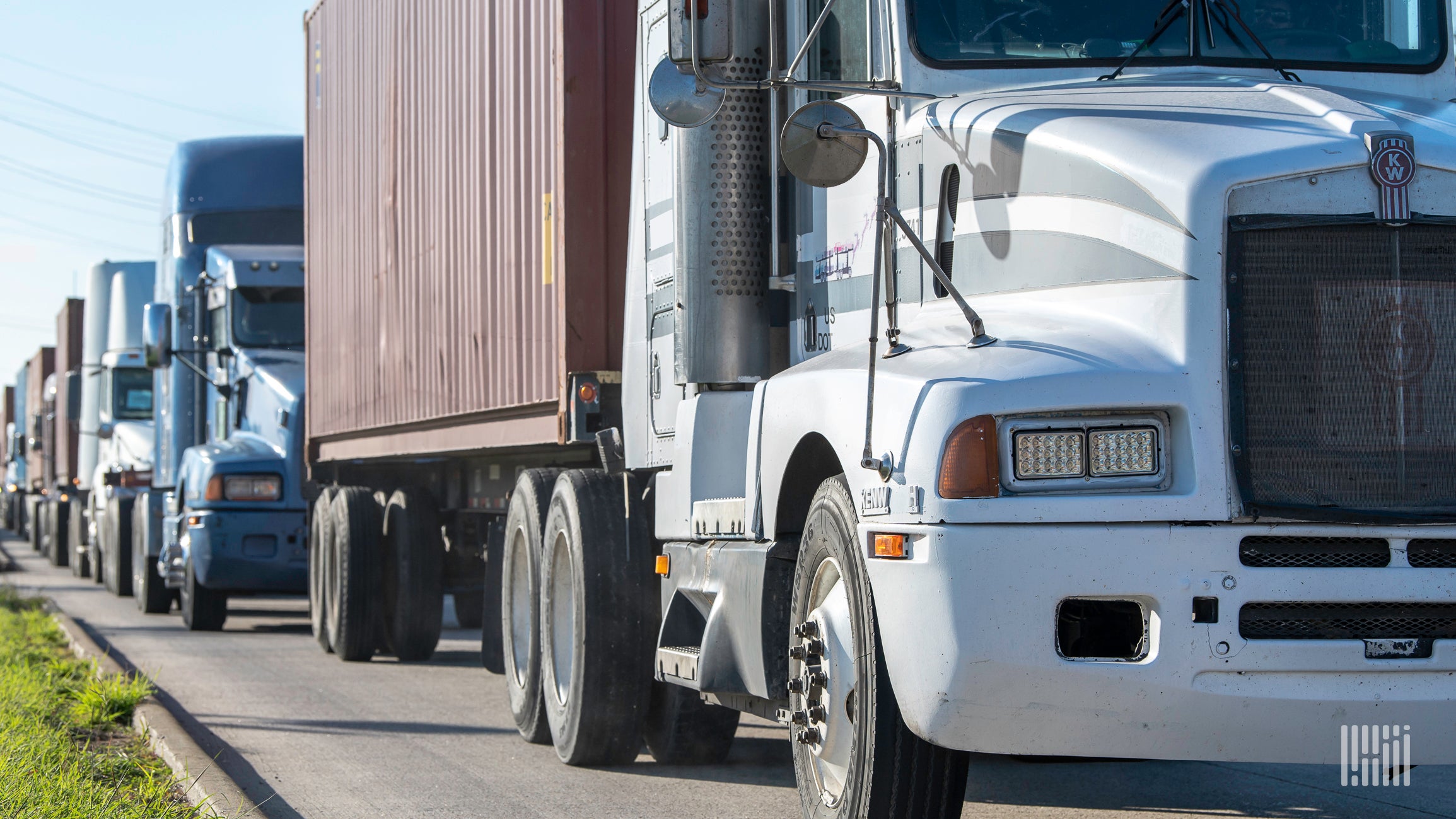
It does seem like long haul trucking is overrepresented in our logistics chain.
It would take either another port opening, or logistics companies suing the ports to force them to hire more workers.
As for the last mile:
1. train rolls into freight yard
2. crane lifts container off of rail car
3. crane puts container onto last mile truck
4. truck drives last mile
1. truck drives onto flat car
2. train goes long haul
3. truck drives off flat car
4. truck drives last mile
It seems to me the solution is to have a major rail artery which at least allows freight to be delivered to a distribution center farther inland(Ontario, Palm Springs, or somewhere east). That would free the truckers from dealing with LA freeway traffic.
Another option would be a canal up to the Salton Sea. Obviously that's a much more major effort but it has nearly endless economic and ecological benefits.
That would be an obscene undertaking... going a hundred miles THROUGH several mountain ranges.
There would be no ecological benefit. Salton sea will still not have an outlet, so after a one-time dilution, the seas will continue to increase in salinity, endlessly. It needs a massive supply of FRESH water to try to dilute the salt down to acceptable levels. Sea water with salt will just worsen the problem, long-term.
The economic benefits are marginal. You'll be limited to the number of vessels the canal can handle, the size of the port you can build in the desert, and you very quickly overwhelm the roads in the area.
Any malfunction or damage to the canal would be devastating... the unstoppable flooding in the low desert and along the canal zone would be unprecedented.
Or you could build a 20 mile tunnel from the Port of LA/Long Beach to offload the road network. I even know a local guy with a tunnel boring machine company.
He said union-free, not automated.
Also, the park and rides are full too early, meaning people have to drive or get to work 1 hour or more early. Parking never kept up with all the new apartment buildings, the newer ones are multi levels, and are already mostly full.
Public transit has failed to keep up with demand, meaning more cars on the road.
Then the limited amount of highways, trucks are stuck in traffic for hours, sharing the road.
Uber and Lyft isnt a fix for less cars on the road.
Now compound that by the hundreds of issues along the supply chain, decades old port design, same methodology from the 1960s on loading/unloading at the ports, limited space at the ports/warehouses, day long waits for truckers at the port, inefficiency from start to finish.
Some ideas, Have the ports move containers to a farther location for pick up, during non traffic times, 9pm to 5am. Have the National guard build some new depots outside of town, hopefully along highways.
Optimize the ports, the containers are sitting too long in warehouses, and not enough cranes.
The solution shouldn't be "ticket truckers" who cant fix the core issues.
They quoted a professor who had, according to the article, the most accurate model of NYC traffic given a large number of variables e.g. number of commuters, taxis, buses, subway frequency etc.
A key take away was the a taxi (or Uber/Lyft etc) is much WORSE for traffic than a commuter car. Commuters drive in, park, leave their car all day then leave.
Taxis are constantly circling and looking for fares. IIRC the impact of a taxi was several multiples of the impact of a commuter on daily gridlock.
Now, I love Uber/Lyft for all of the regular reasons e.g. allows people in under-served areas get transportation, senior citizens and the disabled with more access etc.
The traffic impact, however, seems pretty substantial.
Thus, though it’s true that the impact of taxis on traffic is significant, the alternative is much worse. People still need to get around.
I imagine a fleet of buses directed by sophisticated scheduling and navigation algorithms.
Users select a destination and pick up point, along with an arrival time. Discounts for ordering 1 day early to aid with scheduling. Pay extra to have the algorithm favor a shorter travel time for you.
System makes dynamic smart routes for buses to get people to where they want to go. Make it good at predicting arrival times so people can rely on it.
Seems like such an obvious next step for the whole uber/app-based-transport model. Not sure why nobody has tried it yet.
I would expect that anyone who has lived in a city with good, clean, affordable, basic, high quality mass transit looks on that privilege quite fondly. Compared to most (awful) systems in the US having once known such a system and now dealing with what much of the US has to offer will be either rage inducing or depressing (or both).
https://www.cnet.com/tech/mobile/chariot-private-bus-startup... https://en.m.wikipedia.org/wiki/Leap_Transit
These sorts of casual dismissals assume that the underlying technological landscape doesn't change, and that all organizations execute identically on product. Neither assumption holds true.
The primary reason we use large buses rather than e.g. minivans is that it amortizes the cost of the driver over more people. If it weren't for that buses would be less efficient because they're very often not completely full and to be completely full in most cases requires a larger vehicle to travel more miles.
What you really want is, effectively, car pools. Someone was already going there and they just take on more passengers, so there is no separate driver you have to pay.
But Uber already has this. It's called "driver destinations." You tell it you're driving to work, it gives you passengers near you who want to go near there. You make some extra money on a trip you were making anyway and now your car has five people in it instead of one.
Is the problem just that people don't know this?
> The primary reason we use large buses rather than e.g. minivans is that it amortizes the cost of the driver over more people. If it weren't for that buses would be less efficient because they're very often not completely full and to be completely full in most cases requires a larger vehicle to travel more miles.
> What you really want is, effectively, car pools. Someone was already going there and they just take on more passengers, so there is no separate driver you have to pay.
> But Uber already has this. It's called "driver destinations." You tell it you're driving to work, it gives you passengers near you who want to go near there. You make some extra money on a trip you were making anyway and now your car has five people in it instead of one.
> Is the problem just that people don't know this?
The problem is also insurance. Namely, mine doesn't cover ride shares, and here in Canada at least, most don't (unless you pay extra).
Having a bus take a known route through important routes that allow you get to a stop and board a bus within <10 minutes without even having to know what time it is is really important for people to start relying on the bus system.
With that, even if the public transport takes slightly longer, not having to actively drive (in traffic) and find parking makes it much better. Now you use the time to read/think/mindlessly scroll through your phone on your way, or even be a bit dizzy on the way back.
I think that adding buses is not enough to reduce car traffic. Probably car-oriented cities are already organized in a way that driving is "needed" often. Cities with public transport make walking amenable, often fun and relaxing.
I know you haven't thought deeply and this is just an internet forum post, but how do you address:
1) Many riders don't have smartphones
2) How do casual riders know which vehicle to get on?
3) If a profitable route is found, how do you prevent companies from cutting under each other, cost wise? If you think public transit is uncomfortable, can you imagine what it would be like if there was a profit incentive?
4) how do you regulate safety standards and driver training?
5) public transit can afford to be flexible and not collect fares sometimes. You think private for profit companies will let folks skip paying a fare?
Etc etc etc. There are many, many practical reasons why it's much less efficient and desirable to have a number of private companies fighting over a natural monopoly.
In Sweden, it's been privatized for quite a while (since the 1990s) with substantial cost savings and service improvements. See https://www.thestar.com/news/crime/2010/03/03/in_socialist_s...
In your points you assume privatized = unregulated, but nothing in the modern world is unregulated. You also assume privatized = not publicly funded. In other words, all of your points are strawmen and don't apply to modern privatization efforts.
In fact even in states that have public transportation, what they do is typically create an authority which is a GSE -- government sponsored enterprise -- to run the infrastructure. The vast majority of port, rails, etc are run by GSEs. The difference between a GSE style approach and privatization is that the GSE is awarded a monopoly for all routes that never changes. That creates a lot of disincentives for good performance and cost efficiency.
The rationale of privatization is that you let private businesses bid for contracts for fixed periods of time -- rather than just awarding a permanent contract for all routes to the GSE.
> I know you haven't thought deeply and this is just an internet forum post, but how do you address:
Ouch. I'd suggest that you could think some more about this issue as well.
https://www.smdailyjournal.com/news/local/samtrans-ondemand-...
[0] https://www.translink.ca/rider-guide/transit-accessibility/h...
The big downside of these systems is that you must reserve your route at least 30 minutes in advance, so the bus company can plan the most efficient route. I think they're mainly used by (and exist for) people who have no other options.
The whole of that part of WA is a shitshow where infrastructure has not kept up with demand. No, light rail and housing along such will make up for the greater shitshow.
I’ve been dealing with the area for over 20 years. The ferry system is also falling apart and that affects those that may take bridges instead of ferries.
The gridlock in that area impacts the ports and truckers, but their impact is small compared to the other things that make it a shit show. Seattle / WA driving habits don’t help matters either.
I applaud them for working to expand their light & heavy rail options, while also maintaining a (IMHO) decently effective bus system. But that obviously isn't enough. The reality is that people continue to choose single passenger vehicles and the government hasn't don't much to address it.
I understand the opposition to single passenger vehicles, but the failure to expand transit corridors when land was cheap will have lasting impacts on the ability to expand rail and mass transit networks as such expansion becomes impossible due to cost.
The reality is that, barring a major economic change(which, granted, may finally be here), people will continue to choose single passenger vehicles and not supplying the infrastructure for them means they are even less efficient while they sit in traffic.
Seattle has always been a boom (and bust town). I grew up their 20 years ago, and my dad lived in Seattle after his tour ended in Vietnam. The same things we complain about today, we were complaining about them in the 90s and dad was complaining about them in the late 60s.
The boom city nature of Seattle means that it goes through periods of lots of growth quickly enough.
> people will continue to choose single passenger vehicles and not supplying the infrastructure for them means they are even less efficient while they sit in traffic.
Building more freeways usually just attracts more demand. We will never build enough roads to satisfy single driver occupancy demand. The only way to win this is by moving people around more efficiently. If Transit can’t work in Seattle, the city is simply doomed and it’s growth will implode (another bust…it’s not like we haven’t had a few of those before).
I'm not sure I understand this point? For one, if anything there's a clear preference for cars as the default mode of transportation.
Even when staying there, let’s say Woodinville or Kirkland. Driving to Bellevue or Redmond let alone Seattle sucks worse than those.
I feel that it is glossed over. Nobody talks about the larger effects of the traffic in US cities beyond: "You sit in the car longer for work.", not "your meat is expensive because traffic is bad."
Cities are always very hesitant to introduce measures to reduce demand on our roads. I wonder if it is intentional that nobody talks about this.
In this case even that’s not being done. The government is just not continuing to subsidize car-based transit via roads at an adequate level to keep up with demand for car usage.
I do think a big part of the problem is that you need a critical mass of public transit before people can really ditch their cars. The network needs to be able to reach far away and enable more than just commuting to a desk job in the city center. And it needs times to remain in that state for all the businesses to rebalance around the public transit network (ie less reliance on huge shopping centers and strip malls only accessible by car). As a result I think you probably get a bit of a U shaped cost:benefit curve wrt funding of transit infrastructure.
There is also, in the US at least, a strong argument to be made about Freedom of Movement. I don't know if it has ever been tried in court, but I would be interested to see the result of such a court case.
Though honestly, at the end of the day, there are large corporations making huge profits whose workers commute to their office every day, and they should be the ones footing the bill.
I think of my local situation in Portland, Oregon, where many people in Vancouver Washington commute to portland every day and do not pay a DIME for the road infrastructure they clog up.
I have often suspected that merely charging a toll for using a road creates records which could be subpoenaed. Now say you have a club that meets to discuss edgy topics concerning the government of the day. Do they want their travels to be recorded?
Now, this seems pretty quaint because around here, they use license-plate scans to reinforce the automated collection of tolls, and who knows what else is going on.
FWIW I'm on the same frequency with respect to the disproportionate impact that road pricing and road usage reduction measures have on people with low-paying jobs.
I always assumed truckers took mandatory breaks during rush hour. Here in Charlotte, traffic is minimal except during rush hour.
I agree traffic is oddly bad during the pandemic, but we have solutions, more transit, protected bike lanes, and apartments near light rail and buslines.
Progressives building trains that sit in traffic is very expensive virtue signalling as far as I am concerned.
Try not to dismiss ideas so quickly as "virtue signalling" without an understanding of what they accomplish
Of the 3 stops where it isn't, it has it's own lane on a major thoroughfare and only chances an errant driver crossing an intersection.
Now for the Seattle Streetcars, those are a different story. For the most part, they have a dedicated lane so they breeze past traffic, but could get caught if traffic is especially bad.
Your description is apt for the South Lake Union Streetcar, though.
Within the densest part of Seattle they took over the underground tunnels which for years had been used as (electric) bus transit only tunnels with light rail.
Past the stadium in the south it's at grade.
After a brief tunnel under the major hill it is at grade through the gentrifying area south of Seattle.
It goes above grade near the airport.
There are expansions to the east and north that I haven't seen yet, and the expansion to the south hasn't yet reached a stage where I've seen sufficient details to answer.
I live in a NW Seattle neighborhood that doesn’t even have sidewalks that you could walk to get to the school if you wanted.
As a counterpoint- I take express bus 545 from Redmond to Seattle between 8 and 9am on weekdays, and there’s typically less than a half dozen people on the bus. I get from my home to the office in 30-40mins. The slowest part is the tiny stretch of I-5 with no bus lane.
I don’t think public transit has failed to keep up, it’s under-utilized, in part due to anxiety about COVID. These same routes were jam packed in 2019.
Public transit simply does not work if people have the option of cars. Public transit did not fail, society’s leaders (and hence society itself) optimized for individual cars. There is no possibility that both can coexist.
Public transit also requires dense living.
Once you make public transit be the most convenient, people will take public transit. At the point, public transit expands, typically with more frequent buses/trains on a route. And that makes it even more convenient, because you no longer need to plan ahead to catch the hourly bus.
And where does this leave drivers? Even better than they were at the start. Every bus on the road means that 50 fewer cars on the road. That reduces traffic congestion far more than any amount of counter-productive road expansions that ignore induced demand.
And public transit will never be convenient as long as human operators are needed because convenient public transit means a train or bus every 5 to 10 minutes at most, and that labor is extremely expensive.
And if you have to wait more than 5 minutes for public transit, especially in less than ideal weather, you are going to prefer a car. And once you have invested in a car, you are going to balk at the taxes need to provide public transit that has 5 minute intervals.
You also need Tokyo like density to make those rapid transit intervals make sense.
Remove all COVID-era restrictions from schools, workplaces, and transport, and systems will go back to functioning normally.
Boston Dynamics has built droids capable of handling cargo.[1][2][3]
[1] https://www.youtube.com/watch?v=5iV_hB08Uns
[2] https://www.youtube.com/watch?v=m7v8ZUq16F4
[3] https://www.youtube.com/watch?v=zkv-_LqTeQA
If humans are in short supply and these supply issues are causing companies to lose money, surely every business handling cargo from the ports will line up to buy some BD droids?
The kind of equipment suitable for this job doesn't look like a droid. If you don't know what you are looking at you would mistake them for a crane, because technically that's what they are. Search for automated rubber tired gantries[1], or automated rail mounted gantries.
Port automation is a fascinating subject. The equipment is huge, so it is very expensive. It's not like you just order a crane from Amazon and it's delivered by the next day. Just figuring out how they get to your port from the manufacturer is an operation in itself. (Here is a time lapse of the Port of Houston unloading their new RTGs [2])
Then you have the problem of integrating them into your software infra. Sure the crane can pick up any container from the pile and put them down anywhere, but to be efficient you try to minimise wasted movements. If a truck comes in for a container and your automated cranes needs to dig it out from the bottom of the stack you just wasted a lot of time. The best case is when all the operations are integrated such that the terminal operating system (TOS) knows before the container is unloaded from the ship when and where will it be needed next. That way they can optimise where they place it to minimise double handling. Here is a good video which shows all the moving parts of the full system, software and hardware: [3]
And then let's not even talk about labour issues. Understandably longshoreman don't like to assist in replacing themselves if they can help it. If you have a working port and you want to slowly transform it into an automated one, you will probably encounter friction. Best case you win the hearts and minds of your existing workforce over, but if you don't do this very carefully your whole operation might screech to a halt. It is often simpler to build a new automated terminal from the ground up than to try to do knee surgery on a running giraffe.
1: https://www.youtube.com/watch?v=W2uFoP12ksE
(I brought up the Baltimore bridge height because, in looking it up, I ran across some articles about the delivery of the new, giant gantries at the Port of Baltimore from China, similar to your Houston example. The ship made its way carefully and successfully underneath the longer Chesapeake Bay Bridge and also the Baltimore Beltway bridge, with only a few feet to spare in both cases. Obviously, this was all carefully coordinated with the local authorities and experts. What I found especially interesting was that the "ship" was also very wide. Very long booms or whatever were stretched out horizontally and perpendicular to the ship. My memory is that these were part of the gantries and they were lowered to further decrease the height of the ship, but maybe the booms are normally this way on the ship to keep it from becoming too top-heavy? [I should watch the YouTube you provided of Houston!] Anyway, this took me off on tangents on the internet reading more and more about the ships and the ports.)
They did recently build out a new expansion of the canal but these problems still remain. What is really cool is the fact that the New York port raised a bridge deck to support the new maximums. https://en.m.wikipedia.org/wiki/Bayonne_Bridge
However, I don't support injuring workers with tech efficiency advances - it's morally wrong.
But I do wish tech and labor everywhere had better discussions on how to introduce efficiency while also, and more importantly, preserving gainful employment and creating better work experiences.