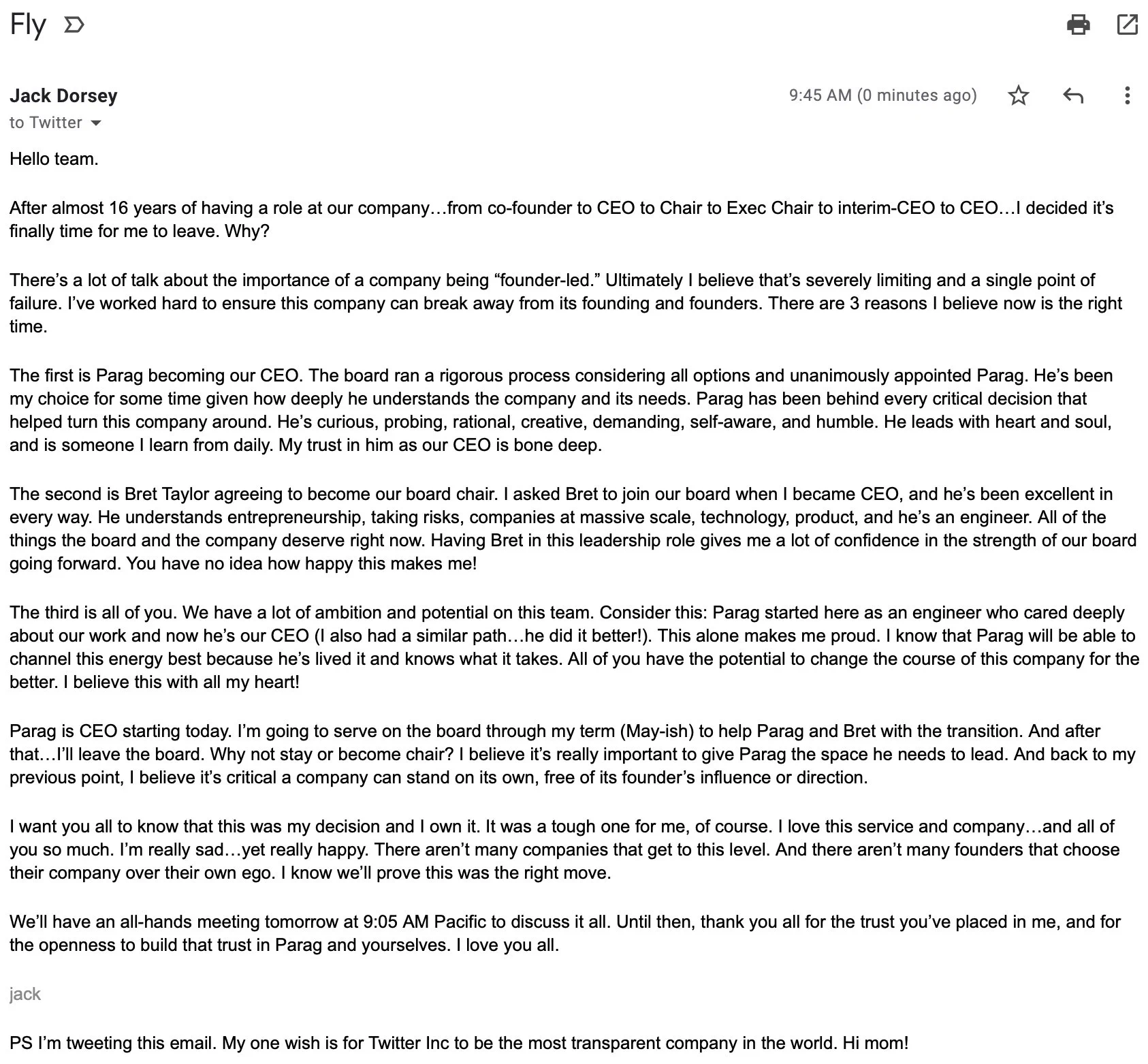
jack (@jack) on X
not sure anyone has heard but, I resigned from Twitter
X (formerly Twitter)
1692 points · by ryzvonusef · 4y ago · 1061 comments
[1] If you have access to the Internet, that is. [2] https://en.wikipedia.org/wiki/Speakers%27_Corner [3] https://twitter.com/jack/status/1204766078468911106
Twitter don't even have an RSS feed let alone championing decentralisation.
love this bit:
"The truth is that Twitter could become decentralized almost overnight by simply adding some JSON-LD serializers, an inbox endpoint and maybe tweaking their storage schema slightly to become part of the fediverse – anyone who wouldn’t want to use twitter.com could follow twitter.com users from their own server and so on. That does not require 2 years of making people who don’t work for you talk to each other."
We can speculate why Jack left, but the lagging stock price certainly didn't help him. So if anything, rather than criticizing him for not giving away the content for free, it seems the guy should have done more of the opposite (to prevent someone else taking his job who will do all that and then some).
I'd say the sword and the coin have both been far more controlling than limited information spread.
What of free society? Is the government of the USA, UK, or other "enlightened" societies throughout history relying upon censorship and denial of information? I think they're moreso allowing moneyed interests and plutocracy to have lobbying and backdoor dealings, they can easily ignore the public square most of the time. I just don't see Twitter piercing the armor of entrenched interests that well.
In contrast, I do see it degrading and toxifying democratic discourse, making us less resilient and more divided. That's anti-thetical to a free society in my view.
This is definitely part of the picture. To add to this, I'll refer to Manufacturing Consent by Noam Chomsky. "Propaganda" does still exist in modern "free societies," but it isn't overt like a 20th-century dictatorship would have been. Subtle manipulation of corporate media by monied interests to sway public opinion, combined with lobbying and corporate capture of government institutions, is more than enough to maintain the hegemony of certain narratives and power structures. I find it fascinating, and unsettling, to learn about.
So in a nutshell, controlling information and mainstream media narratives is important for the modern ruling class, but it's much more subtle than overt censorship like a dictatorship would have. Which, in my view, makes it much more advanced and insidious.
I'll make a tangentially related argument: Starting with the printing press, and through the advent of telephone, radio, television, and now the Internet (mainly via the Web), controlling messaging via these media (or controlling these media directly at times) has been as much a tool of control for those in power in democratic societies as in autocratic ones.
Congress shall make no law /.../ abridging the freedom of speech, or of the press
And while it talks about the Congress, it is clear why the founders considered it to be necessary - the principal value of the free and unabridged speech to forming a free society is tremendous.
True, in an armed conflict, speech has been used as a weapon, and it is also true that the reality of US government has often fallen short of the noble ideals laying at its foundation. But until recently, it has been a widely recognized principle that unmediated and un-gated access to speech and expression - be it audio, printed, electronic or any other means of speech - is a vital cornerstone of a modern free society. Unfortunately, recently certain part of political and cultural establishment decided they want to "move past" these antiquated ideas of equality and appoint themselves as gatekeepers of speech - "for our common benefit and the benefit of the society", of which they are but selfless servants, to be sure.
The new Twitter CEO is, unfortunately, one of these people, and has unashamedly promoted this approach personally. Thus, we can expect only redoubling of effort from his side to suppress and remove speech that he considers "harmful" and discussion of topics he considers not up for discussion. Fortunately, there's an easy way to deal with it. As David Chappelle noted recently, "twitter is not a real place" - and doesn't need to be elevated to the position of society's gatekeeper, but rather demoted to society's cesspool. They proved themselves not up to the task to maintain robust free discourse platform - let them rot in their own bubble.
2) Mediating access to information in Western societies is now in a much more advanced state than brute censorship.
That sentence piques my interest, do people see the USA and UK that way? I think of Switzerland and Canada that way, for example, but my knowledge is all based on stereotypes. Maybe it depends where you're from, as the stereotypes must differ among regions.
> The pen is mightier than the sword.
You’re taking the same company that repeatedly used their api to kill all the third party competitors to their horrible client(s)? I avoid Twitter like the plague And even I followed them enough to know they are anything but open.
I wonder where Jack was behind this re-evaluation and if it might not get re-re-evaluated in his wake.
API 2.0 just got even riskier for developers !
[1] Updates to the Twitter developer platform https://news.ycombinator.com/item?id=29231262
More like the closest to a worldwide-accessible bar fight. It's been nothing but a truly destructive force.
So just like real life, where a rich corporation can use its money to spend on Ads to attack politicians who dont support the corporation.
There's a reason why the government was not able to effectively execute on developing a cost-effective space launch system, while SpaceX was. The efficacy of using the profit motive and competition to engender innovation and efficiency is not corporate propaganda. It's the lesson of the last 400 years.
The sanctification of the government, as some kind of healthy antidote to corporate greed, and representative of the collective will, is a deeply misguided and extraordinarily dangerous notion. Thomas Sowell's account of his experience at the Department of Labor in 1960 is a poignant example of how untrue it is: https://youtu.be/v6PDpCnMvvw?t=38
They're utilities and should be treated as such.
I don't expect this to happen in the US unless there's a a Great Digital Depression.
In some countries like Finland, the democratic government holds some large non-majority stake in companies that affect the public interest. However, I don't think that model would work in the US, particularly in light of some unique jurisprudence (Buckley v. Valeo, Citizens United v. FEC, and Americans for Prosperity v. Bonta) that make all three branches of government captive institutions to a small number of wealthy donors.
See also https://www.npr.org/2021/04/05/984440891/justice-clarence-th....
[1] https://www.supremecourt.gov/orders/courtorders/040521zor_32...
Maybe that’s what you intended to suggest, by the phrase “wading in.”
I once thought like that. And now, after seeing the cesspool of hate and ignorance on social media, and the turmoil it has created, I miss the days of quality journalism. Today, I fear getting trapped into echo chambers on the net, and not knowing anything beyond the narrow view they create. Having to figure out what content to trust is also not only tiring, but dangerous too.
Far, far, far from it! They actively suppress information they do not like, while giving reasons for it that are transparently double standards.
Until the Great Bluecheck Purge, which revoked the verified status of significant twitterati - not because of question about their identity, but because their politics were incorrect.
Why is this something that adults invest their energy into? It feels very much like being back in grade school and getting upset over who got a sticker. Shouldn't both sides of that conflict have better things to be pissed over?
Anonymity is important, and Twitter gave that to anyone who wanted it. Identification is important too, and Twitter denied that to dissenting views (not weirdos, but about half the population - normal mainline opinions).
Twitter isn’t grade school. It succeeded as the new global online public town square, widely quoted as an authoritative forum. If @Talanes posts something important, good to know it’s the real Talanes people assume it is - but if he’s denied a blue check because he promotes wrongthink (even if shared by hundreds of millions), the validity of the post is questioned.
I’ve seen enough “not really who you think it is” accounts obfuscate truth to know it’s a real problem. Online identity verification, when wanted, is important.
Look folks, Twitter was never really profitable and it showed. Innovation has been lagging for years, and they had to rely on sensationalism from Trump that simply can't be allowed to persist any more.
The profit model has changed, and therefore the CEO music change.
The big question is where it all will go next. I can think of several ideas that will improve the platform, but nobody asked me to write them, and I'm not getting paid CEO money by them to spit it out.
The biggest question now is what will happen next... I guarantee you though, any more plots to start billing users and turn Twitter into more of a "pay-for-play-ware" or "freemium" service will lead to a giant user base exodus. ;/
I knew <software_name_here> when it used to rock-n-roll. I knew <software_name_here> when it used to do the pony.
to tally software that started great but alas died on the vine.
1) Remember that CEOs of public companies are essentially unable to say what they think or want. The cost of doing it is being sued for damages, having to spend countless hours with lawyers, etc. Jack might think X, but he's only allowed to say Y, and he doesn't want to go beyond that because he doesn't want to fight that fight.
Only people in a close circle really know what's going on, and it's most certainly not random people on the Internet (or HN).
2) Also, consider that Twitter, and perhaps Facebook (sorry but I don't give a sh*t that its new name is Meta), are really difficult companies to run, especially if you'd like to do some public good, as opposed to just maximizing returns.
There are so many things that can go wrong, so many other things that will set your company on fire without warnings, and that doesn't give people the time to think strategically on how to tackle certain difficult scenarios.
Twitter and Facebook essentially control most of the public discourse these days; never seen such amount of power in the hands of a few companies.
3) Despite common opinion, I actually think that Twitter (unlike Facebook) has done more good than harm. Why? Because it has essentially enabled an incredible explosion of "voices" that can be heard (err, read) all over the world.
4) Yes, we can think of countless ways to make Twitter better, but remember that Twitter is not run by Jack Dorsey, nor that other companies are run by their CEOs. Companies are run by boards, which means, by large funds with controlling interest in these companies. Even a well-intentioned CEO has to fight against many things his/her board want. And unlike enlightened CEOs, enlightened boards are essentially a very rare creature, almost never seen on planet Earth (IMHO).
5) You might think I'm defending Jack, perhaps I am, but it might be because hatred is really easy to dispense, while trying to be balanced in your judgement is really hard, and perhaps the conversation about Twitter should benefit from cooler heads, as opposed to quick slogans.
1. Younger and left-leaning outrage tends to dominate on Twitter.
2. Older and right-leaning outrage tends to dominate on Facebook.
3. Any conclusions are going to be subjective AF accordingly, and HN is a more young and left-leaning cohort.
All social media is a double-edged sword, under the most charitable view.
The same people controlling the media once, are on the boards of the companies that allegedly made the change possible.
On the other hand, their faces are hidden now, so we can't really say if a certain topic is legitimately important for the general public or the consensus has been fabricated or, even worse, their platform has been abused and we won't know until it's too late because it's bad PR.
At least in the past I could almost be sure that a media outlet was not easy to infiltrate so their opinion reflected their beliefs and I could take a stance pro or against.
For example
https://en.m.wikipedia.org/wiki/Saudi_infiltration_of_Twitte...
Now if I think Twitter has been corrupted by malevolent entities, I can't really do a lot about it, because I risk to.lose my voice too.
There aren't many other ways I can have the same exposure.
There's a completely different set of incentives at play.
The media was just the media; they'd get put in their own box for analysis and skepticism.
Twitter's great power is controlling peoples' impression of what the people around them are thinking and saying. Or, rather, allowing various aggressive agenda-driven groups to control that.
So now the corps don't just control the voice of the media; they control the voice of your community too.
> never seen such amount of power in the hands of a few companies.
These two points seem contradictory. If you are very powerful, you can draw on great resources, and you can address many things.
Twitter has more than enough resource to prevent it from being the extremely harmful manipulation machine that it is.
There is no excuse beyond “we want money more than a healthy society.”
Power isn't a single resource that can be accumulated and spent. The accumulation of soft power over public discourse isn't the sort of thing that inherently helps you put out fires, and in fact managing that growth can be one of the fires.
>There is no excuse beyond “we want money more than a healthy society.”
Which GP covered in their 4th point. Even a CEO who doesn't believe that answers to a board who does. And if the board has reservations, they answer to shareholders who do. It's a structure that continually passes the buck so no one has to consciously decide to put profits over people.
Fiduciary duty is a pretty slick moral hack, making the act of chasing the dollar feel like a communal good.
Socrates's prosecutors called, they want their undisprovable accusation back! Serious any claims of "ruining" or "harming" society are specious and a classic symptom of a moral panic. You would think people would have learned from atonal music, Jazz, rock and roll, and rap alone having already ruined society. Let alone allowing women and minorities to vote and gay marriage and things getting better from a "ruined" society.
But would you actually want them to do that? What if their idea of "extremely harmful manipulation" is different from yours?
Very controlled, curated, and politically corrected explosion. "Very lively debate within allowed spectrum".
I began using Twitter a week ago after avoiding it for years. Imo it incentivizes you to gain likes/followers, but in order to do so you have to tailor your content to appeal to bots/algo/quick-digestion. And it's not fun tweeting if nobody interacts, so you end up self-censoring to post clickbaity hype content
FB (Meta?) is run by its CEO. He controls the board. This is rare, of course (and perhaps unique for a company of this size and powe).
clearly, you do
Elon Musk seems pretty free. He just pays the fines time to time.
If somebody wants to tell the world their private life, good for them, but without me.
Turns out, I care a lot more about the former than the latter.
You could relatively easily flip the script and use the platforms in the opposite way. (although Twitter's narrow reach makes it harder to follow IRL "friends" because they're not so likely to be on the platform or use it regularly).
And by better I mean, less divisive, and less mindless scrolling of memes/low effort content.
Thinking about it from the business's perspective, it probably ultimately also lowers their user engagement metrics. Users get a higher quality experience using the site, but also spend less time on the site. It sorta reminds me of the freemium/grinding experience in games today. It makes for a worse game experience, but a better company bottom line.
- Uncensored/unmoderated
- Encompasses all viewpoints
- Civil
    It takes effort on behalf of the user to make their
    experience on the site "better"
I would say that for me, Twitter falls approximately halfway between:
1. Facebook: which is only barely tolerable, after much effort, and still seems to optimize for negative emotions, spam, etc
and
2. Reddit: with minimal effort (just need to subscribe to subreddits) it is an entirely personalized experience of exactly what I want to see
You can subscribe to high quality substacks and publications
The reason it takes effort on behalf of the user is because there's no such thing as a perfect read-your-mind content recommendation system that doesn't require any inputs from you, as much as people like to pretend machine learning is magic. Twitter/Reddit et al are a tool for building a content stream that fits you perfectly: their recommendations aren't intended to be blindly and indiscriminately consumed, but to narrow your search space to make the construction of this stream possible in the first place.
This is a simple extension of the trend of broadening distribution we've seen, from having three broadcast channels (all reporting the same news with the same slant and the same blind spots), through cable television, all the way up to today's wide-open, bottom-up distribution system. The root of this type of complaint about social media is that they treat their users with too much respect, trusting them to have the emotional continence and intellectual maturity to build a custom content stream that fits them instead of being told precisely what to believe and what to care about by Walter Cronkite.
I don't see anything that normally hits the front page, everything I do see is somewhat relevant to me, and it basically deletes all politics from what is presented.
By far the best reddit experience possible, I think.
The whole point here is to get rid of the all of the default subreddits, since they become garbage once they become default no matter what, and then find things that you're actually interested in that aren't default and thus not full of 'normies' who ruin most of reddit.
There was a time before reddit got huuuuge that most of it was pretty ok, but that time was years and years ago. Now there are just niche subreddits of quality and an ocean of garbage.
It’s like programming using only global variables.
This is a systemic risk of decentralization in all of its forms, too, really. At its most extreme, a world comprised of arbitrarily many self-governed communities is a dystopia.
I think Twitter has forgotten about them, since they don't display ads.
Being able to block entire instances is a really, really nice power.
Square, ~$100B Market Cap, profitable, still mainly US based and growing. Crypto and Payment. Lots of potentials.
It is not too hard to pick which one to run.
It’s not a matter of getting some amount of money…it’s choosing when you step back from the game and cede the future to your rivals.
What a headache. I'm not trying to dismiss these issues, but I can certainly see why it's a lot easier to spend your time worrying about how to make everyone happy at the company when it's Square than Twitter.
EDIT: here it is https://www.youtube.com/watch?v=aFd5zlw13FU
If you attempt to do things that the employees do not want to do then your company will turn to shit. People will leave, and those that remain will have terrible productivity.
Yes, you get some "Just do as I say" points, but you have to choose where to spend them very wisely.
This is par for the course, ask a politician a question get a non-answer, ask an NFL coach about the next game “They are a good team, we have to practice hard.” It’s all just talking without really saying anything.
here's hoping jack actually believes in sacrificing money and power to defect out of this information oligopoly, though i'm skeptical as those forces are irresistable to most humans.
A billionaire Republican megadonor has purchased a "sizable" stake in Twitter and "plans to push" to oust CEO Jack Dorsey among other changes, according to new reports, raising the prospect of a shocking election-year shakeup of the social media platform that conservatives have long accused of overt left-wing political bias.
Paul Singer’s Elliott Management Corp. has already nominated four directors to Twitter's board, a development first reported by Bloomberg News, citing several sources familiar with the arrangement. The outlet noted that unlike other prominent tech CEOs, Dorsey didn't have voting control over Twitter because the company had just one class of stock; and he has long been a target for removal given Twitter's struggling user growth numbers and stock performance.
Aside from these two paragraphs the rest of the article is a lot of speculation and some quotes from people who've been against Twitter for some time:
https://www.foxnews.com/politics/twitter-paul-singer-republi...
Like a trial that is touching a lot of big players in tech?
something.. something.... L*** express?
Thus resigning is better for the shareholders and him.
When you have both parties in agreement that FB, Twitter and Google are a threat to free speech and democracy, you best watch out.
This was my thought. The heat was getting too much for him. Law makers repeatedly asking him to come testify on this and that. The pressure to get rid of 230, and have better controls on banning people may have just worn on him enough where he just decided to toss in the towel and move onto something else and quietly disappear.
Twitter's not immune from ending up on this list (on a long enough timeline):
https://en.wikipedia.org/wiki/List_of_defunct_social_network...
See his recent interview on CNN : https://www.facebook.com/cnn/videos/2100868666791589/
Acknowledging that it is a difficult problem and you don't know how to solve it might be better than thinking you know how to solve it and doing something worse.
People are also quick to blame platforms without acknowledging that a lot of people are awful, the venue in which they practice their awfulness isn't necessarily at fault but it's easier to blame a thing which could be destroyed (religion, organization, social network, etc) than to acknowledge that this is a feature of humanity.
but those people had no such platform before, maybe not thinking about the consequences because "growth" wasn't a great idea after all.
It doesn't even need a watchdog agency like the environment does.
I enjoyed his interview with Sam Harris. He was honest and direct in answering tough questions about Twitter. He explained how they try to balance free expression but also want Twitter to be a safe place for people to interact.
Compare this to Zuckerberg who is never candid or forthright in public.
More a risk of becoming the next Tumblr.
https://www.investopedia.com/terms/a/activist-investor.asp
It's important to remember that in common usage “activist” doesn't mean anything other than trying to change how a company is run — there isn't the connotation of social values or similar which the term has in common usage.
https://www.bloomberg.com/news/articles/2020-02-29/singer-s-...
(previous link paywalled, outline: https://outline.com/gxqsh2)
https://www.cnn.com/2020/02/29/tech/elliott-twitter-jack-dor...
Why do you think it's a poor term?
I think the bigger issue is who gets to replace him: will it be someone with smart ideas or someone to serve as a puppet of activist investors? I can't find a source right now but I remember at the time Fleets were launched (Twitter's since-removed version of Stories) that the feature was pushed heavily by investors rather than anyone inside the company. If that's true then the next CEO could be a true disaster.
EDIT: ah, there we are: https://pxlnv.com/linklog/twitter-fleets-elliott-management/, and a deeper read on Elliot Management: https://www.newyorker.com/magazine/2018/08/27/paul-singer-do...
A fun case of "rules for thee, but not for me" when it comes to anti-moonlighting clauses and such. I can't "give it my all" if I take some weekend gigs, but you can hold two C-suite positions, be on two boards, plus have an "advisory" role with some startup? It's a lot like drug testing for front-line folks while the C-suite are exempt (and would fall apart if denied their various chemical habits).
The moonlighting employee has the same options. Don't get caught. If you do get caught, you get fired, just like the CEO.
This is also a good portion of why CEOs get paid so much. The average person doesn't like to inhabit the Hobbesian reality that CEOs do, where they're accountable for results and any bad things happening are automatically their fault. They want a world where if they take the right actions and follow the rules, they get some reasonable amount of security. Employment is basically a way to create an artificial island of "if you follow the rules, you get paid", at the expense of the company capturing much of the value you create. Most people take this bargain, because they value security over maximizing profit. Those who don't are always able to take the opposite side of the trade, and become an owner/executive, at the cost of being exposed to all the risks of the real world.
Does this actually happen though? I'm not sure I've ever seen a President or CEO of a company be held accountable for bad behavior or bad decisions in any meaningful way.
Best case scenario, you mess up and get "fired" (with a million-dollar-or-more severance/contract payment attached, or similar in stocks -- enough cash paid out that you can basically retire for life). Worst case scenario, seems to be that you get hauled in front of Congress to answer questions and/or get teased on the internet for a few days -- stuff that has almost no lasting effect.
Obviously, a C-suite can have certain sway in these situations and a company might not go after a lowly grunt's pet project, but there is a wide gap between these two situations where there are worse ramifications than losing a job.
It's the same for programming projects. It's good to work on more than one, so you can pick apart intrinsic problems that nobody knows the answer to and just artifacts of one particular codebase.
You have to collect this data for yourself because it's not like there's a service you can subscribe to that shows you all the problems that various public companies have.
[EDIT] Oh, and:
> You have to collect this data for yourself because it's not like there's a service you can subscribe to that shows you all the problems that various public companies have.
Actually, there is! It's called management consulting. The main value they provide aside from the much-cited blame-absorbing one, is being a normalized and accepted method of corporate espionage. They call it stuff like "industry best practices" but what they're doing is telling you what your competitors are up to, so you can mimic the good parts.
Conservatism consists of exactly one proposition, to wit: There must be in-groups whom the law protects but does not bind, alongside out-groups whom the law binds but does not protect.
That applies to no-moonlighting clauses, but also to no sexual harassment clauses, no insider-trading clauses, and plenty more. It’s not just that the rules don’t apply to some people, but the rules and system are set up to protect them from the rules.
With sexual harassment, for example, it’s not just that HR looks the other way when they are accused: HR often works to protect them from consequences and punish/dismiss/pay off the victims.
Source: https://crookedtimber.org/2018/03/21/liberals-against-progre...
Can you help me connect the two or at least help me understand the underlying proposition?
I'd bet in most companies the CEO is basically just a buffer between the board and the rest of the company, and essentially a fall guy position so the board can avoid accountability.
I have reasonably decent leadership where I work, and the only times I have much contact outside of my direct reporting line is when something has gone (or might go) seriously wrong. Outside of that, I'm given direction, expected to execute, and left to get on with it as I touch base every few days.
Are you thinking of companies in general, or of reasonably prominent/stable publicly traded companies? The CEOs at the startups I've worked at did a heck of a lot more than that -- fundraising, strategy, resolving personnel issues, talking to clients, etc.; I'm thinking of a small company (10-20 employees) and a mid-sized one (400-500).
As it should be if the executive isn’t micromanaging. If a crisis erupts and they’re nowhere to be found, on the other hand, that’s a problem.
It happens when the CEO has put out any fires before they've grown big.
Or possibly when, by dumb luck, the organization runs well without any such interventions.
And companies certainly do recognize that not everyone has to sit at a desk - all the expensive consultants...
On one hand, you have Elon Musk at Tesla and Zuck at FBMeta. Their board is essentially non existent.
On the other hand, we had Carly Fiorina, who wasn’t even buffering the board, and was quite horrible at executing.
I agree. As much as he tried to justify the dual CEO roles, it never made any sense.
It was also maddening to watch him shift to a 3rd focus of promoting cryptocurrency and his own cryptocurrency investments. Hanging on to the CEO role of both Twitter and Square put him in a great position to push both companies toward more cryptocurrency integration, but it never felt like it was being done for the benefit of the users of each platform.
Cynically, I'm yet to see any crypto that benefits anyone but the people that invented it (they benefit the most) and the savvy traders trying to make a buck (and sometimes succeeding at the expense of others).
Same could be said about social networks.
Honest question, because it's eerie how you could swap Dorsey for Musk and the statements would still apply but seem much less true.
I'm also skeptical of Jack's claim about founder led companies. When you're the exec handing things over you'd have to make some comment like that to show your trust is entirely behind the new person. I don't really buy it though.
Also I thought Evan Williams and Biz Stone were the Twitter founders? Maybe I'm forgetting the history.
I think even the Musk superfans eyeroll whenever he gives a date for some new advancement. For example, didn't Musk say the test orbital launch for Starship was goign to be last July or something?
Absolutely. Musk's companies manage to get stuff done, but are any of them particularly "well run"?
> I agree. As much as he tried to justify the dual CEO roles, it never made any sense.
If I remember correctly he was originally going to step away from Twitter to focus on Square, but then Twitter couldn't find a replacement and basically begged him to stay.
The point of platforms is not to benefit the users, otherwise, every successful platform has failed.
The type of synergy you are describing, is what builds value for the only people which count... shareholders.
> Parag started here as an engineer who cared deeply about our work and now he's our CEO... Parag will be able to channel this energy best because he's lived it and knows what it takes.
Facebook is a giant VR company and three-four giant social networking companies. Google runs phone infrastructure, search, self driving cars. Amazon is a giant retail outlet plus a giant cloud services company.
Is running both a social media company and a fintech firm that different, even though they aren't grouped under a single corporate owner?
Stunning article. Everyone has a bit of dirt on them I suppose, and it's more important than ever to safeguard one's privacy.
Jack explicitly says that Parag Agrawal (current CTO) is replacing him.
Edit: typo + speaking as an ex-Twitter engineer circa 2011
Seems more likely that Jack has been the puppet of activist employee's not investors. Hopefully Twitter will hire someone to have a back bone in the face of the activist employee's that want twitter to be a political echo-chamber / safe space
Is Twitter the way it is because of activist investors, or just capitalists (in the literal, neutral sense of the term) who know that certain crowds are easily manipulated?
Elon Musk
edit: a month or two ago there was this huge increase in SpaceX development all of a sudden that has since dwindled. I wonder if that was Musk working on SpaceX but now back at Tesla? of course i could be way off base too ( FAA thorn in SpaceX's side etc )
Elon Musk would disagree.
see /r/twitter for a summary of issues people see on a day to day basis.
What does that mean?
The medium is the message and Twitter is curt, prone to exaggeration / outrageous / mean spirited content.... and the people on there EAT IT UP.
What is going to mature?
Dorsey was probably the biggest advocate for free speech amongst the CEOs of any major company & Twitter is significantly less toxic than Facebook partly because of him. I fully expect his removal to lead the company in a more dystopian direction.
I suggest Matthew 7:5 for them.
Twitter has not as aggressively monetized with advertising as FB has, I wonder if we will see the same soon.
Because they are the toxicity.
You need someone with brains and decency (not just luck) to run the company.
stock is back to where it was a week ago, and is still lower than most of the year. These headlines are meaningless.
They've been making progress in the last year or two but I suspect most people think they could be doing more...
The line is a bullshit TV talking point to rationalize (to the markets) an abrupt 180 by one of the characters.
Edit: The submission to HN was before the tweet. Huh? I guess it originally linked to somewhere else.
> Our role is not to be bound by the First Amendment, but our role is to serve a healthy public conversation and our moves are reflective of things that we believe lead to a healthier public conversation. The kinds of things that we do about this is, focus less on thinking about free speech, but thinking about how the times have changed. One of the changes today that we see is speech is easy on the internet. Most people can speak. Where our role is particularly emphasized is who can be heard. The scarce commodity today is attention. There's a lot of content out there. A lot of tweets out there, not all of it gets attention, some subset of it gets attention. And so increasingly our role is moving towards how we recommend content and that sort of, is, is, a struggle that we're working through in terms of how we make sure these recommendation systems that we're building, how we direct people's attention is leading to a healthy public conversation that is most participatory.
https://www.technologyreview.com/2020/11/18/1012066/emtech-s...
Sounds like he advocates an emphasis on how to algorithmically "guide" the conversation and shape public opinion....
A social media CEO that's interested in breaking the cycle there and trying to recommend content that's more constructive than inflammatory sounds like a great thing to me. Yes, there are a dozen pitfalls awaiting anyone that tries, but it's still worth attempting.
Who's worldview should win? Mine, your's, Twitters?
IMO platforms like twitter should not be making the choice as to what is or is not toxic, they should be giving users the ability to curate their feed's.
Do they? Are you sure? I’ve certainly seen many calls for the glorification of violence to be limited, stuff like that. But banning actual discussion of guns? I’d be interested to see examples of people advocating for that. In any case, Twitter can simply ignore people asking for that because it isn’t a reasonable request.
You can have sensible, level headed discussions about guns and gun control. You can also have inflammatory, toxic discussions about them. It’s interesting to think how you’d develop a system that prioritises the former without bringing along the latter.
> Who's worldview should win? Mine, your's, Twitters?
What does "win" mean, here? If you're the CEO of Twitter then Twitter's worldview should always win. Of course, as CEO you also get to choose what Twitter's worldview is.
It's pretty well known that Reddit is Liberal-dominated, hence Conservative opinions are far more likely to be downvoted. And now, hidden by default.
It's easy to see how systems like this just serve to amplify the echo chamber.
- Ban all guns, completely!
- No restrictions on gun ownership should be allowed whatsoever, not even age limits!
These cause the most outrage / emotion => therefore they get the most retweeted => create a distorded mental picture of even deeper division. We're never going to solve anything that way.
The problem isn't one of free speach and censorship. Its a problem of amplification of emotionally manipulative content. The amplification is exponential (because the retweet process is exponential). This is a disaster.
For example, millions of people believe the lie, the fabrication that the 2020 presidential election result was fraudulent. If there are organizations on your platform amplifying messages that are fraudulent or intentionally misleading in nature, should Twitter take action?
The new CEO seems to think the answer is "yes".
IMO people should be able to curate their own feeds, but Twitter has the full right (and perhaps the moral obligation) to flag content that is bullshit as bullshit. The danger, of course, is that the kinds of people who fall for conspiracy propaganda from fascists on the right will then think, if their leaders' lies are called out, that the calling out is itself a conspiracy, and further entrench themselves rather than heed warnings.
"How to keep a social media platform from enabling anti-democratic demagogues" is an unsolved problem.
The key is the issue is the amplification. Promoting of content you’re not following in feeds.
Of course, completely changing it back to only content from those you follow in chronological order and allowing you to curate would solve that problem as well, but there’s no way they go back to that as there’s far less money involved.
But as seen on Instagram, YouTube and TikTok, this is not most effective way to make money.
He's only acknowledging that they're already algorithmically guiding the conversation and shaping public opinion. The algorithms are just bad: there are tons of feedback loops, too much emphasis on amplifying the already-popular and virtually no effort to de-emphasize the trash, and so you end up with a dumpster-fire / cacophony that Twitter is today.
Hacker News discussions are great because they're so well-moderated. It's not hard to imagine Twitter doing a better job of algorithmically demoting some of the obvious rage-bait, fake news, straight-up hate speech, etc.
Strictly from a business pov, that couldn't be good for stability.
Seems like Dorsey was standing in the way of some censorship and the board replaced him.
People documenting riots like Andy Ngo will be the first to go.
No they don't, they put it all into crypto.
Twitter welcomes bots (and other ways for many accounts to be run by few real people) because they want to increase their Monthly Active User count.
Twitter was Jack's baby, and he loved it so much that he gave 50% of his Square time to leading Twitter. Jack has so much more to gain from Square from both an equity and Bitcoin maximalist perspective, it's curious why Jack would try to lead two very demanding companies simultaneously. (Not that it can't be done. Elon, Jack, et al. have done it for years.)
My thought is that this is Jack returning focus to Square after the recent SQ earnings report miss, slowing growth of Cash App, stock slip (down 20%), and incredibly increased competition from Shopify, PayPal, and now MAGMA. (Microsoft is entering BNPL, Google/Apple/Facebook pay, etc.)
But more importantly, he says he eventually will leave the board?
Twitter is already taking steps to get less unpleasant. Having a thoughtful tech-oriented CEO work on their issues full time ought to go a long way toward accelerating their progress, if Microsoft is any example.
His successor could very well be much more aggressive in this respect.
  Twitter CEO Jack Dorsey is expected to step down from his executive role, sources tell CNBC’s David Faber.

  Twitter stock jumped more than 11% on the news.

  This is breaking news. Please check back for updates.
This whole thing is so bizarre
Why? He's been a part-time CEO whose focus has clearly been on Square. Having a full-time CEO focused on a company with as high a profile as Twitter makes a lot of sense.
TF is going on?
making Twitter into what it "should have been" the whole time.
Twitter tipping has already been announced, etc
[edit: well this was a silly comment :/ please ignore ]
Twitter CEO Jack Dorsey is expected to step down from his executive role, sources tell CNBC's David Faber.
Twitter stock jumped more than 11% on the news.
Dorsey currently serves as both the CEO of Twitter and Square, his digital payments company. Twitter stakeholder Elliott Management had sought to replace Jack Dorsey as CEO in 2020 before the investment firm reached a deal with the company's management.
Elliott Management founder and billionaire investor Paul Singer had wondered whether Dorsey should run both of the public companies, calling for him to step down as CEO of one of them.
It's unclear who's set to succeed Dorsey. But if he steps down, the next CEO will have to meet Twitter's aggressive internal goals. The company said earlier this year it aims to have 315 million monetizable daily active users by the end of 2023 and to at least double its annual revenue in that year.
Twitter did not respond to a request for comment.
Right. It better close up more than 11% today.
[0] https://www.macrotrends.net/stocks/charts/TWTR/twitter/numbe...
Smoke and mirrors and pay-for-play have completely corrupted social media now since the pandemic. "Success" on social platforms depends on how much you can afford to pay for it.
I understand everyone has bills to pay, but these services started out as free services and converted stealthily and at times deceptively into paid services, and that shouldn't be just overlooked or given a pass.
And their Operating Expense keeps growing with Gross Profits.
And also, there's not just engineering. HR, Accounting, Lawyers, Trust and Safety, it's all there
"If you're not paying for the product, you are the product" as they say
The hard part is the business part.
You don't leak it to a reporter like it's the latest variant of the iPhone.
There should have an announcement from the board, a LONG time before markets were to start (ideally end of markets on friday) clearly explaining WHAT is happening and WHY (even if it's a bullshit reason, there should be a reason).
It would have allowed markets to absorb the news instead of the NYSE having to halt trading amid the uncertainty.
Sending a tweet works just as well to get the message out.
The 8-K is functionally a legal requirement for this and the rest is just making sure you control the message to reduce speculation which can hurt you.
https://www.foxnews.com/politics/twitter-paul-singer-republi...
Zuck and Jack were alone but only Zuck is untouchable.
Tweet by Jack confirming...
https://news.ycombinator.com/item?id=29381199
EDIT: Now that the threads are merged, you can ignore this comment!
Then about 2 years later, the site became very fast which kept me stay.
It seems Twitter team is one of the most responsive dev team that i've seen.
Notably, he left well before the 2024 election season.
He'll face a lot less political pressure now.
And it's not like he has shown some sort of political backbone either. Twitter is much much more of a political cesspool, and has an odd persuasive influence on real life politics that facebook posts just doesn't have. And that's with Twitter being pretty okay with handing out bans and protecting blue checkmarks (and it's obvious they have a very heavy biais when it comes to who they verify). I'm genuinely puzzled that you can see dorsey as having stood up for pretty much anything.
I know this is very unpopular but while Zuckerberg has obviously no problem with turning his platform into a creepy ad filled universe he controls, he's still infinitely more "backboned". 99% of the attention fb or Zuckerberg are getting is due to their (relatively) unwavering obsession with their vision of free speech and an open platform. Every single major media platform on pretty much both sides has been trashing him and facebook for the past 4 years. He could've gone the dorsey way of just yielding and taking the very easy path of doing whatever to make the controversy go away but he didn't. You can agree or disagree with his stance, but at least he has one (again, I'm not talking about the monetization or ad side). If he didnt, the past 4 years would've been a breeze for him and Meta. Remember, most of the mainstream controversy has been about allowing fake news, wrong think, how the platform is moderated, how meta is totally why the other side won... The privacy/tracking/advertising issues have been mostly ignored in comparison (they probably have been covered extensively on HN but that's an outlier) unless they overlapped with a political tribe issue.
Here's an example off the top of my head. Banning Trump I felt was pretty courageous.
After years of letting him say whatever he wanted, they waited until the opposing party was firmly seated and the threat of retaliation was lowest. Good move tactically I guess but it took no bravery.
Wasting tons of his time and resources on promoting cryptocurrency + NFTs was also actively bad for the Twitter ecosystem - it creates lots of negative sentiment and attention that distracts from features relevant to the rest of the userbase. These days I periodically see high-profile Twitter accounts being hijacked by hackers in order to boost crypto and NFTs and when you read coverage of NFTs in the news it's often about scams - why would you willingly associate Twitter with that kind of negative buzz when you could wait until it's settled down?
What issues have you had with Twitter's v2 apis[0].
[0]https://developer.twitter.com/en/docs/twitter-api/getting-st...
By blocking any 3rd party use of Twitter and making it impossible to write your own clients? It's more like he Killed the eco-system
people on the opposite side of the privileged class are barely allowed to exist on those platforms - only if they police their speech very carefully to avoid breaking a myriad of vague and unwritten rules, and even then they're still subject to being unpersoned for some perceived offense committed off-platform.
I'm having trouble understanding what any of this means
Not sure what you're talking about. Can you provide examples/evidence?
Twitter's rules enforcement is historically EXTREMELY casual, the only thing I can think of is that they are relatively consistent about punishing death threats regardless of context. Even then, they let some of that slide. Very often a rules violation just results in a tweet being deleted or marked with a disclaimer, not a ban - few services would treat rules violations that way.
oh, that's a great example, actually. as far as I vaguely recall from the times before the pandemic, expressing skepticism or criticism towards the government and corporations was not against the rules.
>Twitter's rules enforcement is historically EXTREMELY casual
yes - for the privileged class, twitter does indeed "let some of that slide".
It’s really difficult to read when you can’t properly zoom and stuff
There are no "community standards". There are corporate rules and censorship. We are not a community if we can't have free speech. We are subject to a corporation that is publishing and benefitting our content, subject to their terms and political beliefs.
If you're a publisher the size of Twitter of contact, then it's much harder to create a monopoly, because you need to spend countless millions of hours per week editorial editing content to make sure that none of it is illegal/defamatory/etc. Having the protections of a public square well only pretending to actually be one is fraud.
I am biased here because it's the only place I have any sort of social 'presence or interaction', and care about it more than Facebook, which I don't use, or any other service that stores people's data.
I know it's technically possible to "download my content", but that's a poor substitute for a more transparent Twitter, with _easy_ and _open_ API access.
But He is still the CEO of Square.
So I am wondering if setting the start to X:05 might help?
   Humor HN: I knew <software_name_here> when it used to rock-n-roll.
             I knew <software_name_here> when it used to to the pony.
Twitter feeds seem more oriented towards a specific person whereas Reddit seems more oriented towards a specific topic. Which one do you think works best for you? What would you change?
1. Twitter is the last untapped value in social 2. Jack doesn't know how to monetize it
Now I'm very much interested to see if I was right or not.
    "If they are not gonna make a distinction between muslims and extremists, then why should I distinguish between white people and racists."

    — Parag Agrawal (@paraga) October 26, 2010
“The kinds of things that we do about this is, focus less on thinking about free speech, but thinking about how the times have changed.”
"Startup idea: Twitter with full-time CEO"
Well, some things come true.
I'd love to know what goes on in his head besides the PR crap he's posting.
I was hosting my own content on Twitter's service, same as I do on my web host.
In both cases, you're not "hosting your own content" by anyone's definition of the term. You're paying someone to host it. Anyway, all web hosts have rules aka terms of service aka censorship.
It's my right (and Twitter's) to offer a service that has terms, and those terms can include removal of speech that I feel is bad for my business. This is a basic freedom of association -- I don't have to do business with people whose speech I don't like, and I certainly don't have to broadcast it.
Arguing that Twitter must be a neutral host is like arguing that Uber or Airbnb can't ban customers for saying racist things (both have) or that Facebook must accept 100% of ads.
If you are conveying someone's speech as a service as part of a for-profit, private business, you can choose not to convey that person's speech for any reason. There is no demand in the US (Constitutional, statutory, or otherwise) that a private entity broadcast the speech of another entity. In fact, that's a violation of the broadcaster's First Amendment rights (as repeatedly upheld by liberal and conservative justices, over and over again).
Seems like they've taken forever to build an actually decent business out of the platform, despite widespread use.
[0] https://edition.cnn.com/2021/03/23/tech/jack-dorsey-nft-twee...
> I love twitter
Weird timing. Also I don’t know anyone who actively and daily uses Pinterest.
I do agree with the overall point though that images are a suboptimal way of conveying text.
Given the amount of hacks from twitlonger, to unrolling threads, to audio I feel it is simply annoying at this point
OP comment was a throwaway comment trying to say that long form text based comments should be allowed on twitter? Think how terrible twitter would become if that was the reality.
And shareholders expect this which is why shares are up today.
I think you're right, but it's debatable whether it's a good business decision.
Smart.
It's interesting the handoff though eg. cashapp or something else vs. directly through Twitter
yeah... there's all kinds of things to consider managing money yourself
By providing simple rules of information flow: small amount of content, retweet, followers) and rewards (likes), they've created the most efficient engines for finding and spreading novelty at the expense of everything else.
There are no incentives to improve accuracy, increase thoughtfulness, paint nuance. Fact checking gets lost in the wind.
The environment is essentially one designed for brain viruses, where whether you click RT (after thinking around 5 seconds about it) determines the Rt. The most superficially convincing, novel looking and emotion inducing content wins. You can get your misinformation in two flavors: deliberate disinformation by grifters, or accidental misinformation, sometimes by real experts who (like everyone else) make a sensational mistake that gets super amplified.
The worst bit is that social media is becoming the primary source of news for most people today. The results have been nothing short of catastrophic.
The new CEO has quite a bit of work in front of them.
William Randolph Hearst (https://en.wikipedia.org/wiki/William_Randolph_Hearst) did all of this first in the early 1900s. (Along with his rival Pulitzer. But the image above is clearly in Hearst's image, a fact probably lost to the modern audience)
The "problems" you state are far older than Twitter, and its best to study history and the problem of "Yellow Journalism". Over 100 years ago, people were complaining about false-outrage that manipulates the American public.
The only thing that has changed is that the American public has _forgotten_ what it was like to live in a outrage-fueled society, and we have to relearn the lessons of the past now. We need laws and society to change and recognize that all this fake-outrage is damaging ourselves, our psyche, and ultimately, our society.
The specific problems of today are utterly unlike anything older. The medium is overwhelmingly determinate of impact.
The simplistic version of this is: there are profound non-linearities introduced by lack of friction. "Superficial" differences in the role of feedback and tailored results which are noise in the case of print and broadcast media, are everything in contemporary social media.
Most particularly, the so-called "algorithm" problem is specific to contemporary social media; and it is imbedded in our society in ways that are unlike anything which has challenged it previously: as the citizen-facing sharp edge of surveillance capital, in which the origin and flow of "value" (i.e. consumer data) is all but entirely removed from public view and individual agency; and acts as a meta-filter, which is the sharp edge of social media serving increasingly as the sole mechanism whereby people receive media.
We live in a world in which what we read is ever more carefully targeted, deluded in the belief that we have agency in what we see and some defense about what it does not just to us, but to society as a whole.
Contemporary social media is stochastic mind control. And as said, it is currently performed almost entirely in service of ends very much at odds with the common good, in almost any dimension you choose to inspect.
Oh well. We had an OK run.
The USA literally started a war on false pretenses and took over the Philippines as a result of Yellow Journalism. https://en.wikipedia.org/wiki/USS_Maine_(1889)
This included at least 15 years of harsh occupation, as the Philippine Katipunan (in the north) and Moros (the Muslims of the south) fought a guerilla war against their US occupiers, with roughly 200,000 dead from famines and war. I mean, USA occupied the Philippines until the 1940s (the seeds for Philippine independence were planted by the 20s, but WW2 severely delayed plans). But just because US Citizens have forgotten the story doesn't mean that this stuff didn't happen.
The Yellow Press has been a bane upon US society for over a century. There's letters from Ben Franklin about how he manipulated the press (ie: leaking false "scalping" stories about native Americans / British) to aid in the US Revolution. (See Henry Hamilton, a British Administrator who was widely believed to be a scalper, but proof never was offered on the subject: https://en.wikipedia.org/wiki/Henry_Hamilton_(colonial_admin...)
-------
This is literally who we are as a people. Easily manipulated, outraged filled citizens who individually seem to have difficulty doing any form of critical thinking. Then a few elites get a good idea about how to manipulate the masses: be they Benjamin Franklin, William Hearst, his rival Pulitzer, or today Zuckerberg or Jack Dorsey.
Its been like this for centuries, and it will continue to be like this long after you or I die.
The old press was broadcast-only and had to catter to the lowest common denominator. As a result, at least some people were immune.
The new "press" is crowdsourced and tailored just for you. Social media doesn't even have to do research on what works or what doesn't on who. Natural selection by means of retweeting does all the work. You can find misinformation of all levels of sophistication, all the way to incorrect scientific papers if thats your shtick. (It will mostly be based on reading abstract conclusions in those cases without checking quality of methodology, or on whatever the funding intrests of big companies are)
This isn't new at all. "More doctors smoke Camel Cigarettes". https://www.youtube.com/watch?v=gCMzjJjuxQI
And the Tobacco industry funded all types of scientific papers, that were published all over the place to demonstrate Tobacco's "health benefits".
-------
The only reason we can't find examples older than maybe the mid 1900s or so, was because doctors weren't even trusted until the 1900s. 1800s doctors were well recognized as quacks and had very little reputation among the American people. So there was no reason to use doctors as a propaganda point back then.
EDIT: I need to add clarification. I don't mean when breaking news gets onto mainstream channels. No question that happens.
What I mean is the use of a single tweet with maybe 1 or 2 likes here or there to reflect public sentiment on different issues. All any news station had to do was fish through the pile of tweets about any given topic to find something they wanted to show on air and then act as if it represented a large segment of people. I watched it happen over and over for years.
Twitter created the ability to engineer the perception of public sentiment already with bots, but when main stream news joined in things went downhill much, much faster.
The media began showing Tweets because Twitter had reached a sufficient audience size. The real problem is the audience size.
Stroustrup famously said [1]:
> There are only two kinds of languages: the ones people complain about and the ones nobody uses.
I'd paraphrase this about communication platforms (including social media, Reddit, forums, etc):
> There are only two kinds of communication platforms: the ones where people are reactionary, argumentative, tribal, incendiary, conflict-seeking, virtue-signaling and just downright mean and the others too small for that not to have happened yet.
[1]: https://www.stroustrup.com/quotes.html#:~:text=%22There%20ar....
But I would pinpoint it to the inflated value of impressions. My experience (but i can not back this up) tells me that ad sellers tend to over estimate the impact of an impression, which makes the value chain completely inflated, and skews the business model. If ads were worth less (and, according to me, closer to the real value), less money would go round, and creating value for the end user would become more a necessity.
But I might be wrong, obvs.
Silicon valley just optimized it and turned it in to a science.
I'm sure various social scientists and historians could link it other issues. Advertising and selling goods in and of itself doesn't really explain how people just fall in to utter bullshit beliefs, does it?
No, social media is not the root problem - it showed us who we really are.
> The worst bit is that social media is becoming the primary source of news for most people today. The results have been nothing short of catastrophic.
There is good news - people are figuring out the effects of social media. Your post is one example - you see there are issues, you have "woken up." The "Social Dilemma" on netflix is another example, that deprogrammed a lot of people. Frances Haugen's testimony to congress, another. Slowly and surely, people will build "immunity" to "mind viruses." Humans fought this battle and won [1], but the war will go on as long as humans and media coexist.
Maybe people here are too young to remember how toxic, argumentative, irrational and judgmental everything else was that came previously: forums, mailing lists, Usenet, you name it.
Sure products can influence user behaviour but they can't totally change it. And if none of them (as you assert) "improve accuracy, increase thoughtfulness, paint nuance" ask yourself why: is it because all the platform providers are wrong? Or simply that's what users want?
Personally I've never liked Twitter. Of all the platforms I find it dominated by people who like the sounds of their own voices. I've described it as a "write only" platform. Even calling it "social media" seems like a stretch as there are no relationships, just people you follow and a news feed.
I'm in agreement humans are flawed, but why should we allow billionaires, who mostly want power and wealth, to decide how to referee our public discourse?
To me, these companies are run by humans and used by humans, so like drinking and driving, speed limits, personal safety, and all other kinds of laws: we need guardrails against bad actions.
We need some rudimentary policing, for as Hamilton stated: "if men were angels, no government would be necessary"
Of course they never achieved the same technological pace. Also, nowadays, when you think of newspapers, you think mostly of quality publications, writing considered, contextualised pieces.
But even nowadays, there are plenty of crappy tabloids chasing ad revenue (clicks?), with no regard for information and only about the shock factor. And in the past it was much worse, since the whole cesspit of attention-grabbing was contained in newspapers and pamphlets.
Tech changes, humans don’t.
1) in the Renaissance, literacy was much lower, books were scarce and expensive, and writing was often made in Latin, like the original bibles and Newton's Principia Mathematica. Therefore, print had MUCH less reach than social media.
2) the attentional cost of a book is vastly greater than a tweet. Tweets are designed to be simple and read in seconds; books are often complex and take weeks to digest.
3) due to 2, I feel Twitter's discourse evolves and devolves much, much faster into extremism and bullying and bad behaviors. It takes a long time for book disses to reach their target, not so for Twitter.
I could go on, but suffice to say, social media is an exponential notch above printed media in it's potential misuse and damage to society.
Not as fast as a tweet, but low cost, sub-book media has existed as long as the printing press was around. The classic books we study today are the equivalent of the criterion collection dvd sets.
This is a very unique perspective. It's one I don't share, and neither do the majority of Americans[1]. The economic and cultural forces shaping journalism make it so that it's vanishingly rare to find pieces that meet (my personal bar for) "considered, contextualized pieces". It's been a decade since the world of blogs/independent publishing has been an infinitely better source for that type of writing than traditional media has.
Naturally, independent publishing is also where you go to find the absolute worst of analysis and reporting, to a degree that traditional media would never stoop to. The core problem is that of discovery, finding the subset of high-quality sources in the acres of chaff that is the modern news environment.
It turns out that aggregators like Twitter are amazing for this, for those with the mental maturity and cognitive ability to use them with discipline. It's not very difficult to start with a trusted core of intellectually honest follows, then iteratively (and hyper-selectively) add high-quality accounts/author that you find through your existing follows. You have to be okay with a sparse feed to start, and you have to be disciplined enough to recognize perspectives that are high-quality even if you disagree with them, but it's an extremely straightforward path towards a much better media diet than the vast majority of people.
Note that this process doesn't disadvantage traditional media; it just fails to give it an undue advantage. Traditional publications and individual journalists within them can be treated like a source like any other, that can be compared to In practice, this is nominal only: in my experience, the incentives of the industry are such that 99% of them fall massively short of the basic quality and intellectual honesty bar. (Seriously, try it: start checking the sources and reading the papers cited by every article you read from eg the NYT and see how long you maintain confidence in modeling them as basically intelligent people telling you what's basically the truth).
[1] https://news.gallup.com/poll/355526/americans-trust-media-di...
The effects of social media on our collective attention span legitimately scare me. Our attention spans are shrinking with each generation, and the effect has gone parabolic in the last 15 years. Look at old movies, and notice the longer length of cuts compared to movies today. Now look at the infinite feed on TikTok.
What happens when the minority of the population that actually does their civic duty of informed voting can no longer pay attention to important issues?
What happens when people can't think about any topic beyond a sound bite or meme?
What happens when no one has more than 1000ms of patience to question whether they're looking at a deepfake?
Climate change? Holding politicians accountable for corruption or abuses of power?
I think we need to take a good look at where we're headed.
[1] - "Behave" by Sapolsky [2] - The Willpower Instinct
From that I recall they explain that the reward system responds to feeling of novelty because it's good for survival, f.e. you can find food or water source in a new location or maybe notice a hostile animals there. So, it's a behaviour caused by evolution. Twitter, Facebook, etc. just exploited it. And they admitted it:
https://www.theguardian.com/technology/2017/nov/09/facebook-...
I actually think there is a great opportunity here to fix this problem as SM has made it painfully obvious and visible to everyone, while also democratizing the entire process. (Democratizing manipulation and outrage isn't necessarily the best thing in the world though, but we can at least start thinking what causes it and what can be done to improve things)
I wonder what the mods found objectionable. Its a general news event, so this kind of commentary seems relevant. Social media CEOs are facing this problem everywhere and they seem unable (or unwilling?) to fight it.
Those are indeed elementary factors, but I think that Twitter's effectiveness stems from how it enables tribal thinking and actively nourishes it with its algorithmic ranking.
It's one gigantic outrage machine, and few things are as addictive as outrage.
But as CTO, the new CEO seems to have focused on increasing engagement and growing audiences. Unless that changes, expect the problem you describe to get bigger.
I think Silicon Valley made a major misjudgement thinking geeks with products with billions of people won’t be taken over by politicians with decades of power game experience. It’s not even a fair game. These are literally the biggest power players in the world, Zuckerberg and Dorsey didn’t stand a chance.
I believe that free publishing, or many-to-many media, is crucial for the future of our society. If anything, it is still not easy enought to get ideas out there and discussed (unless you have enough reach).
To phrase it a bit provocatively, I believe radical democracy is a good thing, even if many of the plebs are stupid.
People are dying because of social-media-amplified misinformation: https://threadreaderapp.com/thread/1460368038859919361.html
I think neither he nor Tim Cook are stooges for Republicans but they are scared to look anti-Republican. Serious question, do you think the new CEO is going to be more bold in the face of right-wing criticism than your average CEO?
I knew we're not talking about Apple but their last liberal-seeming act was speaking out against a bathroom bill that is clearly unconstitutional; but the backlash shut them up.
Please dont say something like Parler
I really liked the "Hi mom!" at the end of the letter. To be one of the co-founders and CEO of global tech co, and to say "Hi mom!" at the end of the your publicly shared resignation letter is such a big flex.
I understand his mom must already have been very proud of him, but this hit different.
How the fuck does Elon do it then? The mf has like four concurrent organizations under his helm.
> I think the bigger issue is who gets to replace him: will it be someone with smart ideas or someone to serve as a puppet of activist investors?
The rising stock price implies yes. Elliot MG has been desperate to make twitter the next mega app. Expect payment options, return of VIne as a tiktok clone, etc
Engagement is key, afterall. Good bye to text, I guess.
https://www.wired.com/story/how-elon-musk-gwynne-shotwell-jo...
As for Neuralink and The Boring Company…well, I am typing this, not using my brain-machine interface, and my friend took the Blue Line from O’Hare this morning, and not some underground supertrain.
https://www.chicagotribune.com/business/ct-biz-elon-musk-hyp...
I'm not sure what point you intended to get across with this take. I don't own any Lenovo products, is Lenovo defunct?
Edit: Yikes. My analogy isn't perfect, sorry folks.
Exactly. Lenovo has viable and desirable products that you could purchase if you were so inclined. That's not the case for Boring and Neuralink.
Boring makes a D-grade tourist attraction and offers no viable solution to the problem they claim to be solving.
Neuralink's biggest success has been in bringing attention to the field, but has made no actual progress of its own.
And that's not to say they won't bring viable products/solutions some day, but it's clear where Musk shines (e.g. bringing in money, hype, PR) and where he's atrocious (e.g. executing, planning, people). Shotwell is a fantastic example of a CEO using Musk where he shines, and keeping him away from where he's bad. What Tesla, Boring, and Neuralink all need are their own respective Shotwells.
Jack is CEO of two public companies and one is arguably underperforming, that's an untenable situation.
Isn't this the major part of the definition of excellent manager?
Anyway the guy's a wreck and wrecking ball, I wouldn't be surprised if he disappears or takes a step back for a while soonish. Tesla's stonks will crash, etc.
Elon was kept only because he didn't give away founder control. At the end outside MBAs always try to take over and destroy the companies.
The 3x growth is only because they finally figured out monetization 7-8 years post ipo and rode the rising Ad wave that lifted all CPMs across Snapchat and TradeDesk.
Overall, pretty subpar stock and pretty grim outlook.
Hyperbole. De-risk companies is the right word, MBAs unlike wide eyed founders understand that odds are against companies and survival is the priority.
They understand that a company like Yahoo! which in 20 years produced lots of value for shareholders, customers, users and employed so many people...that's a happy story.
People on HN see Yahoo! and think "failure", that's the same as saying Derrick Rose is a failure for not being Lebron, well if that's the case where's your 100M net worth for playing basketball?
Yup. Many once great companies, for one reason or the other, believes they have to at some point bring these people in. Who then of course bring more in, who bring more in, etc. And the people that built the company from nothing to something huge are slowly runout and all the leaders from engineer and technology backgrounds are replaced by the "business people". And the culture dies as the company becomes one of abstract "deals" and "efficiencies" and growth stops and it is sold off.
Far, far more companies have been destroyed by cluesless founders than MBAs, and I don't think it's close.
Tesla = primary concern | SpaceX = Gwynne Shotwell (Prez & COO) | Boring Company/Neuralink ["Labs" projects] = funsies
Trying to advance/safeguard humanity is the most funsies thing one can do.
Outside of Tesla the other companies are not viable yet.
Elon is most definitely the CEO of SpaceX (and Chief Engineer, for whatever that's worth)
if you are thinking of Ms. Shotwell (what an appropriate name for a rocket scientist!) She's the COO.
Or pushing the idea of catching payload fairing and now boosters.
Especially catching boosters is the type of crazy stuff that only Elon would have stomach to try.
Outside of his role as a visionary and promoter, I think his affect on the day-to-day of his companies might be questionable to negative.
There is SpaceX (mostly run by Gwynne Shotwell) and Tesla. DeepMind/Boring Company are mostly just marketing schemes.
I wouldn't demote them to "marketing schemes" -- he actually wants to bring these technologies to market (unlike Hyperloop) -- but they're pretty slow burn / almost hobby projects compared to SpaceX & Tesla. Both have started posting job reqs for Austin.
I think the secret is having some really stellar #2’s. Gwynne Shotwell Does wonders for space-x giving Elon the space to focus on the non-boring next-gen stuff. Jack had the same with Sarah Friar at Square but she left for Nextdoor. He also used to have Anthony Noto doing the company building at Twitter but he left for Square? But honestly, Elon’s probably an anomaly and no one else could match that ethic and sprawl
I mean either you share links to long-form content, or source an opinion, or you are contributing nothing to a discussion.
Also, the promoted tweets are always way, way off my interests. They look like pigeon droppings on my windshield.
Unfortunately Twitter doesn't want you to use their service this way, so they inject other (usually divisive) content into your feed in an effort to increase engagement. Because of this, I'm not really sure what Twitter is for anymore. I guess you could make the claim that it's keeping your finger on the pulse of what random people in the world are talking about at any given moment?
The value of this is that it gives me more time to spend digging deeper into topics that matter to me. I don’t have to keep the TV on in the background all the time to maintain situational awareness. I don’t have to constantly skim basic news articles just to know what is happening.
Have you considered you’re not getting value from it because your follows are high-brow?
Instead of following big shots with their own marketing teams, follow small creators in areas that interest you (e.g. indie game developers).
You want Twitter to be the most transparent company? Maybe start by making it accessible to the visually impaired by not posting images of text.
He should've done a sentence a tweet and threw a mention to threaderapp at the end...
Well, if you have more riches, you can do more charitable giving, so I don't see why he would not be motivated by the possibility of more riches.
We detached this subthread from https://news.ycombinator.com/item?id=29384379.
he seems also a bit into the transhumanist narrative
it's interesting to hear them chat but don't expect deep stuff, it's rich people having fun about markets and futures
It feels like it's easier to marie-kondo people I don't care for anymore in twitter since there's little-to-no-expectation that I know anyone on twitter, and for me, anyways, twitter is a much more pleasant experience than any other social network has been.
I think the mistake people make is approaching Twitter follows like they would friendship links on Facebook or other platforms. You don’t have a relationship with the people you follow. Don’t hesitate to let it go.
The loudest people on Twitter are often the worst at providing actual value. They optimize for clickbait and engagement, which can trick people into thinking that the person is a good follow.
The moment you realize someone’s Tweets are not providing value or they’re always making you sad/angry/outraged, click that unfollow button. It makes a world of difference.
Aggressively not following people to require unfollowing later would be another way
What I'd really like would be to say "don't show me tweets like this from this person". Yes it's hard to figure out what "tweets like this" mean to me, but hey, you're a giant company that does nothing but show an updating page of hypertext, seems like you could throw some work toward figuring this out.
They already have a start - they push following categories. So presumably they are categorizing individual tweets into these categories. It should be feasible to both provide finer-grain categories, and tooling to include/exclude how those intersect with those accounts one is following.
I considered a similar purge, but ultimately decided the variety and evolution of what I’m exposed to is better for my experience. I’ve also made several friends through Twitter (and even a short romantic relationship, which also led to me adopting a puppy who’s the light of my life!), so I’ve tended to keep a pretty open mind about the whole thing.
- follow only tech people/tech-adjacent people
- unfollow any tech people/tech-adjacent people who post too much off-topic and/or do too much clickbait or too much emotionally taxing stuff
and moving forward I do:
- follow a more diverse (race, ethnicity, country, political leaning, gender) people, while following the above guidelines.
- follow some people who "post interesting shit" while following the above guidelines.
It's a huge contrast from reddit where you can follow subreddits but most of the stuff you see is surfaced up and there's a hive mind at work. I won't even bother with FB since I deleted my account months ago
What kills me are the brand accounts. Like, McDonald's: 4.3M followers. For what? Why are you purposely asking for advertising in the middle of your advertising?
Any tweet I see that I don't like (usually someone using a tone that gives me a terrible vibe from them), I block the author of the tweet.
Now almost all tweets that I see have a positive vibe.
Edit: I also adhere to an old adage that goes "follow slowly; block fast".
I really wish there were more aggressive options to do that in lists, some people have great content but retweet an insane amount of things as well and it'd be nice to be able to exclude those from a list but not universally across the whole feed like you can with block words.
Same on HN. I often upvote comments, even though I disagree with them, whenever I feel they’re a meaningful contribution to the discourse.
At least in the U.S., I think that’s more attributable to their enormously disproportionate political power.
Honestly, life was so much more peaceful once I curated my social media apps to focus on my hobbies and remove "general news/current events" from my feed, which are largely garbage. I'll look up info about candidates when elections roll around, the rest of the year, I don't want to hear the worthless bullshit in that space.
Edit: Submitted this on an out-of-date page, not realizing so many people would respond the same. Not being a copycat.
not just conservatives
I definitely filter those out.
About once every 6 months the tweets "liked" by people I follow pop up again, it's usually very noticable as the feeds quality turns down dramatically.
To get rid of those, I do the "..." > "I don't like this tweet" > "show fewer likes from XYZ" on 2 or 3 tweets, and they're all gone for another few months.
It's not ideal, a settings menu where you can disable those permanently would be far better, but it works.
If you’re seeing a lot of friends-of-friends content, you might be scrolling too long or not following enough people you actually want to hear from.
Maybe we just should accept that we are not cognitively equipped to deal with all that comes with social media. It's just too much for our brains, and having a sane relationship with them requires an active effort to moderate who you follow.
Yes, they optimize por clicks and views, yet Twitter at least allows you total control of what are you consuming.
So if there's any social media out there that has both utility and allows control, it's Twitter.
FB it's another level of shady shit we can discuss another day.
When 10 people are agreeing vicariously and there is a sense that any dissent is crushed, time to be the person playing devil’s advocate and challenge them. This can happen in a small context and it usually is harmless. But on Twitter, you’re going to feel the weight of the world when you go against the grain. The mob will chase after you. They’ll become more powerful as bystanders join. You will be crushed. Others will take a note and feel the chilling effect.
... can fail. As in, there's no guarantee the system so designed is good, or healthy, or net-gain valuable.
It’s worth reading Christakis’s 2009 book “Connected: Surprising power of social networks”. It’s mind blowing that social networks are not regulated to some form. I don’t mean censorship but meme-acceleration and propagation of information needs to be curbed. Unfortunately it goes against engagement metrics and will never happen.
Comments are often terrible. You know the kind of comment where you have absolutely no idea what is being discussed or why, only that it has made someone very angry? Twitter is the land of such comments, devoid of anything other than hostility or snark (for a mile example, a gif of "double face palm, when one face palm isn't enough" kind of thing - you really have no idea that the person is responding to or what their thought are).
It's like getting a 5 course meal of poison food, and defending the meal because the dessert was delicious, and "all you have to do" is not eat the rest of the meal.
I don’t post, and I don’t follow people.
If anyone is feeling any of what the OP has felt, strongly encourage changing how you use it.
Nothing is worth this.
His move is the ultimate founder/rich playboy move. Maybe he will buy that magazine.
I predict Twitter will die a death of irrelevancy sooner than we think, given that Dorsey was fighting and failed. Nobody is interested in playing in the Twitter Commons Playground if it can’t stay fresh and neutral.