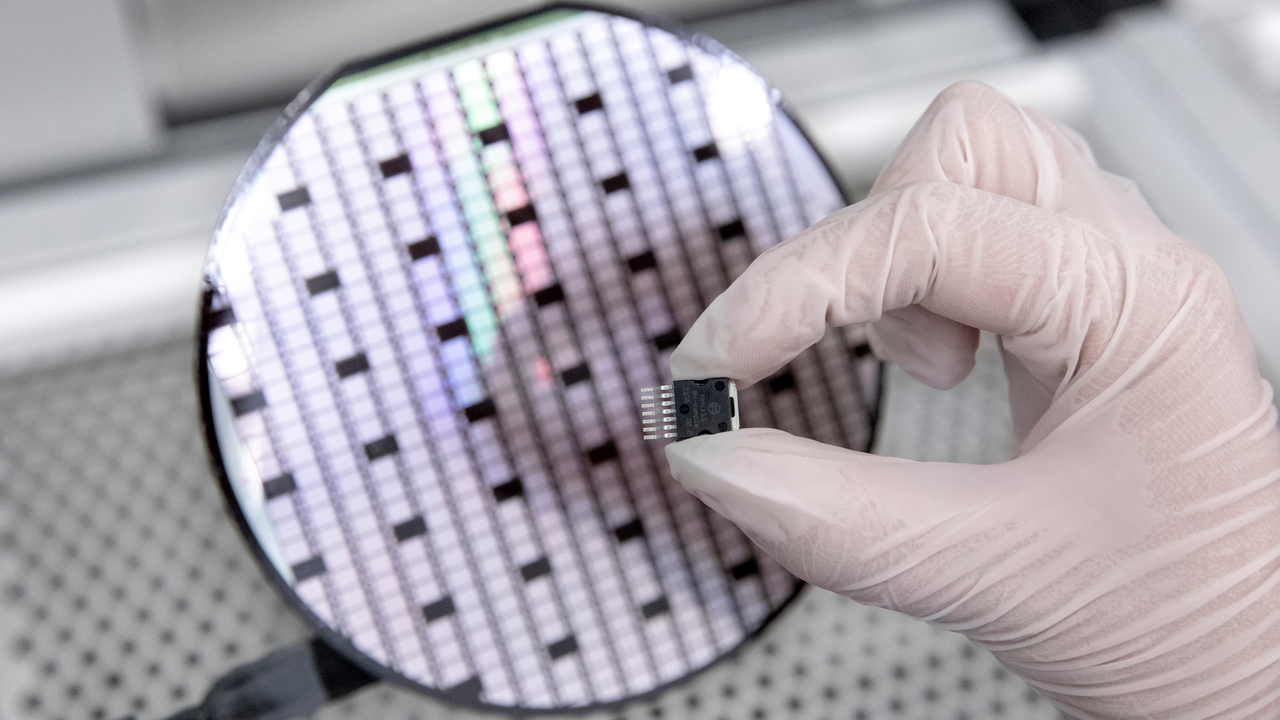
Longer range as standard: Bosch gives go-ahead for volume production of silicon carbide chips
Bosch Media Service
249 points · by Tomte · 4y ago · 240 comments
That and if you can remove all cooling, not just cost savings, but in some cases being able to remove active cooling and less moving parts is always an engineering win win.
I don't think it's that a 700C chip doesn't need cooling the way a 90C chip does; it's that the delta between 700C and room temperature means that a much smaller and much more passive cooling apparatus may be sufficient.
However, space craft would be where being able to run hotter would significantly reduce the size and complexity of cooling systems, as they can only use radiative cooling bleed off the heat they generate into space.
I've seen a diamond FET operating at 700°C. Devices like that could use the Venusian atmosphere for cooling.
... ok I'm reading about the material properties of SiC and it's insanely complex so I'm just going handwave and say that α-SiC has tighter packing with stronger bonds because of the alternating Si and C atoms.
Mixed solids are more sensitive to temperature variations (there's no change on the melting point), but actual chips are already full of mixed materials, and temperature variation isn't the bottleneck. A SiC chip has actually a bit fewer kinds of materials on the mix, but still, probably not enough to make a difference. (Anyway, we are talking about discrete transistors here, so the material count is exactly the same.)
You are probably thinking about pure substance (the ones that only have a single kind of chemical element). If so, you are completely wrong, pure substances usually have a very low melting point, and very few reach as high temperatures as you can get with composed ones.
I'm sure it's possible to build something that could operate at these kinds of temperatures permanently, but it would probably need an RTG (nuclear battery) and may be hard to test it on earth and also allow for thermal expansion and shrinkage (hard to keep the probe at this temperature for the entirety of travel to Venus). We'd also need to design lubricants for gears, cameras and sensors that can tolerate a wide range of temperatures, etc.
The upside of all this is that there are probably legit industrial use cases here on earth for electronics that are resilient in extreme temperature ranges, and in satellites as well.
Imho it's 600+ miles on a single charge, with a 300m recharge in 10 minutes.
My 2015 Model S 70D has a range of 330 km in summer a little less in the winter. I use a supercharger to add perhaps 40% charge about once a week, the rest of the time I charge overnight.
Hardly anyone needs 600 miles and no one seems concerned that it takes an hour to add 300 km because most people charge overnight.
14.8% of private cars in Norway are electric now, more than 25% if you include hybrids.
The only thing holding most people back from buying electric is the cost and that is why we have so many in Norway, at the moment they are exempt from the purchase taxes and annual fees that ICE cars must pay.
Western Europe (where I live) relies on street parking and has very little capacity for overnight charging. I regularly see people camping out for chargers in mall parking lots. I can't imagine the situation is much different in urban Romania, Poland or Lithuania.
I wish we had a charging grid that allowed for most private cars to be electric without any range anxiety, but that's just not true right now. You might also wish for street parking to go away (I do) but that's not happening either.
We're seeing just another dividing line going through our society here. An fully electric car says a lot about your income. It's like a huge new IPhone everybody can see.
On the scale of obstacles, this one is pretty minor, just requiring enough (political) willpower to achieve.
Norway is a sparsely populated, thin country over a vast distance, and the northern half has some pretty harsh winter conditions.
Put another way: If Norway can, surely Germany and Spain can.
On the other hand outside the cities the situation became worse during the last year based on my anecdotal observations. One may need to wait at charging stations for another car to leave. Clearly the pace of building those lags behind the number of cars.
Yes, hardly anyone needs 600 miles, but if you can't find a place to charge overnight, boom, you wake up to 80 kilometers left in your charge, and you need to find a fast charger somewhere in the vicinity, and high chances are, it wil be occupied by other cars.
You grossly overestimate availability of chargers in Europe (or anywhere, for that matter)
They’re far more common than people expect, but you won’t see them unless you’re looking for them. 90% of the chargers are just posts with a cable, or just little black box on a lamppost with a socket. (There’s about 5 within a 10min walk of flat in London, that are hardly used)
Certainly it can be tricky in more rural areas, but if you’re spending most of your time around towns and cities you’ll be fine. If you live rural you’ll have the space to install your own private charger.
But I have read from news that electric-cars can't do similar round-trip all the way at highway speeds. So in addition to having find charging point somewhere, I would have had to spend extra half-an-hour driving slower... Not to even think of winter case...
And no public-transport would be even slower than electric car with some charging...
I could do with a 200km range for my daily commute, but I also have a camping trailer that I'd like to use at least once every year for a 1000km+ trip. This is just not feasible with the current generation of EVs. I could imagine loading up the camping trailer with batteries to give me that 1000+ km range, though that will increase the weight and recharging at the destination is usually impossible.
Also EV owners are spoiled in several other ways: https://www.amsterdam.nl/en/parking/electric-charging/
A basic charging point capable of charging a car and accurately measuring consumption for the purpose of charging costs about $700.
Electricity meters are extremely simple and cheap devices. There’s literally nothing probative about installing one in every parking space. While your at it, might as well integrate a proper car charger.
Good luck driving electric in the North.
Also. Electric cars are slow.... Good luck holding 120 kph with an electric and not watch the battery melt.
I regularly drive for 4 hours straight on highway speeds on a single charge. The battery doesn't melt. I don't know where you get that idea from, certainly not reality.
By the way, where are you going 120kph? I think I averaged 80kph between Bergen and Oslo. I was shocked at how slow typical road speeds are in Norway.
The news won't stop when some technical or economic barrier is passed (which I'd argue has already happened) but when people generally believe it to be true.
But the news won't stop, because battery, motor, charging innovations now have an even bigger market and even more people will be working on it. They'll just change from "this is the breakthrough that makes EV practical" to "this innovation will make your already more than adequate EV even better and cheaper in a relentless progress of technology".
I wish that government electric car subsidies would be retargeted at cheap cars. I want to drive an electric economy car, not a luxury car. Here in Switzerland, we kind of have that: subsidies are in the form of a 99% reduction in road tax, so that every year you get a subsidy, flashy car or boring car. I'd like to see the kind of people who have to flash their cash (ahem, Tesla buyers) pay for moderate income car owner's road taxes.
No. The petrolhead press praises today's EVs for what they're strong at (acceleration) and correctly criticizes them for what they're (generally) weak at (price, range, charge time). When EV's come along with strong range like the Mercedes EQS and the Lucid Air they are rightly praised for their range.
> and then they will choose some new strawman to battle
No. This is just a strawman of your own.
If you use an electric car only for a commute, why not commute by bicycle or by bus? Why buy an electric car at all if you only ever drive short distances? Why not take the train if you are going long distance only four times a year?
Why even buy a new car then?
...that is, provided that said new cars are built with longevity in mind instead of planned obsolescence. Targeting subsidies toward EVs that maximize user-repairability and mandating right-to-repair would hopefully encourage that.
Right now; they seem to be going for hybrids.
If they can’t make the economic case for electric, I don’t know how anyone that drives 1/5th or 1-10th as much can.
I suspect that is an unfair comparison. Electric cars often don't make sense for high duty cycle uses, or for long distance driving around town during the time they are active. Every minute waiting for a charge is a minute the vehicle is slack and wasting the driver's time.
Overnight charging works for lower km commuters, depending on specifics of opex and capex.
That will no doubt upset some ICE vehicle owners with enough disposable income that they could feasibly be targeted with a lucrative product that appeals to them. Good news is that cars with 600 miles and 10 minute recharge to 300 mile (50%) are totally feasible!
E.g. the hummer that GM is rumored to be working on will apparently have 200kwh. Of course it has the weight of a Tank and the aerodynamics of barn door, so it might not be enough to get to 600 miles.
If Tesla ever puts that kind of battery in a Tesla it would probably end up with close to 1000 mile range and they would need to make it a bit bigger. That's 20 hours non stop driving at 50 miles an hour. Absolutely nobody should be doing that. But you could build a car that does that. That's a about 3x what they currently put in a model 3 (75kwh). It will be a bit heavier of course so maybe not 3x the range. But you get my point. Solvable problem for people with money.
For the rest of us normal people, take a break & plug in, go to the bathroom, eat some lunch, stretch your legs, relax, etc. After the 300+ miles that you can get with a few decent EVs that's probably a good idea. It's not the end of the world.
True in some smaller countries, but in places like the United States it’s very common for people to do a road trip occasionally to visit family or go on vacation.
Stopping for a 30-60 minute charge a couple times per trip isn’t terrible, but it would mean that my annual family visit would become a 2-day drive instead of a 1-day drive. I can deal with that, but many people aren’t ready for it.
I doubt we’ll see gigantic batteries going into small cars for ridiculous range. The efficiency hit would be too large due to the extra weight. I think fast charging and a fast charging network is what we need.
But charging networks are the real issue at this point. They’re out there, but interoperability issues means the various networks often don’t work as fast as they claim or maybe not at all with your car. Range anxiety is bad enough, but when you can’t even be sure the charging station will work when you get there it’s a different level of worry altogether.
The more fossil fuel consumption drops in developed countries, the cheaper fossil fuels get, which would then allow people who currently cannot afford fossil fuels to buy them and replace demand.
In my opinion the Battery equation is already solved. Even for those who are at the end of longer driving range curve, we have a solid and realistic roadmap of battery technology. Pick Tesla tabless battery for example. It isn't Solid Battery like Holy Grail Battery, but it gets to the point where even if you are somewhat skeptical of EV, surely this is edging close to good enough?
People often confuse range anxiety with battery capacity. I dont think that is strictly true. It is one of these things where engineers would come in and suggest we need bigger battery to solve our customer's problem. But here is an product person POV, what if you have fast charging station everywhere. From your car pack living in cities, to packing in a mall or pubic parking space. This is similar to charging smartphones. Once you can charge your smartphone even dinning in Restaurants or on a Bus. You dont get nervous about running out of battery.
So as many comment have suggested, the biggest obstacle to EV isn't battery, is the abundance of Charging station. And given I actually believe City transport in the future should be micro mobility, whether that is e-bike or something else we have yet imagined, we need charging port for both bike and EV. And this needs some government planning.
While this is all good discussion, I really wish we focus more on silicon carbide :)
I wonder why they didn't jump straight to 300mm and only upgraded to 200mm wafers. They could have completely cornered the market with better economy of scale.
https://www.thedrive.com/news/43320/how-an-electric-rivian-r...
Just more pull through parking at chargers would help a lot.
Doesn't that already exist in cars that consumers already have? Can't the Lucid Air, Porsche Taycan, and all of the new Teslas (and probably more I'm not thinking of) all do that?
The other thing you can get burned with is to forget to charge before a trip. If so, it’s about an hour detour to drive to super charger, wait and get back.
If you stick to interstates, recharging at superchargers is easy. If you travel on smaller roads you have to plan more carefully to find destination chargers, RV parks, etc along the way but so far that hasn't been a problem for me.
Granted I recharge in my garage so I can commute locally without ever needing to think about range, but for purposes of long-distance driving I think range anxiety is an overblown issue, at least for Teslas in the US.
The largest gaps between gas stations on that trip are probably 20 or 30 miles.
I would describe the Supercharging trip as very doable, but it requires following ~1 available plan vs just stopping when it is convenient (for a bathroom break or snack or whatever).
Charging on the way there just doesn’t feel right since we have enough juice to get there and everyone is anxious to reach destination, but it’s the only way to ensure we don’t have to take a detour at some point.
We solved this by getting an adapter so we can charge at their house using their dryer plug.
Yes, these are completely first world problems but it adds just enough hassle I could see some people just wanting to use an ICE car to make the trip.
Current EVs need a 20 min charge per 3 hours of driving. It may not be ideal for pee-in-a-bottle cannonball racers, but IMHO it's entirely reasonable for most people. It's approaching a point of diminishing returns.
Compare this with charging of smartphones vs brick phones. Daily charging used to be considered a dealbreaker, but fast charging made it a no-big-deal, and people got used to it.
I know people all can’t charge at home and street parking is a thing, so it seems like 400+ mile range and 10 minute fill ups 10 minute away will be needed.
I think what would really clinch this is not creating gargantuan batteries but simply making batteries universal plug-n-play. So if needed you just stop a battery station and replace it.
This solves also the unfortunate bottleneck of everybody charging their batteries during night-time, which (last time I checked) is when the sun is not shinning...
That could come from burning oil (probably new power plants) or from solar or whatever (new infrastructure anyway.)
Range anxiety will stop being a thing when electric vehicles are common and nobody thinks of them a something special. It's a matter of social acceptance, and the infrastructure that follows.
Driving an EV would be terribly annoying if I didn’t have a charger at home, but I know people that rely on super charging to keep their car going (have free super charging given early Tesla adopter).
In a motor controller you will probably bank that as an efficiency improvement, probably on the order of 1-2% at cruise and maybe a bit more during heavy acceleration or deceleration. In a charger you will probably change your optimization to reduce its size and weight for a given power delivery capability. In case that's on onboard charger, that means you haul around less weight and further improve vehicle efficiency a bit. That improved figure of merit also reduces the cost of having more power handling capability, which is how it might incrementally speed up charging.
To my mind, the biggest thing we can do to improve cars generally is to figure out how to reduce their weight. It's not obvious how to do that without either cutting back on passive safety or dramatically driving up the structural cost (e.g., with metallic foams for energy absorption in crashes).
It also can operate at higher temperatures more effectively, so it can be driven harder than a silicon transistor.
If you open up an electric motor controller you'll find it's full of MOSFETs, and they get really hot the harder you push them. The ones in EVs usually have liquid cooling and/or fans and lots of heat sinks.
So with this chemistry it sounds like less energy spent cooling, and more energy spent driving or charging.
Also sounds like they're more efficient at higher voltages in general. So again, more range or more power, or both.
So GaN is more efficient for higher frequencies and higher power and SiC is better for high temperatures and has higher potential power density than GaN
SiC will be cheaper and probably dominate GaN in production volume. Epitaxial GaN on SiC (and even GaN on diamond substrate) are used for high power, low noise at high frequency RF where the applications can justify the cost.
Diamond's thermal conductivity is uniquely high. The diamond substrate conducts heat away from the GaN FETs.
RFHIC uses this technology in some of its high power microwave sources and amplifiers.
They're incredibly beautiful and I think a good alternative to diamonds:
> As some of its properties are quite similar to diamond, moissanite can be used for scams. Testing equipment based on measuring thermal conductivity in particular may give deceiving results.
I knew that semiconductor manufacturing was complex, but this fact surprised me.
Stopping short of looking up EU grant numbers, the wording seem to be meant to address a target audience and not meant to educate the public.
And what is the process node being used?
Will silicon carbide be useful for general computing appliances, CPUs, GPUs?