The Sea People
Alexander the Great tread in the footsteps of forgotten Greeks
nemets.substack.com
157 points · by rsj_hn · 4y ago · 151 comments
Another theory is that Palestine came to be known as Palaistine after the Philistines via "pars pro toto", which means that a part becomes the name of the whole. One example is Russia, named after the Rus people who inhabited merely a small fraction of modern-day Russia. In other words, the Philistines may have been the dominant people in Palestine and the Greeks may have referred to the whole region as Palaistine, just as many people (sloppily) refer to the United Kingdom as "England". Numismatic evidence shows that the Philistine cities were large trading centers and minted coins earlier and in larger quantities than in other Palestinian cities.
The history is well known, and there's no need for theorizing. You meant 'renamed by Emperor Hadrian to the names of nearby provinces, after crushing the local revolt as a method of erasing the province's residents'.
Herodotus in his travel diaries wrote about the region in the 5th century BC and he used the word Palaistine for the region and Palaistinian for the inhabitants. Aristotle in 340 BC wrote about the Dead Sea - "a fabled lake" - which he situated in Palaistine. This suggests that the Greeks thought Palaistine was a greater region than merely Philistia.
Why Hadrian choose to rename and reorganize the provinces of the southern Levant right after the end of the Bar Kokba revolt in 135 is a mystery. The record is silent. Although absence of evidence is not evidence of absence, if the renaming was intended to punish the Jews, why weren't the Romans explicit about it? If the renaming was to serve as a deterrent for future rebels? Afaik, the claim that Adrian renamed Iudaea comes from the Christian 4th century scholar Eusebius and is not found in other sources (such as the Talmud). To Christians at the time, God punishing the Jews for crucifying Jesus by having the Romans destroying their temple and erasing their province would have made prefect sense. I.e. Eusebius may have been putting two and two together here.
Another problem with the "renaming as a punishment" theory is that in 135 the Philistines hadn't existed for several centuries. So if punishment was Hadrian's impetus for the renaming, he must have been well-versed in Hebrew religion, otherwise how could he have known that the Philistines was one of their worst enemies? That seems unlikely.
Of course Greeks used the name given to them by fellow Greeks (when they existed at the province) and weren't clear on borders. However, every empire and kingdom which actually ruled there knew very well how the locales called it and that's why the province was named as it was.
Now, Hadrian was acquainted enough with Judaism to specifically ban many of its practices like circumcision, reading the holy books, etc. Learning a tiny bit on a province after fighting a massive war there is rather expected. However, I believe it's much more likely that he chose the name from Greek language and history. This is a Roman Emperor we're talking about, Greek was a extremely popular language for the Roman elite, he must have been very familiar with Greek.
Renaming the province is consistent with Hadrian's other moves which do have a well known rational of suppressing the Jews. There's no reason to think renaming the province just after the massive rebellion is somehow different, accidental or separate from all the other moves, like renaming Jerusalem itself or banning many of Judaism's practices.
> the claim that Adrian renamed Iudaea comes from the Christian 4th century scholar Eusebius and is not found in other sources (such as the Talmud)
The Talmud has no reason to care about how the Romans name things in their own language for their own empire. It's a religious text, not a history book. It's actually noteworthy that there is an ancient text mentioning this - most ancient historians cared little for such details.
EDIT: I also note that Eusebius lived and wrote when the Roman Empire still existed, and probably did not have much need for guessing. A Roman historian living at that time could access Roman primary sources and common knowledge easily.
'Theorizing' that ignores well known data is suspect.
https://en.wikipedia.org/wiki/Syria_Palaestina#cite_note-F90...
https://en.wikipedia.org/wiki/Syria_Palaestina#cite_note-FOO...
One interesting tidbit (and I'm going to be lazy and not look up the references): There is a time when the Israelites don't have iron working, but the Philistines do. The Israelites have to go to the Philistines to get their iron implements sharpened, taking them to a town that translates as "smith of the goyim".
It eventually fell to the Mongols. 2 centuries later Moscow overthrew the Mongols and reunited (and grew) the empire.
There's no continuous history per se, but east slavic peoples (Russian, Ukrainian, Belarussian) have always been essentially the same people. The Rus and Russian empires were the same people even if there was an interruption and the capital changed because of historic circumstances.
When my family came to North-America from the Austro-Hungarian empire, they were even known as Rusyn/Ruthenian (they're Ukrainian)... No one has ever disputed that the modern Russian empire represented the same people as the (Kyivan) Rus empire until very recently. Like, I know a bunch of Russians, Ukrainians, Poles, Czechs and Slovaks and they can all more or less understand each other. Slavs are far more similar than different (language, culture, food, temperament, etc...).
Edit - it's ok to admit a shared history while also wanting some countries that weren't historically independent to stay independent and forge a new national identity. Trying to rewrite history is petty.
It detracts from the writer's argument to uniquely characterize the IE Europeans as savage here. Savagery was the norm for all groups at the time. Monopolies of violence didn't exist in any significant way, and institutions were also non-existent.
Some civilizations appear more egalitarian than others, i.e Crete, Indus Valley, but the idea of non-savagery as a virtue didn't emerge until much later, and we don't know how much savagery those civilizations might have engaged in because we have lost their histories.
For example, notice the author of this blog post starts with a description of a campaign of horrifying brutal violence perpetrated by “civilized” Greeks.
One feature of language (for better or worse) is that words whose denotation involves some associations considered to be negative in one context tend to be used as slurs, adding and intensifying negative connotations until they eventually become confusing when used in the original non-normative sense.
The word “savage” originally just meant “wild” (literally, “from the forest”), i.e. not domesticated. Under this original definition, a rabbit is “savage” but an aggressive guard dog is not.
> By the mid to late 5th millennium, the peoples of Greece had diverged from their cousins. Europe was convulsed in a parallel set of conflicts involving tribes of WHGs conquering their EEF neighbors and establishing themselves as a new ruling class, catalyzing a new synthetic culture with their new subjects.
The WHG by your definition are just as "savage" than the Indo-Europeans but they are described as "conquering" (which is a term of glorification), and "catalyzing a new synthetic culture". In contrast, the Indo Europeans are described as "destroying" and "not content their new lands".
I have a hard time believing the intent, process, and outcome behind either circumstance was appreciably different from the other, at least in any way we can infer from archaeology.
If the term "savage" as used in the article is simply a matter of "civilization" and not brutality, then the Indo-Europeans should be considered far less savage than the WHGs, since they had created the spoked wheel and chariot technologies, and were pastoralists who practiced wheat/barley agriculture and animal husbandry - they were not forest-dwelling hunter-gatherers. In this way, they were far more similar to the EEF in lifestyle.
Therefore, I don't think that the author is using the term "savage" denotatively as you suggest, but rather is coloring their otherwise fascinating article with their own anachronistic opinions of the ancient Indo Europeans.
https://m.youtube.com/watch?v=M4LRHJlijVU
Eric clines lectures are really cool
I especially enjoyed https://youtu.be/d2lJUOv0hLA, as I had no idea the first cities were already so advanced and lasted for so many centuries.
EDIT: fixed youtube link.
It's astonishing to me that there's so much high-quality stock footage of the area that someone can create such a high-quality historical documentary while only calling it a "podcast".
Making the sea peoples all Greek totally flies in the face of the written records at the time, for example where Ugaritic leaders wrote to Cypress for help given the ships attacking them and got the response "it's your own ships."
SOME of the sea peoples were Greek. But a single genetic result most closely matching Crete (which was only 40% not "almost completely") shouldn't be extrapolated to be all the sea peoples. And it ignores the research that the Minoan ancestry was in line with the Anatolian farmers of the Neolithic period.
It also ignores the role of Lybia in the early Egyptian records of sea peoples battles, as well as Ramses II's capture of many peoples following Sherden/Lybian battles and then Hittite battle of Kadesh (where he captured 12 groups of tribes).
And arguably the biggest oversight (not just by OP but by many looking at this period) is failing to put aside the myth of ethnocentrism and monotheism from the Israelite story of 12 tribes fleeing Egypt under Moses with oldest part of that story referring to Dan "staying on their ships."
The Greek story of the Exodus claimed many different people left, and placed the fleeing of Danaus alongside them. Danaus, the likely eponymous leader claimed to be a brother of the Pharoh with 50 sons and connected with Lybia. Sounds kind of like Ramses II, who had 50 sons and whose forensic report identified him as appearing to have been a Lybian Berber.
Sure weird that a lot of the sea peoples conquered territories were then named for Mopsus/Muksus, including the Denyen of Adana who centuries later still had a ruling "House of Mopsus."
I wonder if that has anything to do with Dan, who "stayed on their ships" in the Song of Deborah - the earliest part of the Bible, in Judges 18 ending up with a grandson of Moses as chief priest.
There's a lot more, especially in the Cretan/Lybian genetic overlap with the Ashkenazi, particularly given the 80% pre-history European mtDNA lineages. Or in Aegean archeology for details in claimed Biblical history. But suffice to say the sea peoples shouldn't be as much a mystery as it remains if only people would do a better job looking at what's clearly myth (Abrahamic lineages given Y-haplogroups and early Israelite monotheism) and who was writing the story (Judah, who wasn't a group present earlier on).
This is still a matter of considerable debate. An alternate explanation for the LBA collapse was offered by Drews: a shift in military tactics from chariots with composite bows to armored infantry armed with Naue Type II swords (as well as javelins).
The systems collapse theory strikes me as a theory that's been elaborated to the point of untestability, and a violation of Ockham's Razor.
Attributing "cause" to any of them is an exercise in preference of importance. Do you pick the last one that happened? Do you decide which one had the biggest impact? Do you pick the one that was the easiest/hardest to find? It's a silly exercise to pick one. You will find that the failure was caused by a concert of things working together, the only reason to pick one is a personal preference for there to be one thing to pick.
A common pattern is the "straw that broke the camel's back" in a relatively small aberration or mistake which pushes a system from a working state into a phase change to a non-working one revealing all sorts of structural deficiencies. Do you say that last straw was the "cause"? Only if you're particularly short sighted.
I've experienced this personally many times. No we didn't have 3 days of downtime because there was a 5% performance regression in the last release, we had 3 days of downtime because systems A through G were constantly on the edge of collapse and nobody noticed until all hell broke loose.
* https://www.goodreads.com/en/book/show/40536236-sea-people
* https://www.npr.org/2019/03/13/702505578/sea-people-examines...
This is a fascinating observation to consider even terms of our modern era. Prior to the pandemic, the cost to ship a $20-retail pair of athletic shoes to the US from Asia via the sea was only $.30. [1]
Every passing technological wave that triggers growth seems to concentrate it most in strategic maritime areas (even if much of the raw materials and goods flowing through maritime channels originate in landlocked/inland areas).
One theory of these historical invasions is that that wealth eventually attracts the attention of inland peoples who eventually band together to attack the maritime cultures.
[0] Not my native language, though; landlocked nations use other expressions.
First, if they were Minoan that would have been recorded in the annals of civilizations like Egypt and others which kept good records. The Egyptians and others of the Eastern Mediterranean had long links with Crete and the Minoans. It doesn't stand to reason that the Minoan could launch such a large movement (in the sense impact so many areas of the Eastern Mediterranean) and no one notices.
Secondly - the nature of the sea peoples attacks, assaults suggests a group of people moving, migrating - not looting and returning. If the Minoan were doing this - why would they not return with their gathered spoils to their homeland. If they did return - where is the physical and archeological evidence?
Those are the pressing ones that come to mind first. There's also the question why would the Minoan embarknon something so foolish as invading Egypt. Egypt was what a hundred times bigger? If you failed - first you'd expose yourself to retribution and secondly - you'd weaken yourself severely leaving you exposed to others.
"The Philistines (known to the Egyptians as the Peleset) were among several groups listed as the Sea Peoples by the Egyptians. The other Sea Peoples were the Tjekker, the Shekelesh, the Ekwesh, the Shardana, the Danuna, and the Weshesh. An inscription on the tomb of Ramses III reads:
“The foreign countries made a conspiracy in their islands. All at once the lands were removed and scattered in the fray. No land could stand before their arms, from Khatte, Qode, Carchemish, Arzawa, and Alashiya on, being cut off at [one time]. A camp [was set up] in one place in Amurru. They desolated its people, and its land was like that which has never come into being. They were coming forward toward Egypt, while the flame was prepared before them. Their confederation was the Peleset, Tjekker, Shekelesh, Danuna, and Weshesh, lands united. They laid their hands upon the lands as far as the circuit of the earth, their hearts confident and trusting.”
Arzawa is in western Anatolia, Khatte is the Hittite realm in central Anatolia, Qode is Cilicia in modern southeastern Turkey, Carchemish was a city on the banks of the Euphrates River, Amurru was an Egyptian vassal in northern Lebanon and coastal Syria, and Alashiya is Cyprus. The Danuna are the Greek tribe of Danaans referenced by Homer in “The Iliad”. The ruins of the Hittite capital of Hattusa have been excavated, and the destruction of the city was between 1190 and 1180 BC. In the same decade, the city of Troy was destroyed as well, likely in what is remembered as the Trojan War.
The identity of the other groups is less certain. The Mycenaean Greeks are known to have had contact with the EEF peoples of Sardinia - the Nuragics - from pottery finds. The etymology of Sardinia’s name is unknown, but the the name predates the arrival of the Phoenicians. The Shardana referenced by the Egyptians as being among the Sea Peoples may be Sardinians, Nuragics recruited by Mycenaean Greek sailors for campaigns of plunder and conquest. The Sardinians certainly knew of the wealth of the east - their copper, valuable in the Bronze Age as one of the ingredients for bronze, originated from Cyprus.
Similarly, the name of the Shekelesh may refer to the aforementioned Sicanians in Sicily. Alternatively, it could refer to the Italic-speaking Sicels (relatives of the Romans) who invaded southern Italy and Sicily in the late 13th or early 12th century during a massive drought in their home, the Po River Basin of northern Italy."
https://en.wikipedia.org/wiki/Sea_Peoples#Primary_documentar...
I think of these people as groupings of war chieftans and landholding warrior aristocracies and their crews, conducting raids abroad and territory at home, similar to the crews of Viking ships. Similar in that they had skill with ships, and similar in holding onto older Indo-European traditions of raiding (back to Yamnayan cattle raids on the Pontic steppe), class structures (warrior/priest/farmer) and systems of managing subjects and fiefdoms.
Calling them "Greeks" is about as accurate as calling the old Vikings "Norwegians" or "Swedish". Related by descent, but not nearly the same, and almost 1000 years separating them.
I mean... wouldn't the people of the British Isles during the Viking Age have called the raiders Danes, or Norsemen? Not vikings?
If your invaders speak Greek and come from the area of Greece, calling them Greek seems to make sense, albeit obviously not in a way equivalent to Hellenes.
It's best not to transplant our national identities into the past where they don't make sense. Nationalist mythologies can and have been used for some pretty awful things.
The ancient sources list a large number of different tribes which composed the Sea People.
Whether all of them were Greeks or some of them had a completely different origin, nobody knows.
Of the Greeks we know more, as they had later known descendants, so we have a chance to identify their ancestors, either by DNA tests or by some cultural aspects.
Of the many other people that had existed in Southern Europe and who are mentioned in ancient sources, but who were later assimilated by the Greeks or by the Romans, we know much less, so it is difficult to identify any of the Sea People who might have been related to them.
I think there is fair evidence that some names refer to places in Greek. At the same time seem to refer to cities in other places. Those however could be Greek colonies in Italy and Sicily. Or maybe non Greeks in those places.
I don't think single origin explanations work all that well.
He makes confident assertions about which current scholarly consensus is far less certain. It would be nice if he highlighted that.
For instance, contrast the tone of his blog post with the tone of this article, quoting the researcher whose findings Nimitz references[*]:
> "Some interpretations of ancient texts have suggested that the Philistines were one of the groups that comprised the Sea Peoples," study leader Michal Feldman, from the Max Planck Institute for the Science of Human History, told Newsweek.
> "Our genetic results could fit with this hypothesis since we detect a movement of people that crossed the Mediterranean and reached Ashkelon in the relevant time period—around the 12th century B.C. However, from the genetics we cannot determine whether these ancestors of the Philistines that migrated to Ashkelon were indeed part of the Sea Peoples or not." [emph. mine]
I think footnotes, particularly for assertions like this that he believes to be true - or that he chooses to gloss over for the sake of narrative - but that scholars are not so convinced, would lift his writings out of the realm of entertainment. As it is, unfortunately, his writings - as entertaining as they are - could mislead readers like me who prefer accurate uncertainty over inaccurate but consistent and entertaining narrative.
[*] https://www.newsweek.com/biblical-philistines-sea-peoples-dn...
Unfortunately the sea castle is no longer due to centuries of silt accumulation on the causeway, effectively "merging" old tyre with mainland.
However, another walled island is in Sidon ("Saida"), nearby. It is quite a sight.
https://en.m.wikipedia.org/wiki/Sidon_Sea_Castle
Going back to Tyre - The hippodrome of Al Bass, with a bit of luck (ex: concert or wedding lightining placement, etc) would rival Baalbeck itself as the most extraordinary site in Lebanon
And yet, “Mycenaean” translates roughly to the mushroom people…
"Mycenaean" comes from a feminine name, which in the older pronunciation before the 1st millennium BC would have been "Mukaanaa".
The Greek name of the mushroom, in the older pronunciation would have been either "mukeet" or "mukaat", which is likely to be derived from a word meaning "mud".
While the feminine name "Mukaanaa" starts with "muk", like mushroom, it is not formed according to the usual Greek rules for word derivation and there are also many other Greek words starting with "muk".
There was indeed someone (Solmsen) who, in 1912, proposed seriously this etymology, but others (e.g. Krahe) presented counterarguments that this etymology cannot be true, which were considered much more convincing.
https://books.google.com/books/about/The_Road_to_Eleusis.htm...
I have found online a fragment of Wasson, but unfortunately the fragment stops before page 129, so I could not see the rebuttal, only a mention by Wasson that some colleague derided him for believing that there is a connection between the name Mycenae and mushrooms.
Wasson might be right about the use of mushrooms at the Greek mysteries, but that has nothing to do with the name of the city Mycenae.
We know that the female name from which Mycenae is derived has been in use, e.g. in the Odyssey some nymph with this name is mentioned.
It does not make much sense for a woman's name to refer to mushrooms.
Assuming that you are right and the woman/city name is pre-Greek, then that removes any connection with the Greek name of the mushroom, which is likely to be Indo-European, derived from the same word with the Latin "mucus".
Although I guess we could imagine that they roared because of all the mushrooms.
Btw, my favourite para-etymology is that of "Xochicalco" [1], the name of a Pre-Columnbian settlement which was explained as "The countryside temple of the Goddess Kali" by one over-zealous Greek nationalist. In Greek, "exochi" (εξοχή) is "countryside" and I guess "calco" ...sounds a little bit like "kali"? That "Xochicalco" is the name of a city built by pre-Columbian Americans is a feature, not a bug, as, if I remember correctly, the book I found this para-etymology in was one of those that claim that the Ancient Greeks had been there before everyone else (bonus: they came from Sirious in spaceships, or something like that. It was a long time ago I read that book, or rather only the first few pages thereof).
So, you know, morale of the story and so on, some caution is adviseable when taking the fact that two words "sound like" each other (we have no idea how ancient Myceaneans pronounced anything btw) as proof that they have a common origin. The French even have a word for this kind of word: "faux ami". False friend. You say "Chaire s' il vous plait" and you think you asked for a chair, but, no. "Chaire" is French for "flesh". Now imagine the faux amis you can find lying about after a few thousand years of language evolution.
____________
[1] https://en.wikipedia.org/wiki/Xochicalco
Edit: To be more precise, "μυκηθμός" describes the roraring _of an ox_ so more like a... cow moo. If you think about it, that's not at all an unlikely name for a city that would count part of its richess in the number of its cattle. So Myceneans could be "the people of the cows". Or, I guess, "the people of the moos".
This has got to be my top-contender for wackiest HN comment if the week.
Please: could you show any sources for this assertion? Start with the sctual Greek; because, the actual Greek words are about as related as "moose" and "mouse".
So the prediction of the god to Acrisius found its fulfillment, nor was his fate prevented by his precautions against his daughter and grandson. Perseus, ashamed because of the gossip about the homicide, on his return to Argos induced Megapenthes, the son of Proetus, to make an exchange of kingdoms; taking over himself that of Megapenthes, he founded Mycenae. For on its site the cap (myces) fell from his scabbard, and he regarded this as a sign to found a city. I have also heard the following account. He was thirsty, and the thought occurred to him to pick up a mushroom (myces) from the ground. Drinking with joy water that flowed from it, he gave to the place the name of Mycenae.
> Legend has it that the name was connected to the Greek word mykēs (μύκης, "mushroom"). Thus, Pausanias ascribes the name to the legendary founder Perseus, who was said to have named it either after the cap (mykēs) of the sheath of his sword, or after a mushroom he had plucked on the site.
https://en.wikipedia.org/wiki/Mycenae
Even if that's true then it is still a leap from "People from Mushroom City" to "Mushroom People"
This is fabulous, thank you. Very compelling.
There are giant Neolithic carvings of mushrooms in Thrace. But apart from these small scatterings of ambiguous evidence—almost nothing supports the idea that psychoactive mushrooms were known to the Greeks. Which is just, well, odd.
https://www.ancient-origins.net/history-ancient-traditions/m...
This is my favorite kind of knowledge to collect.
We don't know where the name comes from. The association with mushrooms is the popular etymology but that's not to say it's right. Wikipedia has this to say:
Legend has it that the name was connected to the Greek word mykēs (μύκης, "mushroom"). Thus, Pausanias ascribes the name to the legendary founder Perseus, who was said to have named it either after the cap (mykēs) of the sheath of his sword, or after a mushroom he had plucked on the site.[11]
So even this apocryphal explanation for the name doesn't imply any close association of the Myceneans with mushrooms. Certainly not for the use you suggest, that really didn't feature much in the tales of ancient Mediterranneans.
Was it really widespread? Compared to fields of grain?
See https://en.wikipedia.org/wiki/Ithobaal_I and https://en.wikipedia.org/wiki/Philistines
The Phoenicians are not referred to until ~1500BCE, by which time the Mycenaean and Minoans had been doing their things (mostly trading) for a few hundred years. The Phoenicians didn't peak until after the Late Bronze Age Situation (~1200BCE).
"Around 3000 BC, a group of savage tribes now known as the Indo-Europeans invaded Europe from eastern Ukraine and southern Russia, destroying the EEF civilizations east of the Rhine in at most two centuries. Not content with their new lands, the Indo-Europeans learned how to build boats and launched a new wave of bloody conquests 350-600 years later."
"Two branches of the second Indo-European wave play a role in this story. The first was was the early Greeks themselves, who arrived in northern Greece (Macedonia and Thessaly) at the end of the 3rd millennium BC."
"Ancient DNA finds from the Elati-Logkas site in western Macedonia confirm the identity of the invaders. The earliest known Greeks are found in this site, and despite several centuries of time separating them from the initial conquest, they were quite distinctive from their predecessors. About 2/5ths of their ancestry came from the original Indo-Europeans. Even more of their ancestry came from the subjects of the Indo-Europeans further north, who by the time of the invasion had mixed considerably with their conquerors."
"Thucydides writes that the Greeks of the centuries before the Trojan War had no conception of national identity. Instead, they identified with their tribes, some of them named in Homer’s epic poem “The Iliad”."
A common theme of steppe peoples- settled tribes identify with lands; nomads identify with cultures.
This source identifies the sea peoples as a mixture of middle eastern groups, using the Egyptian inscription on Ramses III tomb as a reference. Western Anatolia, Hittite (central Anatolia), Cilicia (modern southeastern Turkey), Carchemish (city on the banks of the Euphrates River), Amurru (Egyptian vassal in northern Lebanon and coastal Syria), and Alashiya (Cyprus). The Danuna are the Greek tribe of Danaans, among the groups (and some others whose identity is uncertain) that the Egyptians claimed were aligned as "Sea Peoples".
The identity of the Sea People is a very important group to know because they were a major force in the Bronze Age Collapse; a collapse which set the stage for the rise of the Phoenicians, and 500 years later the Greeks.
This article is confusing however, because it asserts that the Sea Peoples were Greek: "Alexander’s destructive path down the Levantine coast was not unprecedented, even among Greeks. Over 800 years before, other Greeks had laid waste to the Levant, known only to their adversaries as the mysterious “Sea Peoples”."
Yet as also quoted this article reads the Egyptian burial inscription of Ramses III as a conglomerate of Middle Eastern peoples- not Greek (except for Danaan).
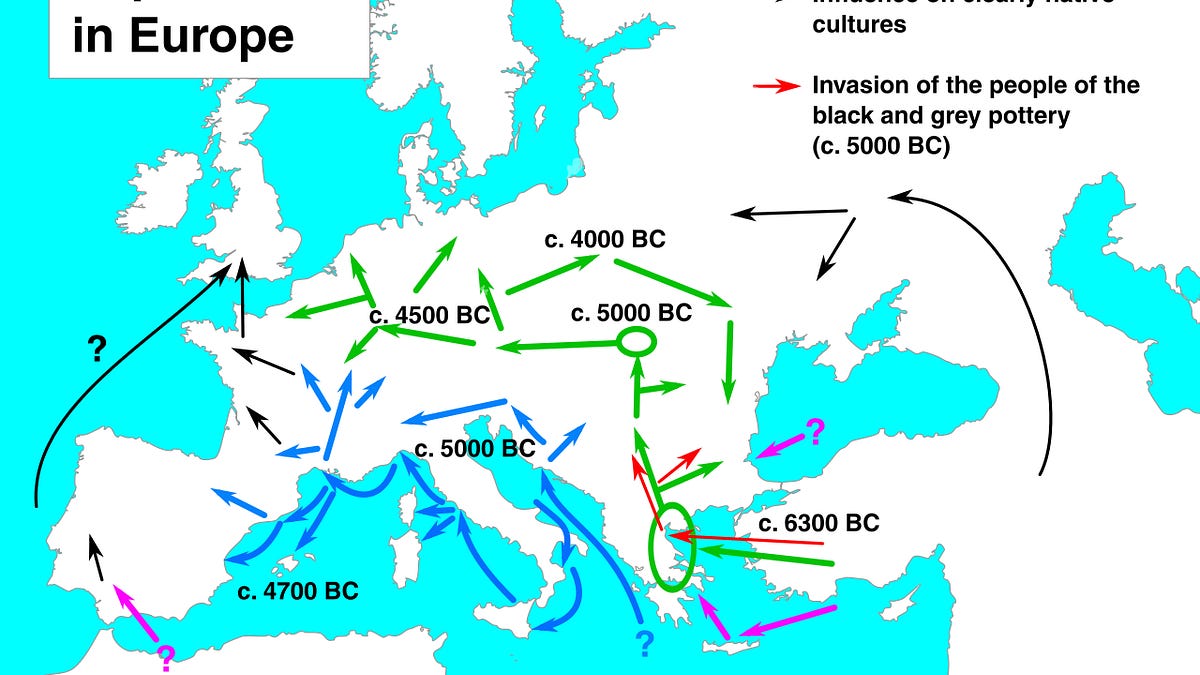
This chart from wiki is beautifully done and shows the evidence we have for the movements of peoples quite well, and might help explain the identity of the Sea Peoples:
https://en.wikipedia.org/wiki/Late_Bronze_Age_collapse#/medi...
Notably, we see the black arrow (Proto-Indo-European/steppe/PIE peoples probably) pressing into Anatolia/Hattusa. Were these the same people rolling through the Greeks? Was it the pressure of these forces that forced the Sea Peoples to attack Egypt (because they lost access to safe coastlines for trade)? Did Phoenicia know this was going to happen, and made an alliance that history has long since lost?
Here's the overall effect the Bronze Age Collapse had, from wiki: "The palace economy of Mycenaean Greece, the Aegean region and Anatolia that characterized the Late Bronze Age disintegrated, transforming into the small isolated village cultures of the Greek Dark Ages. The Hittite Empire of Anatolia and the Levant collapsed, while states such as the Middle Assyrian Empire in Mesopotamia and the New Kingdom of Egypt survived but were considerably weakened. Conversely, some peoples such as the Phoenicians enjoyed increased autonomy and power with the waning military presence of Egypt and Assyria in the Levant."
Well summarized; the only certain winner here was Phoenicia. Thus, one would assume that if anyone wanted the Bronze Age Collapse, it was Phoenicia. A waning Egypt and Assyria meant stronger profits for long distance traders.
Another question I've had about the Bronze Age Collapse is why the Sea Peoples fought on both sides of the Egyptian empire. I don't see the strategic value in doing this, and from what I remember the battles fought on the Western Egyptian border were years apart from the North-Eastern battles. Were fleeing Greeks pressing into Northern Africa, causing local tribes to attack Egypt?
Well then.
‘Alexander and the Greeks, except the Lacedaemonians(Spartans), set up these spoils from the barbarians dwelling in Asia.’
Have to respect a pretty good diss, the 300 suits of armor is an obvious reference to Thermopylae
my next band name
And, well, everyone else. I have a very difficult time taking the number of people kill during or after an assault. Many inscriptions refer to the complete destruction of a city, where the city is back in business apparently untouched a few years later.
Surpri-ise!
It literally incentivizes only working hard enough to not be punished and effort and investment of owners is into more slaves instead of improving productivity. Slavery is an economic trap of local maxima to the slaveholder. It is no coincidence that late abolishers are worse off than their neighbors who abolished earlier.
Not bothering with slavery is what helped acquire technology to massively beat out the short term. In spite of the emphasis on lower per unit cost slavery also is terrible in an industrial context, especially in a war one. The gulags weren't closed from kindness but because they looked at the infastructure produced and saw how awful it was. Using it for war materiale you may as well not bother with any locks or posted guards and outright invite in any foreign spies and saboteurs you find because you have them all literally incentivized to work just good enough to make it appear initially good to inspection and then fail in practice.
In all fairness to slavery it was the alternative to genocide historically. Yes, that previous sentence is horrifying on many levels. Genocide was the prior status quo and fights were over food supplies in the first place meaning displacement to a hostile undesirable wilderness or outright genocide were the common outcome for losers and being taken as a mate was "being lucky".
Food was too expensive to keep non-working captives for anything less than a suitably huge ransom. Human sacrifice had a habit of appearing and then falling out of favor once slavery was instituted (seen well in early Chinese tombs). The implications of human tendencies towards rationalization to justify what they want are clear and disturbing.
uh, maybe we just disrupted the market for slaves, so it isn’t so profitable it justifies the risk/backlash anymore (for all but a tiny subset anyway)? Which is good.
Mass murder still seems to be on the menu though, unfortunately.
Pretty much every culture around the world in ancient times had some sort of moral explanation for why infanticide was allowed. Now that extra mouths to feed aren't an imminent threat of everybody dying, the practice is considered immoral
https://en.wikipedia.org/wiki/Infanticide
we aren't genetically different from those people, we just happen to live in a time where we don't have to make as many tough choices
I don't think anyone is claiming a genetic evolution. It has been a memetic evolution.
You’d previously get word of mouth of what was happening (with lots of us vs them, dehumanizing, etc.). Now you’d get to see it ‘in person’ in 4K @ 60fps on YouTube.
It’s easier to say (and think) ‘yeah, those bastards deserved it’ when you aren’t seeing a very human person have it done to them up close.
Which is a good thing.
>https://en.wikipedia.org/wiki/Infanticide
At least half of the history in the wiki describes major civilizations and religions which absolutely banned the practice. Ancient Egypt, all Abrahamic religions, ancient China... Apparently many people did thought infanticide was immoral and did ban it.
While yes, there remains some underground slavery, and it is indeed terrible.
The world uniting and deciding to end this terrible practice is a hugely positive step for our species.
Macedons invaded and took over the Greek kingdoms:
Where is the source on this? According to this[0]:
> The surviving public and private inscriptions found in Macedonia indicate that there was no other written language in ancient Macedonia but Ancient Greek
So Macedonia was a kingdom where the aristocracy spoke Attic and later Koine Greek, and the vernacular being either a Greek dialect or other Hellenic language. So the written language would have been Attic/Koine. Alexander, being royalty, would have spoken and written in Attic/Koine Greek.
[0]: https://en.wikipedia.org/wiki/Ancient_Macedonian_language
Sure but... Alexander and his countrymen didn't speak that language or use that alphabet, and were not of that people. You might as well say he was an Ottoman Turk, or a Roman.
To clarify, are you talking about modern Macedonians, or ancient Macedonians? The modern Macedonians speak a language similar to Bulgarian and use the Cyrilic alphabet, both of which were not around in the time of Alexander.