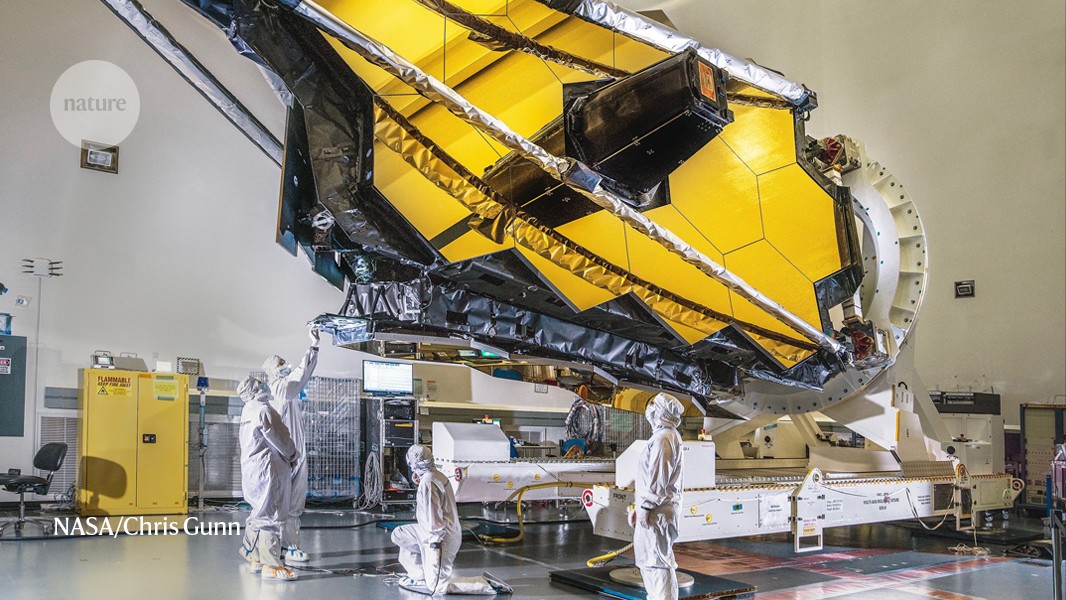
The $11-billion Webb telescope aims to probe the early Universe
Three decades after it was conceived, Hubble’s successor is set for launch. Here’s why astronomers around the world can’t wait.
nature.com
353 points · by infodocket · 4y ago · 280 comments
Have been waiting for this since I was a teenager. Can't believe we are almost there (launch on Dec 22).
Here's a short 2 min video of that deployment sequence if anyone wants to be fascinated: https://www.youtube.com/watch?v=RzGLKQ7_KZQ
Also a short interview with Dr. John Mather (could listen to him all day) if anyone wants to know how the telescope works: https://www.youtube.com/watch?v=4P8fKd0IVOs
$10B buys a lot of QA and I'm sure they try to engineer everything with the right margins, but it's still an unfathomable amount of state space.
Are there techniques to stay sane and manage risk without just throwing money at it? I feel like that kind of knowledge could be useful for software test development.
Then, you need to validate that each requirement is met by your system. This can be done by test, analysis (mathematically proving some property), review of design, or inspection. It's true that you can't fully validate most space systems on Earth, because we can't simulate all environmental conditions simultaneously. That's why you ideally you want each requirement to be validated by two methods.
When you find anomalies due to integration effects, it's usually because your interface requirements are not specified well enough ;)
My experience in industry is that we validate requirements when we confirm that they are necessary to achieving a particular mission.
We then verify that the system under construction does in fact satisfy the set of validated requirements.
"level of detail codified in functional, performance and interface requirements"
functions, usage frequency, APIs.
"usually because your interface requirements are not specified well enough"
It's probably a bug in the API.
https://martinfowler.com/bliki/TwoHardThings.html
"There are only two hard things in Computer Science: cache invalidation, naming things, and off-by-one errors"
https://en.wikipedia.org/wiki/Ctags
Suggestion: use ctags to list all functions, variable names in your code. Look for ambiguity (e.g. variable name "i"). Look at neighbouring code. Zoom in and out. A small bug in the most-used code is actually more serious than a big bug in code that rarely gets used.
"How long can you work on making a routine task before you're spending more time than you save?"
NASA Systems Engineering Handbook https://ntrs.nasa.gov/citations/20170001761
That's the 2017 version; maybe there's a later one. IIRC, it's an abridged from NASA Expanded Guidance for SE, but my link to that is broken.
"USL was inspired by Hamilton's recognition of patterns or categories of errors occurring during Apollo software development. Errors at the interfaces between subsystem boundaries accounted for the majority of errors and were often the most subtle and most difficult to find. Each interface error was placed into a category identifying the means to prevent it by way of system definition. This process led to a set of six axioms, forming the basis for a mathematical constructive logical theory of control for designing systems that would eliminate entire classes of errors just by the way a system is defined.[3][4]"
https://en.wikipedia.org/wiki/Universal_Systems_Language
There's a diagram of rules on the USL Wikipedia page. The rules show triangle feedback loops with a parent, left, right child. Those are like generations of a Sierpiński triangle. Every part is trying to serve the Good Cause that it's working for, and love its neighbour.
https://en.wikipedia.org/wiki/Minimal_realization
"any state-space model that is both controllable and observable and has the same input-output behaviour as the transfer function is said to be a minimal realization of the transfer function The realization is called "minimal" because it describes the system with the minimum number of states."
https://en.wikipedia.org/wiki/Optimal_control
"the problem of driving the output to a desired nonzero level can be solved after the zero output one is."
An electronic analogy: find GND, then solve for 1.
A common solution strategy in many optimal control problems is to solve for the costate (sometimes called the shadow price) A shadow price is a monetary value assigned to currently unknowable or difficult-to-calculate costs in the absence of correct market prices. It is based on the willingness to pay principle – the most accurate measure of the value of a good or service is what people are willing to give up in order to get it. The costate summarizes in one number the marginal value of expanding or contracting the state variable next turn.
Each part looks ahead 1 generation, chooses left or right.
https://en.wikipedia.org/wiki/Kalman_decomposition
convert a representation of any linear time-invariant (LTI) control system to a form in which the system can be decomposed into a standard form which makes clear the observable and controllable components of the system
Take a big problem, break it down, look for I/O ports. Or in software test development: layers of abstraction. A suggestion: only add a layer of abstraction when it's too big to fit on the screen at once. Use tools like code folding, tree views.
https://en.wikipedia.org/wiki/Optimal_control
Optimise for time? When we're in a hurry we break things. Another suggestion: aim to minimise entropy, maximise connectedness.
Thank you for asking a good question, and thank you for reading! Let's go and tidy up this world together, in software and hardware.
That is kind of what I figured, basically it always boils down to divide and conquer.
It just feels like with software, it's simultaneously easier than mech eng in so many ways (everything is in silico, near infinite abstraction power, ability to automate so many parts), yet it feels like we are constantly struggling with complexity. It starts simple but then quickly becomes a ball of yarn.
Maybe that perception is wrong, but if there is some truth to that intuition, I think it is due in part to this: software is all degrees of freedom and very few invariants to start, but then the system space quickly fills with rigid rules than can intersect in unpredictable ways. Physical engineering, you start with lots of invariants (the laws of physics, materials, chemistry, electronics, and geometry) but they are all thoroughly documented at this point. Things intersect, systems interact, but it feels much more bounded. You're only ever gonna have 3 dimensions, 6 simple machines, 92-ish usable elements, the standard model and universal constants.
This is why I value Rich Hickey's "Simple made easy" as the the exemplar of software philosophy. It's easy to say "oh yeah modular code good" but it's another to actually write code that is naturally decoupled.
As an aside, both disciplines tend to benefit from "throw more hardware at it!"
Let's hope it all works out, if not, some expensive lessons are about to be learned.
I wonder that mostly because we've managed to use a lot of our other space equipment well past their their mission lengths. I'd be interested if JWST is possibly the same.
Edit after someone corrected me.
Please refer to this comment: https://news.ycombinator.com/item?id=29490291
5.5yr is the minimum, 10 sounds probable (stated goal), while 20-40yrs is the best guess with expected fuel usage.
https://space.stackexchange.com/questions/55309/james-webb-t...
(The projects are still amazing; I'm not complaining about the engineering or performance!)
Starship could possibly take normal sized heavy equipment to other planets, such as heavy earth movers. (Not those with a combustion engine, but still useful.)
Just think of all the engineering and risk that’s going into a process that will be used once.
I think its just such a difficult thing to justify huge upfront costs to congress, especially if you see how long it has taken SLS to get anywhere. IMO, ULA, Boeing (solo) and Northrop's cultures couldn't possibly cut it for developing another amazing vehicle at any appreciable speed without the Euphoria and meaning that the Space Race provided.
I would definitely love to see something like the Space Station V from Kubrick's 2001 - A Space Odyssey IRL. AFAIK it was almost a quarter of a mile in diameter. This seems to be suited for in-orbit fabrication and assembly.
If the JWST will in fact spend almost a month in earth's orbit, does someone have an educated estimate on the magnitude of risk posed by space junk to nominal deployment?
Looking at those solar shields I imagine that they could be destroyed entirely by even the smallest of debris fragments. Same with the mirrors.
Edit: I'm wrong here (thanks @thethirdone). The burn set to occur after deployment is the L2 insertion burn and not the transfer insertion burn. Most of deployment will occur in the transfer orbit en route to L2, far away from earth-orbiting debris.
"James Webb Telescope will run a proprietary JS interpreter by a bankrupt company "
https://news.ycombinator.com/item?id=19737663
https://www.researchgate.net/publication/252882358_Event-dri...
"The James Webb Space Telescope (JWST) will use an event-driven system architecture to provide efficient and flexible operations as initiated by a simplified, high-level ground command interface. Event-driven operations is provided through the use of an on-board COTS JavaScript engine hosted within the payload flight software..."
Edit: Found something ....Is it too late to postpone the launch?
https://www.stsci.edu/~idash/pub/dashevsky0607rcsgso.pdf
"...The JWST science operations will be driven by ASCII (instead of binary command blocks) on-board scripts, written in a customized version of JavaScript. The script interpreter is run by the flight software, which is written in C++. The flight software operates the spacecraft and the science instruments.
The on-board scripts will autonomously construct and issue commands, as well as telemetry requests, in real-time to the flight software, to direct the Observatory Subsystems (e.g., Science Instruments, Attitude Control, etc.)...
The flight software will execute the command sent by the calling on-board script and return telemetry, which will be evaluated in real-time by that on-board script. The calling script will then send status information to a higher-level on-board script, which contains the logic to skip forward in the observing plan in response to certain events (see Section 4.1)... "
Found it...
"JWST uses an extended version of JavaScript, which was developed as a COTS product called Nombas ScriptEase 5.00e. ScriptEase provides functionality common to many modern software languages and follows the ECMAScript standard."
http://brent-noorda.com/nombas/us/toolkit/index.htm
http://brent-noorda.com/nombas/us/toolkit/isdkdownload.htm
Latest errata from 2004, moving from worried to full panic mode...
http://brent-noorda.com/nombas/us/devspace/errata/isdk/index...
It is also worth considering that the JS engine likely hasn't changed much (if at all) in the past 15 years. Its bugs and limits are well-known at this point.
It is also an interpreter which makes it slower* but less subject to vulnerabilities that impact the host. Honestly that's probably the correct choice for a spacecraft where reliability and safety is more important than performance.
Don't get me wrong: JavaScript is a big ball of WAT and nonsense we've spent way too much effort improving but I don't blame them for making the choice so long ago and sticking with a known quantity rather than risk introducing new problems by changing things.
* I once worked on a project that used IronJS to run JS in the .Net runtime. It took advantage of the runtime's JIT but was a lot of not terribly optimized F# code. I built a V8 bridge and was very excited for the increase in perf... but it got slower. It turned out most customer-written JS code spent most of its time using the API which was backed by C# code and that meant lots of bridging. At the time I left they were still using IronJS because it was faster for their workloads. It taught me the importance of testing your actual workload and taking a whole-system approach to perf.
"The major characteristics of our process are
- 1) coordinated development of the operational scripts and the flight software,
- 2) an incremental buildup of the operational requirements,
- 3) recurring integrated testing. Our iterative script implementation process addresses how to gather requirements from a geographically dispersed team, and then how to design, build, and test the script software to accommodate the changes that are inevitable as flight hardware is built and tested.
The concurrent development of the operational scripts and the flight software enables early and frequent "test-as-you-will-fly" verification, thus reducing the risk of on-orbit software problems...."
"Nombas,Un-Incorporated" http://brent-noorda.com/nombas/us/index.htm
He is in the critical path...
The observatory has around 7000 moving parts with complex structures for the primary and secondary mirrors and more importantly, the sunshield that would be used to keep the observatory instruments at a specific low temperature. It will take roughly 30 days for Webb to reach the start of its orbit at L2.
At the end of 30 days, the telescope should have stabilized itself in an orbit around L2. But I would assume it takes that many days for deployment and unfolding everything because of the sheer number of parts and motions involved coupled with things like getting to L2, stabilizing orbit, temperature stability and all the checks for the instruments on board along with the mirror deployment (since it's not one big sheet of mirror).
Here's a link which gives an idea about the logistics involved (along with a cool video series of the journey embedded): https://hackaday.com/2021/11/02/30-days-of-terror-the-logist...
To fathom how complex the sunshield deployment is (and that's just a part of the whole sequence), from the link above:
"Full deployment of the sunshield is without a doubt the sketchiest part of the whole process. The sunshield consists of five separate metalized Kapton sheets, each the size of three tennis courts. Each one must be unrolled, extended to its full size, tightened, and spaced out vertically for the sunshield to do its job. This takes the coordinated action of 140 release mechanisms, 70 hinges, eight deployment motors, about 400 pullies, and nearly 400 meters of cable to accomplish, not to mention the sensors, wiring harnesses, and computers to control everything. It’ll take the better part of two days to complete the sunshield deployment."
The whole thing is just insane.
From this talk by Dr. John Mather: https://www.youtube.com/watch?v=2RLGx_wgyAw
Around 1:47 you can see the number of people involved. 3 space agencies (ESA, NASA, CSA), over 3000 engineers and technicians and 100 scientists worldwide.
Edit: nope, I was wrong, it’s going to deploy a whole range of systems while on the way to the L2. https://youtu.be/RzGLKQ7_KZQ
The shuttle was decommissioned after the primary Webb design was done. What would have known the launch options at the time it was ready?
So, roughly $11 billion over 25 years. Something that many nations could afford.
There is a reason recently NASA has started to focus on Fixed Price contracts.
We need a shift to more missions, building these things more often and more on price. Putting absurd amount of money into 1 mission compared to 20 missions for 500M$ likely doesn't make sense.
The Webb telescope has been so long in development that lots of subsystems could have evolved considerably since then.
This only very recently became financially reasonable with SpaceX. It would have been impossible for NASA to know at that time that private industry would manage to lower the cost of launch by magnitudes.
Cost didn't matter back then because you only got one shot to launch anyways. If the rocket blew up and took the satellite with it you're never getting approval to launch again. It would be better to let the project overrun than to worry about financials and contractual obligations when the risk of cancellation or failure is already so high. But now, with launches being relatively cheap, it is actually possible to envision a backup plan where a second satellite goes up with a second rocket. Again, this only very recently (maybe ~5 years ago?) became possible.
I agree with you now though - NASA ought to be reconsidering overhauling its procurement process now that Falcon 9 exists.
> If the rocket blew up and took the satellite with it you're never getting approval to launch again.
That's not accurate.
But there's always have uncertainty in the payloads. First, because there are lots of contractors involved. That's somewhat fixable.
Second, and most important, is that many of these payloads are cutting-edge. They've never been built before and some of them push physical and engineering limits. I've worked on missions where the only delay was the payload for many years, and they were simpler than JWST.
It's a problem of not knowing what we don't know. When working on those kinds of systems, the estimates lose a lot of meaning.
https://en.wikipedia.org/wiki/Military_budget_of_the_United_...
Just because DoD budget is $750b, doesn’t mean that we should have a free pass to waste money. I’d like to see DoD spending cut in half while holding vendors accountable. Same with space industry.
Another way to think about this if it helps is for $11b, we should have gotten more done. Imagine James Webb Telescope + 5 more projects for the same $11b. Wouldn’t that be awesome?
If someone were to point to specific ways in which the project wasted money, that'd be different. But I haven't seen such detailed criticisms.
Nobody is arguing that wasting money is a good thing.
Not to imply that ISRO isn't doing important work, but simply looking to cut costs for the sake of cutting costs is just as bad as the waste you're complaining about. It'd be like comparing whatever it cost TSMC to switch to 3nm to what it cost to setup 20nm fabs.
What we should be pushing for is more accurate cost estimates. It isn't a problem that the latest and greatest in space telescopes cost $11B, technological progress is often expensive, it's a problem that initially we were told it would cost $2B. If we have a better cost estimate from the start, we can better control our expectations.
I could have used paper-clip manufacturer instead of ISRO for that matter.
But, we want a large bureaucratic organization (by design), extremely risk-averse(by design), extremely slow(by design), having only one shots (by design) to do this for us
This launch and perspective for science has me anxious and excited since its inception - and it’s been a while.
I will open a bottle of champagne when the first data will be sent from L2 with something along the “fully operational” lines.
Godspeed.
Since it's impossible to do maintenance on this observatory while it's in solar orbit, and since launches have strong vibrations and forces, it's important that the delicate and sensitive equipment be stowed in a way to minimize the effects of launch forces and minimizate the requirements for after-launch maintenance.
More lift capacity also means less weight optimization and more emphasis on robustness, reliability, redundancy, and power.
It is destined for a point in space 1.5 million kilometres from Earth — too far away for astronauts to visit and fix the telescope if something goes wrong. Hubble required an after-launch repair in 1993, when astronauts used the space shuttle to get to the Earth-orbiting observatory and install corrective optics for its primary mirror, which had been improperly ground.
https://www.nasa.gov/content/hubbles-mirror-flaw
One may assume that maybe the error was simply too big and that's why the aberration. Here's the root cause and the magnitude of the error would be dismissed as nothing by most people on this planet but ultimately turned out to be huge!
"Ultimately the problem was traced to miscalibrated equipment during the mirror's manufacture. The result was a mirror with an aberration one-50th the thickness of a human hair, in the grinding of the mirror."
For the first few hundred thousand years, the universe was opaque.
This link goes into a good amount of detail about the first light in the universe:
https://phys.org/news/2016-11-universe.html
We might be able to see a bit closer to the events after the Big Bang with a more powerful telescope in the future, but I don't think we can ever be able to actually "see" the Big Bang.
But there are other types of radiation that penetrate dense matter better: neutrinos and gravity waves. Right now it's "holy shit I saw one" for both kinds, so we're a long way off from doing any kind of imaging in those media. But if we ever manage detectors large enough and sensitive enough, we should be able to take "pictures" of the universe when it was even younger than when the CMB was released.
Dense enough matter will stop neutrinos, so that signal will be further back, but not the bang itself. So far as we know, nothing stops gravity--so that signal ought to be... interesting.
(Or at least, that's what Lee Smolin says in his book: Time Reborn)
Digging Beryllium for James Webb
https://earthobservatory.nasa.gov/images/148574/digging-bery...
I also learned that I actually broke down inside another telescope:
The Telescope Array project is a collaboration between universities and institutions in the United States, Japan, Korea, Russia, and Belgium. The experiment is designed to observe air showers induced by cosmic rays with extremely high energy. It does this using a combination of ground array and air-fluorescence techniques...The Telescope Array observes cosmic rays with energies greater than 1018eV. The surface array samples events over 300 square miles of desert.
Which brings me to the JWST. I'd love to know how likely it is that this amazing (and amazingly complex) tool actually succeeds in its goals. There's no way I could figure it out myself; I'd have to take someone else's word for it. Unless... there is a prediction market somewhere betting on whether the JWST will succeed, so I can piggyback on others' research and self-interest. I haven't been able to find one though. (Perhaps people think betting "against" success is too macabre.)
Anyone want to throw out a likelihood of success? (My WAG: 70%.)
It was great for me, I made some good money, but it definitely downgraded prediction markets in my mind from “uncannily accurate” to “good but not perfect”. They’re not going to predict Black Swans or other odd things in a way you can rely on.
- Search for the first galaxies or luminous objects that formed after the Big Bang.
- Determine how galaxies evolved from their formation until the present.
- Observe the formation of stars from the first stages to the formation of planetary systems.
- Measure the physical and chemical properties of planetary systems and investigate the potential for life in those systems.
I suppose I'm also hoping to go deeper. Like how is this going to help us understand how galaxies evolve? I suppose it will because we can see farther and so younger galaxies, and compare that to older galaxies to learn more about how they change.
I guess I'll have to wait for science to do it's thing and then we'll likely have lots of information to explain it all. Right now it wouldn't be a particularly compelling book to write.
And yeh, that is exciting!
And I do believe there is a high probability of detecting those bio-signatures.
JWST has been estimated to be 800% - 2000% over budget.
James Webb was also director for the Office of Management and Budget, 1946 – 1949.
https://www.space.com/3833-nasa-adds-docking-capability-spac...
That article is from 2007 but it still had the docking ring as of 2013. Can't find any recent ones that confirm if it will still have the docking ring at launch.
But I don't think we have the capability as of now to actually service it in case something goes wrong. But given how technology is advancing, maybe we can when JWST reaches EOL in 10 years.
I was surprised to find out, 5-10 years. I was expecting longer.
Those famous Hubble pictures are the defining images of a generation of scientists and dreamers. Are we about to get an update of those?
Or is this mission about the data?
Here is a comparison of what pics look like in visible vs infrared (both taken by Hubble, since it has some infrared capability):
https://www.jwst.nasa.gov/content/about/comparisonWebbVsHubb...
https://www.rmg.co.uk/stories/topics/james-webb-space-telesc...
https://www.cam.ac.uk/research/news/colour-changing-magnifyi...
We need a space industry that delivers on target and reward those contractors.
The growth in cost of Webb, directly detracts from other missions. It also has to be compared to actually building 4 actual $2.5B telescopes. There is lots of evidence that faster iteration, more missions give more overall science.
Continuously launching and continuously improving would be far better plan. Webb has lots of subsystems that have been done base on 10-20 year old engineering. But because of the approach one iteration cycle for some of these technologies takes 30 years.
In the '90's there was this huge Manhattan-like project, called "The Human Genome Project" [1]. The pricetag was about $3 BN. It took more than a decade. Then out of nowhere a startup appeared, and sequenced the human genome ten times faster and ten times cheaper (and fully with private funds). Nowadays, of course, we can sequence someone's genome for literally cents.
The JWT project started before SpaceX was a thing. Right now it looks quite likely that in less than one year we'll have a launch vehicle that will be able to put 100 tons in orbit in one shot, and for cheap. All the complexity of the folding involved with JWT would become unnecessary with Starship. If someone were to start right now a JWT project, there's a realistic chance they'll finish it in a tenth of the time and a tenth of the cost, just like Celera did. We would get the same scientific results, but maybe one or two years later.
So, now, am I allowed to ask again: why exactly was the $11 BN a good deal?
Essentially we allowed people $11 billion in human agency to occur for scientific reasons.
Sorry we didn’t put more of it into cars and video games, but your economy surely benefited from people doing the real economic exchange this required.
Personally I’d love to put it into designer drugs we can use to let me hallucinate a reality where miserly bean countering control freaks don’t exist, since we’re all going to die anyway and entropy will erode the universe.
Excepting rules against violence and careless end of the species, why all the rules?
But that's not the alternative here. Cars and video games are created via private investments, by for-profit corporations (and sometimes by volunteering developers). JWST was funded by NASA with public funding. The alternative to JWST was not cars, but rather the other projects that NASA could have funded, but didn't. When NASA made the initial decision to build the JWST, it excluded other projects on the premise that the JWST will cost about $0.5 BN. When later on NASA had to revise upward the cost, it had to either forgo other projects, or ask the Congress for additional funding. Well, the Congress did not provide additional funding [1]. Those with an internal view of NASA know what other projects were dismissed, or canceled because of the perpetual JWST cost revisions. We (the outsiders) will not be privy of these projects, but they certainly existed.
Make no mistake, I consider JWST to be a phenomenal scientific instrument. But when people applaud the launch of JWST, they don't see the non-launch of the multitude of projects that had to be canceled because of the JWST cost overruns.
This is a glaring problem for the standard model (big bang LCDM) right now.
XMM-2599, SPT0418-47, MRG-M2129, all mature galaxies, far away
By the time it finishes it's mission we're likely to have exceeded that $11 billion budget in fusion research.
Unfortunately, I don't think fusion is something simply solved by more money.
Fusion has no practical application other then some super advanced spaceflight situations maybe.
Fission is 10^12 more dense then oil, Fusion gets that to 10^15. If we are not willing to make the effort for 12 orders of magnitude, why would anybody care about a couple more?
We should also talk about fossil fuel subsidies ~5T/yr (!), infra $1.2T (one time), defense at $768B/yr, etc etc.
https://e360.yale.edu/digest/fossil-fuels-received-5-9-trill...
Those problems are political and most them already get much money spent on them. World Hunger is already being fought with lots and lots of money. And it turns out its not actually really a money problem.
https://endhomelessness.org/homelessness-in-america/homeless...
In January 2020, there were 580,466 people experiencing homelessness in America. Most were individuals (70 percent), and the rest were people living in families with children. They lived in every state and territory, and they reflected the diversity of our country.
That $11B would give about $18000 to all of those people. At $1000 a monthly rent that would house them for nearly two years and would most likely help them to stabilize their lives. Plus it would pump more money into the economy.
You will never find the end of the universe, or know why it began. And if you do find out, what is the purpose? Will it help you love another human being more? No, you will invent something else you need to discover.
Let's not change algebra to fit our conclusions, shall we?
I really don't understand how people are getting angry at $11B in space exploration funding. Consider the following:
a. Go through some of the cutting-edge technologies humankind has at its disposal nowadays (yes, yes, the kids starving in Africa do not, but that's an entire new tangent) and have a look at how they were invented. Chances are a lot of them originate in space exploration or space experiments. Modern navigation systems that power basically any systems you can think off that you use everyday. The high-tech tracking systems making sure the laser scalpel during LASIK eye surgery doesn't destroy your sight but rather restores it? Yea that was developed from a program that developed automated docking and rendezvous laser tracking systems for space dockings.
b. Can't you think of many more money sinks that would deserve to get defunded before thinking of space exploration? How about you start with the US Military? Last year the US spent over $750B on defense costs, that's over 68x the $11B figure quoted for James Webb. Surely we can deduct a billion or two here and there? You know what? that'd be double positive since you wouldn't create a whole portion of hungry humans at the same time since you're not going to war with half the world anymore. Stop the stupid fucking military complex first, then you can talk about defunding space exploration.
Yes we should have UBI but like, that doesn't meant we can't do science at the same time. Maybe look to the MIC to cut first.
Yes, cut the MIC budget, but this is part of that budget, kind of, since "Northrop Grumman Fully Assembles NASA’s James Webb Space Telescope"
https://militarycouncil.ca.gov/2019/09/19/northrop-grumman-f...
If you doubt this true, consider the fact that the US Government currently spends upwards of $1 Trillion /year on welfare programs per year. That is money specifically dedicated to poverty elimination and/or management. An amount that makes the James Web 0.44 billion /year over 25 years look like a rounding error. By your numbers, that $1 Trillion could be used to give each of the ~0.5 million homeless around $1.7 million per year. If it's this simple, why hasn't it been done? Is your assumption about how poverty elimination is as simple as throwing money perhaps incorrect? What do you know that the US Federal government doesn't?
FYI emotional appeals about how a telescope can't help us love each other will do you no favours here. Likewise with implications that you are the only one who cares about homelessness, or that one cannot care about both homelessness and space exploration at the same time.
This is NOT true. This is a made up figure by Jeff Session ins 2013.
https://www.realclearpolicy.com/blog/2013/04/01/about_that_1...
>FYI emotional appeals about how a telescope can't help us love each other will do you no favours here.
I am not looking for favors for myself. And if I cannot appeal to your emotions then WTF is wrong with you? Are you a sociopath?
> Plus it would pump more money into the economy.
It would "pump" money straight into the pockets of landlords. Its not like the money spent on JWT was shredded...
[1] https://www.budget.senate.gov/imo/media/doc/CRS%20Report%20-...
https://www.cbpp.org/blog/the-deeply-flawed-sessions-report-...
So no, we do not spend $1T on "welfare" a year. But let's focus on the money spent specifically for helping house the homeless. It is only $2.5B.
https://www.hud.gov/press/press_releases_media_advisories/HU...
The U.S. Department of Housing and Urban Development (HUD) today awarded $2.5 billion to renew support to thousands of local homeless assistance programs across the nation. HUD's Continuum of Care (CoC) grants will provide critically needed support to 6,597 local programs on the front lines of serving individuals and families experiencing homelessness. See local impact of funding below.
Any one of those changes would directly provide orders of magnitude more funds than scrapping this telescope. Getting worked up over such a relatively tiny expense with such longtail upside seems like a crazy place to focus on cutting costs.
https://www.northropgrumman.com/space/james-webb-space-teles...
But yeah, cut spending anywhere, but just can't help not getting excited over this while people are suffering. And I am saying this as a kid who wanted to be an astronomer when he was 13 and worked at a gas station to buy a celestron C80 telescope.
Unfortunately you can't just live inside a pile of cash. The problems surrounding homelessness are slightly more complicated than you are letting on, and "we spent the money to buy a telescope instead" is not one of them.
People who say "it's complicated" to these issues really just do not want to spend the money on caring for the worst off.
There's more to what any military force brings, obviously, both positive and negative. It's just sometimes when discussing the purpose of a military with others, the concept seems a little too fuzzy because most resources seem broadly available enough that they could easily be shared from a laypersons perspective. Lagrange points are very finite.
edit: apparently the area contained within a lagrange point is larger than I expected. Negates my point.
The reality is that spacecrafts fly on very large orbits around these points: the Planck spacecraft followed a 400,000 km-wide orbit [1] around the Sun-Earth L₂ point, and this is the same for many other spacecrafts that have flown around that place.
400,000 km is ~30 times larger than the Earth's diameter. Unless somebody has nasty intentions like e.g. purposefully crashing their own spacecraft against some other, there is no reason to be worried. There is more space around these points than here on Earth.
https://en.wikipedia.org/wiki/List_of_objects_at_Lagrange_po...
It's really a none issue
Lack of a "space force" doesn't mean lack of military capability in space.
#NotAScienceEquipment #wontlaunch