Column: Leaked SoCal hospital records reveal huge, automated markups for healthcare
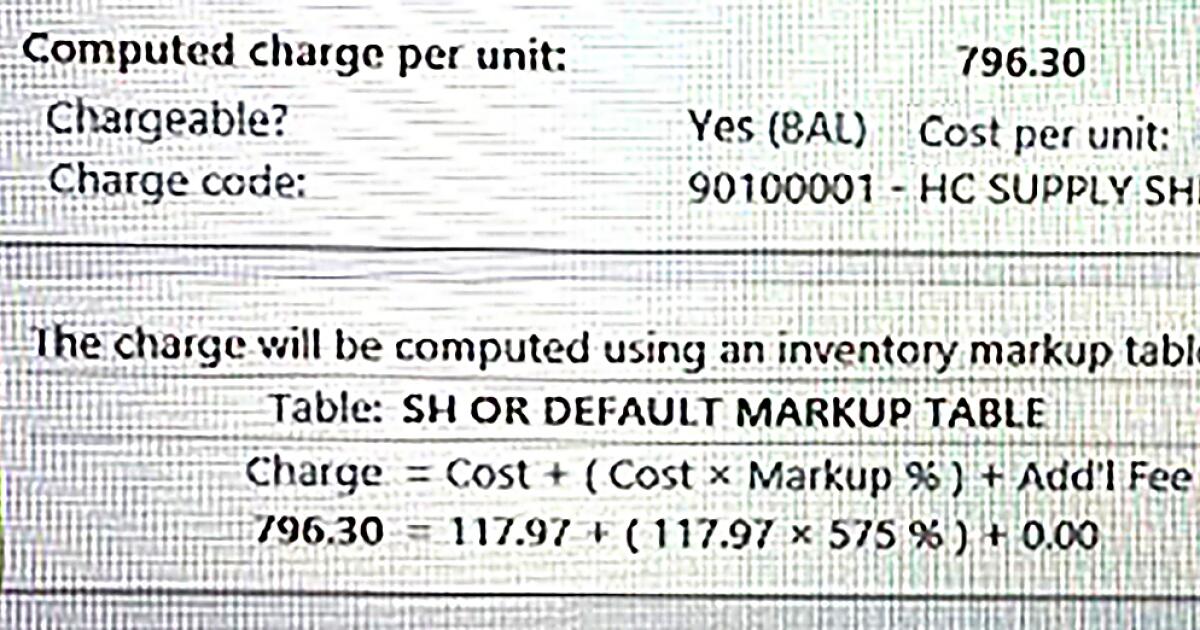
Screenshots of a system used by Scripps Memorial Hospital show markups of as much as 675% being imposed automatically during treatment.
Los Angeles Times
124 points · by mmastrac · 4y ago · 177 comments
I’m a health economist and much of my research is on hospitals. As much as everyone loves to complain about drug companies and insurers as being responsible for high US health care costs, that is not where the money goes. The money goes to doctors and to hospitals. (Specifically: about half of all national health spending to those two groups.)
If you want to save money on health care, you need to talk about paying less to doctors and to hospitals. If you don’t want to pay less money to those two sets of entities, you aren’t going to save much money. That’s all there is to it.
Yes, we can do better by spending less on drugs, but it’s a small amount compared to the gigantic sums which go to doctors and to hospitals. (Specifically: all drug spending is about ten percent of national health spending.) Yes, we can do better by reducing the administrative burden, but that slice of the pie is less than 10%. (And you will never have 0 admin expenses.) The administrative burden of health insurance is even lower than 10%.
So… go ahead and share your ideas for paying doctors and hospitals less, because otherwise you’re talking about stuff which doesn’t amount to much!
A big part of the problem is where the money comes from, not just where it goes. People are less averse to doctors being paid well than they are being stuck with absolutely ridiculous bills that they cannot reasonably pay, which should go without saying.
This is why so many people want to rich taxed much more heavily and that money used to subsidize healthcare, instead of the current trend of handwaving the wealthy as "not having liquid assets," something that never seems to matter when a wealthy person wants to pay for something expensive but suddenly matters when the working class wants the IRS to come knocking. If they need to dump stock or some other assets to pay their tax bill, that's their own problem and not anyone else's. It's also something that could be willfully avoided on their own accord.
That $768B "defense" budget is absolutely nauseating in the face of medical debt being one of if not the largest cause of bankruptcy in the US.
We’d be in a completely different situation if people paid for regular medical care out of pocket and paid for their catastrophic insurance by themselves. There’d be competition between health care providers to offer affordable care directly to individuals, just like other normal markets.
- France
- Japan
- Australia
- Great Britain
- Finland
- Taiwan
- New Zealand
- South Korea
- and many more!
All countries which do not spend anything like what we do on defense, are not under Chinese or russian domination, AND nearly all have longer life expectancy than we do while at the same time spending much much much less on a per capita basis on health care than the US does.
Besides, that $768B is spent on military operations for all sorts of purposes, not just "freedom". Fat defense contractor margins are another big chunk.
I'm also curious about doctors' personal expenses. If most of their salary is going towards rent or homeownership, short of situating a hospital on something like a kibbutz... maybe there is some sort of rent subsidy -- or tax break for landlords that give a 10% rent discount / for banks that give a medical professionals low interest home loans -- that could be enacted. It could allow doctor's effective salaries to stay the same, but medical prices to drop?
I'm afraid you are going to say that doctor's biggest personal expense is student loans for medical school! If medical-school-debt were to be wiped out, do you know how much salaries could drop in terms of objective price without changing doctor's effective income?
- doctors in the US are paid relatively more, generally by A LOT, but the only data I know about this is old. US doctors are not that enthused about hearing they should be paid less.
- as another commenter notes, we have fewer doctors and fewer hospital beds than most other OECD countries.
- related: despite what you may hear, our utilization is lower than most other oecd countries. (At least in the following dimensions: hospital visits are less frequent and are shorter.)
- I don’t know of good data about doctors’ personal expenses. But there is a paper from a few years ago which looked at labor department data and found that a decent fraction of the top 1% of the income distribution in the US was made up of doctors. I may be able to find that reference and the fact I’m citing may be misremembered.
- sure, doctors do have high medical school expenses and debt here relative to other countries but for anyone who is not in primary care, it’s not going to take that long to retire the debt. There are multiple specialties which pay north of $400,000 per year.
- I do not think doctors’ salaries are related in a meaningful way to their debt. Which is to say: if you canceled all medical school debt tomorrow, prices for physician services would decline by about 0%. Those costs are sunk. They are not going to have a large effect on prices.
Don't get me wrong, I'm a big fan of the NHS. It's humane, generally provides very good care, and (in comparative terms) is cheap. It'd be a happier place if it wasn't permanently having to handle demand increasing faster than budget.
[0] https://www.ucop.edu/federal-governmental-relations/_files/f...
Anesthesiologist is buying a lamborghini, the family practice person needs a few years before they can entertain buying a house.
Admin bloat is a consequence of having too few doctors, and also legal requirements on how visits have to be handled in the US. For each medical visit you get at least 10~15m of recording the visit. A doctor without any help would spend around half the time talking to a patient, and half the time filling out charts for insurance and legal requirements.
Thus to make money you need to delegate all those tasks as much as possible, and you get to a point where some hospitals even offer a full medical assistant per provider. To solve this you need to have way more doctors, and a lot less medical liability from a legal standpoint. For example, you cant have paper charts in the US, which is standard in many other first world countries.
Billing is also a very expensive source of admin work. You have to have a perfect pipeline for billing to have high collections, then you have issues collecting the money months after that is settled, etc etc. Many ways to solve this one, but partially solved by moving a lot of expenditures to cash-based payment. You can save all of this in a cash-based system. Alternatively you could have competition in the insurance market, but although that could improve things, in the end, you still need to write medical and administrative work to get paid. This problem also exists in many other countries.
> Are doctors paid relatively less in other countries?
The Gross income of physicians in the US is surely the highest in the world. But gross is gross. At those levels taxation approaches 50%, and medical education can cost half a million dollars. Its a perverse system where you pay a lot to a ticket to earn a lot, but you get collected all the way to the bank. And if you dont make it, you fail really hard. Primary care physicians are the lowest paid in the us and have an abnormally high suicide rate.
> And is there any chance that the high pay is needed to counter-act overly stressful working conditions in the US (vs., say, the UK's NHS?)
High pay is a simple result of too few physicians. But what goes to physicians directly is a smaller part of spending: only about 10% of spending goes directly to physicians. You can make it better, but I think its likely they want better working conditions over money, its just not an option in this market structure. You cant operate part time, or with 30min appointments, without charging patients above insurance levels. (example, OneMedical, Concierge medicine, parsley, etc).
> I'm also curious about doctors' personal expenses. If most of their salary is going towards rent or homeownership, short of situating a hospital on something like a kibbutz... maybe there is some sort of rent subsidy -- or tax break for landlords that give a 10% rent discount / for banks that give a medical professionals low interest home loans -- that could be enacted. It could allow doctor's effective salaries to stay the same, but medical prices to drop?
This market structure needs less rules, not more rules. I have NEVER seen a market so captured as this one, and its captured by everyone in some way. Every single actor in this market is using government to get something from someone else, including patients, insurance takers, physicians, admin, pharma, gov. Literally everyone.
> I'm afraid you are going to say that doctor's biggest personal expense is student loans for medical school! If medical-school-debt were to be wiped out, do you know how much salaries could drop in terms of objective price without changing doctor's effective income?
Causal relationship is backwards here. Salaries are not high because medical debt is high. Salaries are high because there are too few doctors, because it is too expensive to get an education for it. If you wipe out medical debt, you are assisting the ones that made it over, but not all the ones that could not make it in the first place. To reduce the cost of education you need to do a few things:
1- eliminate federal funding for education, that makes it only "approved" universities be able to provide limited slots.
2- Eliminate or reduce the cost of licensing. In the us you need a license per state to practice medicine, and it is very stringent. If it were handled like a legal bar exam instead, you would put significant pressure in the college system while also allowing for independent education to ocurr.
3- Allow medical degrees from other countries to practice in the US. This would leave the option for doctors to study abroad for nearly free and come back and practice.
The market structure is such that there are very few doctors, so you need to do your operations in a way that doctors spend as little as possible with patients, and you delegate as much to assistants and administrative chores. With a massive supply shock on doctors you would not only lower wages for doctors, you would also lower admin costs.
One caveat, even though doctors wages are very high, they are also rent-captured by universities that charge mid six-digits for an education and medical insurance, and certifications that are burdensome and expensive. I remember medical malpractice insurance going to several thousand a month for OBGYN. There is a reason why clinical doctors have an abnormally high suicide rate in the US.
Then hospitals get massive fed spending and money, plus often local protections that mean you cant open competing hospitals. In the book " The Social Transformation of American Medicine" they talk a lot about how hospitals rent-seeking behavior is to turn themselves as a non-profit, and then ask for federal funding and getting that denied to for-profit hospitals, effectively capping the amount of hospitals you can open.
The WHOLE market structure needs a detonation. And this is my desire/wish/prediction: at some point we will get an Uber for medicine. Americans will do most their telemedicine with doctors outside the united states, where education is free, there are not legal requirements or certifications or licenses, etc. This is what immigrants like myself do. A psychiatrist in argentina, for example, charges 5U$S for a visit, while one in Palo Alto, CA charges 1000U$S with a 3 month wait list.
>> Hospitals are 40% of the NH spending so I would even not look at doctors that way.
Hospitals are 30% and physicians are 20%
>> The market structure is such that there are very few doctors,
Agree. Add more medical schools and residency spots.
>> With a massive supply shock on doctors you would not only lower wages for doctors,
Yes, this is a good idea.
>> you would also lower admin costs.
Not clear that this is true or why it would happen.
>>One caveat, even though doctors wages are very high, they are also rent-captured by universities that charge mid six-digits for an education and medical insurance, and certifications that are burdensome and expensive.
Medical school debt may be high, but salaries are higher. Certifications are not likely a large obstacle to more entry, IMO.
>> I remember medical malpractice insurance going to several thousand a month for OBGYN.
There are plenty of “tort reform” states that cap malpractice payouts. Medical services are not cheaper there.
>> There is a reason why clinical doctors have an abnormally high suicide rate in the US.
Source needed on this claim. Might be true. I’m skeptical though. High relative to what?
>> Then hospitals get massive fed spending and money,
They do and certainly in the COVID stimulus bill that was a HUGE waste of public money.
>> plus often local protections that mean you cant open competing hospitals.
This is called “certificate of need.” These laws are dumb but don’t exist in 15-20 states at this point. More entry would be great, but you need more doctors, more competition and more price transparency too.
>> In the book " The Social Transformation of American Medicine" they talk a lot about how hospitals rent-seeking behavior is to turn themselves as a non-profit, and then ask for federal funding and getting that denied to for-profit hospitals, effectively capping the amount of hospitals you can open.
Certificate of need laws are state, not federal.
>> The WHOLE market structure needs a detonation.
I’m on board. But by detonation I really mean: - more medical schools, - more doctors, including permitting foreign doctors to practice here - price transparency - meaningful competition among hospitals on price.
>> And this is my desire/wish/prediction: at some point we will get an Uber for medicine.
Amazon is starting an Amazon Care product. Looks like urgent care for the time being. My hope is that they open hospitals eventually.
>> Americans will do most their telemedicine with doctors outside the united states, where education is free, there are not legal requirements or certifications or licenses, etc. This is what immigrants like myself do. A psychiatrist in argentina, for example, charges 5U$S for a visit, while one in Palo Alto, CA charges 1000U$S with a 3 month wait list.
Great idea and this is what my (foreign born) wife does too. A great way to save money.
For anyone else reading this far down, you can do it too. There are English speaking doctors everywhere.
> Source needed on this claim. Might be true. I’m skeptical though. High relative to what?
It's a persistent misunderstanding of the data, pushed mostly by doctors or people who don't know where to find the data but also by the complexity of understanding suicide.
Firstly, every death is a tragedy and we should be looking at suicide as mostly preventable. Doctors are highly educated, well paid, and tied into local healthcare systems. These should be protective factors. So we should see lower rates of death by suicide in this group. Both of these mean that the rate of death in doctors is too high, and should be reduced.
The "relative to what?" part should be "to other professionals, such as lawyers or architects". And sure, compared to those groups we see doctors have a higher rate of death, and that's worrying because of the protective factors that should be present. (This is mostly because female doctors have a higher rate of death by suicide than women in general.) In healthcare we see nurses and other female care givers have higher rates than doctors.
https://www.cdc.gov/mmwr/volumes/69/wr/pdfs/mm6903a1-H.pdf
> In 2017, nearly 38,000 persons of working age (16–64 years) in the United States died by suicide, which represents a 40% rate increase (12.9 per 100,000 population in 2000 to 18.0 in 2017) in less than 2 decades.* To inform suicide prevention, CDC analyzed suicide data by industry and occupation among working-age decedents presumed to be employed at the time of death from the 32 states participating in the 2016 National Violent Death Reporting System (NVDRS). †,§
> Compared with rates in the total study population, suicide rates were significantly higher in five major industry groups: 1) Mining, Quarrying, and Oil and Gas Extraction (males); 2) Construction (males); 3) Other Services (e.g., automotive repair) (males); 4) Agriculture, Forestry, Fishing, and Hunting (males); and 5) Transportation and Warehousing (males and females). Rates were also significantly higher in six major occupational groups: 1) Construction and Extraction (males and females); 2) Installation, Maintenance, and Repair (males); 3) Arts, Design, Entertainment, Sports, and Media (males); 4) Transportation and Material Moving (males and females); 5) Protective Service (females); and 6) Healthcare Support (females).
> >> you would also lower admin costs. > Not clear that this is true or why it would happen.
There is an operational tax whenever you involve more people into the operation. You need to communicate, add paper trails, set up structure, etc. If say, you had one person collecting payments instead of a secretary, a doctor writing a paper, an insurance biller, an insurance agent, etc for the same ops, it would be a lot easier. You would have doctors perform many of these tasks. For example, give vaccinations, take vitals, etc.
> Medical school debt may be high, but salaries are higher. Certifications are not likely a large obstacle to more entry, IMO.
Thats the survivorship bias. Salaries cant be lower because people would go bankrupt. Certifications reduce competition, and make it harder to practice. There's even a startup that Raised a series A of multiple millions just to make this process faster (medallion). Evidence this affects the market is that most doctors are only licensed in a couple of states at most.
> There are plenty of “tort reform” states that cap malpractice payouts. Medical services are not cheaper there.
I'd like to see some data about this if you have it. Conceptually malpractice insurance is a fix cost that puts downward pressure on supply. IT is particularly salient for physicians that would like to work part-time.
> Source needed on this claim. Might be true. I’m skeptical though. High relative to what?
https://www.webmd.com/mental-health/news/20180508/doctors-su.... This is a well known fact in the profession.
>> In the book " The Social Transformation of American Medicine" they talk a lot about how hospitals rent-seeking behavior is to turn themselves as a non-profit, and then ask for federal funding and getting that denied to for-profit hospitals, effectively capping the amount of hospitals you can open.
> Certificate of need laws are state, not federal.
The point above is that by making it impossible for for-profit hospitals to compete due to lack of subsidies, the supply is deliberately constrained.
Cheers!
Bigger issue is low supply: too few medical schools admitting too few students keeps supply Low and prices high. Current doctors love it. (That’s the same reason non-US-trained doctors can’t come to practice here. You can bet that they’d love to at our salaries!)
Probably the training process is dysfunctional and needlessly brutal. But that doesn’t make prices high on its own.
Just open more med schools, add residency slots, and make it easier for doctors from other places to come here and practice.
It should be clear that in this relationship, the rent-seeker is the university education. Doctors and wanna-be doctors are victims here. From whom? Mainly other doctors. Similar to any union.
Think twice before you ask for it - you might get it.
I often hear that doctors in US make more than they should. Compared to what? My significant other is a practicing physician in a second highly compensated (after surgeons) medical specialty. Besides her daily work she has at least one (sometimes two) night calls a week in the hospital plus another one or two calls from home (should be back to the H on a 30 minutes notice). I am embarrassed that as a computer scientist I make more than her working from home in a comfy chair in front of a screen. Paying doctors less than other skills professions is a sure way to guarantee that the next generation of doctors will be composed from the folks that could not make it into the "better" professions. Don't forget there is no "restart" button on a human corpse after failed surgery. You want a person holding your life in their hands to be top notch.
Last thing to point out: even in equitable societies like Western Europe doctors make more compared to other skilled professionals like software engineers. America is unique that FAANG pays more to their engineers that Mayo Clinic to its physicians.
Compensation isn't correlated with how rigorous a job is, or we might pay laborers more. It's simply what the market is willing to pay for that skillset. Why is that? There are a lot of reasons but I'll agree they aren't great. But I'm not sure how one could change that
Question 2: If you were in charge, what would the future perfect healthcare system look like? Are there any systems today which resemble that system?
--
Despite my efforts to learn, and experience in the industry, I'm at a complete loss. At best, I can spot some zombie silver bullet ideas. (eg "Tort reform FTW.")
And I keep having "aha!" moments. TIL from this discussion is the connection between shortage of doctors and rise in administrative overhead. D'uh. I don't know why I hadn't thought of that. I'd long assumed a major, perhaps biggest, driver was guarantors ratcheting up administrative burden to reduce payouts.
There's too many layers to this onion.
There is overlap in coverage there but health Econ and health policy are somewhat different classes.
David cutler also has two worthwhile and short books: the quality cure and your money or your life. Both are good.
Question 2:
- more medical schools - more residency slots - no restrictions on foreign doctors practicing medicine here - price transparency - proper incentives for consumers to care about what provider they choose - no employer provided health insurance. This is a source of many many many problems.
Probably more but that’s off the top of my head right now
One graph that I've seen shows a huge increase in the number of hospital administrators while the number of MDs has been relatively flat.
Granted, the Y axis is percentage, not numbers, so it may be that we went from 1 administrator for every 100 doctors to 10, which is both a huge percentage increase and probably not a significant dollar increase.
One instance of this graph is in the middle of: https://www.athenahealth.com/knowledge-hub/practice-manageme...
Hospitals are also privately owned in the USA, whereas they're mostly government-owned in western europe. That's billions of dollars redirected from normal people towards rich stockholders.
Also: most large hospitals are technically “nonprofit”. Most of the money there goes to salaries for hospital employees, including well paid administrators.
As I note elsewhere in a reply to another comment: it is an ongoing open research question whether “nonprofit” and for profit hospitals actually do anything different. My strong sense (indicated by my “”!) is that the answer is no! They are equally rapacious.
However, it's not satisfying at face value.
The reason is that as a consumer of health care services, I see two trends.
One is fewer and fewer actual doctors - a group practice I go to seems to be built around a single doctor and lots of nurses or physicians assistants. The doctor only gets involved in really exceptional cases.
The other is that everybody, whether a doctor or not, seems to have an incredibly packed schedule, like they need to see dozens of people per day.
So if they're making so much money, why is it like this?
Find me a payer who will agree to it and I'll show you the solution to healthcare bloat.
A lot of the doctors/dentists/pharmacists made out very well in previous decades, resulting in the healthcare expenditures becoming a political flashpoint, culminating in ACA, and thus the pendulum starts swinging the other way. Sucks for newer generation of doctors.
A friend of mine does ear and neck surgery in the US. For operations where the hospital bills $25,000, he receives $300. Some more goes to the anesthesiologist and other personnel involved, but the vast bulk to the hospital itself. Compensation does seem to vary by field, so I'm curious what you've seen.
Is he an employee of the hospital, or does the hospital contract the doctor for surgeries?
If he's an employee, it only makes sense that he gets a "base" salary and bonuses for actual surgeries. That makes it less risky for him, if, for example, there's a whole month of people not needing ear/neck surgeries.
If the doctor's practice is contracted by the hospital to come in and perform the surgeries as needed, you can bet your ass that doctor would be charging $5k+ per surgery.
Does this less than 10% include the time doctors themselves spend on administration? I've heard that filling out complicated billing and insurance forms takes up a big chunk of their time.
Hospitals are setup mostly as non-profits, which means they have no incentive to have an operating margin. Furthermore, hospitals can have lots of leverage, as sometimes they are the only one in 20 miles or more: so the closer they are to bankrupcy, the more money they can ask government.
Hospitals are very close to the mercantilist corporations pre-liberalism in this way: they are protected from competition and from their own failure.
For doctors, that pay is well deserved given the exorbitant student loans that doctors carry, and the ridiculous shift length and other work related issues.
For hospitals? Here's the real deal where costs can be saved - 25% of hospital expenses is administration expenses [1], and 8% is profit margin [2].
Convert hospitals to non-profit operations owned by a single-payer insurance and immediately save a lot of costs across the entire board.
[1] https://www.commonwealthfund.org/publications/journal-articl...
[2]: https://www.americanprogress.org/article/high-price-hospital...
Disagree on many, many counts.
- do you know many specialists? Ridiculous hours are not part of the picture post-residency!
- deserved why? On the basis of what? More than a taxi driver who works long hours? A convenience store worker who works long hours?
- student loans are not that hard to pay off at US (medical) salaries! There are surgical specialities where the average pay is north of $500k. Family medicine and pediatrics make a lot less.
>> Convert hospitals to non-profit operations owned by a single-payer insurance and immediately save a lot of costs across the entire board
- converting hospitals to non profits isn’t going to do much because most are already not for profit.
- you save money with single payer (ideally) by paying lower prices… which is my original point. There is administrative bloat and burden in the system but it’s on the order of 10% of spending, not 40%.
And, just to be clear, you have to administer hospitals in single payer too so you don’t get rid of those costs entirely.
I can support single payer, but I support it to pay lower prices to doctors and hospitals (and pharma, but as I noted above that’s not a big slice of the pie either).
> For doctors, that pay is well deserved given the exorbitant student loans that doctors carry, and the ridiculous shift length and other work related issues.
Is pure BS. Many professions end up carrying student loan repayment for decades and that isn't usually used as an excuse for increased pay - additionally there are plenty of professions (and folks working two jobs) that end up putting in more hours than doctors. These costs aren't describable using either of those causes.
Additionally, most hospitals are already technically non-profit organizations - it's just that administrators can end up having purely ridiculous take-homes. A single payer system probably is the solution but mostly because of the price setting and ease of billing - if you compare Canada to the US you'll notice that the Board of Physicians sets procedure and drug pricing provincially rather than being left up to a patchwork of random private corporations.
(As an aside, I'm both a Canadian-American dualie (American first - I emigrated to Canada) and I work in a company that tracks US Healthcare insurance information)
Hospitals make ridiculous profit. Insurance companies make ridiculous profit. Neither of them care at all what the real customer gets charged.
See also Federally guaranteed student loans
"It depends."
Non-trauma hospitals in affluent areas that perform lots of elective procedures make a lot of profit.
Trauma centers in less-affluent, usually urban or rural, areas that deliver emergency care almost always run at a loss, and are subsidized by city / state / federal funds to maintain capability.
The norm in most systems (in developed states, anyway) is that the buyer doesn't care what the price is, to at least the same degree that they don't in ours. Yet they're all much cheaper than our system.
The U.S. is different because we allow corporations to lobby/bribe/buy politicians, which most other developed countries consider to be corruption.
So we have a health care system optimized for profits, not people.
I'm no expert but have been reading about this for a couple decades now, and the consistent element in every non-US system in developed countries, despite a vast variety of approaches, is indeed price controls, either explicit or de facto. I'm highly skeptical of any reform attempt in the US that doesn't have that as a central element, due to, you know, gestures at the rest of the world.
The problem, in other words, is that a truly free-market healthcare system would be politically infeasible in a major first-world nation. So instead of a public healthcare system that would provide minimal healthcare services to all citizens, they tied it to employment, effectively moving it from the consumer market to the labor market. So this arrangement, like most neoliberal policies including Obamacare, has served merely to buy more time for the ruling class. And worst of all it has worked.
https://www.investors.com/wp-content/uploads/2018/03/CPIChar...
I guess we should be thankful to Moore's law and figure out how to apply it to Childcare, College, and hospital services? I guess thats where Elon Musks's robot comes in to play. It can teach you skills to get a job, take care of your kids, and then perform your surgery. Problem solved! :)
Administrative fees include profit, but also salaries, IT expenses, whatever other costs it takes to actually run an insurer.
Every US state has laws that prohibit insurance companies from collecting "too much" profit from the premiums they charge their customers. In most states, the limit is given as a percentage of pure profit. So insurers set their premiums based on their expected payout costs plus operating expenses, and usually make premium adjustments on an annual basis.
(That's why most US drivers received a bunch of rebates from our auto insurers, early in the COVID pandemic. The sudden unexpected drop in accident rates drastically reduced the insurers payout costs. They were required by law to return the excess.)
The intended purpose of these laws was to protect consumers from predatory insurance companies. But in modern practice, with basically zero effective cost controls on medicine, it's created a perverse incentive: Rising healthcare costs are the easiest opportunity for health insurers to increase their absolute profits... All they have to do is sit back and let health care providers keep raising their prices.
But:
• the costs are passed only indirectly to the consumers who ultimately pay
• the market for health care is so terribly distorted
• health care demand is highly inelastic
So normal market mechanisms (like price signaling) aren't very effective at containing the rise in costs.
Further, most bigger companies self-insure, and only use the insurance company to provide services. So F100 company partners with Blue Cross Blue Shield just for billing, administration of the plan, etc. What does BCBS care how much surgery costs? They are getting Admin fees the same whether its $5,00 or $10,000. Does a F100 employer really have the time and energy to question whats going on? They just look at the cost last year, raise the price for their employees by %XY and march forward.
Even further, health insurance is incredibly regulated, on a state level. If you have a good idea to "disrupt" the industry, its such a slog to get anything done. Your best bet is to partner with an existing insurance company and go from there.
But the managed care organizations (health insurance companies) still complete with each other. UHC, Anthem, Cigna, CVS, Humana, Centene, etc. there are many.
Considering they all have low single digit profit margins per their 10-K reports, it seems evident that there is sufficient competition to incentivize low prices for managed care services.
What's interesting about this is that around 75% of hospitals in the US are actually non-profit.
Source: https://www.kff.org/other/state-indicator/hospitals-by-owner...
All this ends up meaning is that any revenue above their expenses is plowed into hiring more and more administrative staff and building new facilities.
You also leave out one important place for “extra” money to go: salaries within the hospital.
Back in 2015 the president of Boston University raked in $2.5 million https://www.bostonmagazine.com/education/2017/12/11/boston-u...
While $2.5M is obviously a lot of money, it's a drop in the bucket in terms of how much the university brought in. For universities and hospitals, it's not the high salaries of a few execs, it's the massive amounts of administrative staff.
For the larger hospital systems, several thousand admin staff making 60-70k+ adds up to waaaaay more than the fat paychecks that a dozen execs make.
It's basically a snowball effect. Execs get bonuses for bringing in more revenue, but it's a non-profit so they have to spend it somewhere, so they expand admin and build facilities, rinse repeat.
> Healthcare providers routinely ignore the actual cost of treatment when calculating bills and instead cook up nonsensical figures to push reimbursement from insurers higher.
This is the real story of health care, in a nutshell.
Providers say "A procedure costs $100." Insurers say "Great, we'll reimburse you $50 for it, or you won't be in network." Providers say "But it actually costs $100." Insurers say "Fine, but cut us a deal in exchange for our business, and charge us $50." They hammer out a contract that specifies $55 for that procedure.
On the next procedure, which costs $200, the providers (and their facility) stops to think. "Wait, insurance is going to ask for a substantial haircut on whatever number we give them." So providers say "This procedure costs $400." Insurance says "Fine, we'll reimburse you $200." Providers say "Oh no. Fine, we'll take it."
Then a few years later insurance analysts get around to noticing relative cost differences, and the entire dance starts over again.
The fundamental problems with US health care are (1) the lack of end-user (patient) visibility into costs before undertaking a procedure, (2) opaque insurance-facility contracts, & (3) the bullshit dance between facilities, middle people, and insurance companies that end up adding confusion, delay, and costs to what would otherwise be simpler transactions.
Or to put it another way, without it, you certainly can't answer the question "Where is the best deal for my procedure?" But more importantly, you can't even answer "Are my insurer's negotiated rates a good deal for the procedure?"
The more-free-market ones simply dictate prices on some things and services (with, for the more-free-market ones like Singapore, the very real implicit threat of dictating even more of them if the market gets too greedy, with the less-free-market ones dictating more prices from the outset), and at the less-free-market end of the spectrum you have state monopsony (single-payer) or even direct state control of healthcare service providers, so the price controls are more de facto.
I'm not aware of a single system outside the US [EDIT: in a developed state, that is—I've not looked into developing-world systems] that doesn't achieve their results with price controls. Even the relatively "free market" ones—again, Singapore is usually the prime example people bring out for that, and they use some price controls and a very credible threat of further intervention to make their system work. Given this, I don't have much hope of success for any reform that doesn't either directly set at least some prices and threaten to set even more, or take even more control over price-setting (monopsony power, or nationalizing providers), given how universal that element seems to be.
There are some systems that have private (though, perhaps, non-profit only) insurance and a public insurer as a kind of public option, as an insurer of last resort, but they place all kinds of restrictions on this, like standardizing basic-coverage plans and dictating that all insurers offer them, mandating that providers all accept these plans (including the government one) and so on, and often still having other price controls on top of it.
The fact that patients have the choice to go to the public sector instead of the private likely keeps prices in the private sector down, but if there is literature on the extent and magnitude of those effects, I’m not familiar with it. Mexico is an example of such a country.
- negotiate with the government on prices, or
- work for the government, charging their rates.
Waiting lists for specialists are ridiculous, unless it's something extremely urgent. It quickly becomes about "who you know" and queues can be jumped if you have the inside track.
I've never been encouraged or "nudged" to get a physical or even blood work done. Quite frankly, the system is under so much strain that getting everyone a physical would push it over the brink. So they mandate them for commercial drivers and other high-risk occupations, and everyone else just goes to medi-clinics and sees a walk-in doctor. Zero continuity of care.
Canada is great at treating the dying, terrible at treating the healthy.
I'm self-employed. Dental, prescription drugs, glasses, mental health: this is all out of pocket.
My impression is that if you have a reasonably good job in the United States, you have access to reasonable health care. Is that a fair assessment?
I see no difference between private insurance and government run except the government is constantly lambasted for overspending and medicare seems to have the lowest operating costs and payouts to healthcare providers.
which seems to be the exact metric you want.
edit: just move to a public option system and watch shit hit the fan in the market.
Regulation. If you wanted to start a service that drives elderly patients to get their medicine, in some justictions you need the permission of the local ambulance company to make sure you don't cut into their profits. This process is called a certificate of need[0] and if you dont have one, you can't operate.
It's like this with virtually everything medical related. If you try to compete they have ways to shut you down or stop you from starting all together.
[0]https://www.usnews.com/news/best-states/articles/2021-07-09/...
See also:
Controlling the supply of doctors by limiting residency slots (https://www.aamc.org/news-insights/medical-school-enrollment...)
Banning the reimportation of drugs produced in the US back from Canada at lower prices.
Keeping older, safe, and well known drugs behind the counter (albuterol is a good example) to drive office visits and keep pharmacy revenues up. In other countries you can just buy many common drugs like that over the counter, cheaply.
Publishing prices so people can shop around like any other product is a good starting point. Hospitals do not have to compete on price because insurance covers it in most cases and in many places they have a local monopoly.
Also the more people pay out of pocket for medical the more they care about what the price is.
Single payer.
A real solution to healthcare cost is making healthcare a functioning market where the buyer knows prices before they purchase.
A consumer cannot price shop and delay an appointment or procedure when it is a matter of life and death.
A hospital or insurance company cannot say no to someone who they are 100% sure will never be able to pay the bill.
Now, for anything touching healthcare, you'll have to deal with The Cartel. You are going to get every legal challenge thrown at you by every instance of government (and The Cartel itself) before you can even think of helping your first patient.
You'll basically need a member of The Cartel to vouch for you, or train as one. To even get a chance of getting in, you need to accumulate at least 6 figures of debts and try to squeeze in one of the limited spots The Cartel opens up for new recruits. Then, after about a decade of classes (4 of them completely useless to you) and a few years of pointless hazing, you'll be given the privilege to price gouge yourself.
By then, I'm not so sure you'll want to democratize access, sadly.
Source: https://www.kff.org/other/state-indicator/hospitals-by-owner...
All this ends up meaning is that any revenue above their expenses is plowed into hiring more and more administrative staff and building new facilities.
But at the end of the day, it's not like you're price shopping when you're having a heart attack. You're going to the closest hospital and sorting out the cost later... which is exactly what they are counting on.
There are hospitals overseas who precisely publish their prices for standard procedures. This is why pre-COVID I would travel overseas for any medical procedures that could be scheduled ahead of time: it was a known, low variance expected cost.
There is no reason not to public pricing short of fraud, conspiracy and lack of ethics. We are already seeing exactly how much ethics/morals much of the pharma, health care and public health of USA actually have (i.e. next to NONE).
>Scripps’ automated system took the actual cost of sutures, imposed an apparently preset 675% markup and produced a billed amount that was orders of magnitude higher than the true price.
was jolting for me as a reader -- going from $19.30 to $149.58 is an increase of around one order of magnitude rather than many.
And since this has been brought up in the thread: Scripps is already a non-profit! Their domain name ends in .org. They routinely ask for donations.
This is likely a supply that would be used in an inpatient setting and will be completely written off as a "contractual discount and allowance" after the insurer pays the negotiated rate, which is based on the overall case and it's severity, not what supplies are used.
This is lazy journalism meant to generate outrage without discussing the substance of the problem.
Relax medical licensure requirements. Cap medical malpractice damages and chase the doctors' licenses instead of their pocketbooks. Allow nurse practitioners to provide higher level care. Allow telehealth and reciprocity for out-of-state licensure. Publicly fund more medical schools and residencies. Reduce burdensome documentation requirements and Medicare billing audit penalties.
Just a few ideas that I think are more meaningful options for addressing healthcare costs.
How these markups don't run afoul of price gouging laws is beyond me :-/
A lot of people say this is a failure of capitalism. It is precisely the opposite- it’s regulatory capture. Healthcare and insurance are among the most highly regulated industries in the US. All that regulation has had decades to fix the problem and hasn’t; it’s caused the creation of workarounds like “charge masters” and “pharmacy benefit managers” that make prices more opaque.
Why do we even allow negotiated price for insurance? Sounds like antitrust/price fixing/collusion to me? Why doesn’t each health care provider publish their prices and the insurer publishes what they’ll pay and the patient is responsible for the difference?
2. Allow fee-for-service Medicare.