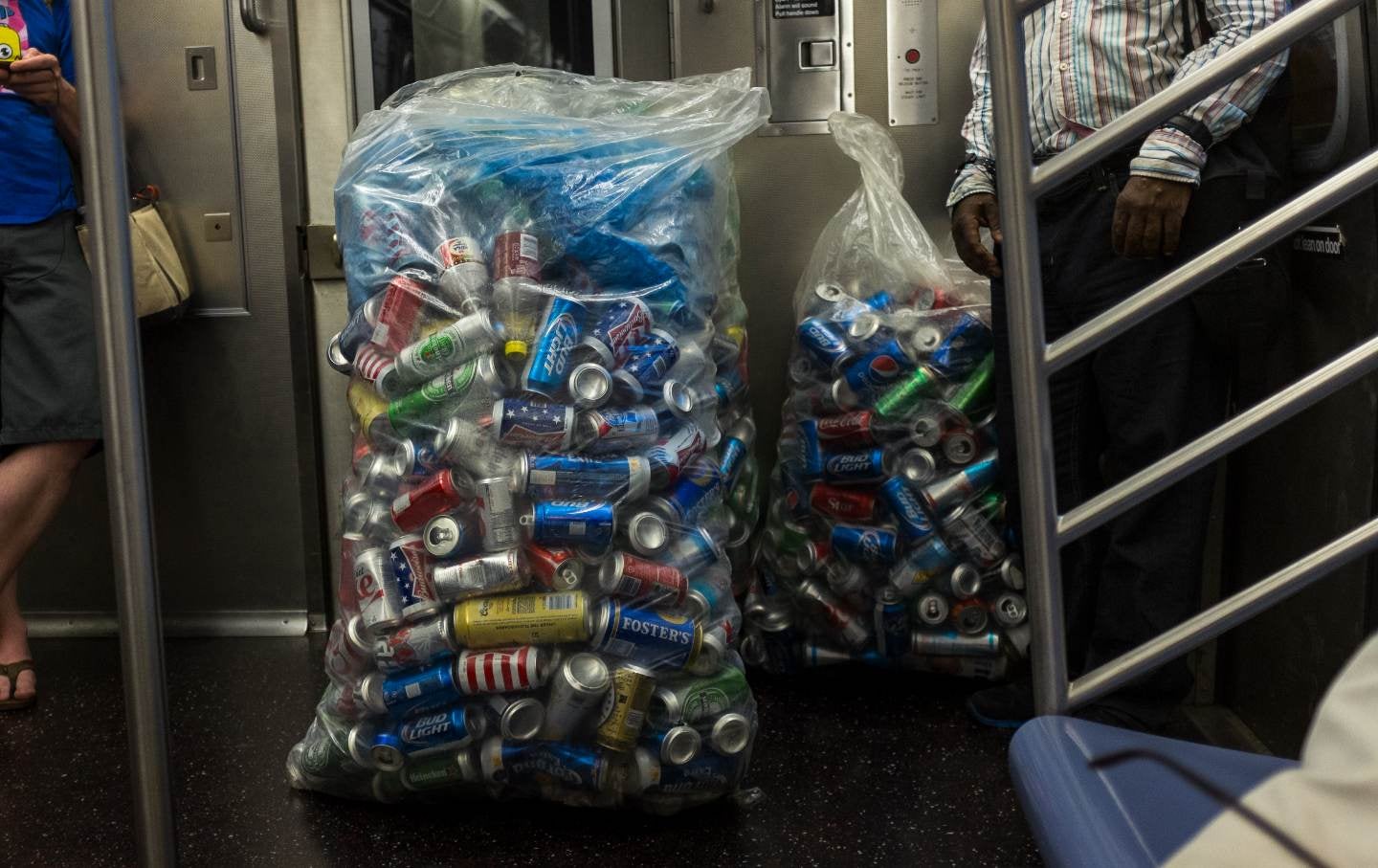
My Parents Collect Cans for a Living
When people ask about my family now, I tell them not with embarrassment or shame but with pride.
The Nation
452 points · by emailed · 4y ago · 392 comments
It gets into your bones. Even today with 25 years software dev experience under my belt, I still feel the twitch whenever I see a discarded bottle or can.
My partner teases me about it but I collect every single can/bottle from my household and any other place I can find them and put them into trashbags in the trunk of my car. I often have no space to store other things in the trunk. When I'm back in my old neighborhood visiting family, I make it a point to stop and give these bags to individuals collecting. I know there are better ways to give back and donate but it's something that I will never stop doing because I know people appreciate reaching them on their level and letting them know we don't judge it, in fact we support it.
Everyone was a winner!
At some point this just kind of dried up. I suspect it coincided with municipalities selling the rights to collect recyclables to waste management companies.
It was not just a past time amongst people of lower economic means. My dad was a computer science professor and when I was a little kid we would go on long walks around our rural town collecting cans and bottles littered along the road and in wooded areas. He seemed kind of into the money we would get back from the supermarket, but I doubt he really cared about it that much. Maybe he was trying to teach me the value of the dollar/work. Maybe he was into the peaceful adventure of it. Or maybe he cared a tiny bit about the environment. It was probably a bit of all of that. Whatever it was, I remember that there were other people who did it too of all social classes that you would see at the supermarket recycling center. I'm not sure why people stopped. Maybe as others have pointed out, municipal recycling trucks have made people less enthusiastic about it.
Actually, this article is about New York, so there should be a deposit there too, which explains why it's feasible.
It's structured as a tax on single-use containers that retailers can buy themselves free from based on the proportion they can demonstrate returns for, coupled with a shared recycling scheme they can join.
In practice it means you can return containers wherever you can buy them, and most larger grocery stores have machines to handle returns. (In fact, the largest manufacturer of "reverse vending machines" for bottles is Norwegian TOMRA).
Recycling rates in places without bottle returns in stores basically shows that just having recycling centres or even curb-side recycling from home is woefully insufficient if you're serious about dealing with plastic waste.
A nickel in the '70s would be roughly a quarter today accounting for inflation, and there is certainly no state in the US with a deposit that high.
(Maybe that’s what the actual article is about, haven’t read it yet.)
"Curt Degerman, known to many as "Tin Can Curt," Degerman spent nearly 30 years roaming the streets of Skelleftea in northern Sweden collecting tin cans and bottles for cash. Those who passed him by simply assumed he was another ordinary street bum.
But to the surpise of many, when Degerman died in 2008, he left more than $1.4 million to his cousin. In between collecting cans, Degerman spent a lot of time in his local library reading business papers and studying the stock market. "
He knew stocks inside and out," said his cousin.
By immersing himself in an education of thrift and smart investing, Degerman used his tin-can earnings to purchase mutual funds. He bought 124 gold bars and also expanded his cash with a savings account. By riding a bicycle and not having a mortgage on his house, his savings were made even easier.
But in 2008, Degerman died of a heart attack, leaving his entire estate to a cousin who had visited him regularly during his last days. He died a millionaire."
Sources:
https://www.nydailynews.com/news/money/tin-collector-dies-mi...
"Jessica is a proud first-generation Ecuadorian-American and a second-year Percy Ellis Sutton Search for Education, Elevation, and Knowledge (SEEK) student at Baruch College majoring in business management with a minor in law and policy."
Jessia is the American dream. First generation, got to college and writing like that.
Lots of Americans concentrate on what is wrong with America. There is value in that but it's really important to remember that America is still a place where immigrants can come and they or their children will really make it.
Good on them.
(BTW. I am not an American but I did live and work there.)
Good thing about wealth generation is ultimately these low level buffoons get weeded out, they will never break past the low millions. They never knew real hardship so they can only go so far.
Read the parent I replied to, then read what I wrote. Sure, me using "THE ONLY PEOPLE" is a bit strong, but unless you're a machine you would understand the context.
She's the one who made it, unlike thousands of others, who worked equally hard, and didn't.
No family should have both parents working 12 hours a day just to survive, period.
Data?
Immigrants continue to do very well in the U.S., often succeeding to a greater extent than people born here.
I don’t know why you decided to compare immigrants to natives. I made no such distinction. Nobody, immigrant or not, should have to work 12 hours a day just to survive.
Isn't living there a choice, not something they are forced into?
Did the electrician or garbage truck driver who's parents came from just as much not also make it?
Why is it implied in so many comments around here that anyone who didn't go to college and get a white collar job pushing papers/code/spreadsheets didn't make it?
What are you arguing here? That all people are equally comfortable and all jobs are equally good, and that implying that suffering is bad is demeaning to the people who suffer? It's like upside-down wokeness. While some people are arguing to put in wheelchair ramps, this is like instead insisting that implying that wheelchair users can't walk as well as everyone else is prejudiced.
But, to me, this situation is what’s wrong with America. Why are people who are clearly so hard working struggling to get by?
Not all hard work gets a reward.
Not everyone has a happy ending.
While statistically, you have a better chance of making a "high" salary in the USA, it really also depends on what you do and who you know.
Picking up cans also sounds like they could be undocumented, with no "legal" work papers.
Many times, it would/could be better for someone to stay in their "origin" country and live a regular life, but at the same time, you have to think - "would many people that have a network and a "career" leave everything they have, uproot their close family and go to another country, where even the language is different to pick up cans?
Is that sacrafrice? Is it worth it? Is it even legal? (lols)
As shown with "amiga" in the article - the authors parents also do not know English.
The same happens with many "normal" Americans as well. The ones that are illiterate, have a poor network of friends, uneducated, etc. While we don't hear about it as often, it's pitted away as more depressing/their own fault because "they were born in the USA anyway."
--
Nothing against the author, but it reads as poverty porn. Great she accepts herself, and isn't ashamed, and while we may all think she should wear it as a badge of honor - in reality, the more socially distanced you appear to your peers, the more you are.
Pariah is pariah.
We're biased in tech because we see H1-B visa holders living a comfortable life, even with lower wages. However, this is an outlier in current, and certainly prior, immigrant stories. Immigrating to a new country is downright hard. Many times it's unskilled, but also, at least in the Western countries, it's an issue of unrecognized skills that makes things difficult. My father had an EE degree and certifications from his home country, but the US, where we immigrated, didn't recognize them. He had to work in lower skilled jobs in electronics for years because of this.
I remember going can scavenging with him to supplement household income. It was a decent way to put food on the table back in the early 80's.
I suspect Jessica's parents immigrated and have very little formal education. Possible causes: trade liberalization means low skill workers in the US are competing with similar workers across the entire world. Simultaneously: 10th, 25th, and even median wages have barely moved in well over 20 years. Many of the jobs previously open to unskilled people willing to work very hard are no longer done in the US. A large shift of economic growth to capital over labor (which is, btw, the result of deliberate policy choices).
The US has the resources to reward hard workers with financial stability. It also benefits from brain-draining other countries with this promise.
If the US continues to slide away from the "American Dream," the brains and prosperity will end up somewhere else.
This happens to a lot of people in the US, as well.
It's very common to see people digging through trash cans and such, collecting bottles and cans to return for deposit. We have two garbage cans in the garage at home, when they both fill up we will take them back to the store. It's a inconvenience to go to the grocery store, wait in line for 20 minutes, then feed all the returnables into the machine, wait for the store staff to empty the machine so you can finish, and then turn the ticket in for eight dollars.
People in line become impatient and just give their bags of cans to anyone else in line who will take them. Then you get the odd bottles that aren't returnable at that store, because they don't sell that brand.
Part of the deal is the automated machines are not very fast. In the old days, a clerk counted them by hand or you just gave them a full 12/24 pack case. There aren't many machines, either. Another problem is if you return them to a small convenience store, the staff won't give you money back, they insist on only store credit, not cash refund. Which I'm pretty sure is against the law.
I have a recycle bin in my office, overflowing with empty aluminum cans of Monster, plastic bottles of Mt Dew, and glass kombucha bottles. I always tell the cleaning guy he can have them. There's a social stigma attached to carrying a bag of bottles through the office and out to my car. There might be 3 or 4 dollars worth in there, so who cares.
Lots of charities have bottle drives, sometimes one of the parents will collect them for their school sports teams, and there's a dropoff for the local 4th of July fireworks show.
Also, when COVID first started, we couldn't return bottles for over 6 months. This lead to some pretty impressive amounts of bottles being kept at peoples homes.
In general, recycling in Germany is really confusing.
By the early 90s, when I was a young teenager, he would use me as free labor and I'd spend my weekends crushing cans piled as mountains the size of pickup trucks. You'd have to remember to empty the can first, otherwise old beer or worse would get everywhere and you'd go home smelling like a chain-smoking drunk. The only redeeming quality was getting to see all the different brands and can designs and dreaming about how they might taste from their lingering aromas.
We did this work on borrowed land in Tulalip, a local Indian reservation where he had made friends offering pickup recycling services. One early summer after a particularly grueling day, my dad handed me $10 and we made our way over to Tulalip's "Boom City", an open-air market of stalls selling fireworks of every imaginable kind. It was like heaven to me, the air filled with tiny explosions and the smell of spent fireworks while crowds palpable with excitement wandered among the two dozen stalls.
I had my heart set on a brick of Black Cat firecrackers, but my allowance only got me half way there. When the stall owner noticed my dad, he threw me the brick. "Oh, you're Ron's son. Just give me what you have." I couldn't believe my luck. After we got home, I called my best friend to let him know about my bounty and that I was coming over to share. I would never get there.
A few blocks from my destination I came across a yard sale, and as was habit spent a few minutes browsing things I could never afford. Most of it was your usual old housewares and used clothing, but among it all sat an old Apple II with a detached 5.25 drive. I'd only ever used a computer at school, and even then just during free time in the library playing "Oregon Trail" or "Where in the World Is Carmen Sandiego?"
"I'll trade you" came a voice as I gawked mouth-ajar at the computer, and I looked over to find a man pointing at my brick of firecrackers.
When I got home and booted it up, I was greeted with the ">" prompt of Apple DOS 3.3 and no idea what to do next. In my excitement I recalled the seller had told me to type "loderunner", and the rest is history.
It blows my mind that a summer crushing cans, a brick of fireworks, and an old Apple II led me out of poverty. I was so ashamed at what my parents did growing up, but realize now they were doing the best they could under the circumstances. It's so easy to look at someone else and judge them, and assume they're the victim of their own laziness rather than complicated people with complicated histories and complicated situations.
My life wouldn't be the same if my poor, uneducated father hadn't been kind to his customers, a stall owner that was kind to a kid, and someone throwing a yard sale that saw the value of his old stuff in the hands of someone new.
I'm from a lower-middle class family.
My father was able to get into computers and video games during the microcomputer boom of the 70s because my GRANDFATHER repaired televisions on the side for extra money, so the house had all the tools for my dad to take people's broken machines, repair them, and use them. This led him to learn basic (and BASIC ha) programming, which helped him get a decent accounting job.
In turn, when I was born in the 80s, we had a computer and, even though neither of my parents were college-educated (in fact, my mother was a high school drop out), my dad could explain programming well enough that I understood and was able to find out I was good at it/really enjoyed it + I grew up in a tinkering household that encouraged experimentation, repair, and tool use.
And now those skills are the main reason I don't have to worry about poverty. Because in the 1940s and 1950s my grandfather fell in love with televisions. That's just luck.
This was a great read, thanks for sharing.
I understand what you mean from an emotional stand point, but isn't it odd we can think of someone crushing pick up size mountains of cans to make a buck as "lazy"?
In retrospect, your dad was obviously busting his butt and hustling to make some honest money as best he could, and that deserves our admiration.
But it isn't the size of the deposit that drives the return rate (95% or more here in Norway) it is the ease of doing it.
Here all shops that sell such goods are required to accept the containers in return even if they were not purchased in that shop and even if they are of a different brand.
So every supermarket has a reverse vending machine [1] where you deposit the bottles and cans and get a receipt that you can exchange for money or goods at the till.
[1] Usually from Tomra: https://www.tomra.com/en/collection/reverse-vending/deposit-...
Weird side-effect: homeless people might ask for your empty bottle and do the collection. Not sure how I feel about that though…
It becomes a respectful cooperation. When you party in a park, you place your containers next to a trash so a homeless can pick it up without searching the trash. They basically help you partying hard (and not caring/carrying about the bottles) and earn (by hard work) a bit of money.
I lived in Alberta 10 years ago and this was totally a thing. One homeless guy hung around the apartment and if you were carrying drink containers he would come and say "Can I take them to the store for you?". Of course, he meant could he get the deposit money on them too. He would hang around until he could fill two or three large garbage bags then head off to the return center to collect the deposit money. In all the time I lived there, I never found out where the actual return center was as I never needed to. The few $ involved was no loss to me (or anyone else in the apartment) but went towards the homeless guy being able to buy food. Never once did he seem drunk or high so he really did seem to be doing it to get food. I would see other guys like him walking along the street with garbage bags of bottles too, so it appeared to be the thing they did and it seemed to work out for everyone as I spoke to lots of people who said they also had a local homeless person that did the same at their apartments.
I have learnt that when organising events at work (sponsored by workplace), you have to charge people. Any amount like €5, its two cups of coffee but turn-up rate is in high 90% of people that paid upfront. Without charging any money its 50-60%
The number of people that sign up were pretty similar, so I hazard a guess that risk aversion was at play.
Its a powerful tool even if you know about it.
It becomes an alternative form of giving them your change, and you conveniently don't have to carry the bottle home. Although I've lived in a city where an old lady was known to roam the parks and was very pushy about wanting you to surrender your bottles.
I pick up the occasional beer can on the beach near where I live but they are almost always Polish and of course have no deposit.
That's kind of convenient actually IMO. I get rid of the bottle, I don't have to give them cash. Win-win.
How does this work for convenience stores or other non-supermarkets that incidentally sell drinks in cans/bottles? They have to have a machine?
There is a limit to how large the deposit can be for stores without a machine. If you come with a big trash bag with bottles/cans, they have the right to refuse and refer you to a place with a machine (most grocery stores have machines)
We have this system also in Germany since the late 80s (I think) and it works very well. Current incentive ranges from 8ct (beer glass bottles ... beer lobby always has exceptions ;)) to 25ct (plastic bottles)
The whole deposit system is extremely convenient when you are drinking in the park or beach, where you usually don't want to bring all the bottles back again, but you'll get people coming by and ask if you have any deposit bottles to give to them.
Too many stores refuse to take bottle types that they don't sell though. I am often left with one or two bottles that technically should be eligible, but I have to take them back with me. The Norwegian way seems more convenient for consumers.
When I was a kid beer was delivered to your house by the crate and empties picked up. I was led to believe this has become less common, which would be regrettable bc it was elegantly efficient.
I also never bother to return my bottles and cans, because it's still a waste of my time. I put all bottles and cans in the recycling, along with anything else recyclable (on the backend, almost everything goes to a landfill anyway. But that's not my problem.)
Edit: for those asking, I have lived in multiple New England states, and bottle return machines have been common in all of them.
My guess it that these machines are only going to be in states with deposit laws, and it's likely the grocery stores are legally required to take returns (whether by machine or human).
There are 10 states with bottle deposit laws (which mostly predate consumer recycling): California, Connecticut, Hawaii, Iowa, Maine, Massachusetts, Michigan, New York, Oregon, and Vermont.
I suspect a much higher percentage of material actually gets recycled from bottles returned via deposit law mechanisms, compared to US standard "single stream" residential recycling, which are kind of notorious for their low rate of actual recycling (material taken away from homes actually being recycled) due to contamination and expense of separation.
Don't worry, just go ahead and don't forget to wince when looking at demographics stats, South Korea and Japan will be your guide.
I remember these machines outside of every grocery store, and now I don't see them anywhere anymore. It never occurred to me it was a purposeful effort, but then again I never gave it much thought.
What caused the machines to disappear?
Because people hate the homeless and want to punish them, for some reason. It's the same reason we can't have comfortable public benches.
Edit: Grammer
Why would this be a goal?
2. Everyone needs a living wage
Hope this helps.
I think everyone would agree with this, but phrased slightly differently I don't think everyone would agree:
"Every method of making money must be capable of generating a living wage for the person using that method"
It's not just inflation you have to keep up with but also falling material costs as aluminum is more mass produced, etc.
Where does the money come from for the refunds? Without government subsidies I don't think it would make economic sense for a recycling center to pay $.50 or even $.25 per can if the amount of aluminum scrap is only worth $.10
Oh...
The reason the redemption value has not gone up much is that people would balk at paying so much for the goods upfront, IMO. Adding 20¢ per can would add nearly $5 to the cost of a 24-pack or soda. The cost per ounce of soda drops dramatically when you buy in volume, so the redemption value would grow to be a substantial portion of the total cost for larger purchases.
They might be reluctant but if there is no other way to get that sugary hit they will do it and eventually it will be just how things are done.
— Erik Brofoss, former Norwegian minister of finance and director of the IMF.
Instead it’s about $2
Of course, there are some plausible technological or political solutions to this. But it does change the economics.
Bottle deposit are there to incentivise some people to return them. They just need to be high enough to do that.
At a higher value say 25c/can picking up 1 can per minute is 15$/hour so again people would go out even if they weren’t collecting very many cans. Higher deposits should result in people doing a better job even if their not paid more.
Only about half the otherwise identical cans and bottles you see are returnable for deposit due to legalese reasons, like the wrong store or the wrong state.
For example, a huge portion of Poland Spring bottles have a red strip on the label, and these are not returnable because they were bought in a 24-pack.
The next time I went, I had the bottles all counted, and I told the guy right as I was giving him the bag. He weighed it, threw it into a common bin, and pretended not to have heard the count. The next time he said something about having to count it out with me, or something. It was a frustrating experience, and it seemed lousy to be scammed when I was going doing all the things I was supposed to do to recycle.
Then I got a sodastream, and my bottle usage plummeted.
So. Are there any people on HN currently collecting cans?
I had the same thought as I was reading. It was all "our struggles make us stronger", not "being poor isn't something to be ashamed about". I had the opposite reaction of most people here, I found it sad that she has to act like the fact that she grew up poor was some personal deficiency she needed to overcome, rather than a tragedy that largely happens randomly due to the circumstances of your birth.
People shouldn't have "to be supportive". It's like telling someone you have diabetes and being relieved when they don't make fun of you. No, not making fun of you should be the default.
About a decade ago in Toronto, Ontario, Canada we actually made collecting cans out of recycling bins illegal. The city claimed that these "scavengers" were taking their rightful profits.
I shit you not. [0]
[0] https://toronto.citynews.ca/2008/08/07/city-to-crack-down-on...
From the article:
But city officials argue the small-time scavengers aren’t its chief concern.
“We’re not going after the single person going down the street going through the Blue Box,” Orpin insists. “We’re going after the professional recyclers, the guy who is running a truck or multiple trucks.”
The only truly recyclable products are aluminum cans, clean paper and clear glass. Aluminum cans and clean cardboard are the only thing that really pays to recycle. If for profit companies, or even thousands of individuals, are going around scooping all the aluminum and clean cardboard first, the system quickly collapses as it becomes a huge expense and blue bins become simply another garbage bin.
These scavengers were also exacerbating contamination in process -- our blue bins would regularly get dumped out on the street or sidewalk and the blue recycling bags ripped open so the "sorter" could find the cans faster.
To be clear, there are no "profits" in recycling ... it's a loss with some cost recovery.
The tool doesn't allow linking to specific items but you can find the source here: https://www.toronto.ca/services-payments/recycling-organics-...
- plastic food tubs: Place any black and/or compostable plastic in the Garbage Bin.
- pizza boxes (food-soiled): Place this item in the Green Bin.
- plastic bags: Recommends reuse first, but does claim that they should be put (bundled) into the recycle.
I'm not saying that they aren't "collected" but it isn't a secret and Toronto very much encourages you doing it correctly.
I know that the city tells you not to put those things in the blue bin, but it's full of that junk. Then a bunch of stuff they say they recycle isn't really recycled, or gets tossed because it's contaminated.
If the job is redundant because volunteers are doing it than maybe the city should stop paying for it.
If you have collectors in your neighborhood I recommend these easy ways to help.
The boxes of cans and bottles seem to disappear within an hour of me putting them out the night before.
ITYM corporations. The government is desperately trying to help and corporate interests (in the form of Joe Manchin's blocking of the BBB act) are how we got to this point.
https://www.theatlantic.com/politics/archive/2021/12/joe-man...
Most people have forgotten that we "solved" the ozone hole problem through regulation. We could have done the same for green house emmissions. But businesses did not want cut into their profits and now here we are.
How quickly we forget.
https://www.marketplace.org/2019/10/16/the-20-year-legal-bat...
https://edition.cnn.com/style/article/radium-girls-radioacti...
There's more. A lot, lot more.
I think poisoning your water supply with benzene might be a bit worse.
I suspect you have an overly rose-tinted view of the past.
https://en.m.wikipedia.org/wiki/Ozawa_v._United_States
When was this magical time ?
What other job do you suggest they could be doing?
Do we?
When he was unemployed he was desperate for any type of work. I was more interested in how gentrification makes her family's life harder. Back when I was 19 you could get a place in LA for 600$. Now same place is 1300$, no matter how many shifts or cans you pick up your not covering that.
I hope some help comes to working class America...
I own some property and have a large 2nd floor 3BR that can fetch $2500 and its in a shitty neighborhood where someone was shot around the corner the other day. Most 2BR apartments are 1800 and up with 1BR apartments starting at 1300+. People living in Manhattan shoe boxes are paying ~2000+ for 1BR.
And LA was affordable up until 10 years ago, then things got rapidly worse.
How much is that worth? With the deposit, collecting cans can be a fairly lucrative side line for children and the retired - you often see people collecting cans from bus stop trashbins and at music festivals or park events there will often be people going around with large trash offering to dispose of empty beer cans.
Can deposits are a great idea, in my opinion. Why don't more places have them? They give people an incentive to recycle (so they get their deposit back), and if they choose to litter, whoever cleans up after them gets the money.
It would be more straightforward if government paid for cleanup of litter and it becomes a part of the spending budget where the amount of spend can be tracked.
And teach children not to litter and cultivate that sense of responsibility for one’s environment.
And prosecute littering.
If you go to a city with a plastic bag tax, you'll notice that far fewer people are using plastic bags. Cashiers won't automatically drop a single item into a bag, they'll ask if you need them and even when they do, they'll use fewer bags.
The funny thing is, a policy like a 7 cent bag tax is incredibly negligible. That means your big-ass shopping trip with 20 plastic bags is costing you $1.40 if you choose to go that route. You could absolutely choose to do that every time you shop for groceries and it wouldn't affect your finances. But that's the thing, people see a financial incentive, and no matter how small, they take it. Similarly, that's why the can/bottle deposit is so effective.
I read this article recently about giving people a tiny monetary incentive to go to the gym got people to go back:
https://www.nytimes.com/2021/12/08/well/move/exercise-motiva...
Surely, these gym members spent more money on gas to just get themselves to the gym in the first place!
Prosecution of littering is impractical, "it doesn't scale," as one might say. It's nearly impossible to catch that crime as it occurs.
I'm not even sure that "raiding garbage bins" is an issue. I guess sometimes people digging through garbage make a mess, but every time I see this happen in real life the people doing it are relatively respectful and make sure the trash stays in the bin.
Local governments already do pay for the cleanup of litter, but the problem is that litter is just everywhere. It's a losing numbers game. You'd have to hire a literal army to keep it in check.
By the way, can/bottle deposits don't cost the taxpayer money! It's a tax you pay on the drinks when you buy them, and you get it back when you return them. That's why it's called a deposit.
We have a similar deposit where I live (Vancouver), and a few times I've collected all my cans and dropped them off at the deposit center. The centers are in inconvenient areas, and I've dropped off maybe 400 cans, which is a pretty full car load, but takes almost 2 hours with driving and sorting. So about $20/hr not counting expenses like gas, wear and tear, and the car itself (many people doing this do so without a vehicle though).
And these were cans I had collected myself at a place I was living. If you consider going from house to house and checking dumpsters for the cans, it takes a lot more time. If you have a truck and 2 people and manage to grab all the cans on collection day, you might make a bit more than minimum wage, but outside of collection day I think you'd be better off with a minimum wage job.
I suspect a lot of people doing this have other obstacles preventing them from holding a job though, which is why something they can do on their own time is worthwhile to them.
For some more context, I think McDonalds starts at $18/hr here and even that isn't really enough to afford living comfortably in Vancouver. Also, most deposits are 10 cents, but I think some larger glass containers are up to 20 cents.
There was a lot more can litter back then, so it was easier to collect. A side effect of aluminum recycling is that most of that litter was cleaned up by can collectors.
[0] https://portal.311.nyc.gov/article/?kanumber=KA-02477
[1] https://www.scrapmonster.com/scrap-yards/prices/new-york/sta...
At some point we noticed that the office was becoming infested with fruit flies, and after some investigation we discovered months or years worth of those cans in a closed off hallway, in a dozen giant trash bags.
My manager tossed a couple of the bags into the back of his car and drove to a nearby grocery store where there was a can recyling "machine" outside, that you could feed the cans into and get a receipt to cash in in the store. One. Can. At. A. Time. He spotted some kids skateboarding nearby and said "hey do you want to make some money" and gave them the cans, then made a couple more trips to get the rest of them.
Probably he could have gone inside and spoken to a manager to arrange a more efficient way to offload the cans, but those kids were absolutely stoked.
Edit, it looked like this:
https://old.reddit.com/r/Dallas/comments/ljr0sa/where_can_i_...
The way that it worked for us, was we saved up a year's worth of bottles and cans in the basement in 55 gallon barrels, then we took them to the local redemption place attached to the general store, where one of the high school kids that attended the full-service pumps would go sort them, which took an hour or so. If it was a good year, it paid for a few rides and some french fries at the county fair.
I try to help them out by separating my cans/bottles into another bag.
At the very end:
> Now, when people ask me what my parents do for a living, I tell them not with embarrassment or shame, but with pride.
In this context, is "pride" appropriate, or would "dignity" (or something else) be better?
My mother tongue is italian. I understand "pride" as referring to something exceptional that was done (which doesn't seem to be the case in this article), "dignity" on the other hand as something <appropriate? something not to be ashamed of?>?
Thx :)
Richest country in the world, but for whom?
There's so many better jobs out there. My own immigrant parents started from doing service jobs in the food industry, driving, and kitchen work. They ended up doing all sorts of other jobs over the years but now own four properties with two fully paid off. This article isn't a success story, it's a story of failure.
Yet I've been blessed to live in several countries, and can speak from experience that most poor families I've seen are on average more happy than most rich families, in both US and Eastern Europe. They only think that they are unhappy, because of the constant struggle with money, but I've seen many lives of people to think otherwise.
So I'm not that pitiful towards the author. Their parents didn't have mental health issues, no one got killed or injured, so I'd say they lived mostly happy life, comparing to others.
There is a mention of $400 towards high school fees causing some anxiety among her parents, but beyond that, not too many concrete details.
The focus of the article is on the writer's experience with the shame she experiences because of her parents' job, so perhaps it's not the right place for this information, but the composite picture would be a much more faithful representation of the overall experience of Jessica's.
This is also a point where America needs to introspect, as a nation: sure, we import less-fortunate immigrants, in large part because they are much more willing to do dirty jobs such as gathering cans, but it's also true that it all comes out in the wash: society as a whole is responsible for bearing the costs of keeping these people fed, clothed, schooled, and taken care of in medical emergencies. If you added up the costs, is the labor "cheap" anymore, or does it make more sense to discourage the immigration of what is likely to be a 2-3 generation underclass, and incentivise people already here to step in?
Second, the "educated young person" was educated courtesy of the United States, not her country of origin. I agree with you somewhat that immigrants have a higher drive to succeed. But, how do poorer uneducated, possibly illegal immigrants fare in this regard vs. self-supporting well-educated immigrants who are better able to integrate easily into the mainstream?
I believe immigration is essential to keep growth going, and to keep various social support systems such as Medicare and Social Security solvent in the current state. However, there is the subtle question of whether that is accomplished by having control and a say over what type of immigration it is that we want, or by relinquishing any semblance of control in the matter. Any democratic society with a right to self-determination should be able to have a frank discussion and the ability to decide for themselves how they proceed on this.
I am myself a highly skilled immigrant (different country). It is convenient to be able to pick and choose, but this can end up in a kind of immigrant monoculture. I know of less skilled at the time of entry immigrants that have achieved more than me, by sheer passion and entrepreneurial spirit. Education is a good indicator but not the end all. Finally, this selection will work for first generation, what you get from the following generations is correlated perhaps, but not defined, and statistically as per my previous answer, the US got pretty good outcomes with minimal controls at the point of entry and with a pure aspirational system of values that self-selected success (big discussion now that we move on this and it’s relationship with generational poverty).
Are the authors parents, or is the author even valid to reside in the USA permanently?
And before anyone cries "racist", my background is 100% similar to the author in question. It's a shame that in the USA we have people who never really learned the Spanish language or culture and go on with "latinx" which is mocked even on twitter, to people who protect people that may have entered the United States illegally.
Migrating for work or school are very valid routes, but as the author stated she was "12" when she started collecting cans with her parents, it paints a picture that she migrated to the United States sometime during middle school. With per parents not having a support network in place, being illiterate in English, it seems highly unlikely they migrated here for work or university. Same for the author being 12 as well, highly unlikely that she migrated to the United States and sponsored her parents.
Nothing veiled about it, very legitimate questions. Many other families come in the country legally and are able to sponser themselves, that is one of the main focal points of immigration services. Are the people who are changing their nationality, able to survive, prosper and adapt to a new environment? Alongside liability, why should the United States have to socially assist someone that is new or even potentially an illegal alien over a "real" USA Citizen?
It is 100% appropriate, and matches the context of the story of the author - or more specifically why can't the authors parents support their child?
My dad being a bus driver+conference phone tech and my mom an office admin we qualified for lunch and other aids as long as I was in school.
Many things were subsidized, but there were also things that weren't. It was hard to know when unless you always asked.
For smaller items sometimes it wasn't worth the embarrassment of always walking up to your teacher or school admin to ask if there was a discount for me. They knew who I was and what I was asking for. Super nice about it, but it doesn't make it feel any less worse. I also had to sneak away from friends. I also didn't want them around while I asked.
But you're right at a $400 required fee, usually there's a form of aid/discount.
I'll give the writer a benefit of doubt. Maybe there wasn't aid available? Maybe there was and it simply wasn't enough. $400 => $100 can still be very stressful.
Regardless, I thank my parents and grandparents, because being one of the lucky ones - I never went hungry.
Having read other stories of other children, yes I would say it was. As the pandemic really got going, shutting down schools was removing some kids only assured meals.
> and did it make a meaningful difference at the right time in your life?
mmmmm for me personally I want to say yes, but can't definitively say so because it wasn't profound enough for me to say "Ah yes my life changed" because of this. I can't tell what my life would have been like if my parents made more money during that same time period.
> Was being better-informed about assistance the biggest challenge by far?
As the parent, probably, I haven't asked. As the child, no, the hardest challenge was asking for it and being told by my parents to go ask. I'd bring home a paper that says you need $50 for this field trip, parents would send me to the office to ask. I'd fight/beg not to. Sometimes I actually got my way, most of time I didn't.
Today, I know/can-imagine what kind of stress that particular fight puts on parents and I thank them so much for raising me.