61 points · by Stevvo · 4y ago · 114 comments
With 4G you get fast enough coverage at long distances for basically everything. Maps for sure, but even streaming video as long as not everyone on the tower is trying to do it at once.
With 5G you get more bandwidth, but you're not going to get it in the middle of the woods because it also requires more towers closer together. So it's for high population density areas. But those areas are the places where it's extremely cost effective to install fiber, and cellular will never ever be as fast as fiber, and installing a million towers everywhere is just about as expensive.
If 4G is about all you're going to get in the middle of the woods and fiber (with the last hundred meters over Wi-Fi for mobiles) is the thing you actually want in the city, why is anybody even wasting money installing 5G towers anywhere?
5G on existing frequencies can do more data with the same spectrum. Something something MIMO. This is broadly useful, if you have an 5G capable device and your network updated their base station equipment. 5G and 4G are supposed to be better at sharing spectrum on demand vs 4G and 2/3G.
5G on new, nearby frequency, in the US, there was a second round of taking historically TV spectrum and reallocating it for communications. These bands will most likely need new antennas on towers as well as on handsets. These tend to be lower frequencies, which could be useful for distance and structure penetration, but may not always be built out.
Then there's the millimeter wave stuff. Very high frequency, very fast, great for density, like maybe transit stations and arenas. This is the stuff that needs a tower on every light pole or whatever. I don't think this is going to get a lot of deployment, but it gets a lot of press. I think this is the part the FAA is objecting to for now.
3.5GHz is also exlusively 5G and not used for anything cellular before. Outside of some old wimax deployments here and there, but those ware usually for fixed users not mobiles.
3.5GHz is also firmly in the centimeter bands. :)
According to assignment map, it uses 4500-4600MHz. https://www.tele.soumu.go.jp/resource/search/myuse/use/10000...
mmWave 5G signals are in the 24-54 GHz range (f = c / 0.001 m ≈ 30 GHz)
The common wisdom would say it heats up but that's not guaranteed.
https://i.imgur.com/KUR4XmX.png
https://i.imgur.com/iUD2v4D.png
https://www.5gamericas.org/wp-content/uploads/2020/12/InDesi...
If you are Verizon or ATT, you have lots of mmwave spectrum, so your interest is in dense urban environments and multi-dwelling units where your speed let's you compete against wifi and cable providers. You spent a bazillion on spectrum and you need to give your customers reasons to pay extra for their service.
If you are t-mobile, you have a ton of mid range spectrum. After all, that was the only reason you bought sprint. You will want to go after consumers with a coverage play, since that is better than mmwave from T and VZ. You might also dip your toe in business services like IoT for farmers and factories.
If you are a hyperscaler, you need CBRS (3.5GHz) to take off. You'll be pitching IoT and edge compute like crazy because the radio coverage is better than wifi, the speeds are good and best of all the spectrum is available at essentially nominal cost.
What you won't get just yet, but will hear about a lot, are the toys like vr robots. The ugly truth is that no one really knows what the killer app for 5g is yet, but every operator is terrified that just like 4G theyll miss the value chain and leave apple or whoever to ride their network and slurp up the profit.
I also blame the industry for missing the point on the whole pivot to virtualization. For those of you not in telco, telcos got together in 2012 and said, "how can we be more nimble like the cool kids?" and concluded that virtualizing everything, was the way to go, as if all it took was a vm and a k8s pod. Really it was about culture and supply chain, but that's a whole other story.
Also the advantage of 5G as far as I'm concerned is being able to connect things (possibly in a mesh?) At very high throughput without cables. If you have an oscilloscope and a signal generator, you should be able to synthesize a (say) network analyzer out of the two of them by linking them via 5G.
Right, right, the really high frequency stuff is what we're talking about. It's confusing that they stick so many things under the same label. The parts of "5G" that are just 4G with better radios and algorithms are useful but also not so contentious. But for that you wouldn't need more towers at closer intervals.
> Also the advantage of 5G as far as I'm concerned is being able to connect things (possibly in a mesh?)
And now we're talking about a third thing.
It could actually be quite useful to open up more unlicensed spectrum for things like this -- if nothing else so we could get better Wi-Fi to hook up to the fiber.
But that's a different thing than having Verizon install a cellular tower on the end of every street corner for high frequency cellular 5G and then not having them come the rest of the way with the fiber into your house, which still seems like some kind of a bad joke.
Although I agree, what we will end up with is going to be broad area WiFi effectively. Seems like the goal is to replace fiber and then you can move around the city always connected at high speeds.
Comcast is already doing this, their routers will let other Comcast users connect over WiFi.
Personally, I believe that is the end objective. I personally am just getting satellite via starlink and probably will get fiber if it’s available.
This is a misconception. You're only thinking about high-band (aka mmWave) 5G. The media has largely focused on this because of the higher speeds and its low range which makes it easy to dunk on with clickbaity articles. But this isn't particularly common outside of sports stadiums or music venues, large train stations, airports (but note that the interference in the article is not in the mmWave spectrum), university campuses, etc.
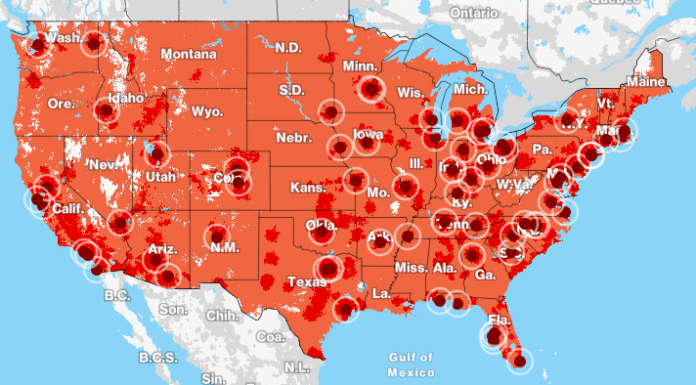
5G has much better range than 4G at the low-band, and at the mid-band they're much faster at a similar distance. If you're in the US, the only carrier that's been rolling out low-band 5G at scale thus far is T-Mobile.
[1] https://www.3gpp.org/release-17
[2] https://www.3gpp.org/technologies/keywords-acronyms/98-lte
I mean yes, corporations are definitely going to attempt that and they can all die in a fire, but telemetry like that requires minimal bandwidth. It doesn't need "5G" for anything.
How do you figure that? Is there something special about the 5G electronics and chipset manufacturing that make would make it much cheaper than 4G electronics? I don't think this is true.
Surveilling your irl location 24/7 with centimeter-precision
https://www.fastcompany.com/90314058/5g-means-youll-have-to-...
https://venturebeat.com/2019/04/29/sk-telecom-will-use-5g-to...
https://www.ericsson.com/en/blog/2020/12/5g-positioning--wha...
In theory you should be able to take your private network anywhere there’s 5G.
Industrial Ethernet. Latency, jitter, and guaranteed delivery are required in many factories. Meaning they’re still relying on cable, wiring, and proprietary PLC hardware close to the sensors.
Private network slices.
5G Broadcast solves that. Radio, live TV, popular Netflix TV shows etc. could be broadcast and save a lot of bandwidth.
In an age of increased awareness around climate change, it's fairly mind-boggling that 5G is being pushed so hard, given the questionable value of the benefits it brings.
How much % of global carbon emissions is due to cell equipment? Is it a big enough portion to worry about?
This is a brochure for Ericsson's lower power innovations, but look at the baseline without their system. Graph on page 2.
The political problem was that the FCC auctioned off the spectrum under the assumption that only half the licenses (the lower frequencies in the band), would have restrictions, and they would be lifted after a 3-year clearing period for satellite base stations to move to different bands. Now the FCC has realized that Landing instrument interference is going to be a problem, so they have to draft new regulatory restrictions. But this regulatory change is going to affect the market value of these licenses, and so the FCC is basically both preparing the new regulations (they are being modeled after similar regulations in Canada), as well as preparing to be sued by Verizon, and potentially AT&T, to try to recover some of the money they spent in the auction.
The regulations are coming, but due to the politics and legal challenges, they're taking longer than expected. So the FAA is publishing their drafts as a PR strategy to force the FCC to hurry up and finalize the regulations.
And it's working... I work in spectrum interference regulatory compliance, and we've been preparing for months for this rollout. Our software is already basically ready to deploy our compliance mechanisms within a days notice. All we need to do is a little bit of geospatial data entry on exclusion zones where transmission is not allowed. So we know that this nightmare scenario isn't gonna actually happen, but the threats have to happen in order to get the FCC to hurry the fuck up and finalize the regulations.
I’d love to know why the FAA is ‘rolling over’ to the telecoms / FCC on this matter. The spectrum was in use for RADALTs before 5G and safety systems like autoland, used when visibility starts coming down to minimums, rely on them.
Seems to me that, like Canada, the US should just not allow 5G cell sites near critical areas around an airport.
I don't know enough about how far around airports they'd want to block C-Band from being used, but in a city like San Diego, it would probably block off a decent amount of the city given where its airport is. In a place like New York, how far would you want to block off? Clearly not all of bravo airspace, but how much is needed (maybe you know how much Canada had to block off)?
I'm not sure that the FAA is rolling over. In some ways, saying "we're going to make air-travel suffer huge problems if they start activating C-Band spectrum" is saying "if you activate C-Band spectrum, Congress is going to start having hearings as to why the government is letting wireless carriers prevent people from traveling." I think the FAA is noting exactly how bad the situation might be if they go forward with C-Band plans.
I think it's also a situation where people might be unsure who has authority. Can the FAA ban wireless signals that the FCC says are ok? Can one government agency take another to court despite being part of the same administration? At some point the administration controls both and might need to make a decision.
But I think there's a lot of pressure to let C-Band go forward. Wireless carriers are looking to 10x their wireless networks and it seems likely that wireless home internet will become a big way that more rural areas get high-speed internet (even C-Band signals can get decent range with good antennas and using low-frequency spectrum for uploads).
Juan (a.k.a. Blancolirio on YouTube) is an airline pilot and former military aviator who doesn’t sensationalize and really knows his stuff.
This playbook has been run before.
So it seems it is basically a question of how wide is the RF input filter bandwidth of RAs on commercial aircraft.
[1] https://rgl.faa.gov/Regulatory_and_Guidance_Library/rgad.nsf...
Here is what a $1 ESP wifi dongle has to follow:
https://en.wikipedia.org/wiki/IEEE_802.11
"The mask requires the signal to be attenuated a minimum of 20 dB from its peak amplitude at ±11 MHz from the center frequency"
So 2 dB/MHz filter.
I let you do the math.
FAA is just ridiculous here if they let old junk radio hardware handle safety landings for airplanes, but well after 737 max what do you expect...
Note there's a pretty big difference between "it should be good enough for 99.99% of planes" and "we can guarantee there won't be even one crash even under unlikely conditions".
Aerospace is already VERY comfy doing ADS-B at 1090 and DME/TACAN from 960-1215 and the old GPS L1 allocation at 1575.42 and the military L2 allocation at 1227.60 (admittedly not many civies using that LOL) and someday probably L4 and remember ASR-11 airport radars blast at 25 KW power over 2700-2900 MHz. But, you know, the straw that broke the camels back and all that.
Most things will be fine. A small amount of things will operate degraded, which is the point of the NOTAM. Some things (like very few) will all fail the same time 5G is deployed, which will be a headache. Going forward every installation of every device on the ground or in the plane will be tested against 5G and it'll be just fine. Most likely for a week or a month everyone will have to treat their radar altimeter as potentially broken until proven otherwise, then it'll be fine and they'll drop the notam. Some equipment will indeed fail and connectors will be tightened or even devices replaced, and it'll be fine.
Could you elaborate on how phase noise would cause an issue in this scenario?
N.B. Most of my experience is in optical systems, my wireless knowledge is limited.
Normally you have lots of space to waste at higher frequencies for guard bands and you can allocate compatible uses for next door bands. Still, when you get a powerful transmitter right next door there are often problems. The previous tenants of that spectrum (C band satellite downlinks) used to have a problem with interference from radar altimeters. So I suppose there is some sort of karmic process here where the service that used to cause interference is now the service that is getting hit with interference.
Seriously, just test it.
You have thousands of flights a day. On a day with visual flight rules put a transmitter at 4.0ghz, max power, worst case radiation pattern and land a 737, 787, A320 and A321 etc as a test.
There is something going on here that we don't know about.
Side note: NOTAM is a notice to pilots [1] the article doesn’t expand on.
RADALTs are tricky things. They are finicky. Sometimes they get good reflections and sometimes they are confused by irregular terrain, particularly over urban areas. Imho 5G would, at most, cause radalt blackout/failure (ie no displayed altitude) rather than the far more dangerous false readings. And any interference should be intermittent. Unless you are hovering over a cell tower the strength of the 5g signal should rise and fall pretty quickly as the aircraft moves between cells.
The FAA's concern here is that the bands will be neighbouring in the USA, which means if either the 5G equipment accidentally transmits a bit of signal outside its allocated band, or the altimeters accidentally interpret out-of-band signals they ought to ignore, then problems could happen.
Since radar altimeters are pretty old tech, and very analogue, their concern isn't totally unwarranted.
This is a sample notam for what the anti-interference alert will look like.
This is about the C-band 3.5GHz 5G spectrum.
When modern planes land in bad weather, especially fog, the height off the ground is determined by bouncing radio waves off the ground. Essentially radar pointing down off the bottom of the plane. This provides added safety over the normal altimeter measurement using air pressure. 5G frequencies are too close to the frequencies used for this radar and so the theory is that this will cause dangerous interference that could cause issues during a critical phase of landing. Without these systems aircraft would not be able to use certain instrument approaches and thus couldn’t land during certain weather conditions when they can today. If the FAA pulls the plug on these it would cause big headaches during times when today planes can land without issue.
tldr 5G might stop you from getting to your destination on time or at all on a future flight.
The radio altimeter is a secondary or tertiary source of height above terrain information, not a primary.
Without a functioning radio altimeter, some aircraft on approach to some runways would have to use higher minimums than would be available if they have a functioning unit. This will contribute to some missed approaches or diversions in low weather. (Where a missed approach almost never ends in a crash in airline operations but rather a second attempt or a diversion.)