28 points · by wsc981 · 4y ago · 42 comments
All Ontario: Case numbers and spread https://covid-19.ontario.ca/data/case-numbers-and-spread
Rate per 100,000 (12/31/21, 7-day average):
Fully vaccinated: 79.86
Partially vaccinated: 63.77
Unvaccinated: 59.75
One hypothesis involves the fact that current mRNA vaccines induce an immune response highly targeted toward the spike protein RBD.
In contrast, natural infection induces a broader immune response that includes antibodies targeting other proteins (Nucleocapsid protein being one of the most notable; it is commonly used to determine if a prior infection occurred).
Omicron in particular is a variant that has accumulated a significant number of mutations in the S protein region.
Is this coincidence or are we seeing selective pressure due to mass vaccination campaigns?
Perhaps, but it's my understanding that Omicron was first observed in diplomats that had already received multiple vaccinations. See: https://www.nytimes.com/2021/12/03/world/botswana-diplomats-...
Edit: While I personally don’t support broad restrictions, I’d actually argue this is evidence that the restrictions are making an impact.
The Danish covid passport does not discriminate between vaccination and a negative test. Both give access to everything
Ironically, this means that lots of vaxxed people don't get tested anymore.
https://covid19danmark.dk/#gennembrudsinfektioner
https://files.ssi.dk/covid19/omikron/statusrapport/rapport-o...
I don't believe this can be due to different behaviour or restrictions on unvaxxed because society is open if you have a negative test.
Very interesting. It's almost as if this experiment is having unforseen consequences XD
Another poster here suggested that we are seeing the mRNA vaccines causing an immune response on a particular axis and that has caused selective pressure on mutations resulting in mutations such as Omicron, which in turn manifests more symptomatically in the vaccinated.
We have some correlation, but no exploration of causation. Id suggest that twitter thread is jumping to conclusions without considering the why.
If this variant is mostly asymptomatic, but spreads rapidly, in the vaccinated population, then you would also see higher rates in the vaccinated population, given that vaccinated people only test after they are notified that they have been in contact with someone who tested positive.
This gives a larger window for the virus to spread further among the vaccinated part of the population before containment.
If unvaccinated has to be tested to participate in social activities, they'll get tested more often and isolate if they get a positive test preventing spread to others in their group (this assumes that unvaccinated group together somewhat, which I don't have any evidence for besides anecdotally)
Being vaccinated might also lead to risky behaviour disproportionate to the risk mitigation provided by the vaccine - it might be a consequence of risk homeostasis, but the risk has now increased, which skews the bias towards more infections in the vaccinated group.
How big is omicron prevalence in Denmark? ECDC data appears to be way outdated. It can be possible that unvaccinated catch the Delta first for some reason. Perhaps because Delta is still more prevalent and does not affect vaccinated so easily but omicron does.
Behavioral changes may also explain some of the difference. If the testing has been mandatory for long time, I would expect some testing fatigue to appear resulting in lower social activity for unvaccinated.
Are there recent seroprevalence studies available? How many from the current unvaccinated population are still uninfected? Previous infection may offer still reasonably good protection against omicron regardless of lower laboratory neutralization activity.
Of course there is also possibility that vaccinated are more affected by omicron but I would then not expect the third dose to increase the protection against it but lower it instead. Efficiency should also increase in time, not get lower. Unless there is some mechanism involved that leaves previously vaccinated people with waned immune response even more vulnerable that people without any previous immunity.
About 90% of Omicron infections are in the vaccinated. They are about 75% of the population.
If Omicron spread equally among both vaxxed and unvaxxed, you should see percentages that represent their fraction of the population.
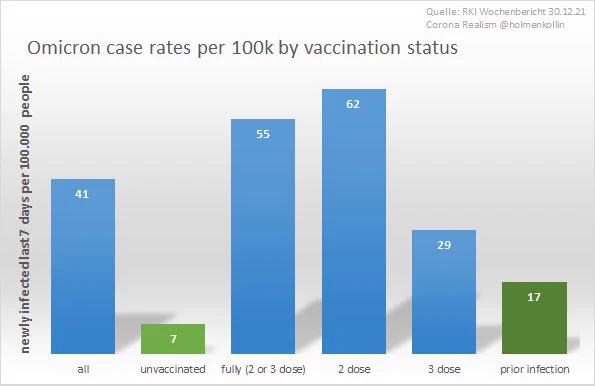
* the daily cases report¹ of the RKI shows strictly raising cases of Omicron, but as of today (03.01.2022) a maximum of 19.9 (per 100k inhabitants, total cases in the last reported week: 274, that is 10% of all Covid-19 cases) – the linked Twitter message shows a completely wrong number "41"
* the weekly report² of the RKI does not mention general Omicron rates of vaccinated vs. unvaccinated at all, neither does any of the from there linked resources. (The in the Twitter message marked text shows some numbers, but these are only a partial excerpt of all cases over all time, where for many cases – 35% – no status info exists at all. They can not be used for calculating what the author proposes.)
* even if you could use that excerpt; the numbers in the graphic the author created, do not even add up to be valid among each other (e.g. "fully (2 or 3 dose)" is smaller than "2 dose"), and do not even reflect the proportion of the wanna-be source (the marked text), which e.g. would show there would be less re-infected state than unvaccinated – again: still the marked text is no usable source at all.
So this is pure fake news from the liar @holmenkollin…
Also the other counterfeited graphs, by another liar @10p8atriot, shown further below in the post, do really suck in 'counterfeiting quality', e.g. more than halving the unvaccinated cases, and adding some 1-vaccinations from April to June which do not at all exist in the data, which can be easily checked at the given source: https://data.gov.il/dataset/covid-19/resource/9b623a64-f7df-... whereof the real graph looks like this: https://ibb.co/f2SjmwP
No idea how these fakers get away with this all the time – must be something quasi-religious or so, at their fanbase.
––––––––––––––––––––––––––––––––––––––––––
[1] daily cases report of the RKI: https://www.rki.de/DE/Content/InfAZ/N/Neuartiges_Coronavirus...
[2] weekly report of the RKI, 30.12.2021: https://www.rki.de/DE/Content/InfAZ/N/Neuartiges_Coronavirus...
* 30.12.2021 RKI Wochenbericht reads "1.097 Patientinnen und Patienten waren ungeimpft, 4.020 waren vollständig geimpft, von diesen wurde für 1.137 eine Auffrischimpfung angegeben."
* 23.12.2021 RKI Wockenbericht reads "186 Patientinnen und Patienten waren ungeimpft, 924 waren vollständig geimpft, von diesen wurde für 161 eine Auffrischimpfung angegeben".
* The OA screenshots a line that reads "186 Patientinnen und Patienten waren ungeimpft, 4.020 waren vollständig geimpft, von diesen wurde für 1.137 eine Auffrischimpfung angegeben." Either they doctored the data, or the 30.12.2021 RKI Wochenbericht perhaps contained an error that was since corrected and the OA panicked seeing the initial version?
One more thing. Using omicron data from 30.12.2021 RKI Wochenbericht and vaccination data from https://impfdashboard.de/en, the omicron incidence rates don't look too good. This is difficult to do correctly in absence of data explicitly broken down by age because <18yo have significantly smaller vaccination rates (thus more "unvaccinated" at virtually no risk) compared to the adult population, but even so:
total unvax vax 2-vax 3-vax
pop 83.2M 21.5M 61.7M 26.9M 32.3M
cases 5117 1097 4020 2883 1137
/100k 6.1 5.1 6.5 10.7 3.5Via Google translate: "Update: The RKI made a significant change in the weekly report 4 days after publication (see below). Now there are 1097 instead of 186 unvaccinated people, so the proportion of those who have been vaccinated is significantly lower. // @world"
Edit: Update of the OA: https://twitter.com/holmenkollin/status/1477970997638676483
I thought that would be unlikely since it was a key feature of this virus.
So I guess it makes sense that current vaccines are much less efficient if the spike changed.
With no evidence of an increase in lethality or odds of contracting a variant with an increased lethality due to being vaccinated the body of evidence firmly sits well within the realm of "better to have coverage for most variants and partial coverage for those emerging" rather than "going in bareback, hold my popcorn!".
I think you’re arguing that VAERD cannot be ruled out. ADE has been known among this family of viruses for long-enough that it’s described in the process of designing vaccine concentration. Though, I’m certainly not educated enough to understand ADE let alone VAED/VAERD.