376 points · by sohkamyung · 4y ago · 225 comments
That aside, my favourite quirk from relativity is this:
"The more you move in space, the less you move in time."
Like relativity in general, it sounds simple enough, but it's consequences are profoundly shocking. (That is, if you take the time to understand it, and don't leap to the conclusion that you know relativity better than Einstein or Penrose ;)Take the case of two people on Earth, one stationary and one travelling past in a car. They each have a different reference frame, and a different set events which make up their present. Now imagine that there is an alien government in Andromeda debating a possible invasion of Earth. In the reference frame of the person on Earth who is moving, the debate is still going on. But, in the reference frame of the stationary person, it is a day or so later in Andromeda, and the invasion fleet is already on it's way! In nature there is no absolute reference frame we can call base reality, and both observers reference frames are equally valid. Then the outcome of the invasion debate is a foregone conclusion. How can there be any room for free will in the deliberations of the alien government? This is the crux of the Andromeda Paradox and the Reitdijk-Putnam-Penrose argument.
BTW:
"Notice that neither observer can actually "see" what is happening in Andromeda, because light from Andromeda (and the hypothetical alien fleet) will take 2.5 million years to reach Earth. The argument is not about what can be "seen"; it is purely about what events different observers consider to occur in the present moment."
https://en.wikipedia.org/wiki/Rietdijk%E2%80%93Putnam_argume...More info https://en.m.wikipedia.org/wiki/Relativity_of_simultaneity
Edit: If you know of any serious alternatives to the 4D spacetime/ block universe theory then I would love to read it. Rescuing free-will from the jaws of spacetime would be cool!
Free will does not exist. It is logically inconsistent. Either your choice is some function of your current state and the environment you are in, then the choice is not free, or it is independent of your current state and the environment you are in, then it is not your choice in any meaningful way, it is just the result of a coin flip.
You can do some mental gymnastics, define free will as being able to do what you want, define it as being free of various kinds of constraints, call it free if the choice is not computable in advance, if you can not measure all necessary variables, in practice or in theory, ... If you are happy with any of those definitions, fine, then you might have this kind of free will, but I would not consider any of those particularly interesting.
1) Define “free”
2) How do you test your hypothesis?
You’re trying to apply logic to an untestable philosophical debate. If you believe free will doesn’t exist, you can’t design an experiment that would invalidate that belief. And if your theory is untestable and unfalsifiable, then what good is it other than a creative exercise?
However, we do know from Quantum Mechanics that the universe is probabilistic and not deterministic:
https://www.thegreatcoursesdaily.com/quantum-universe-fundam....
So, we do know that the universe is not pre-determined and cannot be calculated in advance, but if you want to believe in humans as fully deterministic (or some other definition of no free will) inside of a non-deterministic environment, I haven’t heard anyone propose an experiment that could test that, at which point the debate of “free will” is relegated to the realm of thought experiments rather than science.
So, perhaps the better question is: Does it serve you better to believe there is free will or no free will? And leave it at that.
This is reversing the burden of proof. The issue with "free will" is getting those who think there is a meaningful "free will" concept to actually define what they mean.
Look through this discussion and see the comments trying to justify the existence of free will, and look for definitions of what they actually mean by that.
> However, we do know from Quantum Mechanics that the universe is probabilistic and not deterministic:
That's a meaningless distinction in this context. The point is that nobody has presented a mechanism whereby you can inject any form of agency that fits a definition of "free" (see your own point: define "free") that doesn't devolve to smoke and mirrors that way.
In order to do so, there'd need to be something that would lead to measurable biases in outcomes that can not be explained by the probabilities.
The rest of your argument devolves to Russel's teapot: As long as nobody has posited a reasonable definition that'd give rise to a theory of what free will might mean, the notion is so absurd that it is entirely reasonable to say that free will makes no sense.
If you can present a definition that can't easily be shown to be just smoke and mirrors and which somehow makes sense to people, even without coming up with ways of actually testing it, I might be tempted to moderate that claim, but I've had these discussions with people for decades, and in none of them have anyone ever managed to come up with a cohesive definition of what free will would even mean that doesn't very easily start looking distinctly "unfree".
There are clearly definitions of free will that would allow something you label with that term to exist. But I challenge you to come up with one that people would agree is both "free" and "will".
That is not true, quantum mechanics - more specifically the Schrödinger equation - is deterministic. What is not deterministic is the wave function collapse but that is also incompatible with the Schrödinger equation because it implies non-unitary evolution of the wave function. And we have - as far as I know - no really good ideas how to resolve this. In consequence I think it would be premature to declare that the universe is definitively non-deterministic.
This is not true, and there are consistent interpretations of QM that are fully deterministic (many worlds, superdeterminism, pilot wave).
Still, probabilistic vs deterministic makes no difference. There is no free will in a throw of the dice, and no free will in the wave function collapse.
On the other hand, the main philosophical position on this is compatibilism: free will in a fully deterministic universe (or probabilistic one). If you think of yourself as the sum total of all your experiences and genetics, your next action is of course determined by these; but, another agent in your shoes, one with different experiences and genetics, would make a different choice. So in this framework, your choice, even though uniquely determined by everything that happened before, and theoretically predictable 1000 years in advance, is still meaningfully "your choice".
In fact, random chance hurts this definition, and weakens the case for compatibilism; if your next action is entirely dependent on some random quantum fluctuation, and running the experiment with your exact same experience and genetics but a different random quantum event at this exact time would produce 1000 entirely different actions on your part, then it is very hard to imagine any kind of free will. So, free will actually depends on some amount of determinism. Even the type of determinism in Many Worlds would not solve this - since in that interpretation, all possible outcomes of the quantum event actually happen, so all your "choices" that depend on the random event are fully real. So, if each of the fully real copies of you, with the exact same experiences and genetics, does a wildly different thing, then it's pretty clear there is no meaningful free will in any possible sense.
But it's okay, I understand if you have no choice but to argue with that.
From a pragmatic analysis the answer is pretty straightforward[1] (Spoiler, believing in free will is better if you value moral behaviour). Glad I chose to believe in free will!
[1]https://journals.sagepub.com/doi/abs/10.1111/j.1467-9280.200...
It doesn't seem worth spending much time here, lest the entire argument becomes nothing more than a semantic one. If your definition of "free will" is "this thing that I undeniably feel" then sure, you've made it undeniable by definition.
Do we? Quantum mechanics looks like there is genuine randomness, but one interpretation of experiments testing the Bell inequalities is non-locality. It could be completely deterministic, we just don't know what determines it.
At a first approximation there are obviously limits to our “free” will as no one has yet been able to will themselves to float through the air without support, go without food or water indefinitely, pop a pet dragon into existence, survive the physical destruction of their brain, etc.
So it’s hard to start from a position that anyone ever seriously thought “free will” meant no limits or dependencies.
Personally I'm happy with other definitions, not because I feel I'm doing mental gymnastics, but because the version you give is clearly not what normal people mean by it when they refer to it. It might well be related to what philosophers argue about, but normal people who offer you a 'free choice' or who say that you did something 'of your own free will' do not mean anything like 'your choice was not a function of the state of the universe'.
Despite being happy with those other definitions that you aren't, I'm equally skeptical of the idea that free will has to be rescued just because different points in time can be observed simultaneously. What does someone even mean by free will if it can't cope with that?
There's certainly a duality here where it's fine to talk about people having choices even if one strictly believe they don't, but my experience is that if anything people tend to often get exasperated or outright agitated if you try to question to what extent their decisions are free. A whole lot of human society is organised around the idea that we have agency and that we're the product of choices we've made of our own volition.
E.g. if you genuinely believe the notion that we have free will is nonsense (and I do), then the logical extension is to be very uncomfortable with the notion of e.g. prison used for vengeance or anything at all other than to the bare minimal extent required to protect others, because the logical conclusion of thinking people don't have agency is that there was no way other than other external stimuli in their lives that they could have come out making other decisions.
It's a very uncomfortable thing to view society through a lens of seeing free will as an illusion. But it's also very hard to unsee the lack of any kind of coherent theory of free will that could justify anything else.
The reality is that if you actually talk to people about this, you'll quickly find that most people go through life with a very strong belief that they have agency and that people around them have agency, but the moment you start to question what that belief is based on, the basis for it tends to start to crumble very, very quickly. As I've said elsewhere, in decades of discussing this subject I've never seen someone come up with a definition of "free will" that still looks either "free" or like "will" under scrutiny. Usually you end up with people trying variations of arguments that just leads to infinite regress (e.g. arguing our soul gives us free will, at which point the question just shifts to a definition soul that would give it agency).
[0] https://plato.stanford.edu/entries/incompatibilism-theories/...
You claim that causation and determination were conflated, but if the distinction between them depends on terms that can't be defined scientifically, then you haven't shown that they are different in what they refer to in the universe. It's conceivable that on a physical level causality is just a word for a property of a deterministic system.
Also, I wonder if your either/or line of reasoning depends on the Law of the Excluded middle. What happens to your reasoning if that law is not true?
A third option would have to be a wild thing - a choice would have to neither depend on the state of the universe, i.e. be determined, nor be independent of the state of the universe, i.e. be random. I personally don't see any room for a third option but there are probably a lot of things you could try to poke holes into. Is the state of the universe a meaningful concept? How does it relate to time? Does true randomness exist?
If a black box is fully deterministic to the point that you can construct a model that is entirely accurate, then there's nothing "free" about it. What you're modelling has no agency. For the notion of "free will" to have any meaning at all, it doesn't need to be "unpredictable" in the sense that it keeps confounding someone trying to predict it all the time, but it does need to deviate from predictions sometimes or you have just an automaton, and it needs to do so in a way that is fundamentally impossible to model, and it needs to do so without just injecting randomness.
I've yet to see anyone present a definition of "free will" that doesn't reduce to smoke and mirrors, because that would mean coming up with some fourth category in a venn diagram of determinism, randomness and the combination of the two where they intersect, that is non-deterministic in a way that can't be explained by layering a deterministic model and randomness.
Why do "I" have this experience of having a viewpoint and making decisions? That is a mystery that I am not close to solving. However why would any of that define how the universe must work?
Much like a finite being can hold thoughts of Cantor's classes of infinities in her finite brain. The domains in question are unrelated.
Those that deny the concept of free will do not deny the subjective experience of free will. The subjective experience of free will was never under question.
The debate has always been about 'hard' free will, i.e., if the universe is fully deterministic, if 'choice' is an illusion.
It's like in chess. If you are running an algorithm that plays chess, you will just play the moves mindlessly, so no free will right? Except that per my definition your internal state is influencing your moves, so, you are free (in this sense).
But there are situations where you're forced into a move. For example, the king is in check, there is only one move possible, then this move is forced. It's precisely in this forced case where there is no free will: you are being compelled to move by forces beyond your internal state.
"Forced" moves can have some shades of gray in chess as well. For example, you may be forced to sacrifice a piece to defend the Queen, because sometimes the game is just lost if you don't do so. So.. the rules of the games allow you do to something else, but you can't meaningfully choose if we suppose you're playing for winning. And, of course, you can only play legal moves: some board states have few legal moves left so you're comparatively less free. In those cases, you have your free will partially constrained.
Also, the concept of free will is bound up with the concept of consciousness. What is the entity that may or may not have free will? Until we define and understand that, free will will be an ill-defined concept not amenable to proper analysis
With varying degrees of conscious capability comes increasing amounts of free will. But absolute free will? For example, I choose to end my life, because I choose too is going to be a very hard push. It is only going to happen if I really want it, and will only want it if I am in a situation that calls for such drastic action. Those situations, we can see, are generally on the peripherals (although way too common these days).
So our free will is a function of the Human Condition, which is relative to our levels of consciousness.
Is it not essentially equivalent to "actual" free will? I am perfectly happy with just this.
It is quite interesting in fact, as it lets you sensibly assign moral responsibility to those who were acting of their own free will, even if the world is deterministic. Arguably that's the only kind of free will worth having, and what people mean when they talk about free will (not what people say they mean).
That line of argument makes no difference between the free will of humans and that of animals, insects, bacteria or rocks. But that can't possibly be true: we humans invented free will after all. That's the mental gymnastics that keeps me mentally strong. No beast, nor angel. "Freedom evolves" (DD).
And given that the free will and now are connected it is easy to see why we cannot describe the free will using physical equations. Well, at least until we will manage to describe now.
This is as free as you can get and I don't think anyone ever posited "free will" as something other than this.
I would not call this free, it's a choice completely determined by you and the environment. Same situation, same resulting choice. Every single time. And people have certainly used free will to mean many different things.
Which is what makes the question kind of unknowable. Because we can't rerun our lives to see if we could make different decisions with all of the exact same conditions as before. Even running the choice twice isn't the same. Because the second time you do it, you're now a person who has previously made this choice. And that makes the scenario different, because you are different. We have no real way of testing free will.
But better still: the question does not matter at all.
Either free will exists or it doesn't. There's no spectrum of "50% will" or whatever. You can either make choices or you're essentially the result of all the forces acting upon you.
So, what are the consequences of both scenarios?
If free will exists, then fine, we can make choices. We can choose to do whatever. There's nothing really interesting to be said about this branch.
However. If free will does not exist, then there's something weird going on. Because if free will does not exist, I don't have any choice in whether or not to post this message. I post this message because your post elicits that response in me. Just like you made your post for the same reason. And we just keep pulling this thread all the way back to the big bang.
But we also don't have the choice in how we feel about this discussion either. You will either accept this or not based on the various physical, biological, and chemical processes going on inside of and around you. So you will either agree or disagree and that decision itself is preordained. Regardless if it is true or not. You're either the type to believe in free will or not and you can't choose that. Because if you could choose that, you'd have free will.
Even if you believe you are making a change, you're not. Because you were going to make that change due to the forces at work on you. Forces that were eventually going to interact with you because those forces themselves are the products of other forces, etc. So if you hear all this, take it to heart, and decide to live a life of apathy because you have no free will and nothing matters. Then that's what was going to happen at this point and time regardless.
I’m pretty sure this is wrong (or misleading) on multiple levels:
1) An event in Andromeda occurs at single moment, it’s our observation of the event that is warped. So there aren’t two realities, one where they’re still debating and one where they aren’t. In both realities the debate has concluded, it’s just our observation of the event takes place at different reference times.
2) The car would need to be moving at a non-insignificant fraction of the speed of light to have an observation dilution of a day or more. It’s physically impossible for humans to move that fast with our current technology.
https://www.quora.com/Does-time-slow-down-in-a-moving-vehicl...!
You’d have to be traveling at 0.86c for an entire day to be observing 1 day slower than a stationary person.
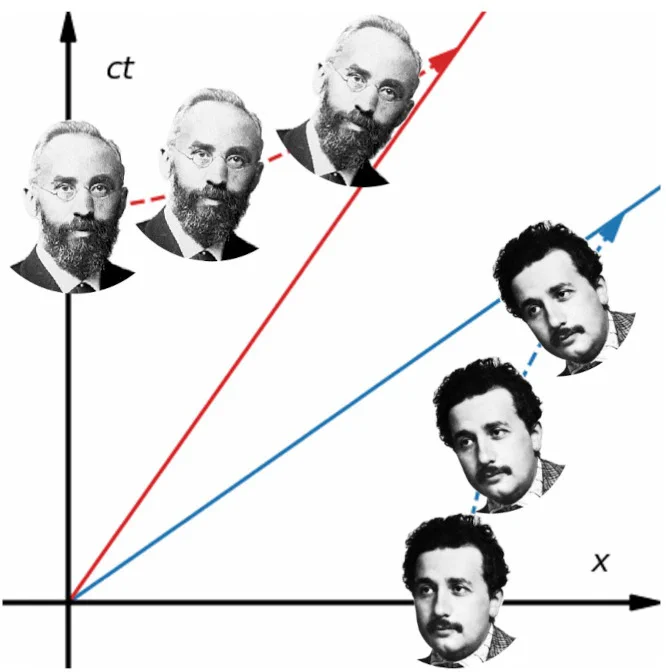
When you undergo an acceleration, it corresponds to a hyperbolic rotation of the spacetime around you (from your frame of reference). When the acceleration is small, the rotation is also very, very small; however at very large distances, even a small rotation can have a large effect.
In the example, that "large effect" is the alien debate moving in time forward or backwards a day (again, from the accelerated reference frame).
This has nothing to do with the observation delay, it's just an artefact of what it means for two far apart events to happen "simultaneously": simultaneity is a relative property, so two things that happen simultaneously in one reference frame might not happen simultaneously in another.
The reason this doesn't introduce a paradox is because without a specific reference frame, events only have a partial order: when you compare two events, there are three possible results:
1) Event A is in the past light-cone of event B.
2) Event B is in the past light-cone of event A.
3) Neither event is in the past light-cone of the other.
For 1+2 this means that the time between the events is greater than the distance between the events, whereas for 3 it means the reverse. For 1+2, the ordering of the events is the same for any reference frame. For 3, there will always be some frame of reference where both events appear to happen at exactly the same time, so nothing can be said about their order without choosing a reference frame.
https://en.m.wikipedia.org/wiki/Rietdijk%E2%80%93Putnam_argu...
From the Wikipedia page on the thought experiment, check out Criticisms:
https://en.m.wikipedia.org/wiki/Rietdijk%E2%80%93Putnam_argu...
> The interpretations of relativity used in the Rietdijk–Putnam argument and the Andromeda paradox are not universally accepted.
> Howard Stein[5] and Steven F. Savitt[6] note that in relativity the present is a local concept that cannot be extended to global hyperplanes.
> Furthermore, N. David Mermin[7] states: That no inherent meaning can be assigned to the simultaneity of distant events is the single most important lesson to be learned from relativity. — David Mermin, It’s About Time
No. The only thing that is "happening right now" on Andromeda from my point of view is the causality wave (light) that is hitting me right now. It's nonsense to talk about anything happening "right now" if its causality wave hasn't reached me yet.
But even beyond that you have the math wrong. Andromeda galaxy is only 2.5 million light-years from Earth. To get a 1 day difference in time dilation across 2.5 million years would take 1 in 913 million difference which someone traveling at even 100MPH (45m/s) isn’t going to see. (1 - (45^2/((3x10^8)^2))^0.5 simply isn’t enough.
> 1) An event in Andromeda occurs at single moment, it’s our observation of the event that is warped. So there aren’t two realities, one where they’re still debating and one where they aren’t. In both realities the debate has concluded, it’s just our observation of the event takes place at different reference times.
Yeah, they're making the mistake of assuming a minute is a minute.
It's closer to the difference in angular motion vs linear motion. If you are closer to the center, you move very little linearly. If you are closer to the outer edge, you move very little angularly.
Now you look at the linear distance as time passed for the object and the angular distance as the amount of "space-time" an object has gone. The amount of "space-time" is constant. It's a bit of a wonky model, but it's probably the simplest one that encapsulates the concept.
So just because they spent 3 days debating, you spent 5 days watching, and Bob only spent 1 day watching; that doesn't mean Bob is 2 days ahead of Andromeda and 4 days ahead of you. Since we are all also traveling through space at different speeds, we've all traveled the same amount of space-time, so we're all seeing the same things.
As for our perception, that more depends on our relative positions from each other rather than speed. Because nothing is faster than light, we can never experience an event before we see it.
I think the term free-will has clouded the issue a bit. Forget about free-will. Scientists, instead, normally talk about Determinism vs indeterminism, or nondeterminism in CS. These have a more precise definition than that other thing. The universe is deterministic if the outcome of events are completely determined by previous events. Or the universe is nondeterministic if the outcome of events are not certain, but follow a random distribution.
As to the precise details of the speeds and distances etc, it is a thought experiment, swap the car for a rocket traveling past at 0.86c, if you like. Or instead of aliens deliberating all day, maybe they are more efficient than we are, and they make their decision instantly by flipping a digital coin powered by the perfectly nondeterministic quantum fluctuations of the vacuum.[0]
For earth rocket man, there is a moment before the quantum dice roll when the decision is indeterminable, it's completely random. But at the same moment in the stationary frame, the fleet is already on it's way. Unless you wish to argue that a stationary reference frame is somehow more valid than a moving one, you have to accept that in the moving frame, the event of the dice roll has still not occurred and should be random, but how can it be random, if it has already happened in the stationary frame. Hence the paradox.
I hope that cleared things up some?
[0] The vacuum has an api: https://qrng.anu.edu.au/Assuming earth rocket man's speed does not change, if he quickly alternates between 0c and 0.99c he could flip flop between "determinate" and "indeterminate".
Anyway for all system on earth the decision event would be in the relativistic present with no causality order
https://en.wikipedia.org/wiki/Minkowski_space#Causal_structu...
Part of the point of relativity is that t1<t2 is not a good test of "comes before"
So ultimately your reference frame is only current within the locus of your own mind and any decisions you make get broadcasted out to observers in the universe. They make their own decisions about where to be, how fast to be, and so on, and from their perspective it could be yesterday from when the decider decided, but its irrelevant just as much as being farther away in 3d space gives a longer delay in ping time.
Whether or not the decider has free will or not I don't think can be argued by this specific example.
Keep in mind that regular people can and have simply replied to the theoretical physicist who posted it and received replies helping them understand better. In this sense it’s a fantastic medium. The same magic that keeps reliably producing spectacular “ah, actually I have a phd in the thing you’re arguing with me about” moments is at play here lowering the barrier to talk to really smart people.
To me the Andromeda Paradox isn't very interesting, because the question is only problematic if you consider time as a process that events happen within simultaneously in a way that you can precisely globally order by positing some way of counting objective units of time backwards from the point the two people on earth both see the invasion force.
If you instead look at the passage of time as simply the propagation of cause and effect where the propagation rate may differ depending on features of the events being propagated, then you get a dependency graph where when you interact different cause-effect chains meet. Only the nodes (events happening) matters, not the edges (the unobservable-because-nothing-interacted other than propagation).
The notion of something happening simultaneously then becomes abstract - you have no objective matter of measuring something being simultaneous except by whether or not they directly interact in a given moment. You're relying on your universe behaving in a way that means you can count events to try to maintain a chronology on the basis you know how they're spaced apart. But the best we can do is count the number of such events that happens in different frames under different conditions between causal chains merging.
Once you ditch the idea of "global ordering time" the "paradox" is nothing of the sort.
Because in that respect talking about "when" the event in Andromeda happened is meaningless, because it is a conversation based on projecting a model of the world as it appears from one local part of that cause-effect graph to another on the basis that there's an objective global ordering outside of what we can impose by counting chronology comparing clock time when we directly interact. It may make your mental model of what happened when messy, but that is because thinking of what happened when instead of what interacted with what in which order is messy.
(if there's any way of achieving faster than light travel, my totally-usupported-by-any-theory bet is that it would show our notion of time to be too static, and that it'd "bypass" the cause-and-effect paradoxes by affecting the laws of physics at the points of FTL interactions)
Even better IMO: everything is moving at the max speed (c) through spacetime, and accelerating along one dimension means decelerating along other dimensions; for example, stationary objects have 0 speed in spatial dimensions but move at c through time, and photons move at c through space but are stationary along the time dimension.
Particles have a trajectory through spacetime. They don't move along the trajectory because the time dimension is already part of the trajectory. So the speed at which they move along their spacetime trajectory seems to be a meaningless concept.
What is true however is that if the particle takes a clock with it, and you mark a tick every second the clock ticks, then the ticks will be equally spaced along the trajectory (where distance is measured using the Minkowski metric).
This makes a bit more precise what it means for photons to be stationary along the time dimension. It does not mean that they move horizontally in a space-time diagram. They move diagonally at speed c, as you expect, so for an outside observer they do move through time. However, the Minkowski distance between any two points on photon trajectories is zero. So if you wanted to annotate their trajectory with the clock tickmarks you could start somewhere and put your first tick there, but then your second tickmark would be infinitely far away on their trajectory.
Thus, for an outside observer, a clock approaching the trajectory of a photon would appear not to tick.
From a different point of view, we can reason by analogy to Euclidean geometry. When we have a curve through space we can talk about the tangent vector at any point. But the length of the tangent vector is not a well-defined concept. Only its direction is. You can define the length of the tangent vector for a particular parameterisation p(t) but for the curve itself, i.e. the set {p(t) : t in R}, the length of the tangent vector is not defined.
It is similar for a curve through spacetime. We can parameterise a curve with some variable x and write the curve as {p(x) : x in R} but this is just a set and the length of the tangent vector of p(x) depends on which parameterisation you chose for the curve. But the data of how a particle moves through spacetime is only the curve {p(x) : x in R} itself, not the function p(x): different parameterisations describe the same physical situation as long as the set {p(x) : x in R} is the same.
[0] https://www.youtube.com/watch?v=A2JCoIGyGxc&list=LL&index=94
Anything requiring more than about 350 chars, IMO. I'm really interested in that thread, but gave up after 5-6 tweets. My loss, I guess.
https://en.m.wikipedia.org/wiki/Rietdijk%E2%80%93Putnam_argu...
Separately, I don't think chronology is broken. It's ok that there is predestination because there is no way for actions taken here to propagate back there in time to change things. If a change does somehow propagate back through a wormhole or something, it's all good, just spinning up another dimension probably...
Isn't that missing a bit at the end? The less you appear to move in time from a different frame of reference?
We all move through time at exactly 1 second per second, don't we?
For reference: Here's Sean Carrol saying exactly that (but in reply to a different question)
https://www.preposterousuniverse.com/podcast/2021/12/15/ama-...
"...it always goes by one second per second. That’s the only speed at which time can possibly go by, and that’s true whether you’re speeding or staying still or in a gravitational field or not. There’s no such thing as the speed with which we move through space-time, the idea of a speed is the amount of distance we travel as a function of time, that’s what speed is. So it just doesn’t apply to going through space-time, it’s a different kind of thing."
> We all move through time at one second per second, don’t we?
You need to define “move through time”. The only way to measure time is with a clock, and the clock’s motion relative to you affects the measurement.
If you let everyone define “time” as the thing measured by the watch on their wrist, then everyone moves through time at one second per second, but since people are in motion relative to each other and therefore have different frames of reference, their clocks will measure different times.
Since no frame of reference is privileged, there is no “absolute time”. Of course you could pick one and measure every event against that one, but that would be an arbitrary choice.
This is my understanding. If I’m wrong, I’d be happy to be corrected.
I'm also no authority whatsoever on the topic :)
Recently there's been an interesting paper about what happens when we don't drop these solutions: https://arxiv.org/abs/1910.02780
Imagine the Andromeda fleet can move faster than light. When you look at it from Earth POV suddenly it manifests near Earth out of nothing. Looks very similar to quantum mechanics indeterminism - if alien general decided to send the fleet it's there, if he didn't - it's not there, and there's no local cause for it appearing suddenly.
What the paper above explores is - starting from relativity including faster-than-light objects and trying to prevent paradoxes they derive quantum mechanics.
... any intelligent thought which takes more than a couple of sentences to type out?
https://en.wikipedia.org/wiki/Julian_Barbour https://en.wikipedia.org/wiki/David_Deutsch
> "The more you [are observed to] move in space, the less you [are observed to] move in time."
"I don't like how does the special relativity/quantum physics works" is not a paradox on its own. In this case, it just challenges our pedestrian view of time.
This violates Heisenberg, but QM is the map, not the territory, right? So maybe, in practice, reality has a way of beating Heisenberg? Thanks to technology, we have been able to probe this question quite recently. Scientist tried to create a near-perfect vacuum, with all the energy and stuff removed, and isolated from the rest of the universe. Inside the vacuum they created an electrical circuit fed to a computer. The circuit was broken by two floating polished plates, separated by an incredibly small gap, roughly the size of a short wavelength of light. So in this test chamber photons of all sizes could exist around the two plates, but between the plates only the smallest photons could fit. If any large photons enter the chamber they would create positive pressure around the plates, pushing them together, closing the circuit and registering a result. As the scientists pushed the vacuum closer and closer to a perfect vacuum, would Heisenberg get in the way? Maybe the experiment is not powerful enough to push the vacuum close enough to really challenge him?
The experiment was a success. As the vacuum increased, eventually large photons showed up outside of the plates and pushed them together. Photons where appearing out of thin air to ensure that no perfect vacuum could be attained. We call these Virtual Particles. They usually annihilate themselves before becoming "real" and observable, but if local conditions are just right, like near a black-hole, some virtual particles are lucky enough to get pulled and stretched, and this process lends them enough energy to materialize. The virtual particles are of course random, and this apparatus is actually used now to generate proper random values. You can actually tap in to the vacuum energy with an API to get your source of entropy!
https://en.wikipedia.org/wiki/Casimir_effect
Vacuum energy quantum RNG: https://qrng.anu.edu.au/
Back to Penrose... when the universe approaches this infinitely cold empty state, it turns out to be the same, mathematically, as the hot dense state. With everything being so distant and disconnected, the universe sort of forgets that it is big and empty. Then all it takes is the enough quantum fluctuations and virtual particles to appear in some small region of space, that they pull on each other and become real. This might, according to Penrose, trigger another Big Bang.What does this have to do with relativity and free will? If it is true that nature, at the smallest level, is fundamentally random, then the block universe containing a predetermined future cannot be real. So free will is safe? Not quite. If the Andromeda people are anything like us, their brains are subject to same laws. The electrical activity in the firing synapses, that we call thinking, must also be subject to the random fluctuations of quantum mechanics. How can they have free will, when the electrical impulses driving that will are fundamentally random and unpredictable?
Weird, eh?
The real question becomes one of probabilities: Unless some entity is able to introduce measurable biases that deviates from predictable probabilistic distributions relative to what could be predicted based on its complete state (including its internal physical structure) and complete inputs, it makes little sense to suggest the entity has agency.
But that leaves us with the problem of explaining how something could effectively break the laws of physics in a way that doesn't just lead to infinite regress.
The day I see someone give a definition of free will that overcomes that, I'll be in awe. Not holding my breath.
This is always the problem with arguments for free will or at least the idea that one "could have done something different" that try to use physics/science.
It requires metaphysical action, literally something that cannot be understood with physics. The whole purpose of physics is to define the universe as deterministic. Quantum randomness is exactly that, random. If it was influenceable in some way, it wouldn't be random. Furthermore, the decision to influence it would still be deterministic so the metaphysics doesn't even make sense.
Quantum magic is just the bleeding edge of woo.
Free will is not something that exists in nature, it is something that exists in the psychology of agents with limited information about the world they operate in. Attempting to find a physical basis for free will is like trying to use an optical drive to read data off a pancake.
"Free will" is a very poorly defined concept that mostly falls out of problems with theodicy in early moral philosophy. Since the idea of "free will" plays a major role in Christian ethics this notion has permeated a huge amount of the Western intellectual tradition, but only makes sense in the framework of other archaic philosophical questions around theodicy like "if god is omnipotent, omniscient, and omnibenevolent why is there evil?" This question is only remotely interesting if you have a cultural reason to need to believe that these three things must be true (or if you're curious about the development of the Western intellectual tradition, in which case it's a very important question to understand).
https://en.wikipedia.org/wiki/Superdeterminism
But otherwise I agree that "free will" is basically just a silly argument over the definition of an undefinable term, or a way to explain away loopholes in theology.
1. The universe is not deterministic (if you believe that wavefunctions collapse)
2. The mysterious thing that makes conscious entities experience high-amplitude events more often than low-amplitude events is not deterministic (if you believe in MWI).
Evidence for free will, a definition of free will; those things physics cannot provide. But there's room for it.
1. Chaos theory ensures that unless we have INFINITE precision measurements, even a perfect simulation of our universe will diverge based on even the smallest differences. A difference of one particle's velocity in the googolth decimal place will eventually cause wildly different simulation outcomes. So, in practice, it's impossible to know what's going to happen given a long enough time frame, unless we can get advanced enough to have literally infinite precision measurements.
2. Given objection 1, using the law of large numbers to explain away quantum processes' non-determinism from initial conditions seems like a cop-out to me. Yes, given enough particles, they converge around some predictable value. But given the need to have exactness in measurements to predict chaotic processes, if a SMALL number of individual particles interact with other matter, and they sometimes do, how could the probabilistic nature of those individual particles be neglected?
Let me sum it up this way. If I take a quantum random number generator and use it to generate lat-long coordinates, and visit that place, could anyone or anything predict what happens given initial conditions before I do that? No, it is not bound by initial conditions.
It's like you're trying to avoid mentioning hidden variables or bell's theorem directly. That is, you're probably not correct when you say something like that.
Sure, you can do this with paragraphs in a blog post. But Twitter works equally well in my mind!
The only thing I think would be improved by having this in blogpost form is more interact-able visuals, equations and similar.
Edit: strike that, it was Firefox's social tracker protection blocking them. Just need to click the shield icon left of the address bar and temporarily disable it.
Also, this "velocity addition for v<<c" is covered in the first chapter.
I read its draft almost 20 years ago (back then, it was a collection of notes in Polish) and didn't find anything remotely close to it in English. Later, I had the pleasure of attending his course.
Also, Andrzej Dragan is a notorious individual, primarily known in photography (https://andrzejdragan.com/). To the point that there are posts on "how to Draganize a picture".
I believe it is harder to write (due to the character limit of each text block), but, far from “unreadable”, I can read it fairly easily.
But it is literally unreadable to me. I couldn't finish reading the thread and had to find an alternative way out of twitter.
Fist trial, using my android phone with fennec fox. There is a modal that hides the content asking me to "log in"; if I close the modal I go back to the twitter homepage. Thus unreadable because I don't have a twitter account. Sometimes I have managed to read a few tweets by a "smart" combination of closing the successive modals and reloading the page, but not this time.
Second trial, using my laptop with firefox browser and heavy adblocking. I can read only the first three tweets, the rest do not load due to some third-party javascript.
No big deal. Third trial, now I open a "clean" firefox browser session with just ublock origin, and I manage to read about 30 tweets, until it starts talking about hyperbolic rotations. The thread obviously continues, but the sole link below it "show replies" does not work. When I click on it it says "Whoops! Something went wrong. Please try again!".
Typically I wouldn't bother and stop reading. Fuck twitter. But today I really wanted to read this thread because I teach these things. Thus I learned to use nitter, which gives an interface of twitter that, even if it's equally ugly, it sort of works (in that you can actually manage to read the text).
In retrospect, this is an extremely sad state of affairs. We have an excellent article which is made of a short text, a few simple formulas, and a few simple images. This could be a static html page of a handful of Kb with img tags. But it is a slow and humongous javascript monstrosity that does not even work, and may disappear at any time if twitter "bans" this user for reasons unrelated to this text.
The tricky part is that if this was published in a static html page it would be less likely that it would reach us (even if the page was linked in the thread). Distribution is hard.
A good compromise I think is keeping the thread but having a link to a blogpost with the same content in the first (or second) tweet.
A Twitter thread formatting tool that also publishes a web version and automatically link to it in the second tweet is a good micro Saas idea if anyone is looking I think.
People are correct to point out it helps material reach a wide audience, but that's not the point. The point is what could be better?
The original argument was to keep communication brief, shorter is better, etc. The fact it keeps being circumvented in this way suggests sometimes a longer format is necessary.
As a practical matter, in this case the person could have linked to a long form blog post and used Twitter as a sort of comment discussion section?
For readers twitter threads are pretty crap tho, that's why I really like to use thread reader app.
[0] https://threadreaderapp.com/thread/1482811504424542211.html
I particularly like how the model you choose to describe things can make the same phenomenon easy or hard to understand.
Now, just as you can use rotation in the complex plane (i^2 = -1) to describe a simple harmonic oscillator in 2D space,
x + iy = e^(it)
It's possible to use a rotation in the split-complex plane[1] (j^2 = 1) to describe the motion of a particle undergoing constant proper acceleration, x + jt = e^(ajτ)/a - 1 [2]
This is because multiplying by e^(jτ) preserves the split-complex modulus (|x+jt|^2 = (x + jt)(x - jt) = x^2 - t^2), which is equivalent to the Minkowski norm. Expanding the above gets you, x = cosh(aτ)/a - 1
t = sinh(aτ)/a
which are the more traditional expressions you would typically see.[1]: https://en.wikipedia.org/wiki/Split-complex_number
[2]: There's a line of reasoning that allows you to write this down almost immediately, or in maths-speak makes it trivial, but I can't remember it at the moment. I spent a good deal of time thinking about this for a university assignment years ago in order to avoid spending 2 minutes doing an integral.
Bit there is one thing I never understood, even though I have a PhD in physics. Why does relative movement put you into a different "world"? Or more precise, why does relative movement correspond to a lorentz boost? That is not a piori neccessary. A stupid example is a laser pointed to the moon. If you flick it quickly, the spot can move faster than light over the ground. But you can also imagine mass moving independent of boost. You have a rock at x=0, t=0. At t=1, cut it and paste it at x=1. At t=2, cut it and paste it at x=2. Now make the time steps infintely small. It is moving (in the sense of dx/dy>0) but not moving (in the sense of v or ß = 0).
My intuition is, if you look at electromagnetism, it takes some time for a changing electric field to create a magnetic field, and for the magnetic field to create an electric field. This is what Einstein meant when he said, time exists so that not everything happens at once. If you think of a relatively moving object - and I'm thinking of it completely in terms of EM for the sake of simplicity - what happens is that the fields are propagating. One field creates the next field not at the same space but slightly in front. So the whole thing is rotated towards the x axis. The "time" vector does not point completely in the time direction, but in the space direction. This gives you time dilation as well as the subjective experience of an intertial frame (because you are just moving forwards in time, but not in space from your POV). I think this microscopic perspective shows why motion must == boost. But does anybody here know if there is a canonical answer to this question?
Edit: I just realize this is basically electromagnetism of moving bodies which Einstein already solved in 1905 :-) but I still find it hard to wrap my head around
I felt things sort of click in my head. The angle in this world being the important thing is dope. Dude, this hecka cool!
I don't know if I admire more the mastery of science of the author or the willpower necessary to write those posts on such a wrong medium for them. Worse than one twit per paragraph, only MMSes.
Photons move only in the 3 dimensions, thus never experience time.
The whole intro to relativity series is worth a watch.
For example, why do we measure in fractions of light speed? What happens when we are already rotated all the way to light speed and then fire another bullet?
I guess there are other ways to reason about this, but it still doesn't feel intuitive to me.
You can’t rotate all the way to lightspeed, that would be rotation by an infinite angle. For any finite angle (i.e. speed below c), you can always add the angle of the bullet to get a new (finite) angle.
That's amazing, and it was well explained in 1908! Yet students today are learning a horrific bastardized version of it. Physics is absolutely terrible when courses and books try to to remove the "complicated" math, and in its place they put something more complicated and ambiguous.
Teach the math!
It's like Greenspun's Tenth Rule, but for math:
"Any sufficiently complicated scientific theory contains an ad hoc, informally-specified, bug-ridden, slow implementation of half of Complex Analysis."
Everything in the universe moves at constant speed through (four-dimensional) spacetime. To simplify the analogy we'll just consider two dimensions: space (x-axis) and time (y-axis) with your spacetime vector being of constant length. At rest your spacetime vector is (0,1). You speed up to 10% of light speed and your spacetime vector is approximately (0.1, 9.99) so you're moving slightly slower through time.
What I like about this analogy is it constrains your space vector to the speed of light. Warp Bubble Andys like to pump negative values for energy and mass into equations to rationalize something they want to be true: that faster-than-light travel is possible. To me, this is just a fundamental lack of understanding about the domain of a function. Velocity is no different. I firmly believe it's bounded by [0,c). Values outside of that range just don't make sense are as such undefined. Garbage in, garbage out.
Why? Because it describes movement as rotation from the infinitely far away point (a special basis vector there). And "coordinates" there are somewhat self-normalizing, because there is a special basis vector that keeps coordinates' squares.
And, of course, it is investigated as a tool to think about relativistic coordinates, linking my comment to a tweet part that says "wrong tools can obscure things".
Doesn't this also work in normal geometry as the length of a translation goes to zero and the distance to the rotation's origin goes to infinity... because a big circle looks like a straight line up close?
Btw the blog site is so much better.