82 points · by rzk · 4y ago · 55 comments
What a sad anthropic principle that would be!
In fact, you can use the fact that humans exist to put (loose) constraints on this universe's parameters. For example, clearly the average temperature must be below one billion Kelvin. Making that kind of argument tighter and more precise actually leads to interesting results: bounds on spacetime black hole formation rate, limits on densitiy of dark energy, etc.
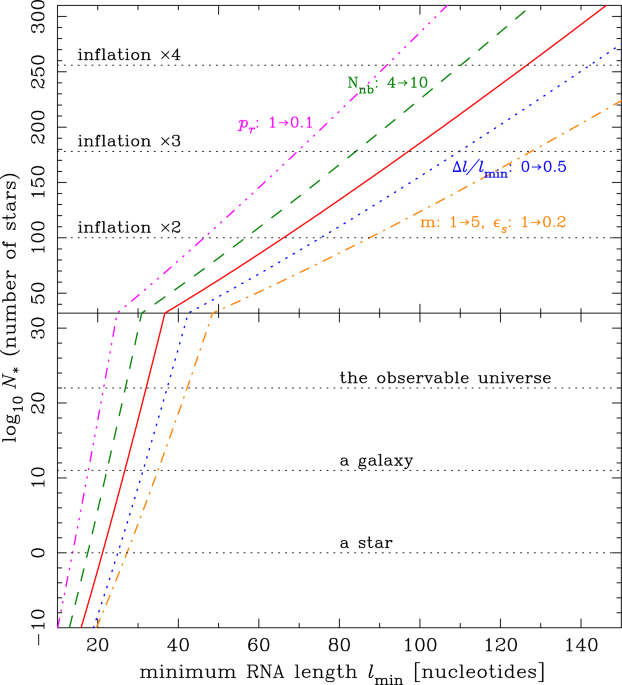
The authors in OP's post take an interesting variant of this line of reasoning: If the universe is "really bad" at producing long strings of RNS, then humans must just be a fluke. In that case, maybe most life in the multiverse exists alone in its own observational bubble. They caculate with their model that self-replicating DNS is indeed hard to replicate. This also means that finding aliens would provide strong evidence against their model.
The weakest form of anthropic argument is the tautological aspect you mention, but I wouldn't cut it so short.
I was referring to the fundamental constants of physics. A lot of argumentation has happened around whether they are "fine-tuned". In the sense that a small change has a radical effect on matter and spacetime, to the point where chemistry would not work at all to make any kind of biological entities, YES, YES, absolutely, our universe is fine-tuned for human life. Or vice versa. Human life is fine-tuned for exactly this universe, planet, climate (!), and time period!
There are several traps that philosophers and cosmologists keep falling into, primarily around probability. Clearly we are not in an average universe, from the very get go. We have no idea how these constants get set, what set them, if there was a universe before that had different constants, if universes elsewhere have different constants. Even if we did know that other universes exist, we have no way to reason about the probability of our universe--we don't know the distribution. If we were to start positing that the constants are randomly chosen, then we're in a very special universe indeed. But somehow, when it comes to these constants, the "probabilistic thinking" just gets forgotten. Philosophers just blink and look away. These constants are special as hell.
The next issue is that there is a huge philosophical problem in assuming that probability is even a thing, because every rando weird thing that has happened has fed into the stupidly improbable fact of our existence. The assumption that we are drawn from some kind of distribution is just a philosophical axiom that goes unstated. Maybe we aren't drawn from some probability distribution but are instead linked in causal chains impossibly long and intricate that using probability has a tool becomes meaningless. To understand what I mean there, just recall that the dinosaurs ruled the Earth for over a hundred million years. They were wiped out by an asteroid with a stupidly improbable chance of impact. The mass extinction that followed was so brutal that literally every single thing that survived pretty much made it by the skin of their teeth--including mammals. So every Tom, Dick, and Harry rabbit that managed to eek out survival on the blasted plains, carrying their painstakingly tuned genetic code, mattered. To the extent that many whole genera of life today depend on literally just a few individuals having survived this cataclysm. The Earth didn't mint new kinds genomes from nothing, they grew and branched off what survived. And it wasn't luck...they were better adapted to the new hellscape. Or was it? Sliced as finely as single individuals, we might be here because a single proto mammal survived a harsh winter or leaped out of the jaws of a predator at just the right time. Put odds on that one.
But speaking of "luck", it wasn't "luck" that the asteroid hit at that moment. It hit because of orbital mechanics, a complex but completely predictable mathematical certainty of orbits and periods. Pretty much all the macro events that we observe as being to have led here to this moment with these funny barely space-faring apes yammering at each other through HN are deterministic, not stochastic events. And the next thought that pops into your head on how to reply won't be stochastic either.
Reasoning about our universe using some Drake-equation-esque probability floundering is a complete waste of time. We got here by history and this whole freaking show is one giant example of selection bias. Average universe, my ass!
If you make the assumption that our universe is drawn out of an infinite set of universes (saying we're here because of the anthropic principle), then the likelihood that life is possible in the future approaches zero, because the anthropic principle only says something about the past.
We have never detected an alternate universe and we don't even have math that makes it probable. It's just a concept. The same way "there's no reason entropy can't run backwards according to the physics" doesn't stop us not having any evidence for backwards running entropy or negative mass or a million other things that might conceivably exist but have no real evidence but sound cool.
In other words, there is a continuum of possibilities where all scenarios consistent with the laws of physics are played out.
Note that this is not evidence (not even circumstantial) that there are other universes with different laws of physics. Just universes with different states or boundary conditions.
Still though, if MWI is true, then there are effectively infinite possibilities in which the chance of life occurring somewhere approaches certainty.
Why is "many worlds" the most mathematically consistent? (I won't bother asking for the philosophical bit; I'm sure it's too long for an HN post.)
What's more interesting is whether our universe can be described by finite information (closed formulae or not, even a stupidly huge but finite trace of all quantum events would suffice). If it's finite information then its description is encoded in every transcendental number in mathematics--which is an infinite number, including the number pi.
Don't trifle with infinity. I wasn't.
To me it seems like the additional universes in this context serve a purpose similar to (my understanding of) additional dimensions in math/physics. It allows you to navigate around singularities.
If you have no evidence for it, your belief in a multiverse is religious not agnostic.
>To me it seems like the additional universes in this context serve a purpose similar to (my understanding of) additional dimensions in math/physics. It allows you to navigate around singularities.
This is additional dimensions in physics, and we just don't have any actual evidence that a multiverse exists. We have a some suppositions that say 'well there's nothing to say it couldn't exist' but no evidence that it could.
You could view that as 'useful' but you can't judge its truthfulness or whether reality reflects such a 'purpose'. Either something exists or it doesn't, and a multiverse is a strictly religious belief at this point.
1) The crystal gene hypothesis of A. G. Cairns-Smith. As a clay crystal grows and splits, the info in the crystal's defect structure is replicating with impressive fidelity, and those defects also interact with the surroundings. So you get the Darwinian game bootstrapped pretty much for free. Later on, the crystals start using organic polymers; later still, the polymer technology is developed well enough to take over from the clay. So this might make abiogenesis reasonably probable on one planet.
2) An observable universe is just any epsilon size patch, on an inflationary universe. The space-time curvature of our whole observable universe is too small to measure, hence the radius of our inflationary universe is a large multiple of the 13 G-lightyear radius we can observe. So abiogenesis could be highly improbable in any observable universe, answering Fermi's paradox, yet be probable within the much greater volume of an inflationary universe (maybe this is what TFA said? TLDR [Edit: yeah, it says that right in the abstract]). And there could even be a large number of inflationary universes, for all we know.
This conclusion is obviously absurd, so the argument goes that there can't be infinitely many places in which random things can happen in the Universe. Note that the size of the Universe required to produce a Boltzman brain is much larger than that discussed in the article. It's still nice to think that there might be an upper bound for us to avoid some of the more daunting implications of the anthropic principle.
Still, somehow we may find a process like natural selection at a cosmic level that makes life way more likely than a purely random starting sequence.
Christians: "We have faith supernatural selection at a cosmic level makes afterlife way more likely."
If we look at life now, DNA does not reproduce itself directly, there is an entire ecosystem of chemicals that reproduces itself collectively, using RNA/DNA as a blueprint.
The question then is how a set of molecules encoded itself in RNA, but I see that as much more envisionable (eg some RNA, and a host set of catalysts) than a self-reproducing strand of RNA appearing all at once.
Not specific to RNA.
And I'm not a biologist.
The Solar System itself has plenty of examples of water. For example, Enceladus is surmised to be completely covered in an ocean below its icy crust. As far as I know, there's not much evidence that points to life as being special. Earth is certainly special in the time window that we are experiencing it in given its balances of energy, heat, water, etc.
Utilizing models to predict what's out there doesn't seem all that controversial when evidence points to life not being all that hard cosmically. We just don't have strong enough binoculars yet.
Seems like you're happy with your own theories.
Life began basically as soon as the Earth did. So, in terms of biological or geological time, it took almost no time.
Note that this doesn't tell us as much as you might think about the likelihood of abiogenesis happening: we find ourselves relatively near the end of Earth's habitability before the expansion of the Sun will make it uninhabitable in a few hundred million years. If abiogenesis happened much later on Earth, then there would not have been enough time for intelligent life to evolve. Planets where intelligent life manages to evolve within the planet's time of habitability will be the weird rare ones where abiogenesis luckily happened ridiculously fast, no matter how unlikely it is for abiogenesis to happen.
Same with self replicating organic molecules - if you mix amino acids together, you're going to get some long strands virtually every time you try it because the probability of amino acids not reacting is very tiny. The probability of getting self-replicating strands approaches 1 after only a few trials. That is, your solution of amino acids would end up with some goop in it, some polymerized amino acid strands that had replicated themselves.
This "what's the probability!?!?" category of anti-evolutionary arguments is just false. "If you put all the pieces of a car in a box and shook it, the probability of getting a car is zero!" True, but an inapplicable analogy to organic chemistry reactions. Intuition about probability leads you astray. Nuts have an extremely low probability of getting agitated into screwing themselves on a bolt. The chemicals relevant to life have an extremely high probability of reacting to form larger molecules.
If there is life with the same technologies to us sending some beacon signal, what's the odd that we get it?